BLOCK 
DIAGRAM
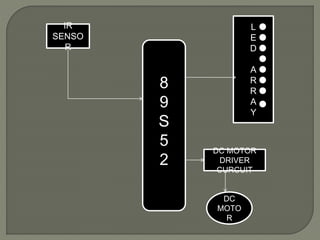
IR 
SENSO 
R 
8 
9 
S 
5 
2 
L 
E 
D 
A 
R 
R 
A 
Y 
DC MOTOR 
DRIVER 
CURCUIT 
DC 
MOTO 
R
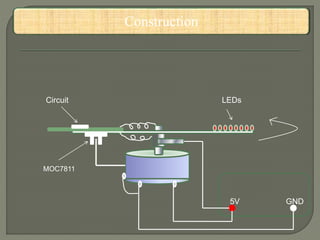
Circuit LEDs 
MOC7811 
Construction 
5V GND
Introduction 
What is Propeller LED Display??? 
Propeller is a term generally associated 
with rotating fan , revolving at high RPM. 
Just like a propeller, this is a special kind of 
a rotating display. 
How it works??? 
PERSISTANCE OF VISION 
This is a phenomenon of the eye by which 
an afterimage is thought to persist for 
approximately 1/25th of a second. So if 
someone is observing images at rate of 25 
images/second, they appear to be 
continuous. 
Confused???
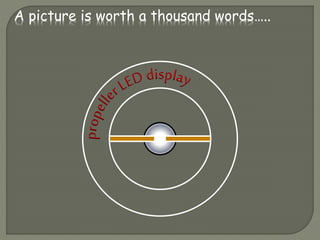
A picture is worth a thousand words…..
System Requirement 
A. Hardware Used: 
1. Microcontroller AT89S52 
2. IR Pair (IR LED AND 
PHOTO DIODE ) 
3. Voltage Regulator 
4. DC Motor 
5. Motor Driver Circuit
MCROCONTROLLER 
AT89S52 
The AT89S52 is a low-power, high-performance 
CMOS 8-bit microcontroller with 8K bytes of in-system 
programmable Flash memory. The 
device is manufactured using Atmel’s high-density 
nonvolatile memory technology and is 
compatible with the industry- standard 80C51 
instruction set and pin OUT before it can be 
programmed again. This led to introduce FLASH 
and NV-RAM versions of 8051.
The micro-controller generic part number 
actually includes a whole family of 
microcontrollers that have numbers 
ranging from 8031 to 8751 and are 
available in N-channel Metal Oxide Silicon 
(NMOS) and CMOS construction. 89c52 is 
an 8-bit micro-controller having 40 pins 
arranged as DIP packages. The features 
unique to micro-controllers include:
 INTERNAL RAM AND ROM 
 I/O PO RTS WITH PROGRAMMABLE PINS 
 TIMERS AND COUNTERS 
 SERIAL DATA COMMUNICATION 
 
 The 89C52 architecture consists of these specific features: 
 Eight-bit CPU with registers A and B 
 16-bit program counter and data pointer 
 8-bit stack pointer 
 Internal ROM of 8k 
 Internal RAM of 128 bytes 
 Four register banks each containing eight registers 
 16 bytes addressable at the bit level 
 80 bytes of general purpose data memory 
 32 input/output pins arranged as four 8 bit ports 
 Three 16-bit timer/counter 
 Full duplex serial data receiver/transmitter 
 Control registers: TCON, TMOD, SCON, PCON, IP and IE 
 Two external and three internal interrupt sources 
 Oscillator and clock circuits
 ) 
 
 As its name implies it is a diode, which emits light when 
forward biased. Charge carrier recombination takes place 
when electrons from the N-side cross the junction and 
recombine with the holes on the P side. Electrons are in the 
higher conduction band on the N side whereas holes are in 
the lower valence band on the P side. During recombination, 
some of the energy is given up in the form of heat and light. In 
the case of semiconductor materials like Gallium arsenide 
(GaAs), Gallium phoshide (Gap) and Gallium arsenide 
phoshide (GaAsP) a greater percentage of energy is released 
during recombination and is given out in the form of light. LED 
emits no light when junction is reverse biased.
 
 Definition: - 
 The transformer is a static electro-magnetic device that 
transforms one alternating voltage (current) into another 
voltage (current). However, power remains the some during 
the transformation. Transformers play a major role in the 
transmission and distribution of ac power. 
 Principle: - 
 Transformer works on the principle of mutual induction. A 
transformer consists of laminated magnetic core forming the 
magnetic frame. Primary and secondary coils are wound upon 
the two cores of the magnetic frame, linked by the common 
magnetic flux. When an alternating voltage is applied across 
the primary coil, a current flows in the primary coil producing 
magnetic flux in the transformer core. This flux induces 
voltage in secondary coil.
A photodiode is a type of photo detector 
capable of converting light into 
either current or voltage, depending upon 
the mode of operation. The common, 
traditional solar cell used to generate 
electric solar power is a large area 
photodiode.
 : 
 
 1. Keil u-Vision: To Write the microcontroller program. 
 The C programming language is a general-purpose 
programming language that provides code efficiency, elements 
of structured programming, and a rich set of operators. C is 
not a big language and is not designed for any one particular 
area of application. Its generality combined with its absence of 
restrictions, makes C a convenient and effective programming 
solution for a wide variety of software tasks. Many applications 
can be solved more easily and efficiently with C than with 
other more specialized language
The Cx51 Optimizing C Compiler is a complete implementation of the 
American National Standards Institute (ANSI) standard for the C language . 
Cx51 The Compiler provides you with the flexibility of programming in C and 
the code efficiency and speed of assembly language . 2.PRO51 
Programmer Software: To load the program in microcontroller. 
3. PCB Artist: To design the PCB of the project.
THANK YOU

Pppt

  • 3.
  • 4.
    IR SENSO R 8 9 S 5 2 L E D A R R A Y DC MOTOR DRIVER CURCUIT DC MOTO R
  • 5.
    Circuit LEDs MOC7811 Construction 5V GND
  • 6.
    Introduction What isPropeller LED Display??? Propeller is a term generally associated with rotating fan , revolving at high RPM. Just like a propeller, this is a special kind of a rotating display. How it works??? PERSISTANCE OF VISION This is a phenomenon of the eye by which an afterimage is thought to persist for approximately 1/25th of a second. So if someone is observing images at rate of 25 images/second, they appear to be continuous. Confused???
  • 7.
    A picture isworth a thousand words…..
  • 8.
    System Requirement A.Hardware Used: 1. Microcontroller AT89S52 2. IR Pair (IR LED AND PHOTO DIODE ) 3. Voltage Regulator 4. DC Motor 5. Motor Driver Circuit
  • 9.
    MCROCONTROLLER AT89S52 TheAT89S52 is a low-power, high-performance CMOS 8-bit microcontroller with 8K bytes of in-system programmable Flash memory. The device is manufactured using Atmel’s high-density nonvolatile memory technology and is compatible with the industry- standard 80C51 instruction set and pin OUT before it can be programmed again. This led to introduce FLASH and NV-RAM versions of 8051.
  • 10.
    The micro-controller genericpart number actually includes a whole family of microcontrollers that have numbers ranging from 8031 to 8751 and are available in N-channel Metal Oxide Silicon (NMOS) and CMOS construction. 89c52 is an 8-bit micro-controller having 40 pins arranged as DIP packages. The features unique to micro-controllers include:
  • 11.
     INTERNAL RAMAND ROM  I/O PO RTS WITH PROGRAMMABLE PINS  TIMERS AND COUNTERS  SERIAL DATA COMMUNICATION   The 89C52 architecture consists of these specific features:  Eight-bit CPU with registers A and B  16-bit program counter and data pointer  8-bit stack pointer  Internal ROM of 8k  Internal RAM of 128 bytes  Four register banks each containing eight registers  16 bytes addressable at the bit level  80 bytes of general purpose data memory  32 input/output pins arranged as four 8 bit ports  Three 16-bit timer/counter  Full duplex serial data receiver/transmitter  Control registers: TCON, TMOD, SCON, PCON, IP and IE  Two external and three internal interrupt sources  Oscillator and clock circuits
  • 12.
     )   As its name implies it is a diode, which emits light when forward biased. Charge carrier recombination takes place when electrons from the N-side cross the junction and recombine with the holes on the P side. Electrons are in the higher conduction band on the N side whereas holes are in the lower valence band on the P side. During recombination, some of the energy is given up in the form of heat and light. In the case of semiconductor materials like Gallium arsenide (GaAs), Gallium phoshide (Gap) and Gallium arsenide phoshide (GaAsP) a greater percentage of energy is released during recombination and is given out in the form of light. LED emits no light when junction is reverse biased.
  • 13.
      Definition:-  The transformer is a static electro-magnetic device that transforms one alternating voltage (current) into another voltage (current). However, power remains the some during the transformation. Transformers play a major role in the transmission and distribution of ac power.  Principle: -  Transformer works on the principle of mutual induction. A transformer consists of laminated magnetic core forming the magnetic frame. Primary and secondary coils are wound upon the two cores of the magnetic frame, linked by the common magnetic flux. When an alternating voltage is applied across the primary coil, a current flows in the primary coil producing magnetic flux in the transformer core. This flux induces voltage in secondary coil.
  • 14.
    A photodiode isa type of photo detector capable of converting light into either current or voltage, depending upon the mode of operation. The common, traditional solar cell used to generate electric solar power is a large area photodiode.
  • 15.
     :   1. Keil u-Vision: To Write the microcontroller program.  The C programming language is a general-purpose programming language that provides code efficiency, elements of structured programming, and a rich set of operators. C is not a big language and is not designed for any one particular area of application. Its generality combined with its absence of restrictions, makes C a convenient and effective programming solution for a wide variety of software tasks. Many applications can be solved more easily and efficiently with C than with other more specialized language
  • 16.
    The Cx51 OptimizingC Compiler is a complete implementation of the American National Standards Institute (ANSI) standard for the C language . Cx51 The Compiler provides you with the flexibility of programming in C and the code efficiency and speed of assembly language . 2.PRO51 Programmer Software: To load the program in microcontroller. 3. PCB Artist: To design the PCB of the project.
  • 17.