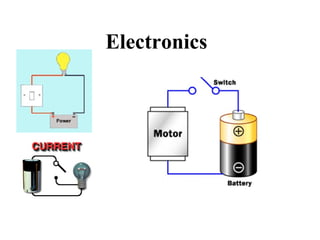
Electronics
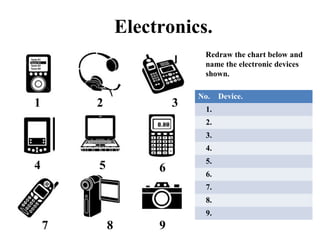
Electronics.
1 2 3
4 5 6
7 8 9
Redraw the chart below and
name the electronic devices
shown.
No. Device.
1.
2.
3.
4.
5.
6.
7.
8.
9.
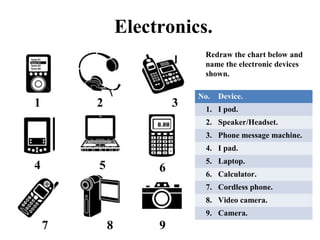
Electronics.
1 2 3
4 5 6
7 8 9
Redraw the chart below and
name the electronic devices
shown.
No. Device.
1. I pod.
2. Speaker/Headset.
3. Phone message machine.
4. I pad.
5. Laptop.
6. Calculator.
7. Cordless phone.
8. Video camera.
9. Camera.
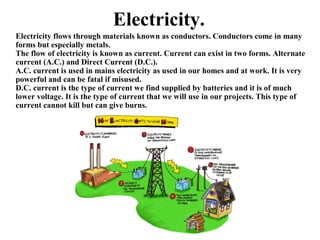
Electricity.
Electricity flows through materials known as conductors. Conductors come in many
forms but especially metals.
The flow of electricity is known as current. Current can exist in two forms. Alternate
current (A.C.) and Direct Current (D.C.).
A.C. current is used in mains electricity as used in our homes and at work. It is very
powerful and can be fatal if misused.
D.C. current is the type of current we find supplied by batteries and it is of much
lower voltage. It is the type of current that we will use in our projects. This type of
current cannot kill but can give burns.
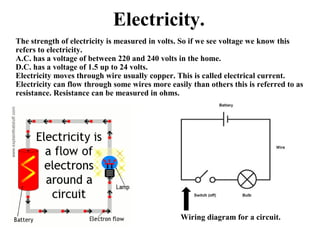
The strength of electricity is measured in volts. So if we see voltage we know this
refers to electricity.
A.C. has a voltage of between 220 and 240 volts in the home.
D.C. has a voltage of 1.5 up to 24 volts.
Electricity moves through wire usually copper. This is called electrical current.
Electricity can flow through some wires more easily than others this is referred to as
resistance. Resistance can be measured in ohms.
Electricity.
Wiring diagram for a circuit.
Electrical Circuits:
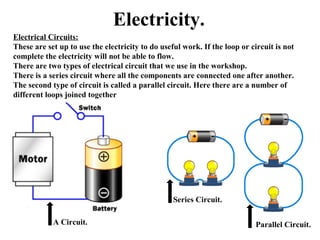
These are set up to use the electricity to do useful work. If the loop or circuit is not
complete the electricity will not be able to flow.
There are two types of electrical circuit that we use in the workshop.
There is a series circuit where all the components are connected one after another.
The second type of circuit is called a parallel circuit. Here there are a number of
different loops joined together
Electricity.
Series Circuit.
Parallel Circuit.A Circuit.
Electricity.Electrical Circuits:
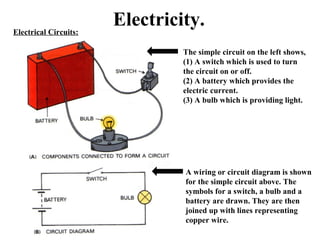
The simple circuit on the left shows,
(1) A switch which is used to turn
the circuit on or off.
(2) A battery which provides the
electric current.
(3) A bulb which is providing light.
A wiring or circuit diagram is shown
for the simple circuit above. The
symbols for a switch, a bulb and a
battery are drawn. They are then
joined up with lines representing
copper wire.
Electricity.
Electrical Symbols:
Classwork:
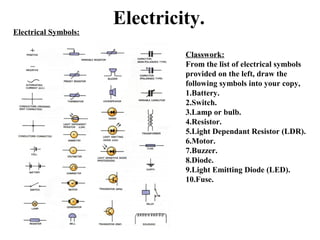
From the list of electrical symbols
provided on the left, draw the
following symbols into your copy,
1.Battery.
2.Switch.
3.Lamp or bulb.
4.Resistor.
5.Light Dependant Resistor (LDR).
6.Motor.
7.Buzzer.
8.Diode.
9.Light Emitting Diode (LED).
10.Fuse.
Electricity/Revision.
Left click with mouse to play video.
Classwork/Homework.
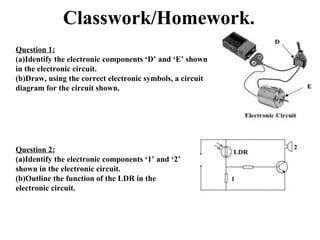
Question 1:
(a)Identify the electronic components ‘D’ and ‘E’ shown
in the electronic circuit.
(b)Draw, using the correct electronic symbols, a circuit
diagram for the circuit shown.
Question 2:
(a)Identify the electronic components ‘1’ and ‘2’
shown in the electronic circuit.
(b)Outline the function of the LDR in the
electronic circuit.
Classwork/Homework.
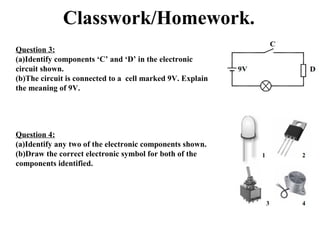
Question 3:
(a)Identify components ‘C’ and ‘D’ in the electronic
circuit shown.
(b)The circuit is connected to a cell marked 9V. Explain
the meaning of 9V.
Question 4:
(a)Identify any two of the electronic components shown.
(b)Draw the correct electronic symbol for both of the
components identified.
Electronics

Electronics

  • 1.
  • 2.
    Electronics. 1 2 3 45 6 7 8 9 Redraw the chart below and name the electronic devices shown. No. Device. 1. 2. 3. 4. 5. 6. 7. 8. 9.
  • 3.
    Electronics. 1 2 3 45 6 7 8 9 Redraw the chart below and name the electronic devices shown. No. Device. 1. I pod. 2. Speaker/Headset. 3. Phone message machine. 4. I pad. 5. Laptop. 6. Calculator. 7. Cordless phone. 8. Video camera. 9. Camera.
  • 4.
    Electricity. Electricity flows throughmaterials known as conductors. Conductors come in many forms but especially metals. The flow of electricity is known as current. Current can exist in two forms. Alternate current (A.C.) and Direct Current (D.C.). A.C. current is used in mains electricity as used in our homes and at work. It is very powerful and can be fatal if misused. D.C. current is the type of current we find supplied by batteries and it is of much lower voltage. It is the type of current that we will use in our projects. This type of current cannot kill but can give burns.
  • 5.
    The strength ofelectricity is measured in volts. So if we see voltage we know this refers to electricity. A.C. has a voltage of between 220 and 240 volts in the home. D.C. has a voltage of 1.5 up to 24 volts. Electricity moves through wire usually copper. This is called electrical current. Electricity can flow through some wires more easily than others this is referred to as resistance. Resistance can be measured in ohms. Electricity. Wiring diagram for a circuit.
  • 6.
    Electrical Circuits: These areset up to use the electricity to do useful work. If the loop or circuit is not complete the electricity will not be able to flow. There are two types of electrical circuit that we use in the workshop. There is a series circuit where all the components are connected one after another. The second type of circuit is called a parallel circuit. Here there are a number of different loops joined together Electricity. Series Circuit. Parallel Circuit.A Circuit.
  • 7.
    Electricity.Electrical Circuits: The simplecircuit on the left shows, (1) A switch which is used to turn the circuit on or off. (2) A battery which provides the electric current. (3) A bulb which is providing light. A wiring or circuit diagram is shown for the simple circuit above. The symbols for a switch, a bulb and a battery are drawn. They are then joined up with lines representing copper wire.
  • 8.
    Electricity. Electrical Symbols: Classwork: From thelist of electrical symbols provided on the left, draw the following symbols into your copy, 1.Battery. 2.Switch. 3.Lamp or bulb. 4.Resistor. 5.Light Dependant Resistor (LDR). 6.Motor. 7.Buzzer. 8.Diode. 9.Light Emitting Diode (LED). 10.Fuse.
  • 9.
  • 10.
    Classwork/Homework. Question 1: (a)Identify theelectronic components ‘D’ and ‘E’ shown in the electronic circuit. (b)Draw, using the correct electronic symbols, a circuit diagram for the circuit shown. Question 2: (a)Identify the electronic components ‘1’ and ‘2’ shown in the electronic circuit. (b)Outline the function of the LDR in the electronic circuit.
  • 11.
    Classwork/Homework. Question 3: (a)Identify components‘C’ and ‘D’ in the electronic circuit shown. (b)The circuit is connected to a cell marked 9V. Explain the meaning of 9V. Question 4: (a)Identify any two of the electronic components shown. (b)Draw the correct electronic symbol for both of the components identified.