
A bit on bibliometrics

                             Science Librarian
                          Rachel Henderson
                         (CHE / PHA / CMP / MTH)
                    Rachel.Henderson@uea.ac.uk

                             Jane Helgesen
                         Information Skills Librarian
                         j.helgesen@uea.ac.uk
Session aims


  Why do you need to know this?
  Introduction to terminology
  Exploring the resources
Why do you need to know this?


  Scholarly communication: tracing the history and
evolution of ideas from one scholar to another
  Can be seen to measure the scholarly influence of
articles; journals; scholars
  Used with other factors in UK Research Excellence
Framework (REF) to determine importance of
research and award money to the institution
Garfield’s metrics


Eugene Garfield: ‘Father of citation analysis’
developed the first bibliometric index tools

  Citation count
  Impact factor
  Immediacy Index
  Citation Half-life
Citation count


Number of times cited within a give time period
 Author
 Journal

Does not take into account materials outside of
citation database so differs depending on source
Exercise


   Web of Science subject search – sort by ‘Times
cited’
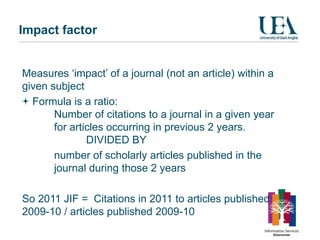
Impact factor


Measures ‘impact’ of a journal (not an article) within a
given subject
  Formula is a ratio:
       Number of citations to a journal in a given year
       for articles occurring in previous 2 years.
               DIVIDED BY
       number of scholarly articles published in the
       journal during those 2 years

So 2011 JIF = Citations in 2011 to articles published
2009-10 / articles published 2009-10
Exercise


  Look at Journal Citation Reports for a journal that
you use
  Find via Web of Science /Additional Resources
Concerns with impact factor


   Can’t be used to compare cross disciplinary due to
different rates of publication & citation
   2 year time frame not adequate for non-scientific
disciplines (has been adjusted to 3-5 years)
   Coverage of some disciplines not sufficient in the
ISI databases
   Reviews will cite more – journals may include more
to boost impact factor
   Doesn’t measure individual researcher’s impact
   Is a measure of ‘impact’ a measure of quality?
Immediacy index - definition


   What it’s supposed to measure: how quickly
articles in a given journal have an impact on the
discipline
   Formula: the average number of times an article in
a journal in a given year was cited in that same year
Citation half-life - definition


  What it’s supposed to measure: Long-term
relevance of articles in a given journal
  Formula: median age of articles cited for a
particular journal in a given year
Hirsch (H) index


  What it’s supposed to measure: Productivity of an
individual, group or institution
  Formula: H value is equal to the number of papers
(n) that have n or more citations
  It will vary depending on the index database journal
coverage
  Biased against early-career researchers as won’t
have had time to be so productive – but study by
Hirsch suggests it’s a predictor of future quality
output
H index - exercise


  Scopus Author Identifier
  WoS author finder
Altmetrics


  Uses web stats to provide more detailed assessment
  of online activity – beyond citations
   Use of open data
   Blog/twitter mentions

  http://altmetrics.org/manifesto/
References & websites
EYSENBACH, G. 2011. Can Tweets Predict Citations?
   Metrics of Social Impact Based on Twitter and Correlation
   with Traditional Metrics of Scientific Impact. J Med
   Internet Res [Online]. Available:
   http://www.jmir.org/2011/4/e123/.
VAN RAAN, A. F. J. 2006. Comparison of the Hirsch-index
   with standard bibliometric indicators and with peer
   judgment for 147 chemistry research groups.
   Scientometrics, 67, 491-502.
WILLIAMS, G. 2007. Should we ditch impact factors? BMJ,
   334, 568-568.
http://www.cwts.nl/ranking/LeidenRankingWebSite.html
http://www.uea.ac.uk/is/collections/researchsupport/Biblio
http://www.ndlr.ie/myri/index.html
Thanks to Elaine Bergman who gave permission
for content to be used from
http://www.slideshare.net/librarian68/bibliometric
s-primer


We welcome feedback on this session - did you
     find out what you needed to know?

bibliometrics for beginners

  • 1.
    A bit onbibliometrics Science Librarian Rachel Henderson (CHE / PHA / CMP / MTH) Rachel.Henderson@uea.ac.uk Jane Helgesen Information Skills Librarian j.helgesen@uea.ac.uk
  • 2.
    Session aims Why do you need to know this? Introduction to terminology Exploring the resources
  • 3.
    Why do youneed to know this? Scholarly communication: tracing the history and evolution of ideas from one scholar to another Can be seen to measure the scholarly influence of articles; journals; scholars Used with other factors in UK Research Excellence Framework (REF) to determine importance of research and award money to the institution
  • 4.
    Garfield’s metrics Eugene Garfield:‘Father of citation analysis’ developed the first bibliometric index tools Citation count Impact factor Immediacy Index Citation Half-life
  • 5.
    Citation count Number oftimes cited within a give time period Author Journal Does not take into account materials outside of citation database so differs depending on source
  • 6.
    Exercise Web of Science subject search – sort by ‘Times cited’
  • 7.
    Impact factor Measures ‘impact’of a journal (not an article) within a given subject Formula is a ratio: Number of citations to a journal in a given year for articles occurring in previous 2 years. DIVIDED BY number of scholarly articles published in the journal during those 2 years So 2011 JIF = Citations in 2011 to articles published 2009-10 / articles published 2009-10
  • 8.
    Exercise Lookat Journal Citation Reports for a journal that you use Find via Web of Science /Additional Resources
  • 9.
    Concerns with impactfactor Can’t be used to compare cross disciplinary due to different rates of publication & citation 2 year time frame not adequate for non-scientific disciplines (has been adjusted to 3-5 years) Coverage of some disciplines not sufficient in the ISI databases Reviews will cite more – journals may include more to boost impact factor Doesn’t measure individual researcher’s impact Is a measure of ‘impact’ a measure of quality?
  • 10.
    Immediacy index -definition What it’s supposed to measure: how quickly articles in a given journal have an impact on the discipline Formula: the average number of times an article in a journal in a given year was cited in that same year
  • 11.
    Citation half-life -definition What it’s supposed to measure: Long-term relevance of articles in a given journal Formula: median age of articles cited for a particular journal in a given year
  • 12.
    Hirsch (H) index What it’s supposed to measure: Productivity of an individual, group or institution Formula: H value is equal to the number of papers (n) that have n or more citations It will vary depending on the index database journal coverage Biased against early-career researchers as won’t have had time to be so productive – but study by Hirsch suggests it’s a predictor of future quality output
  • 13.
    H index -exercise Scopus Author Identifier WoS author finder
  • 14.
    Altmetrics Usesweb stats to provide more detailed assessment of online activity – beyond citations Use of open data Blog/twitter mentions http://altmetrics.org/manifesto/
  • 15.
    References & websites EYSENBACH,G. 2011. Can Tweets Predict Citations? Metrics of Social Impact Based on Twitter and Correlation with Traditional Metrics of Scientific Impact. J Med Internet Res [Online]. Available: http://www.jmir.org/2011/4/e123/. VAN RAAN, A. F. J. 2006. Comparison of the Hirsch-index with standard bibliometric indicators and with peer judgment for 147 chemistry research groups. Scientometrics, 67, 491-502. WILLIAMS, G. 2007. Should we ditch impact factors? BMJ, 334, 568-568. http://www.cwts.nl/ranking/LeidenRankingWebSite.html http://www.uea.ac.uk/is/collections/researchsupport/Biblio http://www.ndlr.ie/myri/index.html
  • 16.
    Thanks to ElaineBergman who gave permission for content to be used from http://www.slideshare.net/librarian68/bibliometric s-primer We welcome feedback on this session - did you find out what you needed to know?

Editor's Notes

  • #15 More immediate reaction to research