Topic- Bibliometrics: An
Overview
Submitted To
Dr. Manoj Kumar Varma
Dep. Of Lib. & Inf. Science
MZU
Submitted By-
Babita Yadav
Research Scholar
Introduction
Bibliometrics is a set of methods used to study or
measure texts and information. Citation analysis
and content analysis are commonly used in
Bibliometrics methods. While Bibliometrics
methods are most often used in the field of library
and information science.
Bibliometrics uses mathematical and statistical
methods to analyses and measure the output of
publications. Modern Bibliometrics has been largely
inspired by Derek de Solla Price and the seminal
work was carried out by him in the middle of the last
century.
Introduction to the term "Bibliometrics”
Origin of the term “Bibliometrics”
Biblio + Metrics = Bibliometrics
“Biblio” is originated from Greek word “Biblion”
which means “Book” or “Paper”
“Metrics” is originated from Greek or Latin word
“Metricus” or “Metrikos” which means the science of
Meter or to measure.
Bibliometrics is a set of methods used to
study or measure texts and information.
Citation analysis and content analysis are
commonly used in Bibliometrics methods.
Definition
According to Potter :- “The Study and
measurement of Publication patterns of all forms
of written communication and their authorship”.
According to Alan Pritchard :- “the application of
mathematical and statistical methods to books and
other media of communication”.
Scope
Identification of the main journals.
Ranking of journals.
Selection magazines.
Development and expansion of knowledge
in various fields.
An institution, contribute to the scientific
progress of the nation or individual.
Measuring the usefulness of information
services.
 Quantitative analysis of science and technology
performance.
 Quantitative analysis of the cognitive and
organizational structure of science and technology
 To know how a certain science or technology has
evolved in a certain period of time.
Purpose of Bibliometrics
BIBLIOMETRIC LAWS
Lotka’s Law (1926)
Bradford’s Law (1934)
Zipf’s Law (1935)
Lotka’s Law (1926)
Measuring the productivity of an author
based on the number of published articles.
Productivity of authors ( researchers); how
many researchers have written
1,2,3…..articles?
Lotka’s Law describes the frequency of
publication by authors in a given field.
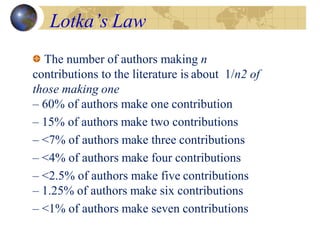
Lotka’s Law
The number of authors making n
contributions to the literature is about 1/n2 of
those making one
– 60% of authors make one contribution
– 15% of authors make two contributions
– <7% of authors make three contributions
– <4% of authors make four contributions
– <2.5% of authors make five contributions
– 1.25% of authors make six contributions
– <1% of authors make seven contributions
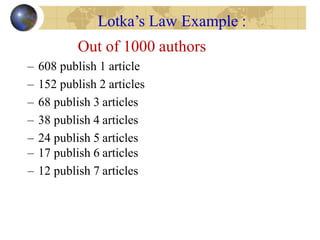
Out of 1000 authors
– 608 publish 1 article
– 152 publish 2 articles
– 68 publish 3 articles
– 38 publish 4 articles
– 24 publish 5 articles
– 17 publish 6 articles
– 12 publish 7 articles
Lotka’s Law Example :
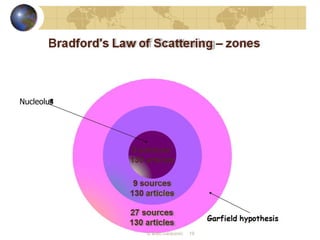
Bradford’s Law (1934)
"If scientific journals are arranged in order
of decreasing productivity of articles on a
given subject, they may be divided into a
nucleus of periodicals more particularly
devoted to the subject and several groups or
zones containing the same number of articles
as the nucleus, when the numbers of
periodicals in the nucleus and succeeding
zones will be as n : n2 :n3.
Samual.Climent Bradford
Nucleolus
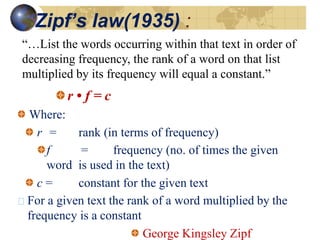
Zipf’s law(1935) :
r • f = c
Where:
r = rank (in terms of frequency)
f = frequency (no. of times the given
word is used in the text)
c = constant for the given text
For a given text the rank of a word multiplied by the
frequency is a constant
George Kingsley Zipf
“…List the words occurring within that text in order of
decreasing frequency, the rank of a word on that list
multiplied by its frequency will equal a constant.”
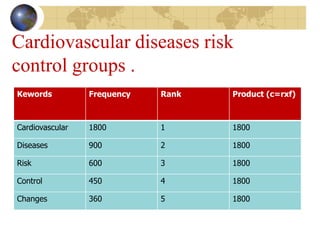
Cardiovascular diseases risk
control groups .
Kewords Frequency Rank Product (c=rxf)
Cardiovascular 1800 1 1800
Diseases 900 2 1800
Risk 600 3 1800
Control 450 4 1800
Changes 360 5 1800
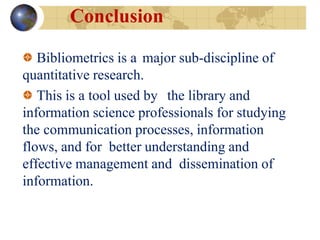
Conclusion
Bibliometrics is a major sub-discipline of
quantitative research.
This is a tool used by the library and
information science professionals for studying
the communication processes, information
flows, and for better understanding and
effective management and dissemination of
information.

Bibliometrics law

  • 1.
    Topic- Bibliometrics: An Overview SubmittedTo Dr. Manoj Kumar Varma Dep. Of Lib. & Inf. Science MZU Submitted By- Babita Yadav Research Scholar
  • 2.
    Introduction Bibliometrics is aset of methods used to study or measure texts and information. Citation analysis and content analysis are commonly used in Bibliometrics methods. While Bibliometrics methods are most often used in the field of library and information science.
  • 3.
    Bibliometrics uses mathematicaland statistical methods to analyses and measure the output of publications. Modern Bibliometrics has been largely inspired by Derek de Solla Price and the seminal work was carried out by him in the middle of the last century.
  • 4.
    Introduction to theterm "Bibliometrics” Origin of the term “Bibliometrics” Biblio + Metrics = Bibliometrics “Biblio” is originated from Greek word “Biblion” which means “Book” or “Paper” “Metrics” is originated from Greek or Latin word “Metricus” or “Metrikos” which means the science of Meter or to measure.
  • 5.
    Bibliometrics is aset of methods used to study or measure texts and information. Citation analysis and content analysis are commonly used in Bibliometrics methods.
  • 6.
    Definition According to Potter:- “The Study and measurement of Publication patterns of all forms of written communication and their authorship”. According to Alan Pritchard :- “the application of mathematical and statistical methods to books and other media of communication”.
  • 7.
    Scope Identification of themain journals. Ranking of journals. Selection magazines. Development and expansion of knowledge in various fields.
  • 8.
    An institution, contributeto the scientific progress of the nation or individual. Measuring the usefulness of information services.
  • 9.
     Quantitative analysisof science and technology performance.  Quantitative analysis of the cognitive and organizational structure of science and technology  To know how a certain science or technology has evolved in a certain period of time. Purpose of Bibliometrics
  • 10.
    BIBLIOMETRIC LAWS Lotka’s Law(1926) Bradford’s Law (1934) Zipf’s Law (1935)
  • 11.
    Lotka’s Law (1926) Measuringthe productivity of an author based on the number of published articles. Productivity of authors ( researchers); how many researchers have written 1,2,3…..articles? Lotka’s Law describes the frequency of publication by authors in a given field.
  • 12.
    Lotka’s Law The numberof authors making n contributions to the literature is about 1/n2 of those making one – 60% of authors make one contribution – 15% of authors make two contributions – <7% of authors make three contributions – <4% of authors make four contributions – <2.5% of authors make five contributions – 1.25% of authors make six contributions – <1% of authors make seven contributions
  • 13.
    Out of 1000authors – 608 publish 1 article – 152 publish 2 articles – 68 publish 3 articles – 38 publish 4 articles – 24 publish 5 articles – 17 publish 6 articles – 12 publish 7 articles Lotka’s Law Example :
  • 14.
    Bradford’s Law (1934) "Ifscientific journals are arranged in order of decreasing productivity of articles on a given subject, they may be divided into a nucleus of periodicals more particularly devoted to the subject and several groups or zones containing the same number of articles as the nucleus, when the numbers of periodicals in the nucleus and succeeding zones will be as n : n2 :n3. Samual.Climent Bradford
  • 15.
  • 16.
    Zipf’s law(1935) : r• f = c Where: r = rank (in terms of frequency) f = frequency (no. of times the given word is used in the text) c = constant for the given text For a given text the rank of a word multiplied by the frequency is a constant George Kingsley Zipf “…List the words occurring within that text in order of decreasing frequency, the rank of a word on that list multiplied by its frequency will equal a constant.”
  • 17.
    Cardiovascular diseases risk controlgroups . Kewords Frequency Rank Product (c=rxf) Cardiovascular 1800 1 1800 Diseases 900 2 1800 Risk 600 3 1800 Control 450 4 1800 Changes 360 5 1800
  • 18.
    Conclusion Bibliometrics is amajor sub-discipline of quantitative research. This is a tool used by the library and information science professionals for studying the communication processes, information flows, and for better understanding and effective management and dissemination of information.