Research
performance
Measurement
Miss Elham Abied
Public services Supervisor
RPM Definition
It Concerned with measuring the performance of:
1. A researcher
2. A collection of selected articles (specialized in one
subject)
3. A journal or an institute.
RPM Uses
• Identifying Research Trends: Researchers need to be able to
identify trends through citation analysis.
• Tenure and Promotion: Administrators and heads of faculty need
to evaluate a researcher’s performance.
• Funding and Grant Applications: Authors need documentation to
demonstrate their performance.
• Research Tracking and Benchmarking: Institutions need to be
able to track the performance of their faculty and benchmark the
research output of their institution against other institutions.
• Policy Setting: Policy makers need RPM data to ensure that the
decisions they make are informed and based on unbiased, credible
research.
• Peer-Review Process: Editors need RPM data to aid in the selection
of editorial board members and reviewers.
H Index
It’s an index that attempts to measure both
the productivity and impact of the published
work of a scientist or scholar.
It is based on the set of the scientist's most
cited papers and the number of citations that
they have received in other people's
publications.
H Index (Cont.)
It can also be applied to the productivity
and impact of a group of scientists such as:
»Department
»University
»Country
»Subject
H Index (Cont.)
A scholar with an index of H has published
# papers each of which has been cited by
others at least # times.
Thus, the h-index reflects both the number
of publications and the number of citations per
publication.
The meaning of the h-index can be explained
as follows:
1. 1 scientist has 15 publications
2. 10 of them cited at least 10 times or more not
less by others.
So, h-index of the scientist is 10, indicating
that the other 5 publications may have less
than 10 citations.
H Index : How to calculate
Sources where from you can collect your works
and it’s citation are (Web of Science, Google
Scholar and Scopus)
1. Find the citations of each of your publication periodically
from different sources (Web of Science, Google Scholar and
Scopus). Available only if you subscribed to
2. Rank them according to the number of citations received.
3. Pick up the top 'h' publications with a minimum of 'h'
citations.
This will give you the h-index of your scientific output.
H Index : How to calculate
H Index : E-Tools to calculate it
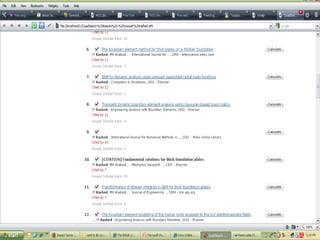
1. Quadsearch: available at:
http://quadsearch.csd.auth.gr/index.php?s=2&lan=1
For example: see the following screen shoots:
H Index : E-Tools to calculate it
2. Publish or Perish: Publish or Perish is a software program
that retrieves and analyzes academic citations. It uses
Google scholar to obtain the raw citations, then analyzes
these and presents the following statistics:
Total number of papers
Total number of citations
Average number of citations per paper
Average number of citations per author
Average number of papers per author
Average number of citations per year
Hirsch's h-index and related parameters
Egghe's g-index
Available to download at: http://www.harzing.com/pop.htm
3. Scopus Citation Tracker:
a tool to collect a scientist works and create the H-index for him or for his
publication within time period or a specific subject field.
Note: Available only if you subscribed to individually or through your organization.
A help documents explaining how to use is available at:
http://help.scopus.com/robo/projects/schelp/
H Index : E-Tools to calculate it
1. The value of h will vary between subjects which should be taken
into account when comparing authors.
2. To have a reasonably good h-index it is not sufficient to have a
few publications with hundreds of citations.
The use of h-index aims at identifying researchers with more
papers and relevant impact over a period of time.
3. The h-index does not take into account the physical age of the
authors being evaluated.
So it grows as citations accumulate and thus it depends on
the 'academic age' of a researcher.
About the H-Index
About the H-Index
4. A scientist with a high h-index may have stopped
publishing some time ago whereas a currently active
researcher with a low h-index has the potential to be
highly cited at some point in the future.
This means that when, for example, two scientists
are being evaluated for grant allocation, it is possible
that a seasoned scientist might be favored over the
new ‘hot’ talent in the field as a result of time.
Impact Factor
The impact factor (IF) is a measure
reflecting the average number of citations to
articles published in journals.
It is frequently used as an indicator for:
– Determine the relative importance of a journal
within its field.
– Compare them to each other in the same field.
Calculating Impact Factors
E.g., the 2009 Impact factor for a journal =
Number of citations in the current year (2009) for
a journal
–––––––––-––––––––––––––––––––––––––––––––
Number items published in the journal for the last 2
years (2007 & 2008)
Other Related indices
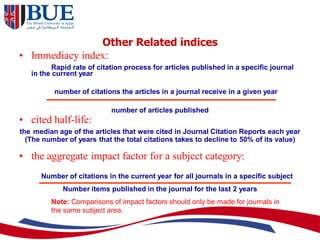
• Immediacy index:
Rapid rate of citation process for articles published in a specific journal
in the current year
number of citations the articles in a journal receive in a given year
number of articles published
• cited half-life:
the median age of the articles that were cited in Journal Citation Reports each year
(The number of years that the total citations takes to decline to 50% of its value)
• the aggregate impact factor for a subject category:
Number of citations in the current year for all journals in a specific subject
Number items published in the journal for the last 2 years
Note: Comparisons of impact factors should only be made for journals in
the same subject area.
The value of the impact factor is affected
by:
• Sociological factors include the :
1. Subjectivity:
• fundamental and pure subject areas have higher average
impact factor than specialized or applied ones.
• Multiple Authorship (Average number of authors per paper)
varies according to subject area (social or life science)
Affecting Factors
Affecting Factors
2. The type of journal
• review articles can raise the impact factor of the journal
rather than research reports or papers.
• Internal cross referral or self-citation can have an effect on
the impact factor of a journal. So its urgent to know the real
one by excluding self-cites from the total cites.
• Rapid publication time
Where we can find
Impact factors are listed in Journal Citation
Reports JCR)
You can easily get to the JCR from the Web of sciense
If you want to see the IF for many journals go to:
http://www.sciencegateway.org/rank/index.html
Thanks,
Practice an assignment

Research performance measurement

  • 1.
  • 2.
    RPM Definition It Concernedwith measuring the performance of: 1. A researcher 2. A collection of selected articles (specialized in one subject) 3. A journal or an institute.
  • 3.
    RPM Uses • IdentifyingResearch Trends: Researchers need to be able to identify trends through citation analysis. • Tenure and Promotion: Administrators and heads of faculty need to evaluate a researcher’s performance. • Funding and Grant Applications: Authors need documentation to demonstrate their performance. • Research Tracking and Benchmarking: Institutions need to be able to track the performance of their faculty and benchmark the research output of their institution against other institutions. • Policy Setting: Policy makers need RPM data to ensure that the decisions they make are informed and based on unbiased, credible research. • Peer-Review Process: Editors need RPM data to aid in the selection of editorial board members and reviewers.
  • 4.
    H Index It’s anindex that attempts to measure both the productivity and impact of the published work of a scientist or scholar. It is based on the set of the scientist's most cited papers and the number of citations that they have received in other people's publications.
  • 5.
    H Index (Cont.) Itcan also be applied to the productivity and impact of a group of scientists such as: »Department »University »Country »Subject
  • 6.
    H Index (Cont.) Ascholar with an index of H has published # papers each of which has been cited by others at least # times. Thus, the h-index reflects both the number of publications and the number of citations per publication.
  • 7.
    The meaning ofthe h-index can be explained as follows: 1. 1 scientist has 15 publications 2. 10 of them cited at least 10 times or more not less by others. So, h-index of the scientist is 10, indicating that the other 5 publications may have less than 10 citations. H Index : How to calculate
  • 8.
    Sources where fromyou can collect your works and it’s citation are (Web of Science, Google Scholar and Scopus) 1. Find the citations of each of your publication periodically from different sources (Web of Science, Google Scholar and Scopus). Available only if you subscribed to 2. Rank them according to the number of citations received. 3. Pick up the top 'h' publications with a minimum of 'h' citations. This will give you the h-index of your scientific output. H Index : How to calculate
  • 9.
    H Index :E-Tools to calculate it 1. Quadsearch: available at: http://quadsearch.csd.auth.gr/index.php?s=2&lan=1 For example: see the following screen shoots:
  • 14.
    H Index :E-Tools to calculate it 2. Publish or Perish: Publish or Perish is a software program that retrieves and analyzes academic citations. It uses Google scholar to obtain the raw citations, then analyzes these and presents the following statistics: Total number of papers Total number of citations Average number of citations per paper Average number of citations per author Average number of papers per author Average number of citations per year Hirsch's h-index and related parameters Egghe's g-index Available to download at: http://www.harzing.com/pop.htm
  • 16.
    3. Scopus CitationTracker: a tool to collect a scientist works and create the H-index for him or for his publication within time period or a specific subject field. Note: Available only if you subscribed to individually or through your organization. A help documents explaining how to use is available at: http://help.scopus.com/robo/projects/schelp/ H Index : E-Tools to calculate it
  • 17.
    1. The valueof h will vary between subjects which should be taken into account when comparing authors. 2. To have a reasonably good h-index it is not sufficient to have a few publications with hundreds of citations. The use of h-index aims at identifying researchers with more papers and relevant impact over a period of time. 3. The h-index does not take into account the physical age of the authors being evaluated. So it grows as citations accumulate and thus it depends on the 'academic age' of a researcher. About the H-Index
  • 18.
    About the H-Index 4.A scientist with a high h-index may have stopped publishing some time ago whereas a currently active researcher with a low h-index has the potential to be highly cited at some point in the future. This means that when, for example, two scientists are being evaluated for grant allocation, it is possible that a seasoned scientist might be favored over the new ‘hot’ talent in the field as a result of time.
  • 19.
    Impact Factor The impactfactor (IF) is a measure reflecting the average number of citations to articles published in journals. It is frequently used as an indicator for: – Determine the relative importance of a journal within its field. – Compare them to each other in the same field.
  • 20.
    Calculating Impact Factors E.g.,the 2009 Impact factor for a journal = Number of citations in the current year (2009) for a journal –––––––––-–––––––––––––––––––––––––––––––– Number items published in the journal for the last 2 years (2007 & 2008)
  • 21.
    Other Related indices •Immediacy index: Rapid rate of citation process for articles published in a specific journal in the current year number of citations the articles in a journal receive in a given year number of articles published • cited half-life: the median age of the articles that were cited in Journal Citation Reports each year (The number of years that the total citations takes to decline to 50% of its value) • the aggregate impact factor for a subject category: Number of citations in the current year for all journals in a specific subject Number items published in the journal for the last 2 years Note: Comparisons of impact factors should only be made for journals in the same subject area.
  • 22.
    The value ofthe impact factor is affected by: • Sociological factors include the : 1. Subjectivity: • fundamental and pure subject areas have higher average impact factor than specialized or applied ones. • Multiple Authorship (Average number of authors per paper) varies according to subject area (social or life science) Affecting Factors
  • 23.
    Affecting Factors 2. Thetype of journal • review articles can raise the impact factor of the journal rather than research reports or papers. • Internal cross referral or self-citation can have an effect on the impact factor of a journal. So its urgent to know the real one by excluding self-cites from the total cites. • Rapid publication time
  • 24.
    Where we canfind Impact factors are listed in Journal Citation Reports JCR) You can easily get to the JCR from the Web of sciense If you want to see the IF for many journals go to: http://www.sciencegateway.org/rank/index.html
  • 25.