


POZZOLANA - MATERIALS
PROF. SAMIRSINH P PARMAR
ASST. PROF. DEPT. OF CIVIL ENGINEERING,
DHARMASINH DESAI UNIVERSITY,
NADIAD, GUJARAT, INDIA
MAIL: SAMIRDDU@GMAIL.COM
1
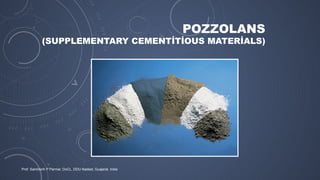
POZZOLANS
(SUPPLEMENTARY CEMENTİTİOUS MATERİALS)
Prof. Samirsinh P Parmar, DoCL, DDU-Nadiad, Guajarat, India
POZZOLAN
• The name Pozzolan comes from the town Pozzuoli, Italy.
• Ancient Romans (~100 B.C.) produced a hydraulic binder
by mixing hydrated lime with soil (predominantly volcanic
ash)
• Horasan mortar, mixing lime with finely divided burned
clay, is extensively used by Ottomans
• Nowadays, the word pozzolan covers a broad range of
natural and artificial materials.
Prof. Samirsinh P Parmar, DoCL, DDU-Nadiad, Guajarat, India
POZZOLAN
A material that, when used in conjunction with Portland
cement, contributes to the properties of the hardened concrete
through hydraulic or pozzolanic activity, or both.
• Natural (Volcanic ash, volcanic tuff, pumicite)
• Artificial (fly ash, silica-fume, granulated blast furnace slag)
Prof. Samirsinh P Parmar, DoCL, DDU-Nadiad, Guajarat, India
POZZOLAN
• Siliceous or aluminous material, which in itself possesses
little or no cementitious value but will, in finely divided
form and in the presence of moisture, chemically react
with calcium hydroxide Ca(OH)2 to form compounds
possessing hydraulic cementitious properties.
Prof. Samirsinh P Parmar, DoCL, DDU-Nadiad, Guajarat, India
POZZOLANIC REACTIONS
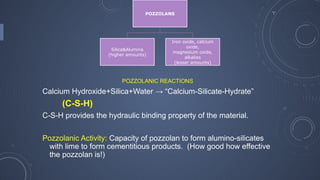
Calcium Hydroxide+Silica+Water → “Calcium-Silicate-Hydrate”
(C-S-H)
C-S-H provides the hydraulic binding property of the material.
Pozzolanic Activity: Capacity of pozzolan to form alumino-silicates
with lime to form cementitious products. (How good how effective
the pozzolan is!)
POZZOLANS
Silica&Alumina
(higher amounts)
Iron oxide, calcium
oxide,
magnesium oxide,
alkalies
(lesser amounts)
FACTORS THAT AFFECT THE ACTIVITY
OF POZZOLANS
1) SiO2 + Al2O3 + Fe2O3 content
2) The degree of amourpheness of its structure
3) Fineness of its particles
Prof. Samirsinh P Parmar, DoCL, DDU-Nadiad, Guajarat, India
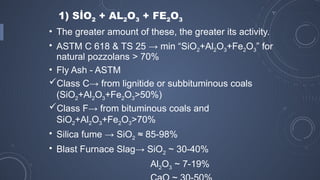
1) SİO2 + AL2O3 + FE2O3
• The greater amount of these, the greater its activity.
• ASTM C 618 & TS 25 → min “SiO2+Al2O3+Fe2O3” for
natural pozzolans > 70%
• Fly Ash - ASTM
Class C→ from lignitide or subbituminous coals
(SiO2+Al2O3+Fe2O3>50%)
Class F→ from bituminous coals and
SiO2+Al2O3+Fe2O3>70%
• Silica fume → SiO2 ≈ 85-98%
• Blast Furnace Slag→ SiO2 ~ 30-40%
Al2O3 ~ 7-19%
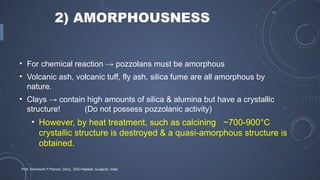
2) AMORPHOUSNESS
• For chemical reaction → pozzolans must be amorphous
• Volcanic ash, volcanic tuff, fly ash, silica fume are all amorphous by
nature.
• Clays → contain high amounts of silica & alumina but have a crystallic
structure! (Do not possess pozzolanic activity)
• However, by heat treatment, such as calcining ~700-900°C
crystallic structure is destroyed & a quasi-amorphous structure is
obtained.
Prof. Samirsinh P Parmar, DoCL, DDU-Nadiad, Guajarat, India
 Clay → does not possess pozzolanic property
 Burned clay → possess pozzolanic property
Blast furnace slag → contain high amounts of silica, alumina & lime.
 However, if molten slag is allowed to cool in air, it gains a crystal structure. *
do not possess pozzolanic property.
 However, if it is cooled very rapidly by pouring it into water, it becomes a
granular material & gains amorpousness. * possess pozzolanic property.
2) AMORPHOUSNESS
Prof. Samirsinh P Parmar, DoCL, DDU-Nadiad, Guajarat, India
3) FİNENESS
 Pozzolanic activity increases as fineness increases.
Volcanic ash, rice husk ash, fly ash, condensed silica fume are obtained in
finely divided form.
Volcanic tuff, granulated blast furnace slag & burned clay must be ground.
Prof. Samirsinh P Parmar, DoCL, DDU-Nadiad, Guajarat, India
DETERMINATION OF POZZOLANIC
ACTIVITY
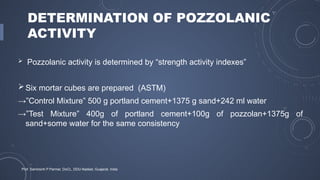
 Pozzolanic activity is determined by “strength activity indexes”
Six mortar cubes are prepared (ASTM)
→”Control Mixture” 500 g portland cement+1375 g sand+242 ml water
→”Test Mixture” 400g of portland cement+100g of pozzolan+1375g of
sand+some water for the same consistency
Prof. Samirsinh P Parmar, DoCL, DDU-Nadiad, Guajarat, India
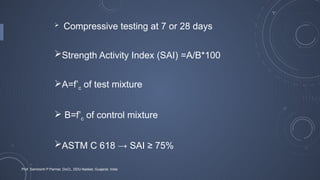
 Compressive testing at 7 or 28 days
Strength Activity Index (SAI) =A/B*100
A=f’c of test mixture
 B=f’c of control mixture
ASTM C 618 → SAI ≥ 75%
Prof. Samirsinh P Parmar, DoCL, DDU-Nadiad, Guajarat, India
CHEMICAL COMPOSITION OF POZZOLANS
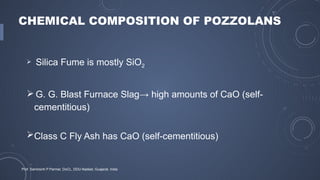
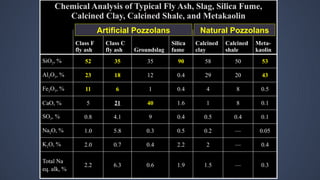
 Silica Fume is mostly SiO2
 G. G. Blast Furnace Slag→ high amounts of CaO (self-
cementitious)
Class C Fly Ash has CaO (self-cementitious)
Prof. Samirsinh P Parmar, DoCL, DDU-Nadiad, Guajarat, India
Chemical Analysis of Typical Fly Ash, Slag, Silica Fume,
Calcined Clay, Calcined Shale, and Metakaolin
Class F
fly ash
Class C
fly ash Groundslag
Silica
fume
Calcined
clay
Calcined
shale
Meta-
kaolin
SiO2, % 52 35 35 90 58 50 53
Al2O3, % 23 18 12 0.4 29 20 43
Fe2O3, % 11 6 1 0.4 4 8 0.5
CaO, % 5 21 40 1.6 1 8 0.1
SO3, % 0.8 4.1 9 0.4 0.5 0.4 0.1
Na2O, % 1.0 5.8 0.3 0.5 0.2 — 0.05
K2O, % 2.0 0.7 0.4 2.2 2 — 0.4
Total Na
eq. alk, %
2.2 6.3 0.6 1.9 1.5 — 0.3
Natural Pozzolans
Artificial Pozzolans
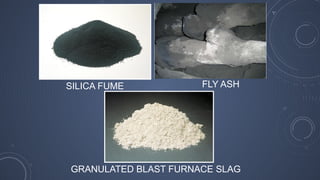
SILICA FUME FLY ASH
GRANULATED BLAST FURNACE SLAG
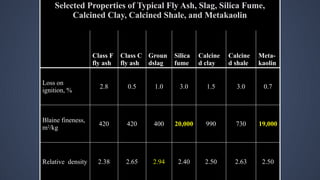
Selected Properties of Typical Fly Ash, Slag, Silica Fume,
Calcined Clay, Calcined Shale, and Metakaolin
Class F
fly ash
Class C
fly ash
Groun
dslag
Silica
fume
Calcine
d clay
Calcine
d shale
Meta-
kaolin
Loss on
ignition, %
2.8 0.5 1.0 3.0 1.5 3.0 0.7
Blaine fineness,
m2
/kg
420 420 400 20,000 990 730 19,000
Relative density 2.38 2.65 2.94 2.40 2.50 2.63 2.50
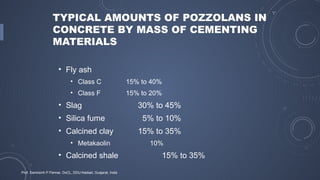
TYPICAL AMOUNTS OF POZZOLANS IN
CONCRETE BY MASS OF CEMENTING
MATERIALS
• Fly ash
• Class C 15% to 40%
• Class F 15% to 20%
• Slag 30% to 45%
• Silica fume 5% to 10%
• Calcined clay 15% to 35%
• Metakaolin 10%
• Calcined shale 15% to 35%
Prof. Samirsinh P Parmar, DoCL, DDU-Nadiad, Guajarat, India
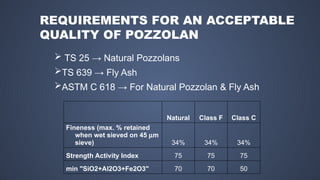
REQUIREMENTS FOR AN ACCEPTABLE
QUALITY OF POZZOLAN
 TS 25 → Natural Pozzolans
TS 639 → Fly Ash
ASTM C 618 → For Natural Pozzolan & Fly Ash
Natural Class F Class C
Fineness (max. % retained
when wet sieved on 45 mm
sieve) 34% 34% 34%
Strength Activity Index 75 75 75
min "SiO2+Al2O3+Fe2O3" 70 70 50
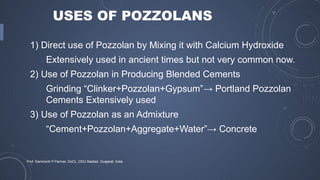
USES OF POZZOLANS
1) Direct use of Pozzolan by Mixing it with Calcium Hydroxide
Extensively used in ancient times but not very common now.
2) Use of Pozzolan in Producing Blended Cements
Grinding “Clinker+Pozzolan+Gypsum”→ Portland Pozzolan
Cements Extensively used
3) Use of Pozzolan as an Admixture
“Cement+Pozzolan+Aggregate+Water”→ Concrete
Prof. Samirsinh P Parmar, DoCL, DDU-Nadiad, Guajarat, India
THANKS FOR YOUR ATTENTION
Prof. Samirsinh P Parmar, DoCL, DDU-Nadiad, Guajarat, India.
21

Pozzolanic Materials- Civil Engineering Materials.pptx

  • 1.
    POZZOLANA - MATERIALS PROF.SAMIRSINH P PARMAR ASST. PROF. DEPT. OF CIVIL ENGINEERING, DHARMASINH DESAI UNIVERSITY, NADIAD, GUJARAT, INDIA MAIL: SAMIRDDU@GMAIL.COM 1
  • 2.
    POZZOLANS (SUPPLEMENTARY CEMENTİTİOUS MATERİALS) Prof.Samirsinh P Parmar, DoCL, DDU-Nadiad, Guajarat, India
  • 3.
    POZZOLAN • The namePozzolan comes from the town Pozzuoli, Italy. • Ancient Romans (~100 B.C.) produced a hydraulic binder by mixing hydrated lime with soil (predominantly volcanic ash) • Horasan mortar, mixing lime with finely divided burned clay, is extensively used by Ottomans • Nowadays, the word pozzolan covers a broad range of natural and artificial materials. Prof. Samirsinh P Parmar, DoCL, DDU-Nadiad, Guajarat, India
  • 4.
    POZZOLAN A material that,when used in conjunction with Portland cement, contributes to the properties of the hardened concrete through hydraulic or pozzolanic activity, or both. • Natural (Volcanic ash, volcanic tuff, pumicite) • Artificial (fly ash, silica-fume, granulated blast furnace slag) Prof. Samirsinh P Parmar, DoCL, DDU-Nadiad, Guajarat, India
  • 5.
    POZZOLAN • Siliceous oraluminous material, which in itself possesses little or no cementitious value but will, in finely divided form and in the presence of moisture, chemically react with calcium hydroxide Ca(OH)2 to form compounds possessing hydraulic cementitious properties. Prof. Samirsinh P Parmar, DoCL, DDU-Nadiad, Guajarat, India
  • 6.
    POZZOLANIC REACTIONS Calcium Hydroxide+Silica+Water→ “Calcium-Silicate-Hydrate” (C-S-H) C-S-H provides the hydraulic binding property of the material. Pozzolanic Activity: Capacity of pozzolan to form alumino-silicates with lime to form cementitious products. (How good how effective the pozzolan is!) POZZOLANS Silica&Alumina (higher amounts) Iron oxide, calcium oxide, magnesium oxide, alkalies (lesser amounts)
  • 7.
    FACTORS THAT AFFECTTHE ACTIVITY OF POZZOLANS 1) SiO2 + Al2O3 + Fe2O3 content 2) The degree of amourpheness of its structure 3) Fineness of its particles Prof. Samirsinh P Parmar, DoCL, DDU-Nadiad, Guajarat, India
  • 8.
    1) SİO2 +AL2O3 + FE2O3 • The greater amount of these, the greater its activity. • ASTM C 618 & TS 25 → min “SiO2+Al2O3+Fe2O3” for natural pozzolans > 70% • Fly Ash - ASTM Class C→ from lignitide or subbituminous coals (SiO2+Al2O3+Fe2O3>50%) Class F→ from bituminous coals and SiO2+Al2O3+Fe2O3>70% • Silica fume → SiO2 ≈ 85-98% • Blast Furnace Slag→ SiO2 ~ 30-40% Al2O3 ~ 7-19%
  • 9.
    2) AMORPHOUSNESS • Forchemical reaction → pozzolans must be amorphous • Volcanic ash, volcanic tuff, fly ash, silica fume are all amorphous by nature. • Clays → contain high amounts of silica & alumina but have a crystallic structure! (Do not possess pozzolanic activity) • However, by heat treatment, such as calcining ~700-900°C crystallic structure is destroyed & a quasi-amorphous structure is obtained. Prof. Samirsinh P Parmar, DoCL, DDU-Nadiad, Guajarat, India
  • 10.
     Clay →does not possess pozzolanic property  Burned clay → possess pozzolanic property Blast furnace slag → contain high amounts of silica, alumina & lime.  However, if molten slag is allowed to cool in air, it gains a crystal structure. * do not possess pozzolanic property.  However, if it is cooled very rapidly by pouring it into water, it becomes a granular material & gains amorpousness. * possess pozzolanic property. 2) AMORPHOUSNESS Prof. Samirsinh P Parmar, DoCL, DDU-Nadiad, Guajarat, India
  • 11.
    3) FİNENESS  Pozzolanicactivity increases as fineness increases. Volcanic ash, rice husk ash, fly ash, condensed silica fume are obtained in finely divided form. Volcanic tuff, granulated blast furnace slag & burned clay must be ground. Prof. Samirsinh P Parmar, DoCL, DDU-Nadiad, Guajarat, India
  • 12.
    DETERMINATION OF POZZOLANIC ACTIVITY Pozzolanic activity is determined by “strength activity indexes” Six mortar cubes are prepared (ASTM) →”Control Mixture” 500 g portland cement+1375 g sand+242 ml water →”Test Mixture” 400g of portland cement+100g of pozzolan+1375g of sand+some water for the same consistency Prof. Samirsinh P Parmar, DoCL, DDU-Nadiad, Guajarat, India
  • 13.
     Compressive testingat 7 or 28 days Strength Activity Index (SAI) =A/B*100 A=f’c of test mixture  B=f’c of control mixture ASTM C 618 → SAI ≥ 75% Prof. Samirsinh P Parmar, DoCL, DDU-Nadiad, Guajarat, India
  • 14.
    CHEMICAL COMPOSITION OFPOZZOLANS  Silica Fume is mostly SiO2  G. G. Blast Furnace Slag→ high amounts of CaO (self- cementitious) Class C Fly Ash has CaO (self-cementitious) Prof. Samirsinh P Parmar, DoCL, DDU-Nadiad, Guajarat, India
  • 15.
    Chemical Analysis ofTypical Fly Ash, Slag, Silica Fume, Calcined Clay, Calcined Shale, and Metakaolin Class F fly ash Class C fly ash Groundslag Silica fume Calcined clay Calcined shale Meta- kaolin SiO2, % 52 35 35 90 58 50 53 Al2O3, % 23 18 12 0.4 29 20 43 Fe2O3, % 11 6 1 0.4 4 8 0.5 CaO, % 5 21 40 1.6 1 8 0.1 SO3, % 0.8 4.1 9 0.4 0.5 0.4 0.1 Na2O, % 1.0 5.8 0.3 0.5 0.2 — 0.05 K2O, % 2.0 0.7 0.4 2.2 2 — 0.4 Total Na eq. alk, % 2.2 6.3 0.6 1.9 1.5 — 0.3 Natural Pozzolans Artificial Pozzolans
  • 16.
    SILICA FUME FLYASH GRANULATED BLAST FURNACE SLAG
  • 17.
    Selected Properties ofTypical Fly Ash, Slag, Silica Fume, Calcined Clay, Calcined Shale, and Metakaolin Class F fly ash Class C fly ash Groun dslag Silica fume Calcine d clay Calcine d shale Meta- kaolin Loss on ignition, % 2.8 0.5 1.0 3.0 1.5 3.0 0.7 Blaine fineness, m2 /kg 420 420 400 20,000 990 730 19,000 Relative density 2.38 2.65 2.94 2.40 2.50 2.63 2.50
  • 18.
    TYPICAL AMOUNTS OFPOZZOLANS IN CONCRETE BY MASS OF CEMENTING MATERIALS • Fly ash • Class C 15% to 40% • Class F 15% to 20% • Slag 30% to 45% • Silica fume 5% to 10% • Calcined clay 15% to 35% • Metakaolin 10% • Calcined shale 15% to 35% Prof. Samirsinh P Parmar, DoCL, DDU-Nadiad, Guajarat, India
  • 19.
    REQUIREMENTS FOR ANACCEPTABLE QUALITY OF POZZOLAN  TS 25 → Natural Pozzolans TS 639 → Fly Ash ASTM C 618 → For Natural Pozzolan & Fly Ash Natural Class F Class C Fineness (max. % retained when wet sieved on 45 mm sieve) 34% 34% 34% Strength Activity Index 75 75 75 min "SiO2+Al2O3+Fe2O3" 70 70 50
  • 20.
    USES OF POZZOLANS 1)Direct use of Pozzolan by Mixing it with Calcium Hydroxide Extensively used in ancient times but not very common now. 2) Use of Pozzolan in Producing Blended Cements Grinding “Clinker+Pozzolan+Gypsum”→ Portland Pozzolan Cements Extensively used 3) Use of Pozzolan as an Admixture “Cement+Pozzolan+Aggregate+Water”→ Concrete Prof. Samirsinh P Parmar, DoCL, DDU-Nadiad, Guajarat, India
  • 21.
    THANKS FOR YOURATTENTION Prof. Samirsinh P Parmar, DoCL, DDU-Nadiad, Guajarat, India. 21

Editor's Notes

  • #15 Table 3-2. Chemical Analysis and Selected Properties of Typical Fly Ash, Slag, Silica Fume, Calcined Clay, Calcined Shale, and Metakaolin
  • #17 Table 3-2. Chemical Analysis and Selected Properties of Typical Fly Ash, Slag, Silica Fume, Calcined Clay, Calcined Shale, and Metakaolin