RAW	
  KAOLINITE	
  
KAOLIN
CALCINED	
  
amorphous	
  
aluminium	
  silicate
content	
  
1.  introduc7on	
  
2.  produc7on	
  
3.  rheology	
  	
  
4.  Chapelle	
  test	
  
5.  advantages	
  
6.  Calcium-­‐sulpho	
  aluminate	
  cement	
  
7.  geo	
  polymer	
  
8.  conclusion	


1.  introduc+on	
  
2.  produc7on	
  
3.  rheology	
  	
  
4.  Chapelle	
  test	
  
5.  Advantages	
  
6.  Calcium-­‐sulpho	
  aluminate	
  cement	
  
7.  geo	
  polymer	
  
8.  conclusion	


KAOLINITE	
  
aluminium	
  silicate	
  
Al2O3	
  (SiO2)2	
  (H2O)2	
  	
  
amorphous	
  aluminum	
  silicate	
  
600° - 800° C.
dehydroxyla7on	
  breaks	
  the	
  crystaline	
  laQce	


  (temperature	
  depends	
  on	
  purity	
  of	
  kaolinite)	
  
Al2O3(SiO2)2(H2O)x+(2-­‐x)H2O	
  
high	
  reac7ve	
  pozzolan	
  
(temperatures	
  >900°	
  C.	
  recrystalliza7on	
  forming	
  mullite	
  with	
  no	
  pozzolanic	
  effect)	
  
Al	
  
O	
  
SiO	
  
OH	
  
de	
  hydroxyla7on	
  breaks	
  the	
  crystaline	
  laQce	


dehydroxyla7on	
  
Al2O3	
  ×	
  2SiO2	
  +	
  Ca(OH)	
  2	
  +	
  H2O	
  
a	
  chemical	
  reac7on	
  of	
  calcium	
  hydroxide	
  with	
  amorphous	
  siliceous	
  material	
  forming	
  
calcium	
  silicate	
  hydrates	
  	
  
pozzolanic	
  reac7on	
  
ac7ve	
  alumina	
  is	
  soluble	
  in	
  basic	
  environment	
  ,	
  pH>	
  11	
  (cemen77ous	
  matrix	
  )	
  forms	
  
stable	
  hydrates;	


• 	
  	
  C4AH13 	
  	
  
• 	
  	
  C3AH6	
   	
  (hydrogarnet)	
  	
  
• 	
  	
  C2ASH8	
   	
  (strätlingite)	
  
• 	
  	
  C-­‐S-­‐H 	
  (calcium	
  silicate	
  hydrate)	


metakaolin	
  reac7on	
  in	
  cement	


Pozzolanic	
  reac7on	
  in	
  a	
  cement	
  mix	
  depends	
  on:	


•  rate	
  of	
  addi7on	
  
•  dissolu7on	
  of	
  alite	
  and	
  belite	
  phases	
  
•  temperature	
  	
  
•  water	
  ra7o	


Two	
  main	
  stages	
  of	
  reac7on;	


•  0-­‐14	
  days 	
  80%	
  of	
  pozzolanic	
  reac7on	
  takes	
  place	


  dissolu7on	
  alite	
  (C3S)	
  	
  
•  14-­‐28	
  days	
   	
  comple7on	
  of	
  reac7on	


  dissolu7on	
  belite	
  (C2S)	
  
Portlandcement	
  blend	
  
When	
  Portlandcement	
  hydrates	
  it	
  forms	
  Portlandite	
  (Ca(OH)2)	
  (phase	
  3	
  and	
  4)	
  and	
  
Ca2+	
  released	
  by	
  alite	
  (C3S)	
  and	
  belite	
  (C2S)	
  (phase	
  2	
  and	
  3)	


Amorphous	
  Metakaolin	
  reacts	
  with	
  OH-­‐and	
  Ca2+	
  ions	
  forming	
  	
  C-­‐S-­‐H	
  	
  calcium	
  
silicate	
  hydrates-­‐reducing	
  the	
  amount	
  of	
  free	
  lime.	


main	
  effects:	


•  binds	
  calcium	
  	
  
•  accelerate	
  hydra7on	
  of	
  silicates	
  
•  addi7onal	
  calcium	
  silicate	
  hydrates	
  
•  reduced	
  pH	
  
•  dense	
  matrix	
  
1.	
  cement	
  minerals	
   2.	
  metakaoline	
  fills	
  pores	
  d50	
  =	
  10	
  μ	
  
3.	
  Forma7on	
  of	
  new	
  hydrates	
  	
  
AL2O3	
  ×	
  2SiO2	
  +	
  Ca(OH)	
  2	
  +	
  H2O	
  →	
  CSH,	
  
C4AH13,	
  C3AH6,	
  C2ASH8	
  
4.	
  closed	
  structure	
  improving	
  physical,	
  
mechanical	
  and	
  chemical	
  performance	
  
1.  introduc7on	
  
2.  produc+on	
  
3.  rheology	
  	
  
4.  Chapelle	
  test	
  
5.  advantages	
  
6.  Calcium-­‐sulpho	
  aluminate	
  cement	
  
7.  geo	
  polymer	
  
8.  conclusion	


rotary	
  kiln	
  calcina7on	
  flash	
  calcina7on	
  
raw	
  kaolinite	
  finely	
  ground	
  
+	
  
flash	
  calcina7on	
  	
  
(few	
  seconds	
  ~670°C)	
  
core	
  grinding	
  /	
  pelle7zing	
  	
  
rotary	
  kiln	
  calcina7on	
  
(2/5h	
  ~750°C)	
  
+	
  
	
  ground	
  
plate	
  structure	
  round	
  shaped	
  
different	
  morphology	
  
different	
  way	
  of	
  calcina7on	
  
CYCLONE	
  
GRINDING	


PRE-­‐HEATING	
  
BURNING	
  ZONE	
  
COOLING	
  ZONE	
  
CYCLONE	
  
GRINDING	
  
RAW	
  	
  
FEED	


  STORAGE	
  
FLASH	
  CALCINATION	
  
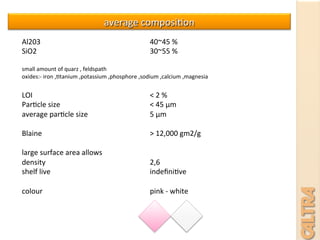
average	
  composi7on	
  
Al203 	


  40~45	
  %	
  
SiO2 	


  30~55	
  %	


small	
  amount	
  of	
  quarz	
  ,	
  feldspath	
  
oxides:-­‐	
  iron	
  ,7tanium	
  ,potassium	
  ,phosphore	
  ,sodium	
  ,calcium	
  ,magnesia	


LOI 	


  <	
  2	
  %	
  
Par7cle	
  size 	
   	
   	
  <	
  45	
  μm	
  
average	
  par7cle	
  size 	
   	
  5	
  μm	


Blaine 	


  >	
  12,000	
  gm2/g	


large	
  surface	
  area	
  allows	
  	
  
density 	


  2,6	
  	
  
shelf	
  live 	


  indefini7ve	


colour 	


  pink	
  -­‐	
  white	


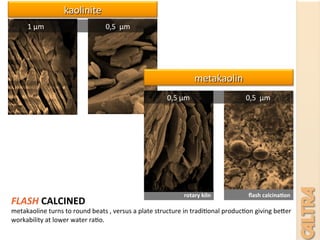
FLASH	
  CALCINED	
  
metakaoline	
  turns	
  to	
  round	
  beats	
  ,	
  versus	
  a	
  plate	
  structure	
  in	
  tradi7onal	
  produc7on	
  giving	
  beser	
  
workability	
  at	
  lower	
  water	
  ra7o.	


  1	
  μm	


  0,5	
  	
  μm	


  0,5	
  μm	


  0,5	
  	
  μm	


kaolinite
metakaolin
flash	
  calcina+on	
  rotary	
  kiln	
  	
  
1.  introduc7on	
  
2.  produc7on	
  
3.  rheology	
  	
  
4.  Chapelle	
  test	
  
5.  advantages	
  
6.  Calcium-­‐sulpho	
  aluminate	
  cement	
  
7.  geo	
  polymer	
  
8.  conclusion	


90	
  
100	
  
110	
  
120	
  
130	
  
140	
  
150	
  
160	
  
0	
   10	
   20	
   30	
  
flow	
  mm	
  
metakaolin	
  %	
  
Flow	
  table	
  test	
  :	
  cement/sand	
  =	
  1:	
  3	
  	
  w/c	
  =	
  0,5	


Up	
  to	
  10%	
  subs7tu7on	
  of	
  Portland	
  cement	
  by	
  regular	
  metakaolin	
  rheology	
  was	
  slightly	
  effected.	
  
Addi7on	
  of	
  	
  flash	
  calcined	
  metakaoline	
  allows	
  a	
  higher	
  addi7on	


tradi7onal	
  calcina7on	


flash	
  calcina7on	


0,0	
  
5,0	
  
10,0	
  
15,0	
  
20,0	
  
25,0	
  
30,0	
  
0	
   5	
   10	
   20	
   30	
  
compressive	
  strength	
  	
  MPa	
  
metakaolin	
  %	
  
1	
  day	


7	
  days	


28	
  days	
  
op7mum	
  is	
  reached	
  at	
  10%	
  subs7tu7on	
  of	
  	
  Portlandcement	
  by	
  tradi7onal	
  calcined	
  metakaolin	
  
Lower	
  viscosity	
  	
  allows	
  higher	
  dosage	
  of	
  metakaoline	
  ,	
  improving	
  further	
  strength	
  development	
  
Addi7on	
  of	
  a	
  plas7cizing	
  agent	
  will	
  improve	
  the	
  workability	
  and	
  further	
  increase	
  the	
  strength	
  
0	
  
5	
  
10	
  
15	
  
20	
  
25	
  
30	
  
35	
  
compressive	
  strength	
  MPa	
  
metakaoline	
  %	
  
1	
  day	


7	
  days	


28	
  days	
  
plas7cizing	
  agent	
  
Because	
  of	
  its	
  fineness	
  (10	
  7mes	
  finer	
  than	
  Portlandcement!)	
  
and	
  its	
  sponge	
  type	
  character,	
  the	
  addi7on	
  of	
  metakaoline	
  influences	
  the	
  rheology	
  
of	
  the	
  blend	


This	
  increase	
  in	
  viscosity	
  can	
  be	
  overcome	
  by	
  adding	
  a	
  plas7cizing-­‐	
  /	
  super	
  
plas7cizing	
  agent	


SeQng	
  7me	
  can	
  off	
  course	
  be	
  adjusted	
  by	
  addi7on	
  of	
  retarder	


0	
  
10	
  
20	
  
30	
  
40	
  
50	
  
60	
  
1	
  day	
   7	
  days	
   28	
  days	
  
compressive	
  strength	
  MPa	
  
7me	
  
reference	
  W/C	
  0,5	
  
poly	
  carboxylate	
  ether	
  0,2%	
  
W/C	
  0,375	
  
Addi7on	
  of	
  right	
  super	
  plas7cizing	
  agent	
  strength	
  can	
  be	
  further	
  increased	
  (20-­‐50%)	
  
1.  introduc7on	
  
2.  produc7on	
  
3.  rheology	
  	
  
4.  Chapelle	
  test	
  
5.  advantages	
  
6.  Calcium-­‐sulpho	
  aluminate	
  cement	
  
7.  geo	
  polymer	
  
8.  conclusion	


puzzolanic	
  ac7vity	
  (Chapelle	
  test)	
  
•  pozzolanic	
  reac7vity	
  is	
  measured	
  by	
  mixing	
  1	
  g	
  metakaolin	
  with	
  2	
  g	
  CaO	
  in	


  250	
  ml	
  of	
  water	
  
•  s7rred	
  and	
  heated	
  for	
  16	
  hours	
  	
  
•  aver	
  cooling	
  amount	
  of	
  lev	
  non	
  reacted	
  lime	
  is	
  	
  established	
  	
  
•  result	
  is	
  expressed	
  in	
  mg	
  Ca(OH)2	
  bound	
  
•  values	
  lies	
  between	
  1000	
  and	
  1400	
  mg	


comparision	
  of	
  puzzolanic	
  reac7vity	
  (Chapelle)	
  
materials	
  
average	
  
puzzolanic	
  ac7vity	
  mg	
  Ca(OH)2/g	


  blast	
  furnace	
  slag	
   40	


  silica	
  fume	
   430	


  calcined	
  bauxite	
   535	


  paper	
  sludge	
   600	


  fly	
  ash	
   875	


  metakaoline	
   1300	
  
1.  introduc7on	
  
2.  produc7on	
  
3.  rheology	
  	
  
4.  Chapelle	
  test	
  
5.  advantages	
  
6.  Calcium-­‐sulpho	
  aluminate	
  cement	
  
7.  geo	
  polymer	
  
8.  conclusion	


advantages	
  
METAKAOLIN	
  in	
  combina7on	
  with	
  Portlandcement	
  forms	
  a	
  dense-­‐knit	
  
structure	
  improving,	
  physical,	
  mechanical	
  and	
  chemical	
  proper7es.	


•  accelera7on	
  of	
  ses	
  –	
  lime	
  gel	
  is	
  bounds	
  allowing	
  C3A	
  ,	
  C3S	
  to	
  dissolute	
  quickly	
  
•  pH	
  is	
  reduced	
  giving	
  more	
  protec7on	
  to	
  glass	
  fibers	
  (GRC)	
  
•  reduced	
  thermal	
  stress	
  slower	
  hardening	
  which	
  limits	
  shrinkage	
  and	
  cracking	
  
•  increase	
  of	
  elas7c	
  modulus	
  (EMR)	


•  new	
  hydrates	
  formed;	
  calcium	
  silicate,	
  strätlingite,	
  and	
  hydrogarnet	
  	
  
•  fewer	
  pores	
  and	
  smaller	
  pore	
  size-­‐reduc7on	
  of	
  efflorescence,	
  
•  lower	
  water	
  uptake	
  
•  less	
  energy	
  needed	
  versus	
  tradi7onal	
  method	
  
•  tight	
  	
  control	
  on	
  calcina7on	
  
•  consistency	
  of	
  product	
  
•  grinding	
  raw	
  kaolinite	
  first	
  contributes	
  to	
  round	
  structure	
  of	
  par7cles	
  	
  
•  contribu7ng	
  to	
  an	
  improved	
  workability	
  
•  higher	
  amount	
  cement	
  subs7tu7on	
  	
  
•  higher	
  abrasive	
  resistance	
  
•  improved	
  opacity	
  
flash	
  calcina7on	
  
1.  introduc7on	
  
2.  produc7on	
  
3.  rheology	
  	
  
4.  Chapelle	
  test	
  
5.  advantages	
  
6.  Calcium-­‐Sulpho	
  Aluminate	
  cement	
  
7.  geo	
  polymer	
  
8.  conclusion	


CSA-­‐cement	
  
•  calcium	
  sulpho	
  aluminate	
  cement	
  relies	
  on	
  forma7on	
  of	
  ye’elimite	
  (C4A3Š)	
  it	
  
takes	
  calcium	
  out	
  of	
  the	
  solu7on,	
  lowering	
  the	
  pH	


•  low	
  pH	
  slows	
  down	
  the	
  dissolu7on	
  of	
  aluminium	
  silicates	


•  belite	
  (C2S)	
  goes	
  into	
  solu7on	
  at	
  a	
  later	
  stage	
  of	
  hydra7on	
  at	
  this	
  stage	
  the	
  
pozzolan	
  effect	
  is	
  reduced	


•  an	
  excess	
  of	
  calcium	
  hydrates	
  form	
  a	
  gel	
  /layer	
  on	
  the	
  pozzolan	
  grain	
  "isola7ng”	
  it	
  
to	
  go	
  solu7on	
  and	
  blocking	
  the	
  reac7on	
  kine7cs	


when	
  CSA	
  cement	
  is	
  blended	
  with	
  Portlandcements	
  it	
  is	
  recommended	
  to	
  first	
  make	
  
extensive	
  tests	
  to	
  establish	
  the	
  possible	
  pozzolan	
  effect	
  
1.  introduc7on	
  
2.  produc7on	
  
3.  rheology	
  	
  
4.  Chapelle	
  test	
  
5.  advantages	
  
6.  Calcium-­‐sulpho	
  aluminate	
  cement	
  
7.  geo	
  polymer	
  
8.  conclusion	


alumino	
  silicate	
  
alkaline	
  reagent	
  
water	
  
geo-­‐polymer	
  
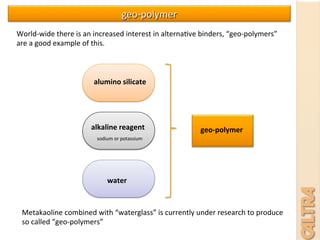
Metakaoline	
  combined	
  with	
  “waterglass”	
  is	
  currently	
  under	
  research	
  to	
  produce	
  
so	
  called	
  “geo-­‐polymers”	
  
sodium	
  or	
  potassium	
  
geo-­‐polymer	
  
World-­‐wide	
  there	
  is	
  an	
  increased	
  interest	
  in	
  alterna7ve	
  binders,	
  “geo-­‐polymers”	
  
are	
  a	
  good	
  example	
  of	
  this.	
  	
  
1.  introduc7on	
  
2.  produc7on	
  
3.  rheology	
  	
  
4.  Chapelle	
  test	
  
5.  advantages	
  
6.  Calcium-­‐sulpho	
  aluminate	
  cement	
  
7.  geo	
  polymer	
  
8.  conclusion	


Decora+ve	
  ,	
  durable	
  and	
  detailed	


Mortar	
  and	
  concrete	
  containing	
  metakaoline	
  proof	
  to	
  have	
  a	
  beser	
  durability.	
  	
  
The	
  consump7on	
  of	
  calcium	
  hydroxide	
  and	
  cement	
  alkalis	
  in	
  combina7on	
  with	
  the	
  
increased	
  density	
  give	
  beser	
  sulphate	
  resistance.	


It	
  further	
  reduces	
  the	
  risk	
  of	
  alkali-­‐silica	
  reac7on	
  and	
  so	
  called	
  “lime-­‐bloom”.	


In	
  decora7ve	
  mortars	
  and	
  concrete	
  colours	
  are	
  more	
  durable.	
  Increased	
  density	
  and	
  
reduced	
  alkali	
  prevent	
  water	
  to	
  migrate	
  lime	
  and	
  alkali	
  preven7ng	
  primary	
  and	
  
secondary	
  efflorescence.	


Addi7on	
  of	
  metakaoline	
  increases	
  the	
  fineness	
  of	
  the	
  binder.	
  Fine	
  details	
  are	
  
followed	
  beser	
  and	
  the	
  surface	
  quality	
  is	
  improved.	
  White	
  metakaoline	
  can	
  easily	
  
be	
  integrated	
  in	
  a	
  white	
  Portlandcement	
  matrix.	


Combining	
  metakaoline	
  with	
  calcium	
  hydroxide	
  allows	
  a	
  simple	
  produc7on	
  of	
  a	
  type	
  
of	
  hydraulic	
  lime	
  oven	
  used	
  as	
  replacement	
  of	
  Portlandcement	
  in	
  restoring	
  natural	
  
stone.	
  
conclusion	
  	
  
www.caltra.com

Metakaolin ecs final

  • 1.
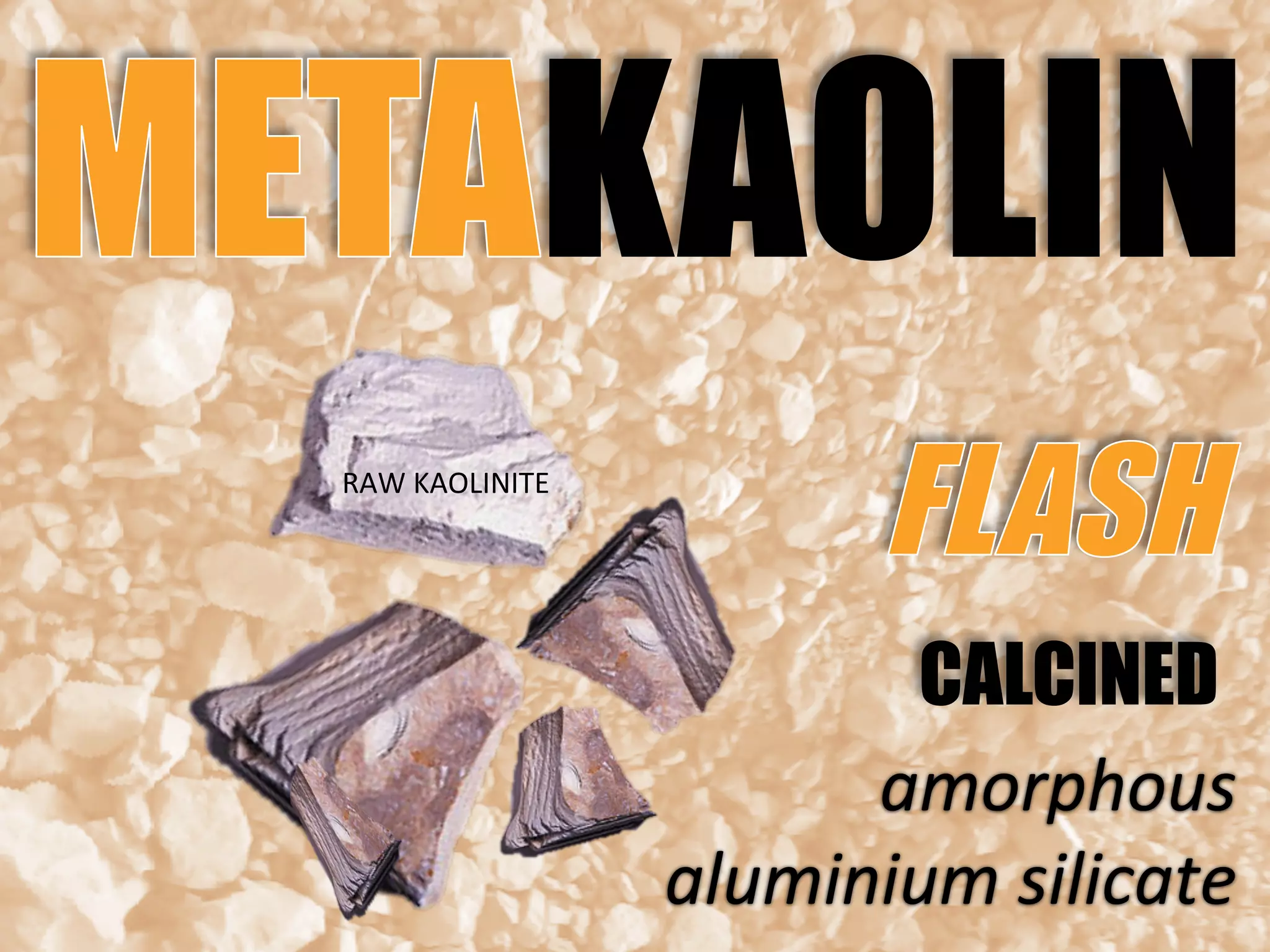
    RAW  KAOLINITE   KAOLIN CALCINED   amorphous   aluminium  silicate
  • 2.
    content   1.  introduc7on   2.  produc7on   3.  rheology     4.  Chapelle  test   5.  advantages   6.  Calcium-­‐sulpho  aluminate  cement   7.  geo  polymer   8.  conclusion        
  • 3.
    1.  introduc+on   2. produc7on   3.  rheology     4.  Chapelle  test   5.  Advantages   6.  Calcium-­‐sulpho  aluminate  cement   7.  geo  polymer   8.  conclusion        
  • 4.
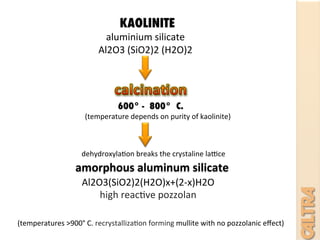
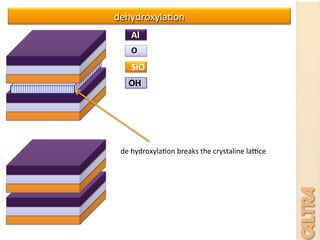
    KAOLINITE   aluminium  silicate   Al2O3  (SiO2)2  (H2O)2     amorphous  aluminum  silicate   600° - 800° C. dehydroxyla7on  breaks  the  crystaline  laQce            (temperature  depends  on  purity  of  kaolinite)   Al2O3(SiO2)2(H2O)x+(2-­‐x)H2O   high  reac7ve  pozzolan   (temperatures  >900°  C.  recrystalliza7on  forming  mullite  with  no  pozzolanic  effect)  
  • 5.
    Al   O   SiO   OH   de  hydroxyla7on  breaks  the  crystaline  laQce       dehydroxyla7on  
  • 6.
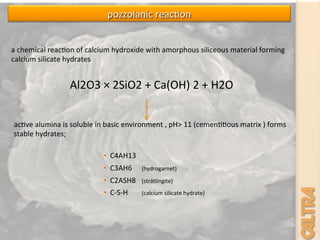
    Al2O3  ×  2SiO2  +  Ca(OH)  2  +  H2O   a  chemical  reac7on  of  calcium  hydroxide  with  amorphous  siliceous  material  forming   calcium  silicate  hydrates     pozzolanic  reac7on   ac7ve  alumina  is  soluble  in  basic  environment  ,  pH>  11  (cemen77ous  matrix  )  forms   stable  hydrates;           •     C4AH13     •     C3AH6    (hydrogarnet)     •     C2ASH8    (strätlingite)   •     C-­‐S-­‐H  (calcium  silicate  hydrate)        
  • 7.
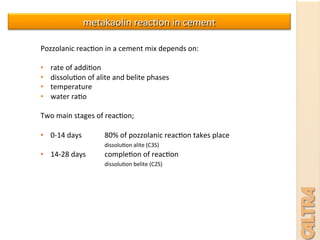
    metakaolin  reac7on  in  cement           Pozzolanic  reac7on  in  a  cement  mix  depends  on:       •  rate  of  addi7on   •  dissolu7on  of  alite  and  belite  phases   •  temperature     •  water  ra7o     Two  main  stages  of  reac7on;     •  0-­‐14  days  80%  of  pozzolanic  reac7on  takes  place        dissolu7on  alite  (C3S)     •  14-­‐28  days    comple7on  of  reac7on      dissolu7on  belite  (C2S)  
  • 8.
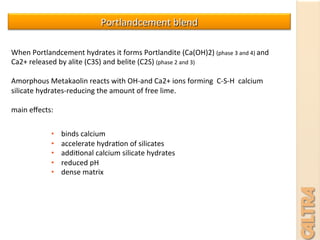
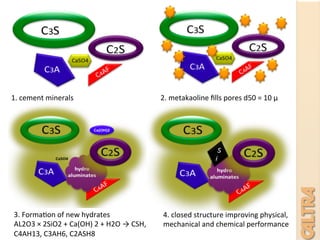
    Portlandcement  blend   When  Portlandcement  hydrates  it  forms  Portlandite  (Ca(OH)2)  (phase  3  and  4)  and   Ca2+  released  by  alite  (C3S)  and  belite  (C2S)  (phase  2  and  3)     Amorphous  Metakaolin  reacts  with  OH-­‐and  Ca2+  ions  forming    C-­‐S-­‐H    calcium   silicate  hydrates-­‐reducing  the  amount  of  free  lime.     main  effects:         •  binds  calcium     •  accelerate  hydra7on  of  silicates   •  addi7onal  calcium  silicate  hydrates   •  reduced  pH   •  dense  matrix  
  • 9.
    1.  cement  minerals   2.  metakaoline  fills  pores  d50  =  10  μ   3.  Forma7on  of  new  hydrates     AL2O3  ×  2SiO2  +  Ca(OH)  2  +  H2O  →  CSH,   C4AH13,  C3AH6,  C2ASH8   4.  closed  structure  improving  physical,   mechanical  and  chemical  performance  
  • 10.
    1.  introduc7on   2. produc+on   3.  rheology     4.  Chapelle  test   5.  advantages   6.  Calcium-­‐sulpho  aluminate  cement   7.  geo  polymer   8.  conclusion        
  • 11.
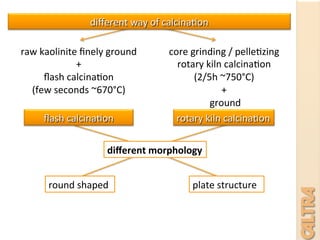
    rotary  kiln  calcina7on  flash  calcina7on   raw  kaolinite  finely  ground   +   flash  calcina7on     (few  seconds  ~670°C)   core  grinding  /  pelle7zing     rotary  kiln  calcina7on   (2/5h  ~750°C)   +    ground   plate  structure  round  shaped   different  morphology   different  way  of  calcina7on  
  • 12.
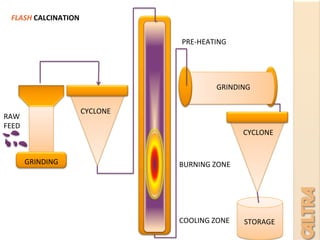
    CYCLONE   GRINDING       PRE-­‐HEATING   BURNING  ZONE   COOLING  ZONE   CYCLONE   GRINDING   RAW     FEED      STORAGE   FLASH  CALCINATION  
  • 13.
    average  composi7on   Al203        40~45  %   SiO2        30~55  %     small  amount  of  quarz  ,  feldspath   oxides:-­‐  iron  ,7tanium  ,potassium  ,phosphore  ,sodium  ,calcium  ,magnesia     LOI        <  2  %   Par7cle  size      <  45  μm   average  par7cle  size    5  μm     Blaine        >  12,000  gm2/g     large  surface  area  allows     density        2,6     shelf  live        indefini7ve     colour        pink  -­‐  white      
  • 14.
    FLASH  CALCINED   metakaoline  turns  to  round  beats  ,  versus  a  plate  structure  in  tradi7onal  produc7on  giving  beser   workability  at  lower  water  ra7o.                    1  μm                                                                    0,5    μm                                                                                                      0,5  μm                                                              0,5    μm                                                         kaolinite metakaolin flash  calcina+on  rotary  kiln    
  • 15.
    1.  introduc7on   2. produc7on   3.  rheology     4.  Chapelle  test   5.  advantages   6.  Calcium-­‐sulpho  aluminate  cement   7.  geo  polymer   8.  conclusion        
  • 16.
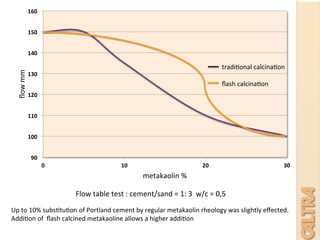
    90   100   110   120   130   140   150   160   0   10   20   30   flow  mm   metakaolin  %   Flow  table  test  :  cement/sand  =  1:  3    w/c  =  0,5       Up  to  10%  subs7tu7on  of  Portland  cement  by  regular  metakaolin  rheology  was  slightly  effected.   Addi7on  of    flash  calcined  metakaoline  allows  a  higher  addi7on       tradi7onal  calcina7on         flash  calcina7on      
  • 17.
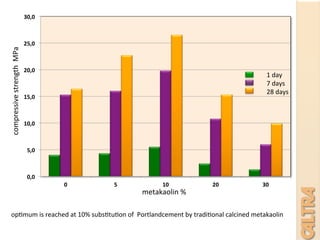
    0,0   5,0   10,0   15,0   20,0   25,0   30,0   0   5   10   20   30   compressive  strength    MPa   metakaolin  %   1  day     7  days     28  days   op7mum  is  reached  at  10%  subs7tu7on  of    Portlandcement  by  tradi7onal  calcined  metakaolin  
  • 18.
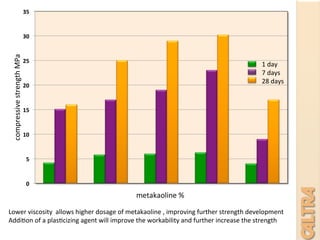
    Lower  viscosity    allows  higher  dosage  of  metakaoline  ,  improving  further  strength  development   Addi7on  of  a  plas7cizing  agent  will  improve  the  workability  and  further  increase  the  strength   0   5   10   15   20   25   30   35   compressive  strength  MPa   metakaoline  %   1  day     7  days     28  days  
  • 19.
    plas7cizing  agent   Because  of  its  fineness  (10  7mes  finer  than  Portlandcement!)   and  its  sponge  type  character,  the  addi7on  of  metakaoline  influences  the  rheology   of  the  blend       This  increase  in  viscosity  can  be  overcome  by  adding  a  plas7cizing-­‐  /  super   plas7cizing  agent         SeQng  7me  can  off  course  be  adjusted  by  addi7on  of  retarder      
  • 20.
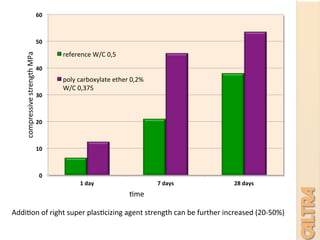
    0   10   20   30   40   50   60   1  day   7  days   28  days   compressive  strength  MPa   7me   reference  W/C  0,5   poly  carboxylate  ether  0,2%   W/C  0,375   Addi7on  of  right  super  plas7cizing  agent  strength  can  be  further  increased  (20-­‐50%)  
  • 21.
    1.  introduc7on   2. produc7on   3.  rheology     4.  Chapelle  test   5.  advantages   6.  Calcium-­‐sulpho  aluminate  cement   7.  geo  polymer   8.  conclusion        
  • 22.
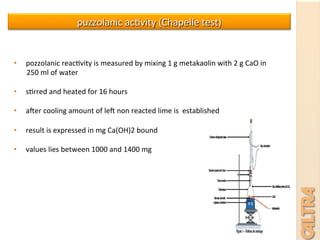
          puzzolanic  ac7vity  (Chapelle  test)   •  pozzolanic  reac7vity  is  measured  by  mixing  1  g  metakaolin  with  2  g  CaO  in                  250  ml  of  water   •  s7rred  and  heated  for  16  hours     •  aver  cooling  amount  of  lev  non  reacted  lime  is    established     •  result  is  expressed  in  mg  Ca(OH)2  bound   •  values  lies  between  1000  and  1400  mg            
  • 23.
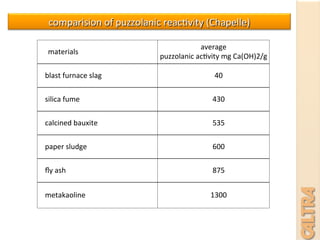
    comparision  of  puzzolanic  reac7vity  (Chapelle)   materials   average   puzzolanic  ac7vity  mg  Ca(OH)2/g          blast  furnace  slag   40          silica  fume   430          calcined  bauxite   535          paper  sludge   600          fly  ash   875          metakaoline   1300  
  • 24.
    1.  introduc7on   2. produc7on   3.  rheology     4.  Chapelle  test   5.  advantages   6.  Calcium-­‐sulpho  aluminate  cement   7.  geo  polymer   8.  conclusion        
  • 25.
    advantages   METAKAOLIN  in  combina7on  with  Portlandcement  forms  a  dense-­‐knit   structure  improving,  physical,  mechanical  and  chemical  proper7es.     •  accelera7on  of  ses  –  lime  gel  is  bounds  allowing  C3A  ,  C3S  to  dissolute  quickly   •  pH  is  reduced  giving  more  protec7on  to  glass  fibers  (GRC)   •  reduced  thermal  stress  slower  hardening  which  limits  shrinkage  and  cracking   •  increase  of  elas7c  modulus  (EMR)       •  new  hydrates  formed;  calcium  silicate,  strätlingite,  and  hydrogarnet     •  fewer  pores  and  smaller  pore  size-­‐reduc7on  of  efflorescence,  
  • 26.
    •  lower  water  uptake   •  less  energy  needed  versus  tradi7onal  method   •  tight    control  on  calcina7on   •  consistency  of  product   •  grinding  raw  kaolinite  first  contributes  to  round  structure  of  par7cles     •  contribu7ng  to  an  improved  workability   •  higher  amount  cement  subs7tu7on     •  higher  abrasive  resistance   •  improved  opacity   flash  calcina7on  
  • 27.
    1.  introduc7on   2. produc7on   3.  rheology     4.  Chapelle  test   5.  advantages   6.  Calcium-­‐Sulpho  Aluminate  cement   7.  geo  polymer   8.  conclusion        
  • 28.
    CSA-­‐cement   •  calcium  sulpho  aluminate  cement  relies  on  forma7on  of  ye’elimite  (C4A3Š)  it   takes  calcium  out  of  the  solu7on,  lowering  the  pH     •  low  pH  slows  down  the  dissolu7on  of  aluminium  silicates       •  belite  (C2S)  goes  into  solu7on  at  a  later  stage  of  hydra7on  at  this  stage  the   pozzolan  effect  is  reduced       •  an  excess  of  calcium  hydrates  form  a  gel  /layer  on  the  pozzolan  grain  "isola7ng”  it   to  go  solu7on  and  blocking  the  reac7on  kine7cs       when  CSA  cement  is  blended  with  Portlandcements  it  is  recommended  to  first  make   extensive  tests  to  establish  the  possible  pozzolan  effect  
  • 29.
    1.  introduc7on   2. produc7on   3.  rheology     4.  Chapelle  test   5.  advantages   6.  Calcium-­‐sulpho  aluminate  cement   7.  geo  polymer   8.  conclusion        
  • 30.
    alumino  silicate   alkaline  reagent   water   geo-­‐polymer   Metakaoline  combined  with  “waterglass”  is  currently  under  research  to  produce   so  called  “geo-­‐polymers”   sodium  or  potassium   geo-­‐polymer   World-­‐wide  there  is  an  increased  interest  in  alterna7ve  binders,  “geo-­‐polymers”   are  a  good  example  of  this.    
  • 31.
    1.  introduc7on   2. produc7on   3.  rheology     4.  Chapelle  test   5.  advantages   6.  Calcium-­‐sulpho  aluminate  cement   7.  geo  polymer   8.  conclusion        
  • 32.
    Decora+ve  ,  durable  and  detailed         Mortar  and  concrete  containing  metakaoline  proof  to  have  a  beser  durability.     The  consump7on  of  calcium  hydroxide  and  cement  alkalis  in  combina7on  with  the   increased  density  give  beser  sulphate  resistance.       It  further  reduces  the  risk  of  alkali-­‐silica  reac7on  and  so  called  “lime-­‐bloom”.     In  decora7ve  mortars  and  concrete  colours  are  more  durable.  Increased  density  and   reduced  alkali  prevent  water  to  migrate  lime  and  alkali  preven7ng  primary  and   secondary  efflorescence.     Addi7on  of  metakaoline  increases  the  fineness  of  the  binder.  Fine  details  are   followed  beser  and  the  surface  quality  is  improved.  White  metakaoline  can  easily   be  integrated  in  a  white  Portlandcement  matrix.     Combining  metakaoline  with  calcium  hydroxide  allows  a  simple  produc7on  of  a  type   of  hydraulic  lime  oven  used  as  replacement  of  Portlandcement  in  restoring  natural   stone.   conclusion    
  • 34.