Unit-II
ADMIXTURES
By,
J.JeyaSippriya
AP, Dept of Civil Engg
Syllabus
Mineral admixtures- Slags- Pozzolanas and
Fillers-Chemical Admixtures-Solutes
Retarders-Air Entraining Agents-Water
proofing compounds-Plasticizers and Super
Plasticizers
ADMIXTURES
Definition:
A material other than water, aggregates, or
cement that is used as an ingredient of concrete
or mortar to control setting and early hardening,
workability, or to provide additional cementing
properties.
Types
• Chemical Admixtures
• Mineral Admixtures
Chemical Admixtures
• Accelerators
• Retarders
• Air entraining agents etc.
• Water-reducing agents
• Plasticizers
• Super Plasticizers
Mineral Admixtures
• Slag
• Pozzolana
Chemical Admixtures in
Concrete
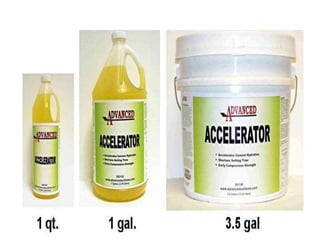
Accelerators
• An admixture which, when added to concrete,
mortar, increases the rate of hydration of
hydraulic cement, increases the rate of
hardening or strength development
Retarders
• The function of retarder is to delay or extend
the setting time of cement paste in concrete.
These are helpful for concrete that has to be
transported to long distance, and helpful in
placing the concrete at high temperatures.
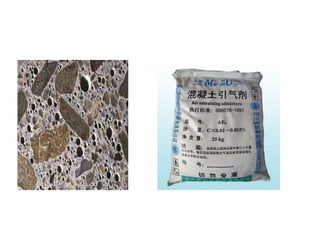
Air-entraining admixtures
• Air-entraining admixtures are surfactants that
change the surface tension . Air entrainment is
used to produce a number of effects in both the
plastic and the hardened concrete. These include:
• Resistance to freeze – thaw action in the
hardened concrete.
• Increased cohesion, reducing the tendency to
bleed and segregation in the plastic concrete.
Plasticizers
These admixtures are used for following
purposes:
• To achieve the same workability by decreasing
the cement content so as to reduce the heat
of hydration in mass concrete.
• To increase the workability so as to ease
placing in accessible locations
• Water reduction more than 5% but less than
12%
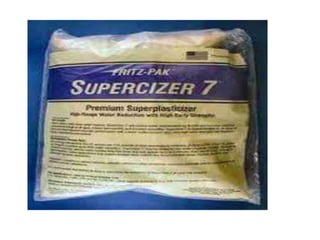
Super Plasticizers
• These are more recent and more effective
type of water reducing admixtures also
known as high range water reducer.
Mineral Admixtures in
Concrete
Slag
• Ground granulated blast-furnace slag is
the granular material formed when molten
iron blast furnace slag (a by-product of iron
and steel making) is rapidly chilled (quenched)
by immersion in water. It is a granular
product, highly cementitious in nature and,
ground to cement fineness, hydrates like
Portland cement.
Pozzolanas
• A pozzolanas is a material which, when combined with
calcium hydroxide (lime), exhibits cementitious
properties.Pozzolanas are commonly used as an
addition (the technical term is "cement extender") to
Portland cement concrete mixtures to increase the
long-term strength and other material properties of
Portland cement concrete and in some cases reduce
the material cost of concrete. Examples are:
 Fly ash
 Silica Fume
 Rice Husk Ash
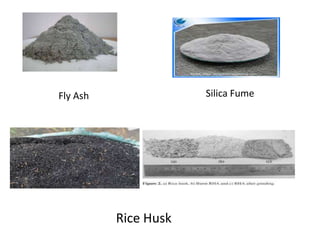
Fly Ash Silica Fume
Rice Husk
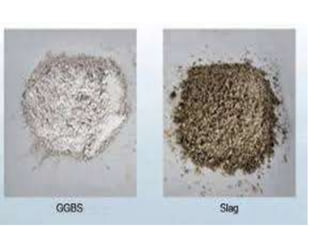
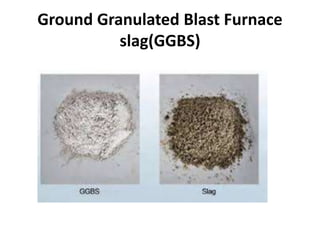
Ground Granulated Blast Furnace
slag(GGBS)
Ground Granulated Blast Furnace
slag(GGBS)
• Ground granulated blast-furnace slag is a non
metallic product consisting essentially of
silicates and aluminates of calcium and other
bases.
• The molten slag is rapidly chilled by quenching
in water to form a glassy sand like granulated
material.
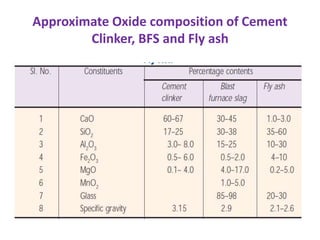
Approximate Oxide composition of Cement
Clinker, BFS and Fly ash
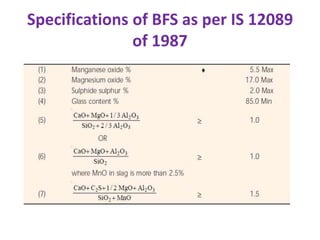
Specifications of BFS as per IS 12089
of 1987
Performance of GGBS in Concrete
Fresh Concrete:
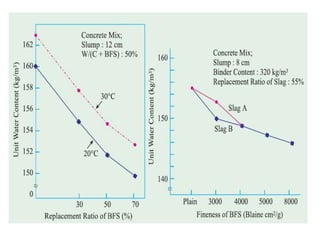
• The replacement of cement with GGBS will
reduce the unit water content necessary to
obtain the same slump.
• This reduction of unit water content will be
more pronounced with increase in slag
content and also on the fineness of slag.
Performance of GGBS in Concrete
Hardened Concrete
• Reduced heat of hydration
• Refinement of pore structures
• Reduced permeabilities to the external
agencies
• Increased resistance to chemical attack.
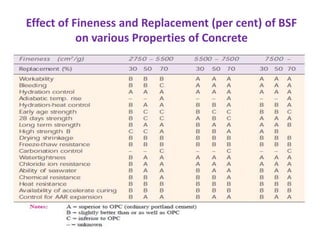
Effect of Fineness and Replacement (per cent) of BSF
on various Properties of Concrete
Inference
• Blast furnace slag, although is an industrial by-product,
exhibits good cementitious properties with little
further processing.
• It permits very high replacement of cement and
extends many advantages over conventional cement
concrete.
• At present in India, it is used for blended cement,
rather than as cement admixture.
Pozzolanic admixtures
• Pozzolana+ Calcium Hydroxide + Water → C – S – H (Gel)
This reaction is called pozzolanic reaction.
• The characteristic feature of pozzolanic reaction is firstly slow,
with the result that heat of hydration and strength
development will be accordingly slow.
• The reaction involves the consumption of Ca(OH)2 and not
production of Ca(OH)2. The reduction of Ca(OH)2 improves
the durability of cement paste by making the paste dense and
impervious.
Types
• Natural Pozzolans
Clay and Shales
Opalinc Cherts
Diatomaceous Earth
Volcanic Tuffs and Pumicites.
Artificial Pozzolans
Fly ash
 Blast Furnace Slag
 Silica Fume
 Rice Husk ash
 Metakaoline
 Surkhi.
Artificial Pozzolans
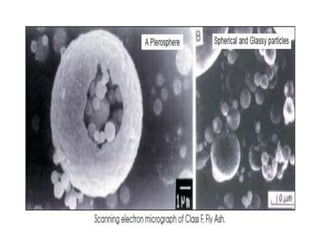
Fly Ash
• Fly ash is finely divided residue resulting from
the combustion of powdered coal and
transported by the flue gases and collected by
electrostatic precipitator.
• Fly ash is the most widely used pozzolanic
material all over the world.
ASTM broadly classify fly ash into two classes
• Class F: Fly ash normally produced by burning
anthracite or bituminous coal, usually has less than
5% CaO. Class F fly ash has pozzolanic properties
only.
• Class C: Fly ash normally produced by burning lignite
or sub-bituminous coal. Some class C fly ash may
have CaO content in excess of 10%. In addition to
pozzolanic properties, class C fly ash also possesses
cementitious properties.
Effect of Fly Ash on Fresh Concrete
• Use of right quality fly ash, results in reduction
of water demand for desired slump.
• With the reduction of unit water content,
bleeding and drying shrinkage will also
be reduced.
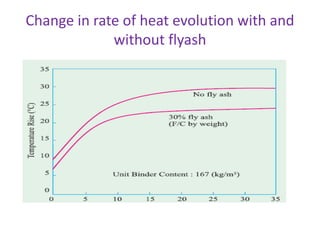
Change in rate of heat evolution with and
without flyash
Effect of Fly Ash on Hardened
Concrete
• Due to continued pozzolanic reactivity
concrete develops greater strength at later
age.
• It should be noted that since pozzolanic
reaction can only proceed in the presence of
water enough moisture should be available for
long time.
• Therefore, fly ash concrete should be cured
for longer period.
Inference
• It may be said that although fly ash is an
industrial waste, its use in concrete
significantly improve the long term strength
and durability and reduce heat of hydration.
• In other words good fly ash will be an
indispensable mineral admixture for high
performance concrete.
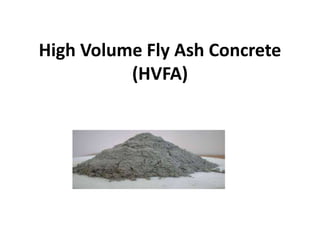
High Volume Fly Ash Concrete
(HVFA)
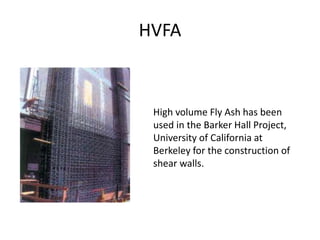
HVFA
High volume Fly Ash has been
used in the Barker Hall Project,
University of California at
Berkeley for the construction of
shear walls.
HVFA
• High volume fly ash concrete is a concrete where in
50 to 60% fly ash is incorporated.
• It was first developed for mass concrete application
where low heat of hydration was of primary
consideration.
• Subsequent work has demonstrated that this type of
concrete showed excellent mechanical and durability
properties required for structural applications and
pavement constructions.
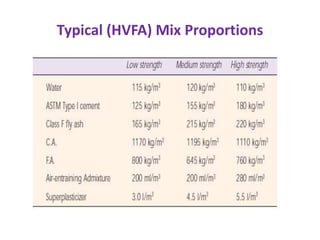
Typical (HVFA) Mix Proportions
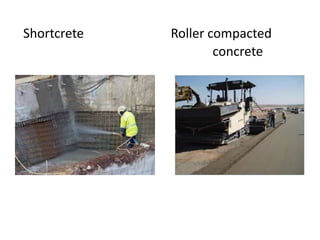
Shortcrete Roller compacted
concrete
Properties of (HVFA) Fresh Concrete
• Bleeding and Setting Time.
• Heat of Hydration.
• Mechanical Properties of (HVFA) Concrete
• Curing of (HVFA) Concrete
• Durability of (HVFA) Concrete
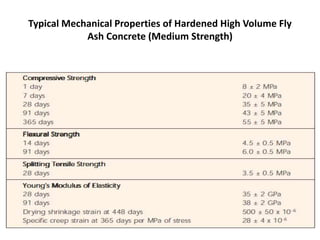
Typical Mechanical Properties of Hardened High Volume Fly
Ash Concrete (Medium Strength)
Inference
• High volume fly ash has been used in many
high rise buildings, industrial structures, water
front structures, concrete roads and Roller
compacted concrete dams.
• There is high potential for this material on
account of sound economy and usefulness to
absorb large quantity of under utilised
otherwise harmful waste material.
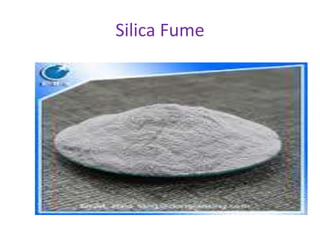
Silica Fume
• Silica fume, also referred to as microsilica or
condensed silica fume, is another material
that is used as an artificial pozzolanic
admixture.
• It is a product resulting from reduction of
high purity quartz with coal in an electric arc
furnace in the manufacture of silicon or
ferrosilicon alloy.
Silica Fume
Available forms
• Microsilica is available in the following forms:
• Undensified forms with bulk density of 200–300
kg/m3
• Densified forms with bulk density of 500–600 kg/m3
• Micro-pelletised forms with bulk density of 600–800
kg/m3
• Slurry forms with density 1400 kg/m3.
Pozzolanic Action
• Microsilica is much more reactive than fly ash or any
other natural pozzolana.
• The reactivity of a pozzolana can be quantified by
measuring the amount of Ca(OH)2 in the cement
paste at different times.
Influence on Fresh Concrete
• Water demand increases in proportion to the
amount of microsilica added.
• Measures can be taken to avoid this increase
by adjusting the aggregate grading and using
super plasticizers.
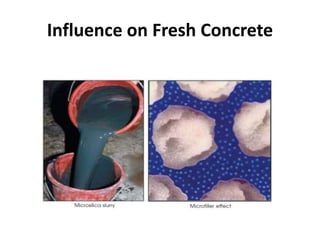
• The addition of microsilica will lead to lower
slump but more cohesive mix. The microsilica
make the fresh concrete sticky in nature and
hard to handle.
Influence on Fresh Concrete
Influence on Hardened Concrete
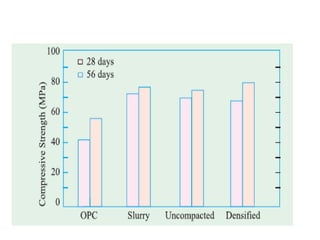
• Concrete containing microsilica showed
outstanding characteristics in the
development of strength.
• Fig. shows that 60 to 80 MPa can be obtained
relatively easily. It has been also found out
that modulus of elasticity of microsilica
concrete is less than that of concrete without
microsilica at the same level of compressive
strength.
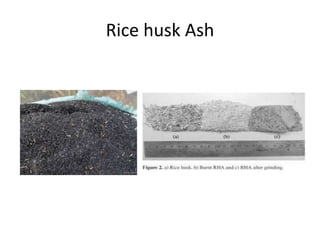
Rice Husk Ash
• Rice husk ash, is obtained by burning rice husk
in a controlled manner without causing
environmental pollution.
• When properly burnt it has high SiO2 content
and can be used as a concrete admixture.
• Rice husk ash exhibits high pozzolanic
characteristics and contributes to high
strength and high impermeability of concrete.
Composition
• Rice husk ash (RHA) essentially consist of
amorphous silica (90% SiO2)
• 5% carbon, and 2% K2O.
• The specific surface of RHA is between 40 –
100 m2/g.
Rice husk Ash
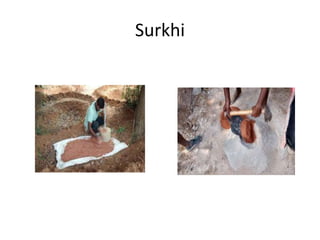
Surkhi
• Surkhi is an artificial pozzolana made by
powdering bricks or burnt clay balls. In some
major works, for large scale production of
surkhi, clay balls are specially burnt for this
purpose and then powdered.
Surkhi
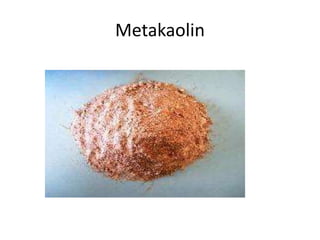
Metakaolin
• Considerable research has been done on
natural pozzolans, namely on thermally
activated ordinary clay and kaolinitic clay.
These unpurified materials have often been
called “Metakaolin”.
• High reactive metakaolin shows high
pozzolanic activity and reduction of Ca(OH)2
even as early as one day.
Metakaolin
Chemical
Admixtures
Chemical Admixtures
• Accelerators
• Retarders
• Air entraining agents
• Plasticizers
• Super Plasticizers
Air entraining agents
• Air entrained concrete is made by mixing a small quantity of
air entraining agent or by using air entraining cement.
• These air entraining agents incorporate millions of non-
coalescing air bubbles, which will act as flexible ball bearings
and will modify the properties of plastic concrete regarding
workability, segregation, bleeding and finishing quality of
concrete.
Air Entraining agents
• The following types of air entraining agents are used for
making air entrained concrete.
( a ) Natural wood resins
( b ) Animal and vegetable fats and oils, such as tallow, olive oil
and their fatty acids such as stearic and oleic acids.
( c ) Various wetting agents such as alkali salts or sulphated
and sulphonated organic compounds.
( d ) Water soluble soaps of resin acids, and animal and
vegetable fatty acids.
( e ) Miscellaneous materials such as the sodium salts of
petroleum sulphonic acids, hydrogen peroxide and
aluminium powder, etc.
Factors affecting amount of
entrainment
(a ) The type and quantity of air entraining agent
used.
(b) Water/cement ratio of the mix.
(c ) Type and grading of aggregate.
(d) Mixing time.
(e) The temperature.
(f ) Type of cement.
(g) Influence of compaction.
(h) Admixtures other than air entraining agent used
The Effect of Air Entrainment on the
Properties of Concrete
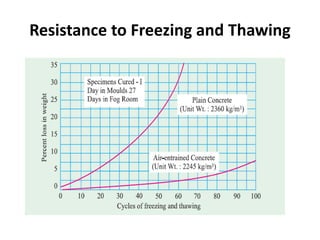
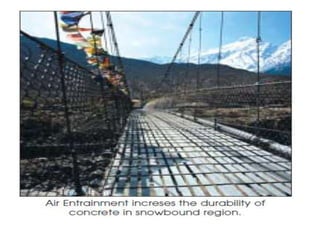
(a) Increased resistance to freezing and thawing.
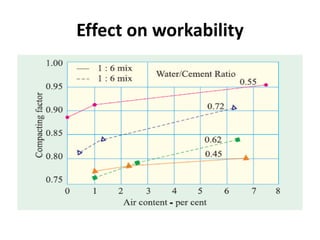
(b) Improvement in workability.
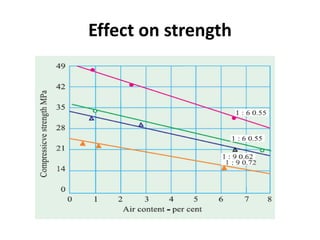
(c) Reduction in strength.
Resistance to Freezing and Thawing
Effect on workability
Effect on strength
Effect on Segregation, Bleeding
and Laitance
Other Properties
• Effect on Permeability
• Effect on Chemical Resistance
• Effect on sand, water and cement content
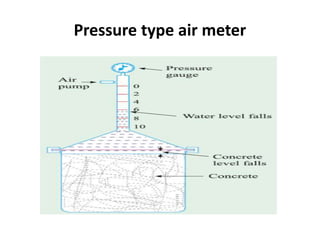
Measurement of Air content in Air
Entrained concrete
(a) Gravimetric method
(b) Volumetric method
(c) Pressure method
Pressure type air meter
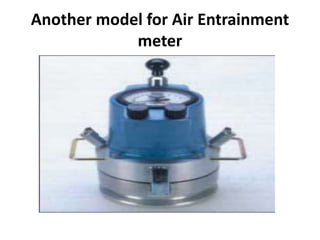
Another model for Air Entrainment
meter
Plasticizers(Water Reducers)
These admixtures are used for following
purposes:
• To achieve the same workability by decreasing
the cement content so as to reduce the heat
of hydration in mass concrete.
• To increase the workability so as to ease
placing in accessible locations
• Water reduction more than 5% but less than
12%
Many research workers explained that one or more of the
following mechanisms may take place simultaneously:
•Reduction in the surface tension of water.
•Lubricating film between cement particles. Dispersion of
cement grains, releasing water trapped within cement.
•Inhibition of the surface hydration reaction of the cement
particles, leaving more
•water to fluidify the mix.
•Change in the morphology of the hydration products.
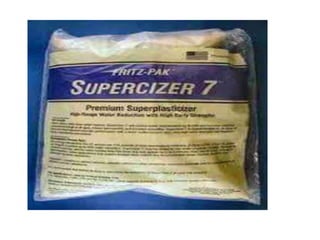
Super Plasticizers
• These are more recent and more effective
type of water reducing admixtures also known
as high range water reducer.
s

Admixtures

  • 1.
  • 2.
    Syllabus Mineral admixtures- Slags-Pozzolanas and Fillers-Chemical Admixtures-Solutes Retarders-Air Entraining Agents-Water proofing compounds-Plasticizers and Super Plasticizers
  • 3.
    ADMIXTURES Definition: A material otherthan water, aggregates, or cement that is used as an ingredient of concrete or mortar to control setting and early hardening, workability, or to provide additional cementing properties.
  • 4.
  • 5.
    Chemical Admixtures • Accelerators •Retarders • Air entraining agents etc. • Water-reducing agents • Plasticizers • Super Plasticizers
  • 6.
  • 7.
  • 8.
    Accelerators • An admixturewhich, when added to concrete, mortar, increases the rate of hydration of hydraulic cement, increases the rate of hardening or strength development
  • 10.
    Retarders • The functionof retarder is to delay or extend the setting time of cement paste in concrete. These are helpful for concrete that has to be transported to long distance, and helpful in placing the concrete at high temperatures.
  • 11.
    Air-entraining admixtures • Air-entrainingadmixtures are surfactants that change the surface tension . Air entrainment is used to produce a number of effects in both the plastic and the hardened concrete. These include: • Resistance to freeze – thaw action in the hardened concrete. • Increased cohesion, reducing the tendency to bleed and segregation in the plastic concrete.
  • 14.
    Plasticizers These admixtures areused for following purposes: • To achieve the same workability by decreasing the cement content so as to reduce the heat of hydration in mass concrete. • To increase the workability so as to ease placing in accessible locations • Water reduction more than 5% but less than 12%
  • 16.
    Super Plasticizers • Theseare more recent and more effective type of water reducing admixtures also known as high range water reducer.
  • 18.
  • 19.
    Slag • Ground granulatedblast-furnace slag is the granular material formed when molten iron blast furnace slag (a by-product of iron and steel making) is rapidly chilled (quenched) by immersion in water. It is a granular product, highly cementitious in nature and, ground to cement fineness, hydrates like Portland cement.
  • 21.
    Pozzolanas • A pozzolanasis a material which, when combined with calcium hydroxide (lime), exhibits cementitious properties.Pozzolanas are commonly used as an addition (the technical term is "cement extender") to Portland cement concrete mixtures to increase the long-term strength and other material properties of Portland cement concrete and in some cases reduce the material cost of concrete. Examples are:  Fly ash  Silica Fume  Rice Husk Ash
  • 22.
    Fly Ash SilicaFume Rice Husk
  • 23.
    Ground Granulated BlastFurnace slag(GGBS)
  • 24.
    Ground Granulated BlastFurnace slag(GGBS) • Ground granulated blast-furnace slag is a non metallic product consisting essentially of silicates and aluminates of calcium and other bases. • The molten slag is rapidly chilled by quenching in water to form a glassy sand like granulated material.
  • 25.
    Approximate Oxide compositionof Cement Clinker, BFS and Fly ash
  • 26.
    Specifications of BFSas per IS 12089 of 1987
  • 27.
    Performance of GGBSin Concrete Fresh Concrete: • The replacement of cement with GGBS will reduce the unit water content necessary to obtain the same slump. • This reduction of unit water content will be more pronounced with increase in slag content and also on the fineness of slag.
  • 28.
    Performance of GGBSin Concrete Hardened Concrete • Reduced heat of hydration • Refinement of pore structures • Reduced permeabilities to the external agencies • Increased resistance to chemical attack.
  • 30.
    Effect of Finenessand Replacement (per cent) of BSF on various Properties of Concrete
  • 31.
    Inference • Blast furnaceslag, although is an industrial by-product, exhibits good cementitious properties with little further processing. • It permits very high replacement of cement and extends many advantages over conventional cement concrete. • At present in India, it is used for blended cement, rather than as cement admixture.
  • 32.
    Pozzolanic admixtures • Pozzolana+Calcium Hydroxide + Water → C – S – H (Gel) This reaction is called pozzolanic reaction. • The characteristic feature of pozzolanic reaction is firstly slow, with the result that heat of hydration and strength development will be accordingly slow. • The reaction involves the consumption of Ca(OH)2 and not production of Ca(OH)2. The reduction of Ca(OH)2 improves the durability of cement paste by making the paste dense and impervious.
  • 33.
    Types • Natural Pozzolans Clayand Shales Opalinc Cherts Diatomaceous Earth Volcanic Tuffs and Pumicites.
  • 34.
    Artificial Pozzolans Fly ash Blast Furnace Slag  Silica Fume  Rice Husk ash  Metakaoline  Surkhi.
  • 35.
    Artificial Pozzolans Fly Ash •Fly ash is finely divided residue resulting from the combustion of powdered coal and transported by the flue gases and collected by electrostatic precipitator. • Fly ash is the most widely used pozzolanic material all over the world.
  • 37.
    ASTM broadly classifyfly ash into two classes • Class F: Fly ash normally produced by burning anthracite or bituminous coal, usually has less than 5% CaO. Class F fly ash has pozzolanic properties only. • Class C: Fly ash normally produced by burning lignite or sub-bituminous coal. Some class C fly ash may have CaO content in excess of 10%. In addition to pozzolanic properties, class C fly ash also possesses cementitious properties.
  • 38.
    Effect of FlyAsh on Fresh Concrete • Use of right quality fly ash, results in reduction of water demand for desired slump. • With the reduction of unit water content, bleeding and drying shrinkage will also be reduced.
  • 39.
    Change in rateof heat evolution with and without flyash
  • 40.
    Effect of FlyAsh on Hardened Concrete • Due to continued pozzolanic reactivity concrete develops greater strength at later age. • It should be noted that since pozzolanic reaction can only proceed in the presence of water enough moisture should be available for long time. • Therefore, fly ash concrete should be cured for longer period.
  • 41.
    Inference • It maybe said that although fly ash is an industrial waste, its use in concrete significantly improve the long term strength and durability and reduce heat of hydration. • In other words good fly ash will be an indispensable mineral admixture for high performance concrete.
  • 42.
    High Volume FlyAsh Concrete (HVFA)
  • 43.
    HVFA High volume FlyAsh has been used in the Barker Hall Project, University of California at Berkeley for the construction of shear walls.
  • 44.
    HVFA • High volumefly ash concrete is a concrete where in 50 to 60% fly ash is incorporated. • It was first developed for mass concrete application where low heat of hydration was of primary consideration. • Subsequent work has demonstrated that this type of concrete showed excellent mechanical and durability properties required for structural applications and pavement constructions.
  • 45.
    Typical (HVFA) MixProportions
  • 46.
  • 47.
    Properties of (HVFA)Fresh Concrete • Bleeding and Setting Time. • Heat of Hydration. • Mechanical Properties of (HVFA) Concrete • Curing of (HVFA) Concrete • Durability of (HVFA) Concrete
  • 48.
    Typical Mechanical Propertiesof Hardened High Volume Fly Ash Concrete (Medium Strength)
  • 49.
    Inference • High volumefly ash has been used in many high rise buildings, industrial structures, water front structures, concrete roads and Roller compacted concrete dams. • There is high potential for this material on account of sound economy and usefulness to absorb large quantity of under utilised otherwise harmful waste material.
  • 50.
    Silica Fume • Silicafume, also referred to as microsilica or condensed silica fume, is another material that is used as an artificial pozzolanic admixture. • It is a product resulting from reduction of high purity quartz with coal in an electric arc furnace in the manufacture of silicon or ferrosilicon alloy.
  • 51.
  • 52.
    Available forms • Microsilicais available in the following forms: • Undensified forms with bulk density of 200–300 kg/m3 • Densified forms with bulk density of 500–600 kg/m3 • Micro-pelletised forms with bulk density of 600–800 kg/m3 • Slurry forms with density 1400 kg/m3.
  • 53.
    Pozzolanic Action • Microsilicais much more reactive than fly ash or any other natural pozzolana. • The reactivity of a pozzolana can be quantified by measuring the amount of Ca(OH)2 in the cement paste at different times.
  • 54.
    Influence on FreshConcrete • Water demand increases in proportion to the amount of microsilica added. • Measures can be taken to avoid this increase by adjusting the aggregate grading and using super plasticizers. • The addition of microsilica will lead to lower slump but more cohesive mix. The microsilica make the fresh concrete sticky in nature and hard to handle.
  • 55.
  • 56.
    Influence on HardenedConcrete • Concrete containing microsilica showed outstanding characteristics in the development of strength. • Fig. shows that 60 to 80 MPa can be obtained relatively easily. It has been also found out that modulus of elasticity of microsilica concrete is less than that of concrete without microsilica at the same level of compressive strength.
  • 58.
    Rice Husk Ash •Rice husk ash, is obtained by burning rice husk in a controlled manner without causing environmental pollution. • When properly burnt it has high SiO2 content and can be used as a concrete admixture. • Rice husk ash exhibits high pozzolanic characteristics and contributes to high strength and high impermeability of concrete.
  • 59.
    Composition • Rice huskash (RHA) essentially consist of amorphous silica (90% SiO2) • 5% carbon, and 2% K2O. • The specific surface of RHA is between 40 – 100 m2/g.
  • 60.
  • 61.
    Surkhi • Surkhi isan artificial pozzolana made by powdering bricks or burnt clay balls. In some major works, for large scale production of surkhi, clay balls are specially burnt for this purpose and then powdered.
  • 62.
  • 63.
    Metakaolin • Considerable researchhas been done on natural pozzolans, namely on thermally activated ordinary clay and kaolinitic clay. These unpurified materials have often been called “Metakaolin”. • High reactive metakaolin shows high pozzolanic activity and reduction of Ca(OH)2 even as early as one day.
  • 64.
  • 65.
  • 66.
    Chemical Admixtures • Accelerators •Retarders • Air entraining agents • Plasticizers • Super Plasticizers
  • 67.
    Air entraining agents •Air entrained concrete is made by mixing a small quantity of air entraining agent or by using air entraining cement. • These air entraining agents incorporate millions of non- coalescing air bubbles, which will act as flexible ball bearings and will modify the properties of plastic concrete regarding workability, segregation, bleeding and finishing quality of concrete.
  • 68.
    Air Entraining agents •The following types of air entraining agents are used for making air entrained concrete. ( a ) Natural wood resins ( b ) Animal and vegetable fats and oils, such as tallow, olive oil and their fatty acids such as stearic and oleic acids. ( c ) Various wetting agents such as alkali salts or sulphated and sulphonated organic compounds. ( d ) Water soluble soaps of resin acids, and animal and vegetable fatty acids. ( e ) Miscellaneous materials such as the sodium salts of petroleum sulphonic acids, hydrogen peroxide and aluminium powder, etc.
  • 69.
    Factors affecting amountof entrainment (a ) The type and quantity of air entraining agent used. (b) Water/cement ratio of the mix. (c ) Type and grading of aggregate. (d) Mixing time. (e) The temperature. (f ) Type of cement. (g) Influence of compaction. (h) Admixtures other than air entraining agent used
  • 70.
    The Effect ofAir Entrainment on the Properties of Concrete (a) Increased resistance to freezing and thawing. (b) Improvement in workability. (c) Reduction in strength.
  • 71.
  • 73.
  • 74.
  • 75.
    Effect on Segregation,Bleeding and Laitance
  • 76.
    Other Properties • Effecton Permeability • Effect on Chemical Resistance • Effect on sand, water and cement content
  • 77.
    Measurement of Aircontent in Air Entrained concrete (a) Gravimetric method (b) Volumetric method (c) Pressure method
  • 78.
  • 79.
    Another model forAir Entrainment meter
  • 80.
    Plasticizers(Water Reducers) These admixturesare used for following purposes: • To achieve the same workability by decreasing the cement content so as to reduce the heat of hydration in mass concrete. • To increase the workability so as to ease placing in accessible locations • Water reduction more than 5% but less than 12%
  • 81.
    Many research workersexplained that one or more of the following mechanisms may take place simultaneously: •Reduction in the surface tension of water. •Lubricating film between cement particles. Dispersion of cement grains, releasing water trapped within cement. •Inhibition of the surface hydration reaction of the cement particles, leaving more •water to fluidify the mix. •Change in the morphology of the hydration products.
  • 82.
    Super Plasticizers • Theseare more recent and more effective type of water reducing admixtures also known as high range water reducer.
  • 84.