Economic Policy
Laissez-Faire
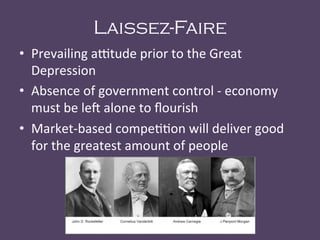
•  Prevailing	
  a+tude	
  prior	
  to	
  the	
  Great	
  
Depression	
  
•  Absence	
  of	
  government	
  control	
  -­‐	
  economy	
  
must	
  be	
  le<	
  alone	
  to	
  flourish	
  
•  Market-­‐based	
  compe@@on	
  will	
  deliver	
  good	
  
for	
  the	
  greatest	
  amount	
  of	
  people	
  	
  
Great Depression
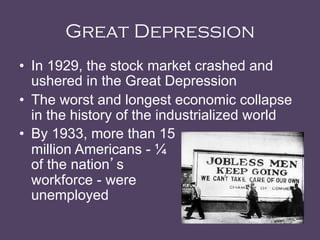
•  In 1929, the stock market crashed and
ushered in the Great Depression
•  The worst and longest economic collapse
in the history of the industrialized world
•  By 1933, more than 15
million Americans - ¼
of the nation’s
workforce - were
unemployed	
  
John Maynard Keynes
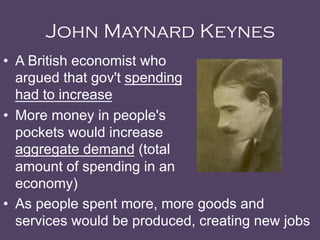
•  A British economist who
argued that gov't spending
had to increase
•  More money in people's
pockets would increase
aggregate demand (total
amount of spending in an
economy)
•  As people spent more, more goods and
services would be produced, creating new jobs
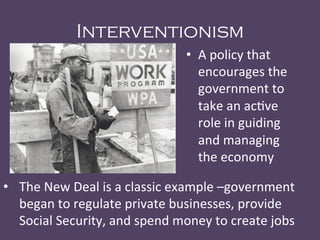
Interventionism
•  A	
  policy	
  that	
  
encourages	
  the	
  
government	
  to	
  
take	
  an	
  ac@ve	
  
role	
  in	
  guiding	
  
and	
  managing	
  
the	
  economy	
  
•  The	
  New	
  Deal	
  is	
  a	
  classic	
  example	
  –government	
  
began	
  to	
  regulate	
  private	
  businesses,	
  provide	
  
Social	
  Security,	
  and	
  spend	
  money	
  to	
  create	
  jobs	


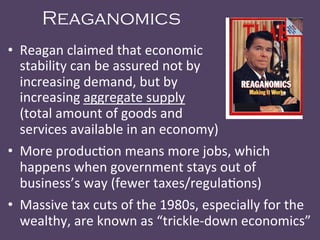
Reaganomics
•  Reagan	
  claimed	
  that	
  economic	


stability	
  can	
  be	
  assured	
  not	
  by	


increasing	
  demand,	
  but	
  by	


increasing	
  aggregate	
  supply	


(total	
  amount	
  of	
  goods	
  and	


services	
  available	
  in	
  an	
  economy)	
  
•  More	
  produc@on	
  means	
  more	
  jobs,	
  which	
  
happens	
  when	
  government	
  stays	
  out	
  of	
  
business’s	
  way	
  (fewer	
  taxes/regula@ons)	
  
•  Massive	
  tax	
  cuts	
  of	
  the	
  1980s,	
  especially	
  for	
  the	
  
wealthy,	
  are	
  known	
  as	
  “trickle-­‐down	
  economics”	
  
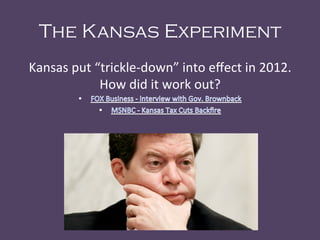
The Kansas Experiment
Kansas	
  put	
  “trickle-­‐down”	
  into	
  effect	
  in	
  2012.	
  	
  
How	
  did	
  it	
  work	
  out?	


Economic Stability
•  Economic	
  Stability:	
  a	
  situa@on	
  in	
  which	
  there	
  is	
  
economic	
  growth,	
  rising	
  na@onal	
  income,	
  high	
  
employment,	
  and	
  steadiness	
  in	
  the	
  general	
  level	
  of	
  
prices	
  
•  Economic	
  Instability:	
  	
  
– Infla@on:	
  a	
  rise	
  in	
  the	
  general	
  price	


levels	
  of	
  an	
  economy	
  
	
  OR	
  
– Recession:	
  a	
  short-­‐term	
  decline	
  in	
  the	
  economy	
  that	
  
occurs	
  as	
  investment	
  sags,	
  produc@on	
  falls	
  off	
  and	
  
unemployment	
  increases	
  
Monetary Policy
•  Used	
  by	
  Federal	
  Reserve	
  Board	
  (“Fed”)	
  -­‐	
  central	
  
bank	
  of	
  the	
  U.S.	
  
•  Monetary	
  Policy	
  involves	
  changes	
  in:	
  	
  
– interest	
  rates	
  (amount	
  paid	
  to	
  borrow	
  money)	
  	
  
– and	
  money	
  supply	
  (the	
  amount	
  of	
  dollars	
  circula@ng	
  in	
  
the	
  economy)	
  
– In	
  general:	
  
•  Lowering	
  interest	
  rates	
  and	
  increasing	
  the	
  money	
  
supply	
  will	
  increase	
  aggregate	
  demand	
  (to	
  expand	
  
economy)	
  
•  Raising	
  interest	
  rates	
  and	
  decreasing	
  the	
  money	
  
supply	
  will	
  decrease	
  aggregate	
  demand	
  (to	
  contract	
  
economy)	
  
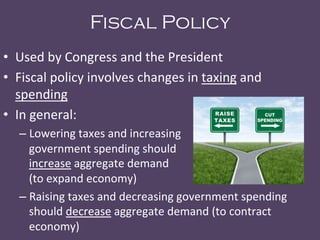
Fiscal Policy
•  Used	
  by	
  Congress	
  and	
  the	
  President	
  
•  Fiscal	
  policy	
  involves	
  changes	
  in	
  taxing	
  and	
  
spending	
  	
  
•  In	
  general:	
  
– Lowering	
  taxes	
  and	
  increasing	


government	
  spending	
  should	


increase	
  aggregate	
  demand	


(to	
  expand	
  economy)	
  
– Raising	
  taxes	
  and	
  decreasing	
  government	
  spending	
  
should	
  decrease	
  aggregate	
  demand	
  (to	
  contract	
  
economy)	
  
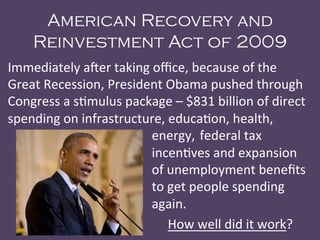
American Recovery and
Reinvestment Act of 2009
Immediately	
  a<er	
  taking	
  office,	
  because	
  of	
  the	
  
Great	
  Recession,	
  President	
  Obama	
  pushed	
  through	
  
Congress	
  a	
  s@mulus	
  package	
  –	
  $831	
  billion	
  of	
  direct	
  
spending	
  on	
  infrastructure,	
  educa@on,	
  health,	


  energy,	
  federal	
  tax	


  incen@ves	
  and	
  expansion	


  of	
  unemployment	
  benefits	


  to	
  get	
  people	
  spending	


  again.	


  How	
  well	
  did	
  it	
  work?	
  
Federal Budget - Revenues
•  Federal	
  government:	
  
– individual	
  income	
  taxes	
  and	
  Social	
  Security	
  taxes	
  
make	
  up	
  over	
  80%	
  of	
  revenue	
  
– corporate	
  income	
  taxes	
  
– capital	
  gains	
  taxes	
  –	
  on	
  investments	
  
– tariffs	
  –	
  on	
  imports	
  
•  State	
  and	
  Local	
  Governments:	
  
– raise	
  about	
  85%	
  of	
  their	
  funds	
  from	
  sales	
  taxes,	
  
property	
  taxes	
  and	
  individual	
  income	
  taxes	


Taxes
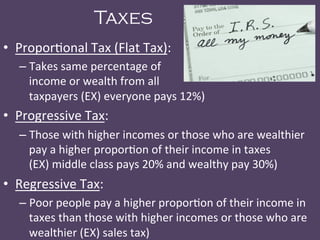
•  Propor@onal	
  Tax	
  (Flat	
  Tax):	
  
– Takes	
  same	
  percentage	
  of	


income	
  or	
  wealth	
  from	
  all	


taxpayers	
  (EX)	
  everyone	
  pays	
  12%)	
  
•  Progressive	
  Tax:	
  
– Those	
  with	
  higher	
  incomes	
  or	
  those	
  who	
  are	
  wealthier	
  
pay	
  a	
  higher	
  propor@on	
  of	
  their	
  income	
  in	
  taxes	


(EX)	
  middle	
  class	
  pays	
  20%	
  and	
  wealthy	
  pay	
  30%)	
  
•  Regressive	
  Tax:	
  
– Poor	
  people	
  pay	
  a	
  higher	
  propor@on	
  of	
  their	
  income	
  in	
  
taxes	
  than	
  those	
  with	
  higher	
  incomes	
  or	
  those	
  who	
  are	
  
wealthier	
  (EX)	
  sales	
  tax)	
  
Federal Budget -
Expenditures
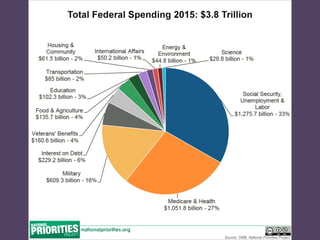
•  Mandatory	
  spending:	
  
– Certain	
  programs	
  that	
  must	
  be	
  funded	
  by	
  law	
  
(Congress	
  has	
  no	
  choice	
  unless	
  they	
  change	
  the	
  law)	
  
– Most	
  of	
  it	
  involves	
  en@tlement	
  programs	
  (Social	
  
Security,	
  Medicare/Medicaid)	
  and	
  interest	
  on	
  the	
  
na@onal	
  debt	
  
•  Discre@onary	
  spending:	
  
– Programs	
  Congress	
  can	
  choose	
  to	
  fund	
  every	
  year	
  
– Majority	
  of	
  this	
  goes	
  to	
  Defense	
  
Consequences
•  Because	
  more	
  spending	
  and	
  tax	
  cuts	
  are	
  needed	
  
during	
  a	
  recession,	
  the	
  government	
  engages	
  in	
  
deficit	
  spending	
  –	
  spending	
  more	
  than	
  it	
  takes	
  in.	
  
•  Deficit	
  spending	
  forces	
  government	
  to	
  borrow,	
  
which	
  leads	
  to	
  debt	
  -­‐	
  the	
  U.S.	
  owing	
  money.	
  	
  
Currently,	
  the	
  combined	
  public	
  debt	
  of	
  the	
  U.S.	
  is	
  
nearly	
  $20	
  trillion.	
  
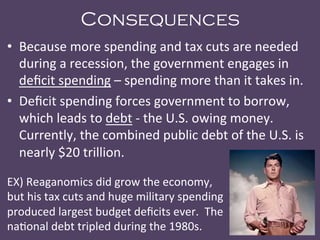
EX)	
  Reaganomics	
  did	
  grow	
  the	
  economy,	
  
but	
  his	
  tax	
  cuts	
  and	
  huge	
  military	
  spending	
  
produced	
  largest	
  budget	
  deficits	
  ever.	
  	
  The	
  
na@onal	
  debt	
  tripled	
  during	
  the	
  1980s.	
  

powerpoint.25

  • 1.
  • 2.
    Laissez-Faire •  Prevailing  a+tude  prior  to  the  Great   Depression   •  Absence  of  government  control  -­‐  economy   must  be  le<  alone  to  flourish   •  Market-­‐based  compe@@on  will  deliver  good   for  the  greatest  amount  of  people    
  • 3.
    Great Depression •  In1929, the stock market crashed and ushered in the Great Depression •  The worst and longest economic collapse in the history of the industrialized world •  By 1933, more than 15 million Americans - ¼ of the nation’s workforce - were unemployed  
  • 4.
    John Maynard Keynes • A British economist who argued that gov't spending had to increase •  More money in people's pockets would increase aggregate demand (total amount of spending in an economy) •  As people spent more, more goods and services would be produced, creating new jobs
  • 5.
    Interventionism •  A  policy  that   encourages  the   government  to   take  an  ac@ve   role  in  guiding   and  managing   the  economy   •  The  New  Deal  is  a  classic  example  –government   began  to  regulate  private  businesses,  provide   Social  Security,  and  spend  money  to  create  jobs    
  • 6.
    Reaganomics •  Reagan  claimed  that  economic                                 stability  can  be  assured  not  by                   increasing  demand,  but  by                     increasing  aggregate  supply                                     (total  amount  of  goods  and                 services  available  in  an  economy)   •  More  produc@on  means  more  jobs,  which   happens  when  government  stays  out  of   business’s  way  (fewer  taxes/regula@ons)   •  Massive  tax  cuts  of  the  1980s,  especially  for  the   wealthy,  are  known  as  “trickle-­‐down  economics”  
  • 7.
    The Kansas Experiment Kansas  put  “trickle-­‐down”  into  effect  in  2012.     How  did  it  work  out?    
  • 8.
    Economic Stability •  Economic  Stability:  a  situa@on  in  which  there  is   economic  growth,  rising  na@onal  income,  high   employment,  and  steadiness  in  the  general  level  of   prices   •  Economic  Instability:     – Infla@on:  a  rise  in  the  general  price                                 levels  of  an  economy    OR   – Recession:  a  short-­‐term  decline  in  the  economy  that   occurs  as  investment  sags,  produc@on  falls  off  and   unemployment  increases  
  • 9.
    Monetary Policy •  Used  by  Federal  Reserve  Board  (“Fed”)  -­‐  central   bank  of  the  U.S.   •  Monetary  Policy  involves  changes  in:     – interest  rates  (amount  paid  to  borrow  money)     – and  money  supply  (the  amount  of  dollars  circula@ng  in   the  economy)   – In  general:   •  Lowering  interest  rates  and  increasing  the  money   supply  will  increase  aggregate  demand  (to  expand   economy)   •  Raising  interest  rates  and  decreasing  the  money   supply  will  decrease  aggregate  demand  (to  contract   economy)  
  • 10.
    Fiscal Policy •  Used  by  Congress  and  the  President   •  Fiscal  policy  involves  changes  in  taxing  and   spending     •  In  general:   – Lowering  taxes  and  increasing                     government  spending  should                         increase  aggregate  demand                                       (to  expand  economy)   – Raising  taxes  and  decreasing  government  spending   should  decrease  aggregate  demand  (to  contract   economy)  
  • 11.
    American Recovery and ReinvestmentAct of 2009 Immediately  a<er  taking  office,  because  of  the   Great  Recession,  President  Obama  pushed  through   Congress  a  s@mulus  package  –  $831  billion  of  direct   spending  on  infrastructure,  educa@on,  health,                    energy,  federal  tax                    incen@ves  and  expansion                    of  unemployment  benefits                    to  get  people  spending                    again.                      How  well  did  it  work?  
  • 12.
    Federal Budget -Revenues •  Federal  government:   – individual  income  taxes  and  Social  Security  taxes   make  up  over  80%  of  revenue   – corporate  income  taxes   – capital  gains  taxes  –  on  investments   – tariffs  –  on  imports   •  State  and  Local  Governments:   – raise  about  85%  of  their  funds  from  sales  taxes,   property  taxes  and  individual  income  taxes    
  • 13.
    Taxes •  Propor@onal  Tax  (Flat  Tax):   – Takes  same  percentage  of                     income  or  wealth  from  all                         taxpayers  (EX)  everyone  pays  12%)   •  Progressive  Tax:   – Those  with  higher  incomes  or  those  who  are  wealthier   pay  a  higher  propor@on  of  their  income  in  taxes                     (EX)  middle  class  pays  20%  and  wealthy  pay  30%)   •  Regressive  Tax:   – Poor  people  pay  a  higher  propor@on  of  their  income  in   taxes  than  those  with  higher  incomes  or  those  who  are   wealthier  (EX)  sales  tax)  
  • 14.
    Federal Budget - Expenditures • Mandatory  spending:   – Certain  programs  that  must  be  funded  by  law   (Congress  has  no  choice  unless  they  change  the  law)   – Most  of  it  involves  en@tlement  programs  (Social   Security,  Medicare/Medicaid)  and  interest  on  the   na@onal  debt   •  Discre@onary  spending:   – Programs  Congress  can  choose  to  fund  every  year   – Majority  of  this  goes  to  Defense  
  • 16.
    Consequences •  Because  more  spending  and  tax  cuts  are  needed   during  a  recession,  the  government  engages  in   deficit  spending  –  spending  more  than  it  takes  in.   •  Deficit  spending  forces  government  to  borrow,   which  leads  to  debt  -­‐  the  U.S.  owing  money.     Currently,  the  combined  public  debt  of  the  U.S.  is   nearly  $20  trillion.   EX)  Reaganomics  did  grow  the  economy,   but  his  tax  cuts  and  huge  military  spending   produced  largest  budget  deficits  ever.    The   na@onal  debt  tripled  during  the  1980s.