Analyze the effect of each on
inflation and unemployment:
Consumers expect an economic downturn
A new president is elected and the profit expectations of
business executives rise
Power companies switch to solar energy causing electricity
prices to fall
Federal government increases the sales tax on gasoline to
balance the budget
What graphical explanation would
explain following conditions?
Price Level and unemployment rise
Price level falls and unemployment rises
Price level falls and unemployment stays the same
Price level remains the same and unemployment rises
Fiscal Policy
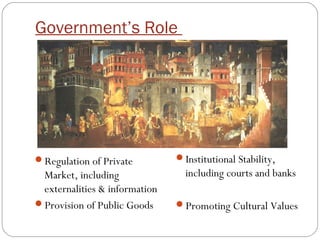
Government’s Role
Regulation of Private
Market, including
externalities & information
Provision of Public Goods
Institutional Stability,
including courts and banks
Promoting Cultural Values
Why Provide Public Goods?
Equity – Everyone should have access to 911 services
Efficiency – Economies of scale and easier to collectively
provide
Overcome Free Rider problem – will not be privately
provided
Provide infrastructure necessary to society and
economy, See Monty Python
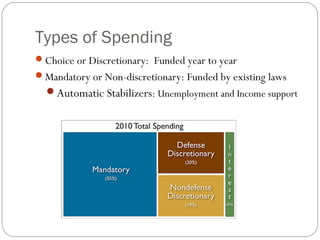
Types of Spending
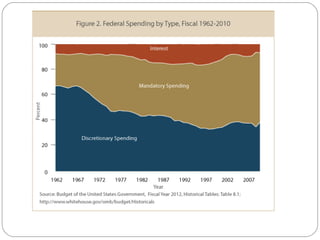
Choice or Discretionary: Funded year to year
Mandatory or Non-discretionary: Funded by existing laws
Automatic Stabilizers: Unemployment and Income support
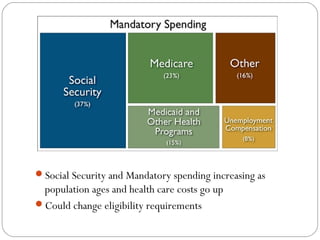
Social Security and Mandatory spending increasing as
population ages and health care costs go up
Could change eligibility requirements
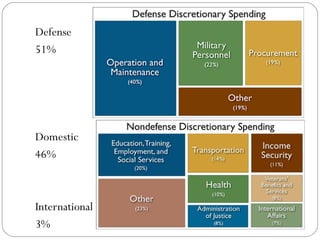
Defense
51%
Domestic
46%
International
3%
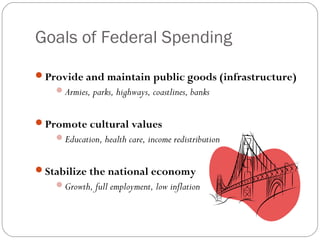
Goals of Federal Spending
Provide and maintain public goods (infrastructure)
Armies, parks, highways, coastlines, banks
Promote cultural values
Education, health care, income redistribution
Stabilize the national economy
Growth, full employment, low inflation
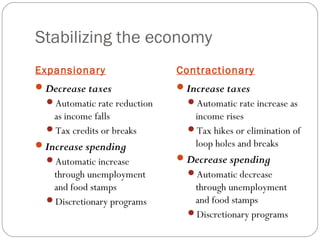
Stabilizing the economy
Expansionary Contractionary
Decrease taxes
Automatic rate reduction
as income falls
Tax credits or breaks
Increase spending
Automatic increase
through unemployment
and food stamps
Discretionary programs
Increase taxes
Automatic rate increase as
income rises
Tax hikes or elimination of
loop holes and breaks
Decrease spending
Automatic decrease
through unemployment
and food stamps
Discretionary programs
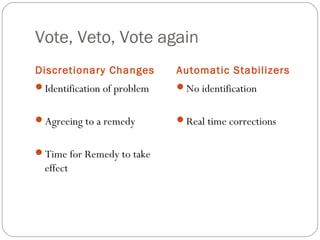
Vote, Veto, Vote again
Discretionary Changes Automatic Stabilizers
Identification of problem
Agreeing to a remedy
Time for Remedy to take
effect
No identification
Real time corrections
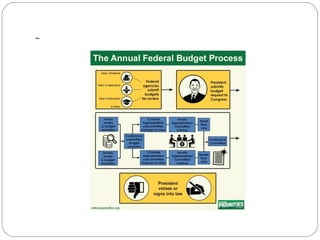
-
Fiscal Policy Complications
Crowding out: Deficits and debts
Regulatory lags: recognition, execution and implementation
Ricardian Equivalence: No effect
Taxes
The revenue side
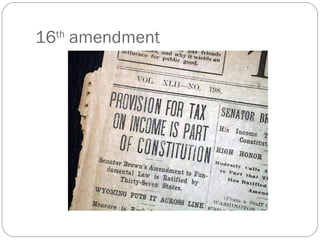
16th
amendment
Consider tax policies:
Current Marginal tax System
Head Tax
Flat Tax
Consumption tax
Tax Evaluation
Consider efficiency and equity
Efficiency – Does it distort behavior (dividend taxes)
 & is administration simple (1040 form)
Equity – Is it Fair
Define fairness
Benefits Received
Revenue from gas tax goes towards road maintenance
Ability to Pay
More one makes the more one pays
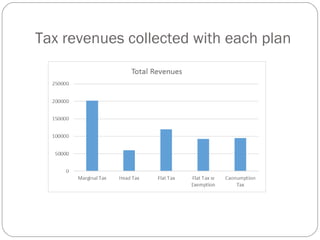
Tax revenues collected with each plan
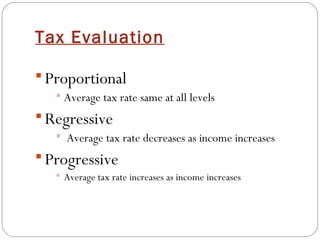
Tax Evaluation
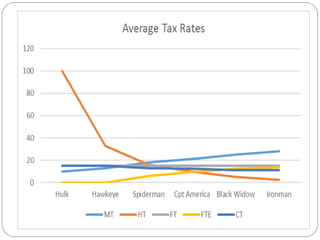
 Proportional
 Average tax rate same at all levels
 Regressive
 Average tax rate decreases as income increases
 Progressive
 Average tax rate increases as income increases
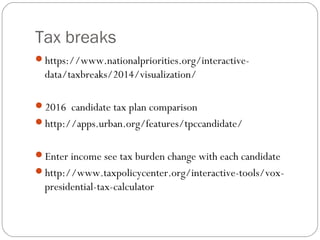
Tax breaks
https://www.nationalpriorities.org/interactive-
data/taxbreaks/2014/visualization/
2016 candidate tax plan comparison
http://apps.urban.org/features/tpccandidate/
Enter income see tax burden change with each candidate
http://www.taxpolicycenter.org/interactive-tools/vox-
presidential-tax-calculator
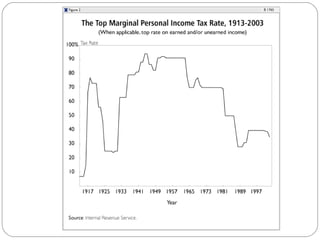
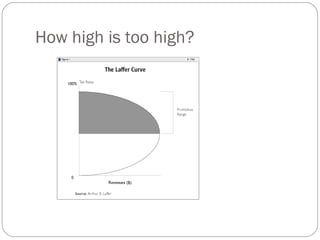
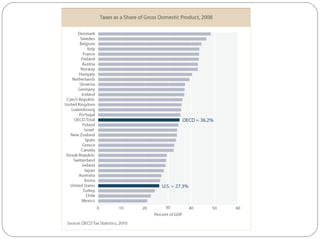
How high is too high?
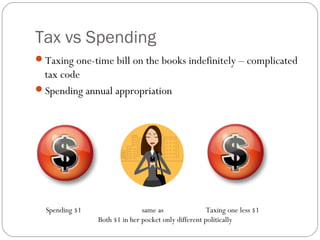
Tax vs Spending
Taxing one-time bill on the books indefinitely – complicated
tax code
Spending annual appropriation
Spending $1 same as Taxing one less $1
Both $1 in her pocket only different politically
Fiscal Policy and AD-AS
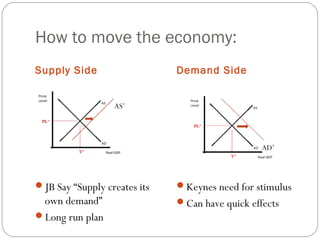
How to move the economy:
Supply Side Demand Side
JB Say “Supply creates its
own demand”
Long run plan
Keynes need for stimulus
Can have quick effects
AS’
AD’
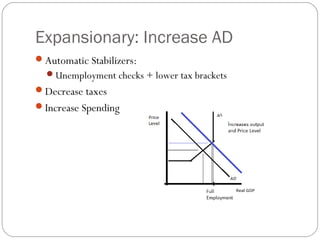
Expansionary: Increase AD
Automatic Stabilizers:
Unemployment checks + lower tax brackets
Decrease taxes
Increase Spending
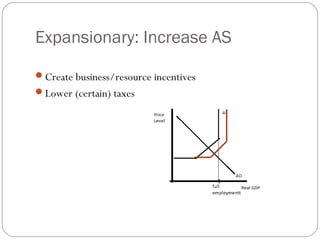
Expansionary: Increase AS
Create business/resource incentives
Lower (certain) taxes
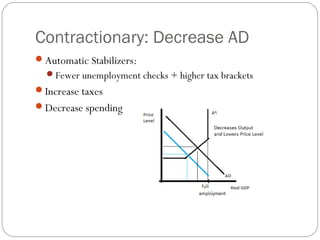
Contractionary: Decrease AD
Automatic Stabilizers:
Fewer unemployment checks + higher tax brackets
Increase taxes
Decrease spending

Fiscal Policy hs

  • 1.
    Analyze the effectof each on inflation and unemployment: Consumers expect an economic downturn A new president is elected and the profit expectations of business executives rise Power companies switch to solar energy causing electricity prices to fall Federal government increases the sales tax on gasoline to balance the budget
  • 2.
    What graphical explanationwould explain following conditions? Price Level and unemployment rise Price level falls and unemployment rises Price level falls and unemployment stays the same Price level remains the same and unemployment rises
  • 3.
  • 4.
    Government’s Role Regulation ofPrivate Market, including externalities & information Provision of Public Goods Institutional Stability, including courts and banks Promoting Cultural Values
  • 5.
    Why Provide PublicGoods? Equity – Everyone should have access to 911 services Efficiency – Economies of scale and easier to collectively provide Overcome Free Rider problem – will not be privately provided Provide infrastructure necessary to society and economy, See Monty Python
  • 6.
    Types of Spending Choiceor Discretionary: Funded year to year Mandatory or Non-discretionary: Funded by existing laws Automatic Stabilizers: Unemployment and Income support
  • 8.
    Social Security andMandatory spending increasing as population ages and health care costs go up Could change eligibility requirements
  • 9.
  • 10.
    Goals of FederalSpending Provide and maintain public goods (infrastructure) Armies, parks, highways, coastlines, banks Promote cultural values Education, health care, income redistribution Stabilize the national economy Growth, full employment, low inflation
  • 11.
    Stabilizing the economy ExpansionaryContractionary Decrease taxes Automatic rate reduction as income falls Tax credits or breaks Increase spending Automatic increase through unemployment and food stamps Discretionary programs Increase taxes Automatic rate increase as income rises Tax hikes or elimination of loop holes and breaks Decrease spending Automatic decrease through unemployment and food stamps Discretionary programs
  • 12.
    Vote, Veto, Voteagain Discretionary Changes Automatic Stabilizers Identification of problem Agreeing to a remedy Time for Remedy to take effect No identification Real time corrections
  • 13.
  • 14.
    Fiscal Policy Complications Crowdingout: Deficits and debts Regulatory lags: recognition, execution and implementation Ricardian Equivalence: No effect
  • 15.
  • 16.
  • 17.
    Consider tax policies: CurrentMarginal tax System Head Tax Flat Tax Consumption tax
  • 18.
    Tax Evaluation Consider efficiencyand equity Efficiency – Does it distort behavior (dividend taxes)  & is administration simple (1040 form) Equity – Is it Fair Define fairness Benefits Received Revenue from gas tax goes towards road maintenance Ability to Pay More one makes the more one pays
  • 20.
    Tax revenues collectedwith each plan
  • 21.
    Tax Evaluation  Proportional Average tax rate same at all levels  Regressive  Average tax rate decreases as income increases  Progressive  Average tax rate increases as income increases
  • 22.
    Tax breaks https://www.nationalpriorities.org/interactive- data/taxbreaks/2014/visualization/ 2016 candidatetax plan comparison http://apps.urban.org/features/tpccandidate/ Enter income see tax burden change with each candidate http://www.taxpolicycenter.org/interactive-tools/vox- presidential-tax-calculator
  • 25.
    How high istoo high?
  • 27.
    Tax vs Spending Taxingone-time bill on the books indefinitely – complicated tax code Spending annual appropriation Spending $1 same as Taxing one less $1 Both $1 in her pocket only different politically
  • 28.
  • 29.
    How to movethe economy: Supply Side Demand Side JB Say “Supply creates its own demand” Long run plan Keynes need for stimulus Can have quick effects AS’ AD’
  • 30.
    Expansionary: Increase AD AutomaticStabilizers: Unemployment checks + lower tax brackets Decrease taxes Increase Spending
  • 31.
    Expansionary: Increase AS Createbusiness/resource incentives Lower (certain) taxes
  • 32.
    Contractionary: Decrease AD AutomaticStabilizers: Fewer unemployment checks + higher tax brackets Increase taxes Decrease spending

Editor's Notes

  • #5 Lorenzetti, The Effects of Good Government in the City (1138-1340) Image credit, http://www.italybeyondtheobvious.com/siena
  • #6 http://www.youtube.com/watch?v=hSELOCMmw4A
  • #7 CBO graph
  • #8 http://taxpolicycenter.org/briefing-book/background/numbers/expenses.cfm
  • #10 http://taxpolicycenter.org/briefing-book/background/numbers/expenses.cfm
  • #17 https://www.google.com/url?sa=i&rct=j&q=&esrc=s&source=images&cd=&cad=rja&uact=8&ved=0ahUKEwiigOuU2J7MAhVouoMKHYLbDrYQjRwIBw&url=http%3A%2F%2Fwww.rarenewspapers.com%2Fview%2F586250&psig=AFQjCNGqw4CZKf_YjCFOFBNF-5WVOGJPtA&ust=1461292273609362
  • #22 How High is too high, http://www.pbs.org/newshour/bb/business/jan-june12/makingsense_01-11.html#disqus_thread
  • #24 http://www.heritage.org/research/reports/2004/06/the-laffer-curve-past-present-and-future
  • #25 http://taxfoundation.org/blog/how-many-taxpayers-fall-each-income-tax-bracket
  • #26 Picure credit: http://www.heritage.org/research/reports/2004/06/the-laffer-curve-past-present-and-future Video: http://www.pbs.org/newshour/bb/business/jan-june12/makingsense_01-11.html#disqus_thread
  • #27 http://taxpolicycenter.org/briefing-book/background/numbers/international.cfm