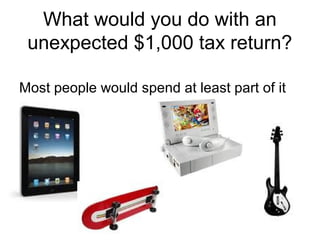
What would you do with an
unexpected $1,000 tax return?
Most people would spend at least part of it
What would you do if you owed
an extra $1,000 in taxes?
People would reduce their consumption
spending & save money to pay it
Fiscal Policy
the deliberate use of taxes and spending to
influence the economy (speed it up or
slow it down)
“Stimulus” money
For many years, people
believed in classical economics
• laissez-faire = let things be
• supply and demand takes care of
everything (remember the “invisible hand”
theory proposed by Adam Smith)
• recessions and depressions would work
themselves out
When did this change?
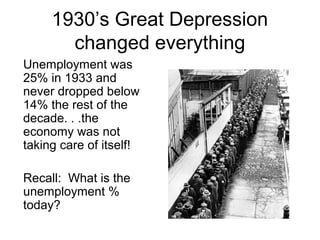
1930’s Great Depression
changed everything
Unemployment was
25% in 1933 and
never dropped below
14% the rest of the
decade. . .the
economy was not
taking care of itself!
Recall: What is the
unemployment %
today?
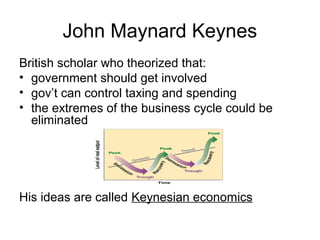
John Maynard Keynes
British scholar who theorized that:
• government should get involved
• gov’t can control taxing and spending
• the extremes of the business cycle could be
eliminated
His ideas are called Keynesian economics
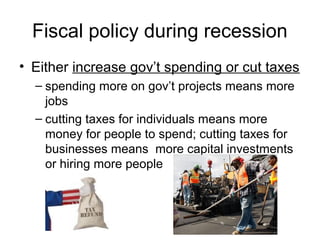
Fiscal policy during recession
• Either increase gov’t spending or cut taxes
– spending more on gov’t projects means more
jobs
– cutting taxes for individuals means more
money for people to spend; cutting taxes for
businesses means more capital investments
or hiring more people
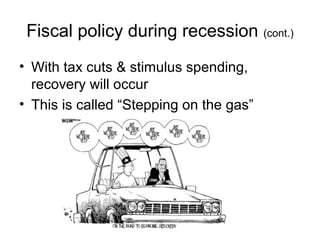
Fiscal policy during recession (cont.)
• With tax cuts & stimulus spending,
recovery will occur
• This is called “Stepping on the gas”
Fiscal policy to prevent inflation
• Gov’t should decrease gov’t spending or
raise taxes
– (Opposite effects from the last slide of notes)
• This will slow economy down, and slow
inflation
• This is called “Stepping on the brakes”
Online open note quiz
Fiscal policy to prevent inflation
• Gov’t should decrease gov’t spending or
raise taxes
– (Opposite effects from the last slide of notes)
• This will slow economy down, and slow
inflation
• This is called “Stepping on the brakes”
Online open note quiz

Fiscal Policy

  • 1.
    What would youdo with an unexpected $1,000 tax return? Most people would spend at least part of it
  • 2.
    What would youdo if you owed an extra $1,000 in taxes? People would reduce their consumption spending & save money to pay it
  • 3.
    Fiscal Policy the deliberateuse of taxes and spending to influence the economy (speed it up or slow it down) “Stimulus” money
  • 4.
    For many years,people believed in classical economics • laissez-faire = let things be • supply and demand takes care of everything (remember the “invisible hand” theory proposed by Adam Smith) • recessions and depressions would work themselves out When did this change?
  • 5.
    1930’s Great Depression changedeverything Unemployment was 25% in 1933 and never dropped below 14% the rest of the decade. . .the economy was not taking care of itself! Recall: What is the unemployment % today?
  • 6.
    John Maynard Keynes Britishscholar who theorized that: • government should get involved • gov’t can control taxing and spending • the extremes of the business cycle could be eliminated His ideas are called Keynesian economics
  • 7.
    Fiscal policy duringrecession • Either increase gov’t spending or cut taxes – spending more on gov’t projects means more jobs – cutting taxes for individuals means more money for people to spend; cutting taxes for businesses means more capital investments or hiring more people
  • 8.
    Fiscal policy duringrecession (cont.) • With tax cuts & stimulus spending, recovery will occur • This is called “Stepping on the gas”
  • 9.
    Fiscal policy toprevent inflation • Gov’t should decrease gov’t spending or raise taxes – (Opposite effects from the last slide of notes) • This will slow economy down, and slow inflation • This is called “Stepping on the brakes” Online open note quiz
  • 10.
    Fiscal policy toprevent inflation • Gov’t should decrease gov’t spending or raise taxes – (Opposite effects from the last slide of notes) • This will slow economy down, and slow inflation • This is called “Stepping on the brakes” Online open note quiz

Editor's Notes

  • #2 Go around the room asking students for responses. Do this before you show the pictures.
  • #3 Again ask students for suggestions before showing the answer.
  • #4 Allow students time to copy the definition into their notes and ask if they have heard of “stimulus” money. Have them give examples.
  • #5 Review some 11th grade history by defining terms and asking questions. Adam Smith created the Invisible Hand Theory. 1930s invoked change.
  • #6 Give stat of unemployment today.
  • #7 Review business cycle from previous chapter.
  • #8 Allow students time to process and/or copy this information