 JINSON GEORGE
ISO 9000
 In the year 1987,composed of representative from national
standards bodies of 91 nations, adopted a series of written
quality standards, to standardize quality requirement of
European countries within the common market and those who
wishing to do business with those countries These standards,
were revised in 1994, and again (significantly)in the year 2000
 The ISO 9000 is a quality assurance protocol that was
created to increase and maintain quality standards in
businesses or organizations. The protocol consists of a set
of quality management guidelines that are recognized
internationally to improve efficiency and customer
satisfaction
 ISO is an international agency consisting of 156
member countries including Kenya
 ISO was formed in 1947 and is based in Geneva,
Switzerland
 It develops international standards to foster
increased trade of products and services
 By July 2005, ISO had published over 15,000
standards
ISO 9000
• Most widely known and successful series of
standards
• Gaining wider interest in new management of
Public administrations
• Represents an international consensus on good
management practices
• Is a tried and tested framework of managing your
business process
ISO 9000
ISO 9000 FOR HOSPITALS
 Hospital performance statistics and articles about
services falling short of expectations are rarely out of
the news these days, its just because of the various
standards
 Hospitals are asked to perform quality measures, is it
not strange that each individual hospital will try and
attain these objectives so they will try to various
quality accrediction
ISO 9000 FOR HOSPITALS
 The generalized implementation of ISO 9000 quality
management systems by health care establishments is seen as a
means of rationalizing client-supplier relationships and an
opportunity to improve the quality of health care while reducing
the costs.
 The document provides a framework for the design and
improvement of process-based quality management systems by
health care organizations. The guidelines are voluntary and they
are not intended for certification or accreditation.
ISO 9000 FOR HOSPITALS
 Guidelines for implementing ISO 9000 quality management
systems in the health care sector were published by ISO
(International Organization for Standardization) on 20 September
2001 as its first "International Workshop Agreement" (IWA).
 ISO 9000's purpose is to ensure that suppliers design, create, and
deliverproducts and services which meet predetermined standards
 The ISO 9000 quality standards are broken down into three
model sets—ISO 9001, ISO 9002, and ISO 9003.
 ISO 9001 is the most wide-ranging, for it specifies the various
operating requirements in such areas as product design and
development, production, installation, and servicing. ISO 9002 is
concerned with quality assurance at the production and
installation stages. ISO 9003 covers testing and inspections.
Establishment of ISO 9000 IN hospital
 Acceptable quality care at affordable prices.
 Timely care.
 Clear communication to the patients.
 Best practices for fixing appointment and service
delivery.
 Reliable diagnostic and laboratory support.
 Reliable support services like canteen, ambulance,
pharmacy
 Safe and pleasant environment.
 Technical competence, courtesy and attitude of staff.
THE BENEFITS OF IMPLEMENTATION
 Uniformity of objectives and methodologies
 Costs: shared processes and methods allow staff to
transfer and work at other sites seamlessly with a
minimum of training.
 Staff costs: it could be strongly argued that if a
standardized quality management process existed
within hospitals, that considerable administrative
and expensive management costs could be
eliminated, given that standard processes, training,
objectives, and goals would exist.
THE BENEFITS OF IMPLEMENTATION
 Improved customer satisfaction: the absolute goal of any ISO
implementation process. Measuring, review, and action versus the
respective clauses of the standard should ensure the continual
improvement cycle and provide better service and effective
lessons learned for the benefit of the end user, the patient.
 Information sharing: standardized processes across multiple
hospitals would allow data and knowledge to be shared, ensuring
greater efficiency and lower costs in pursuit of objectives.
FOLLOWING PROCEDURE
 Periodic management reviews: all organizations using the
same formats and sharing targets and objectives.
 Internal audits all hospitals would have to perform these as
standard practice.
 Measurement and control of suppliers: this would allow
consistency and assurance that taxpayer money was utilized
efficiently.
 Customer feedback: the ISO 9000 requirement to solicit
customer feedback would help to ensure that preventive
measures would be more prominent than corrective actions.
FOLLOWING PROCEDURE
 Corrective action: a standardized and formal corrective action
process that could be shared across different sites could be a huge
advantage to hospital managers.
 Risk assessment: again, this is obviously performed within most
work environments, but a standardized and regular format that is
recognized across multiple sites could bring improved synergy
and reduced costs to the service provided.
 Continual improvement: as the recurring theme of the 9001
standard, the above processes, when undertaken correctly, can
drive real improvement within a hospital environment similarly to
any business.
ELEMENTS AND THEIR APPLICATION FOR HEALTH CARE
PROVIDERS
 Management responsibility. This applies to both administrative
and clinical operations. The purpose is to provide the leadership,
structure and resources, and establish the quality policy for the
entire health care quality system
 Quality system. As with other ISO 9000 applications, health care
providers must establish a quality manual; create a documented
quality management system (QMS); and determine how the
organizational structure, procedures and processes will satisfy
quality objectives.
 Contract review. The purpose of this requirement is to ensure
that all written materials creating patient expectations are
accurate
ELEMENTS AND THEIR APPLICATION FOR HEALTH CARE
PROVIDERS
 Design control. It defines the steps that must be taken by the
hospital when new or additional services are considered for
implementation.
 Document and data control. This clause requires that the
quality system provide timely access to approved instructions for
the accurate and timely provision of patient care and support
functions.
 Purchasing. It is necessary that the QMS ensure the accurate and
timely purchase of materials and supplies from approved vendors
 Product identification and traceability. Patient records and
patient activities are generally connected to a particular patient
through the use of unique identification numbers.
ELEMENTS AND THEIR APPLICATION FOR
HEALTH CARE PROVIDERS
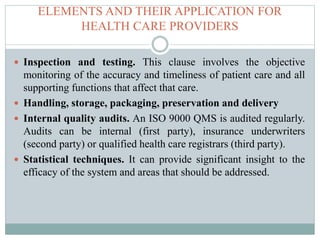
 Inspection and testing. This clause involves the objective
monitoring of the accuracy and timeliness of patient care and all
supporting functions that affect that care.
 Handling, storage, packaging, preservation and delivery
 Internal quality audits. An ISO 9000 QMS is audited regularly.
Audits can be internal (first party), insurance underwriters
(second party) or qualified health care registrars (third party).
 Statistical techniques. It can provide significant insight to the
efficacy of the system and areas that should be addressed.
COST AND CERTIFICATION
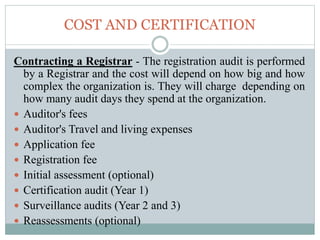
Contracting a Registrar - The registration audit is performed
by a Registrar and the cost will depend on how big and how
complex the organization is. They will charge depending on
how many audit days they spend at the organization.
 Auditor's fees
 Auditor's Travel and living expenses
 Application fee
 Registration fee
 Initial assessment (optional)
 Certification audit (Year 1)
 Surveillance audits (Year 2 and 3)
 Reassessments (optional)
COST AND CERTIFICATION
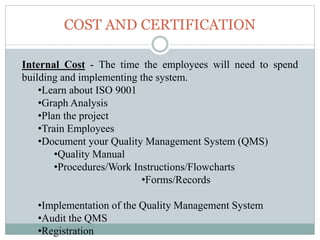
Internal Cost - The time the employees will need to spend
building and implementing the system.
•Learn about ISO 9001
•Graph Analysis
•Plan the project
•Train Employees
•Document your Quality Management System (QMS)
•Quality Manual
•Procedures/Work Instructions/Flowcharts
•Forms/Records
•Implementation of the Quality Management System
•Audit the QMS
•Registration
COST AND CERTIFICATION
 Outside help - This is either consultant fees or the purchasing of
tools to help with the project.
 1-25 Employees, no quality system in place yet
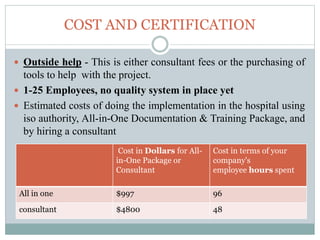
 Estimated costs of doing the implementation in the hospital using
iso authority, All-in-One Documentation & Training Package, and
by hiring a consultant
Cost in Dollars for All-
in-One Package or
Consultant
Cost in terms of your
company's
employee hours spent
All in one $997 96
consultant $4800 48
DISADVANTAGES OF ISO 9000
 Owners and managers do not have an adequate
understanding of the ISO 9000 certification process
or of the quality standards themselves
 Funding for establishing the quality system is
inadequate
 Heavy emphasis on documentation
 Length of the process
ISO 9000 STANDARDS FOR HOSPITALS

ISO 9000 STANDARDS FOR HOSPITALS

  • 1.
  • 3.
    ISO 9000  Inthe year 1987,composed of representative from national standards bodies of 91 nations, adopted a series of written quality standards, to standardize quality requirement of European countries within the common market and those who wishing to do business with those countries These standards, were revised in 1994, and again (significantly)in the year 2000  The ISO 9000 is a quality assurance protocol that was created to increase and maintain quality standards in businesses or organizations. The protocol consists of a set of quality management guidelines that are recognized internationally to improve efficiency and customer satisfaction
  • 4.
     ISO isan international agency consisting of 156 member countries including Kenya  ISO was formed in 1947 and is based in Geneva, Switzerland  It develops international standards to foster increased trade of products and services  By July 2005, ISO had published over 15,000 standards ISO 9000
  • 5.
    • Most widelyknown and successful series of standards • Gaining wider interest in new management of Public administrations • Represents an international consensus on good management practices • Is a tried and tested framework of managing your business process ISO 9000
  • 6.
    ISO 9000 FORHOSPITALS  Hospital performance statistics and articles about services falling short of expectations are rarely out of the news these days, its just because of the various standards  Hospitals are asked to perform quality measures, is it not strange that each individual hospital will try and attain these objectives so they will try to various quality accrediction
  • 7.
    ISO 9000 FORHOSPITALS  The generalized implementation of ISO 9000 quality management systems by health care establishments is seen as a means of rationalizing client-supplier relationships and an opportunity to improve the quality of health care while reducing the costs.  The document provides a framework for the design and improvement of process-based quality management systems by health care organizations. The guidelines are voluntary and they are not intended for certification or accreditation.
  • 8.
    ISO 9000 FORHOSPITALS  Guidelines for implementing ISO 9000 quality management systems in the health care sector were published by ISO (International Organization for Standardization) on 20 September 2001 as its first "International Workshop Agreement" (IWA).  ISO 9000's purpose is to ensure that suppliers design, create, and deliverproducts and services which meet predetermined standards  The ISO 9000 quality standards are broken down into three model sets—ISO 9001, ISO 9002, and ISO 9003.  ISO 9001 is the most wide-ranging, for it specifies the various operating requirements in such areas as product design and development, production, installation, and servicing. ISO 9002 is concerned with quality assurance at the production and installation stages. ISO 9003 covers testing and inspections.
  • 9.
    Establishment of ISO9000 IN hospital  Acceptable quality care at affordable prices.  Timely care.  Clear communication to the patients.  Best practices for fixing appointment and service delivery.  Reliable diagnostic and laboratory support.  Reliable support services like canteen, ambulance, pharmacy  Safe and pleasant environment.  Technical competence, courtesy and attitude of staff.
  • 10.
    THE BENEFITS OFIMPLEMENTATION  Uniformity of objectives and methodologies  Costs: shared processes and methods allow staff to transfer and work at other sites seamlessly with a minimum of training.  Staff costs: it could be strongly argued that if a standardized quality management process existed within hospitals, that considerable administrative and expensive management costs could be eliminated, given that standard processes, training, objectives, and goals would exist.
  • 11.
    THE BENEFITS OFIMPLEMENTATION  Improved customer satisfaction: the absolute goal of any ISO implementation process. Measuring, review, and action versus the respective clauses of the standard should ensure the continual improvement cycle and provide better service and effective lessons learned for the benefit of the end user, the patient.  Information sharing: standardized processes across multiple hospitals would allow data and knowledge to be shared, ensuring greater efficiency and lower costs in pursuit of objectives.
  • 12.
    FOLLOWING PROCEDURE  Periodicmanagement reviews: all organizations using the same formats and sharing targets and objectives.  Internal audits all hospitals would have to perform these as standard practice.  Measurement and control of suppliers: this would allow consistency and assurance that taxpayer money was utilized efficiently.  Customer feedback: the ISO 9000 requirement to solicit customer feedback would help to ensure that preventive measures would be more prominent than corrective actions.
  • 13.
    FOLLOWING PROCEDURE  Correctiveaction: a standardized and formal corrective action process that could be shared across different sites could be a huge advantage to hospital managers.  Risk assessment: again, this is obviously performed within most work environments, but a standardized and regular format that is recognized across multiple sites could bring improved synergy and reduced costs to the service provided.  Continual improvement: as the recurring theme of the 9001 standard, the above processes, when undertaken correctly, can drive real improvement within a hospital environment similarly to any business.
  • 14.
    ELEMENTS AND THEIRAPPLICATION FOR HEALTH CARE PROVIDERS  Management responsibility. This applies to both administrative and clinical operations. The purpose is to provide the leadership, structure and resources, and establish the quality policy for the entire health care quality system  Quality system. As with other ISO 9000 applications, health care providers must establish a quality manual; create a documented quality management system (QMS); and determine how the organizational structure, procedures and processes will satisfy quality objectives.  Contract review. The purpose of this requirement is to ensure that all written materials creating patient expectations are accurate
  • 15.
    ELEMENTS AND THEIRAPPLICATION FOR HEALTH CARE PROVIDERS  Design control. It defines the steps that must be taken by the hospital when new or additional services are considered for implementation.  Document and data control. This clause requires that the quality system provide timely access to approved instructions for the accurate and timely provision of patient care and support functions.  Purchasing. It is necessary that the QMS ensure the accurate and timely purchase of materials and supplies from approved vendors  Product identification and traceability. Patient records and patient activities are generally connected to a particular patient through the use of unique identification numbers.
  • 16.
    ELEMENTS AND THEIRAPPLICATION FOR HEALTH CARE PROVIDERS  Inspection and testing. This clause involves the objective monitoring of the accuracy and timeliness of patient care and all supporting functions that affect that care.  Handling, storage, packaging, preservation and delivery  Internal quality audits. An ISO 9000 QMS is audited regularly. Audits can be internal (first party), insurance underwriters (second party) or qualified health care registrars (third party).  Statistical techniques. It can provide significant insight to the efficacy of the system and areas that should be addressed.
  • 17.
    COST AND CERTIFICATION Contractinga Registrar - The registration audit is performed by a Registrar and the cost will depend on how big and how complex the organization is. They will charge depending on how many audit days they spend at the organization.  Auditor's fees  Auditor's Travel and living expenses  Application fee  Registration fee  Initial assessment (optional)  Certification audit (Year 1)  Surveillance audits (Year 2 and 3)  Reassessments (optional)
  • 18.
    COST AND CERTIFICATION InternalCost - The time the employees will need to spend building and implementing the system. •Learn about ISO 9001 •Graph Analysis •Plan the project •Train Employees •Document your Quality Management System (QMS) •Quality Manual •Procedures/Work Instructions/Flowcharts •Forms/Records •Implementation of the Quality Management System •Audit the QMS •Registration
  • 19.
    COST AND CERTIFICATION Outside help - This is either consultant fees or the purchasing of tools to help with the project.  1-25 Employees, no quality system in place yet  Estimated costs of doing the implementation in the hospital using iso authority, All-in-One Documentation & Training Package, and by hiring a consultant Cost in Dollars for All- in-One Package or Consultant Cost in terms of your company's employee hours spent All in one $997 96 consultant $4800 48
  • 20.
    DISADVANTAGES OF ISO9000  Owners and managers do not have an adequate understanding of the ISO 9000 certification process or of the quality standards themselves  Funding for establishing the quality system is inadequate  Heavy emphasis on documentation  Length of the process