NATIONAL PATIENT SAFETY DAY
June 25, 2011
THEME:
“ Working Together Towards Patient Safety”
Slogan:
“Kaligtasan ng Pasyente, Una Lagi”
What is Patient Safety?
Patient Safety is the avoidance,
prevention and amelioration of
adverse outcomes/ injuries stemming
from the process of health care
Date: July 30, 2008
Administrative Order No. 2008-0023
National policy on Patient Safety
Goal: To ensure that the patient safety is
institutionalized as a fundamental principle of
the health care delivery system in improving
health outcomes.
The Veterans Regional
Hospital Administrative
Manual Patient Safety
Plan
I. PURPOSE
OBJECTIVE:
To provide a planned, ongoing, comprehensive,
coordinated and integrated Hospital-
wide mechanism to objectively and systematically
monitor and evaluate the safety of patient care,
promptly identify and resolve problems, plan
education to improve patient safety and to reduce
medical errors throughout the organization.
The essential elements of the program include:
•The integrated Patient Safety
Committee, supported by the COH, have
the authority to recommend changes and
take necessary actions in order to make
improvements to patient care services
provided.
•Responsibility for Patient Safety
activities are shared by the Medical Staff
Departments, Patient Care Services, the
Clinical Support Services and all other
hospital departments.
•Department Chiefs of all hospital
departments are responsible for the
ongoing education, monitoring, and
evaluation in preventing, detecting and
correcting medical errors within their
departments.
•The information collected
addresses the requirements of DOH
and PHIC for a Patient Safety
Program.
•Appropriate actions are taken to
resolve identified problems and/or
identified opportunities to improve
patient care and non-clinical
services rendered.
•The information derived from each
department’s monitoring, evaluation
and improvement activities is shared
with other departments as deemed
necessary by the Department Chief
and is integrated with information
obtained from other hospital-wide
patient safety activities as
appropriate.
•The Patient Safety program is
reviewed annually to assure the
program’s objectives are attained
and that improvement to patient
care and service delivery is made.
II. DEFINITIONS OF TERMS
The following definitions are
uniformly used in the hospital’s
Incident Report, Sentinel Event
and other relevant environment of
care and medication use policies.
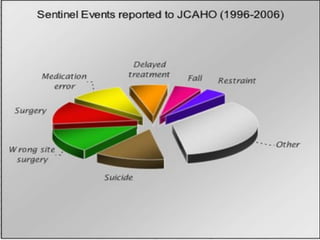
•Sentinel Event
Unexpected incident involving death
or serious physical or psychological
injury, or the risk thereof.
The fundamental objective of sentinel
event reporting is corrective in nature
and the identification of appropriate
actions to prevent recurrence.
•Near Miss or “close call”
An event or situation that could have
resulted in an accident, injury, or illness,
but did not, either by chance or timely
intervention.
It is a serious error or mishap that has the
potential to cause as adverse event but fails
to do so because of chance or because it is
intercepted.
•Latent Failure
An error precipitated as a consequence of
management and organizational processes
that poses the greatest danger to complex
systems.
Latent failures cannot be foreseen but, if
detected, they can be corrected before they
contribute to mishaps.
•No Blame Culture
A non-punitive encouraging voluntary
reporting of adverse events.
•Risk
Is any exposure to a harmful
event. It is directly related to hazard
and vulnerability and, inversely, to
capacity.
•Adverse Drug Reaction
Any undesirable or unexpected
medication related event that requires
discontinuing a medication or modifying
the dose, requires or prolongs
hospitalization, results in disability,
requires supportive treatment, is life
threatening or results in death, results in
congenital anomalies, or occurs following
vaccination.
•Medication Error
Any preventable event that may
cause or lead to inappropriate
medication use or patient harm while
the medication is in control of the
health care professional, patient or
consumer.
Such events may be related to
1.professional practice
2.health care products
3.procedures and systems, including
prescribing; order communication; product
labeling; packaging, and nomenclature;
compounding; dispensing; distribution;
administration; education; monitoring; and
use.
•Unexpected Event
Any situation that is not
consistent with the routine operation of
the affiliate or routine care and safety
of a patient. All events identified
should be reported following the
Patient Incident Report Policy utilizing
the patient incident report.
Policy on Patient Safety
Safety standard policies:
•Access to care and continuity of care (ACC)
Policies: Admission
Networking
Transport
Discharge
Others
Policy on Patient Safety
Safety standard policies:
•Patient and family rights
Policies: Information
Patient care
Autopsy
Confidentiality
Security
Others
Policy on Patient Safety
Safety standard policies:
•Assessment of care
Policies: Referral
Credentialing and hiring
Others
Policy on Patient Safety
Safety standard policies:
• Care of patients
Policies: Clinical pathways. Dse related
groups, clinical practice
Medication preparation, storage
Periodic clinical monitoring and
evaluation
Special care/Intensive care
Others
Policy on Patient Safety
Safety standard policies:
•Anesthesia and surgical care
Policies: pre-anesthetic evaluation
Surgical site preparation
Post –anesthetic care
Credentialing
Others
Policy on Patient Safety
Safety standard policies:
•Medication Management and use
Policies: Procurement
Storage/dispensing
Preparation
Medication errors/near misses
Adverse drug reaction
Others
Policy on Patient Safety
Safety standard policies:
•Medication Management and use
Policies: Procurement
Storage/dispensing
Preparation
Medication errors/near misses
Adverse drug reaction
Others
Policy on Patient Safety
Safety standard policies:
•Patient and family education
Policies: Training and education
Participative care
Others
Policy on Patient Safety
Safety standard policies:
•Quality improvement and patient safety
Policies: Sentinel event reporting and
handling or processing
Others
Policy on Patient Safety
Safety standard policies:
•Prevention and control of infection
Policies: Hand washing
Disinfection
Handling of infectious waste, sharps, specimens
Personal protective equipment (PPE)
Rational use of antibiotics (3rd gen and
above)
Others
Policy on Patient Safety
Safety standard policies:
•Governance, Leadership and direction
Policies: Organizational mission
Monitoring and evaluation
Periodic review of policies and procedures
Handling of complain
Patient survey
Accountability
Others
Policy on Patient Safety
Safety standard policies:
•Facility Management and safety
Policies: Safe Environment
Equipment maintenance
Building and environment maintenance
Patient transport maintenance
Other facility maintenance such as
electricity, generator, water, gas
management
Waste segregation and disposal
Others
Policy on Patient Safety
Safety standard policies:
•Staff qualification and education
Policies: Hiring
Training needs analysis
Continuing professional training
Others
Role:
To take the lead role in
planning, implementing,
managing,, and evaluating
safety initiatives and programs
Committee on Patient Safety
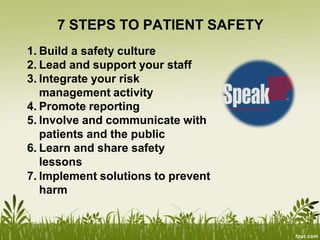
7 STEPS TO PATIENT SAFETY
1. Build a safety culture
2. Lead and support your staff
3. Integrate your risk
management activity
4. Promote reporting
5. Involve and communicate with
patients and the public
6. Learn and share safety
lessons
7. Implement solutions to prevent
harm
Committee on Patient Safety
MEDICAL TEAM
1. Safe Surgery Team
2. Medication Safety Team
3. Blood Transfusion Safety Team
4. Fall Prevention Team
5. Adverse Event Team
6. Infection Control Team
ENVIRONMENTAL SAFETY TEAM
lecturepatientsafety-140713082901-phpapp02.pptx

lecturepatientsafety-140713082901-phpapp02.pptx

  • 2.
    NATIONAL PATIENT SAFETYDAY June 25, 2011 THEME: “ Working Together Towards Patient Safety” Slogan: “Kaligtasan ng Pasyente, Una Lagi”
  • 3.
    What is PatientSafety? Patient Safety is the avoidance, prevention and amelioration of adverse outcomes/ injuries stemming from the process of health care
  • 4.
    Date: July 30,2008 Administrative Order No. 2008-0023 National policy on Patient Safety Goal: To ensure that the patient safety is institutionalized as a fundamental principle of the health care delivery system in improving health outcomes.
  • 5.
    The Veterans Regional HospitalAdministrative Manual Patient Safety Plan
  • 6.
    I. PURPOSE OBJECTIVE: To providea planned, ongoing, comprehensive, coordinated and integrated Hospital- wide mechanism to objectively and systematically monitor and evaluate the safety of patient care, promptly identify and resolve problems, plan education to improve patient safety and to reduce medical errors throughout the organization.
  • 7.
    The essential elementsof the program include: •The integrated Patient Safety Committee, supported by the COH, have the authority to recommend changes and take necessary actions in order to make improvements to patient care services provided.
  • 8.
    •Responsibility for PatientSafety activities are shared by the Medical Staff Departments, Patient Care Services, the Clinical Support Services and all other hospital departments.
  • 9.
    •Department Chiefs ofall hospital departments are responsible for the ongoing education, monitoring, and evaluation in preventing, detecting and correcting medical errors within their departments.
  • 10.
    •The information collected addressesthe requirements of DOH and PHIC for a Patient Safety Program.
  • 11.
    •Appropriate actions aretaken to resolve identified problems and/or identified opportunities to improve patient care and non-clinical services rendered.
  • 12.
    •The information derivedfrom each department’s monitoring, evaluation and improvement activities is shared with other departments as deemed necessary by the Department Chief and is integrated with information obtained from other hospital-wide patient safety activities as appropriate.
  • 13.
    •The Patient Safetyprogram is reviewed annually to assure the program’s objectives are attained and that improvement to patient care and service delivery is made.
  • 14.
    II. DEFINITIONS OFTERMS The following definitions are uniformly used in the hospital’s Incident Report, Sentinel Event and other relevant environment of care and medication use policies.
  • 15.
    •Sentinel Event Unexpected incidentinvolving death or serious physical or psychological injury, or the risk thereof. The fundamental objective of sentinel event reporting is corrective in nature and the identification of appropriate actions to prevent recurrence.
  • 17.
    •Near Miss or“close call” An event or situation that could have resulted in an accident, injury, or illness, but did not, either by chance or timely intervention. It is a serious error or mishap that has the potential to cause as adverse event but fails to do so because of chance or because it is intercepted.
  • 18.
    •Latent Failure An errorprecipitated as a consequence of management and organizational processes that poses the greatest danger to complex systems. Latent failures cannot be foreseen but, if detected, they can be corrected before they contribute to mishaps.
  • 19.
    •No Blame Culture Anon-punitive encouraging voluntary reporting of adverse events.
  • 20.
    •Risk Is any exposureto a harmful event. It is directly related to hazard and vulnerability and, inversely, to capacity.
  • 21.
    •Adverse Drug Reaction Anyundesirable or unexpected medication related event that requires discontinuing a medication or modifying the dose, requires or prolongs hospitalization, results in disability, requires supportive treatment, is life threatening or results in death, results in congenital anomalies, or occurs following vaccination.
  • 22.
    •Medication Error Any preventableevent that may cause or lead to inappropriate medication use or patient harm while the medication is in control of the health care professional, patient or consumer.
  • 23.
    Such events maybe related to 1.professional practice 2.health care products 3.procedures and systems, including prescribing; order communication; product labeling; packaging, and nomenclature; compounding; dispensing; distribution; administration; education; monitoring; and use.
  • 24.
    •Unexpected Event Any situationthat is not consistent with the routine operation of the affiliate or routine care and safety of a patient. All events identified should be reported following the Patient Incident Report Policy utilizing the patient incident report.
  • 25.
    Policy on PatientSafety Safety standard policies: •Access to care and continuity of care (ACC) Policies: Admission Networking Transport Discharge Others
  • 26.
    Policy on PatientSafety Safety standard policies: •Patient and family rights Policies: Information Patient care Autopsy Confidentiality Security Others
  • 27.
    Policy on PatientSafety Safety standard policies: •Assessment of care Policies: Referral Credentialing and hiring Others
  • 28.
    Policy on PatientSafety Safety standard policies: • Care of patients Policies: Clinical pathways. Dse related groups, clinical practice Medication preparation, storage Periodic clinical monitoring and evaluation Special care/Intensive care Others
  • 29.
    Policy on PatientSafety Safety standard policies: •Anesthesia and surgical care Policies: pre-anesthetic evaluation Surgical site preparation Post –anesthetic care Credentialing Others
  • 30.
    Policy on PatientSafety Safety standard policies: •Medication Management and use Policies: Procurement Storage/dispensing Preparation Medication errors/near misses Adverse drug reaction Others
  • 31.
    Policy on PatientSafety Safety standard policies: •Medication Management and use Policies: Procurement Storage/dispensing Preparation Medication errors/near misses Adverse drug reaction Others
  • 32.
    Policy on PatientSafety Safety standard policies: •Patient and family education Policies: Training and education Participative care Others
  • 33.
    Policy on PatientSafety Safety standard policies: •Quality improvement and patient safety Policies: Sentinel event reporting and handling or processing Others
  • 34.
    Policy on PatientSafety Safety standard policies: •Prevention and control of infection Policies: Hand washing Disinfection Handling of infectious waste, sharps, specimens Personal protective equipment (PPE) Rational use of antibiotics (3rd gen and above) Others
  • 35.
    Policy on PatientSafety Safety standard policies: •Governance, Leadership and direction Policies: Organizational mission Monitoring and evaluation Periodic review of policies and procedures Handling of complain Patient survey Accountability Others
  • 36.
    Policy on PatientSafety Safety standard policies: •Facility Management and safety Policies: Safe Environment Equipment maintenance Building and environment maintenance Patient transport maintenance Other facility maintenance such as electricity, generator, water, gas management Waste segregation and disposal Others
  • 37.
    Policy on PatientSafety Safety standard policies: •Staff qualification and education Policies: Hiring Training needs analysis Continuing professional training Others
  • 38.
    Role: To take thelead role in planning, implementing, managing,, and evaluating safety initiatives and programs Committee on Patient Safety
  • 39.
    7 STEPS TOPATIENT SAFETY 1. Build a safety culture 2. Lead and support your staff 3. Integrate your risk management activity 4. Promote reporting 5. Involve and communicate with patients and the public 6. Learn and share safety lessons 7. Implement solutions to prevent harm
  • 40.
    Committee on PatientSafety MEDICAL TEAM 1. Safe Surgery Team 2. Medication Safety Team 3. Blood Transfusion Safety Team 4. Fall Prevention Team 5. Adverse Event Team 6. Infection Control Team ENVIRONMENTAL SAFETY TEAM