Joven Botin Bilbao, RN, MAN
Deputy Chief Nurse Officer
Clinical and Accreditation Educator
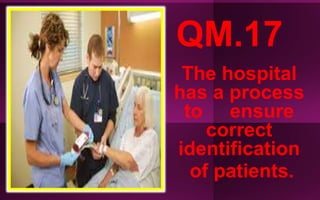
QM.17
The hospital
has a process
to ensure
correct
identification
of patients.
“can you tell me your name and
address” “are you Ahmed Saeed Saleh
Alqahtani”,
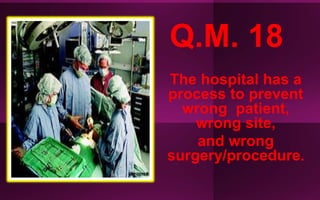
Q.M. 18
The hospital has a
process to prevent
wrong patient,
wrong site,
and wrong
surgery/procedure.
A Surgical Safety Checklist Should Be Done
For At Least:
 Procedures that investigate and/or treat
diseases and disorders of the human body
through cutting, removing, altering, or insertion
of diagnostic /therapeutic scopes.
 The Sign In, Sign Out, and Time Out applies to
a location in the hospital where these
procedures are performed, and it must be done
just before starting the procedure which
involves the entire operative team.
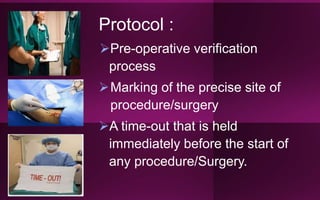
Protocol :
Pre-operative verification
process
Marking of the precise site of
procedure/surgery
A time-out that is held
immediately before the start of
any procedure/Surgery.
Pre-operative Checklist
Will be initiated the day before the
surgery unless the procedure is an
emergency.
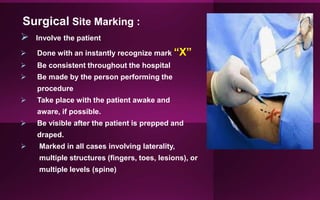
Surgical Site Marking :
 Involve the patient
 Done with an instantly recognize mark “X”
 Be consistent throughout the hospital
 Be made by the person performing the
procedure
 Take place with the patient awake and
aware, if possible.
 Be visible after the patient is prepped and
draped.
 Marked in all cases involving laterality,
multiple structures (fingers, toes, lesions), or
multiple levels (spine)
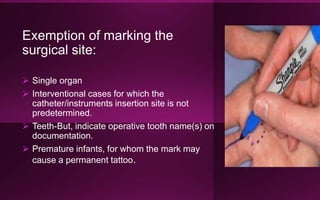
Exemption of marking the
surgical site:
 Single organ
 Interventional cases for which the
catheter/instruments insertion site is not
predetermined.
 Teeth-But, indicate operative tooth name(s) on
documentation.
 Premature infants, for whom the mark may
cause a permanent tattoo.
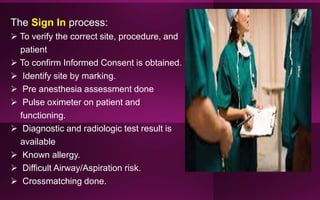
The Sign In process:
 To verify the correct site, procedure, and
patient
 To confirm Informed Consent is obtained.
 Identify site by marking.
 Pre anesthesia assessment done
 Pulse oximeter on patient and
functioning.
 Diagnostic and radiologic test result is
available
 Known allergy.
 Difficult Airway/Aspiration risk.
 Crossmatching done.
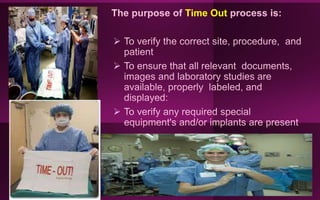
Time Out



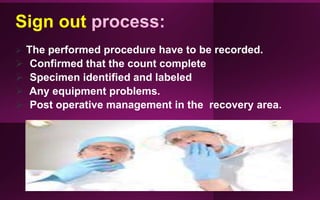
Sign out
 The performed procedure have to be recorded.
 Confirmed that the count complete
 Specimen identified and labeled
 Any equipment problems.
 Post operative management in the recovery area.
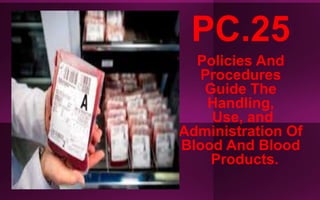
PC.25
Policies And
Procedures
Guide The
Handling,
Use, and
Administration Of
Blood And Blood
Products.
”Transfusion without NAT testing".
 Two staff members


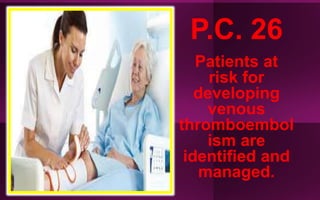
P.C. 26
Patients at
risk for
developing
venous
thromboembol
ism are
identified and
managed.
ADULT VENOUS
THROMBOEMBOLISM RISK ASSESSMENT TOOL.

( Chemical and
Mechanical)SHOULD
Thank You

CBAHI - ESR

  • 1.
    Joven Botin Bilbao,RN, MAN Deputy Chief Nurse Officer Clinical and Accreditation Educator
  • 2.
    QM.17 The hospital has aprocess to ensure correct identification of patients.
  • 4.
    “can you tellme your name and address” “are you Ahmed Saeed Saleh Alqahtani”,
  • 5.
    Q.M. 18 The hospitalhas a process to prevent wrong patient, wrong site, and wrong surgery/procedure.
  • 6.
    A Surgical SafetyChecklist Should Be Done For At Least:  Procedures that investigate and/or treat diseases and disorders of the human body through cutting, removing, altering, or insertion of diagnostic /therapeutic scopes.  The Sign In, Sign Out, and Time Out applies to a location in the hospital where these procedures are performed, and it must be done just before starting the procedure which involves the entire operative team.
  • 7.
    Protocol : Pre-operative verification process Markingof the precise site of procedure/surgery A time-out that is held immediately before the start of any procedure/Surgery.
  • 8.
    Pre-operative Checklist Will beinitiated the day before the surgery unless the procedure is an emergency.
  • 9.
    Surgical Site Marking:  Involve the patient  Done with an instantly recognize mark “X”  Be consistent throughout the hospital  Be made by the person performing the procedure  Take place with the patient awake and aware, if possible.  Be visible after the patient is prepped and draped.  Marked in all cases involving laterality, multiple structures (fingers, toes, lesions), or multiple levels (spine)
  • 10.
    Exemption of markingthe surgical site:  Single organ  Interventional cases for which the catheter/instruments insertion site is not predetermined.  Teeth-But, indicate operative tooth name(s) on documentation.  Premature infants, for whom the mark may cause a permanent tattoo.
  • 11.
    The Sign Inprocess:  To verify the correct site, procedure, and patient  To confirm Informed Consent is obtained.  Identify site by marking.  Pre anesthesia assessment done  Pulse oximeter on patient and functioning.  Diagnostic and radiologic test result is available  Known allergy.  Difficult Airway/Aspiration risk.  Crossmatching done.
  • 12.
  • 13.
    Sign out  Theperformed procedure have to be recorded.  Confirmed that the count complete  Specimen identified and labeled  Any equipment problems.  Post operative management in the recovery area.
  • 14.
    PC.25 Policies And Procedures Guide The Handling, Use,and Administration Of Blood And Blood Products.
  • 16.
    ”Transfusion without NATtesting".  Two staff members  
  • 17.
    P.C. 26 Patients at riskfor developing venous thromboembol ism are identified and managed.
  • 18.
  • 19.
  • 21.