
Submitted by : Arun NagarajanProduction and selected fuel properties of biodiesel from promising non-edible oilsRui Wang, Milford A. HannaRenewable energy
Biodiesel - IntroductionFossil fuel : non renewable resource – million year.But depleted – faster than regenerated.Biodiesel - Alternative fuel for diesel engines.Made from vegetable oil or animal fat.Meets health effect testing (CAA).Lower emissions, High flash point (>300F), Safer.Biodegradable, Essentially non-toxic.Reduces carbon monoxide, hydrocarbon, and sulfur emissions.2(Ma and Hanna, 1999)
Environmental IssuesCombustion of fossil fuels - ↑ atmospheric  CO2  level.Fossil fuels are a limited resource.Biodiesel’s Closed Carbon CycleEdited from: http://www.gift-n-garden.com/algae_biodiesel.jpg3
Reason for study95% Biodiesel produced from EDIBLE OIL.Leads to imbalance between Food & Energy resource.So overall production cost is HIGH (> fossil fuel).To promote global commercialization.LOW COST, NON-EDIBLE OILJatropha curcus, Madhuca indica – best feed stock.High monounsaturated fatty acid (C16:1; C18:1)
Low polyunsaturated fatty acid (C18:2, C18:3)
Saturated fatty acids (C16:0, C18:0).Superior character of Non-edible oilHence Non-edible oil is preferred4(Knothe, 2009; Ramos et al., 2009)
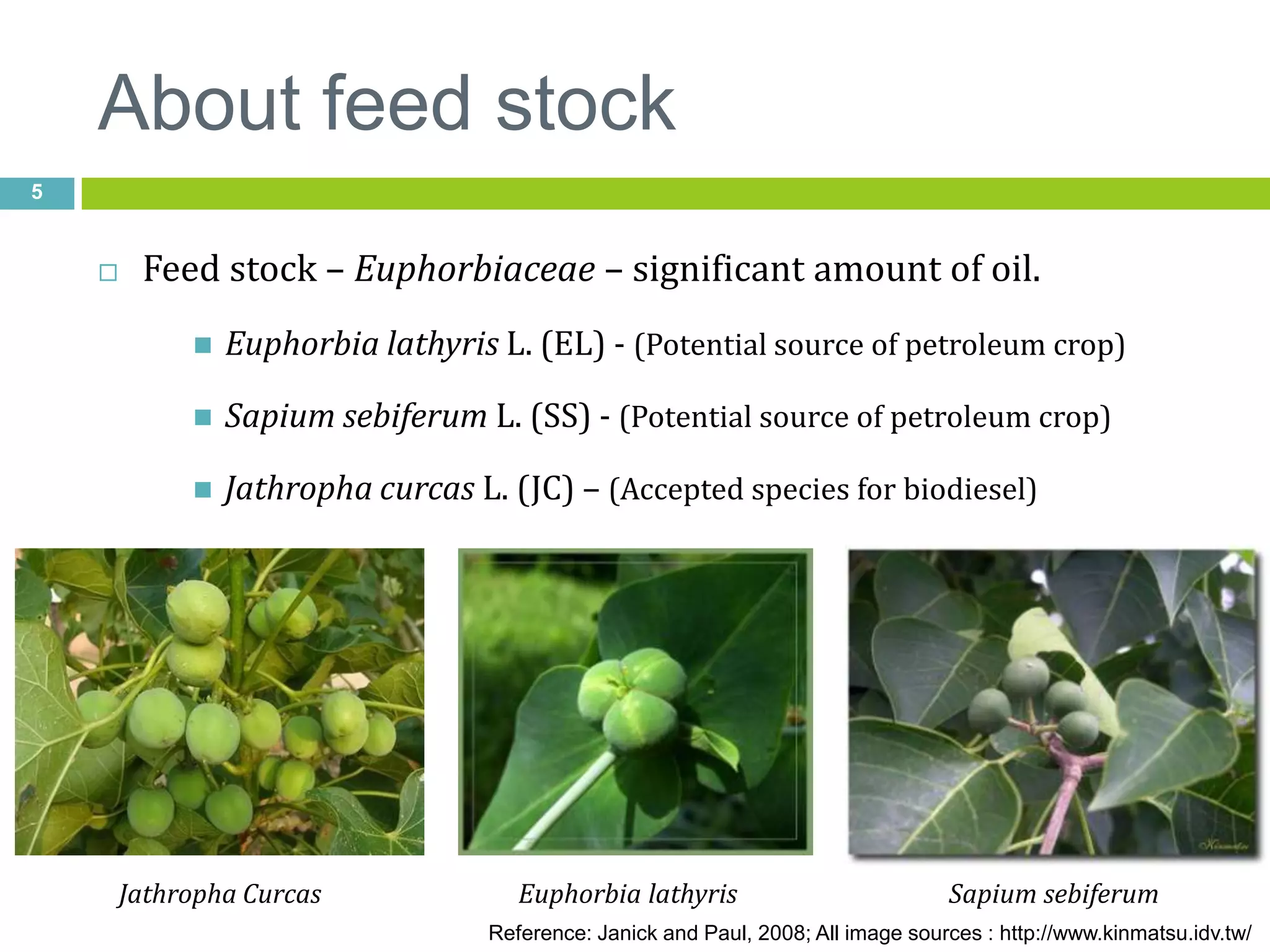
About feed stockFeed stock – Euphorbiaceae – significant amount of oil.Euphorbia lathyris L. (EL) - (Potential source of petroleum crop)Sapiumsebiferum L. (SS) - (Potential source of petroleum crop)Jathropha curcas L. (JC) – (Accepted species for biodiesel)5Jathropha Curcas   Euphorbia lathyris	SapiumsebiferumReference: Janick and Paul, 2008; All image sources : http://www.kinmatsu.idv.tw/
About crops6Ayerbeet al., 1984; Rattiet al.,1995; Guand Liu, 2001; Janick and Paul, 2008)
Drawback7Non-edible oil:Cannot directly transesterified – basic catalyst.Reason: High content of fatty acids. (Pinziet al., 2009) Hence two-step catalytic process.Pre-esterificationTransesterificationThis two-step process was already involved in J. curcus production (Pinziet al., 2009).
FAC & FAME contents8EL oil & JC oil – Mechanical expression.SS kernel oil – De waxing and crushed to extract oil. (Rajamet al., 2005)Extracted OIL + KOH + Boron tri fluoride  Methylated estersMajor fatty acid components were identified by GC/MS.Agilent GC6890 with HP-innowax and flame ionization detector is used.Yield of FAME:FAME YEILD(%)=Total weight of FAMET𝑜tal weight of oil  X 100%FAME is not Biodiesel unless it meets the relevant standards. 
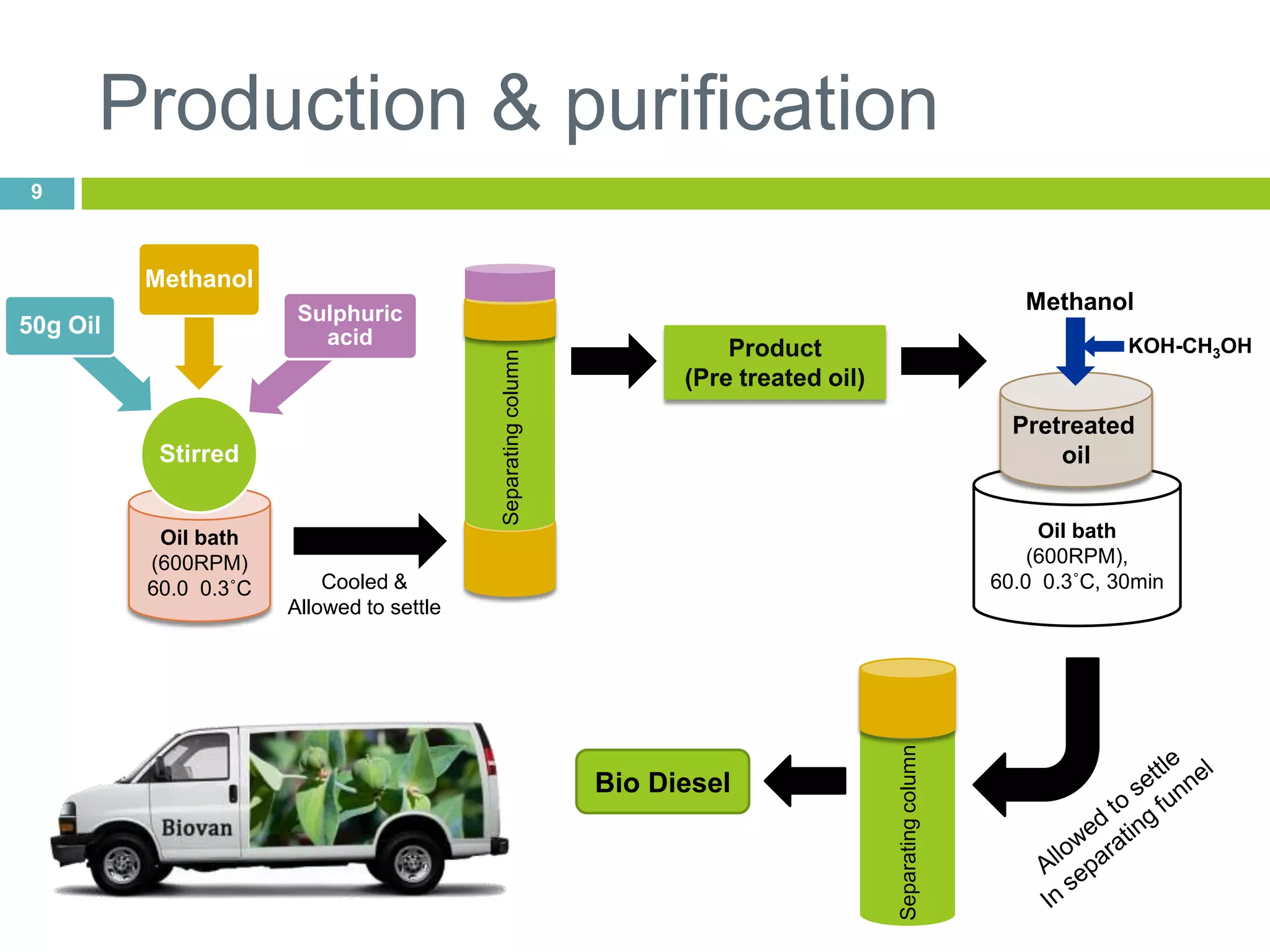
Production & purification9Product (Pre treated oil)MethanolKOH-CH3OHSeparating columnPretreated oilOil bath(600RPM), 60.0±0.3˚C, 30minOil bath(600RPM)60.0±0.3˚CCooled &Allowed to settleBio DieselAllowed to settleIn separating funnelSeparating column
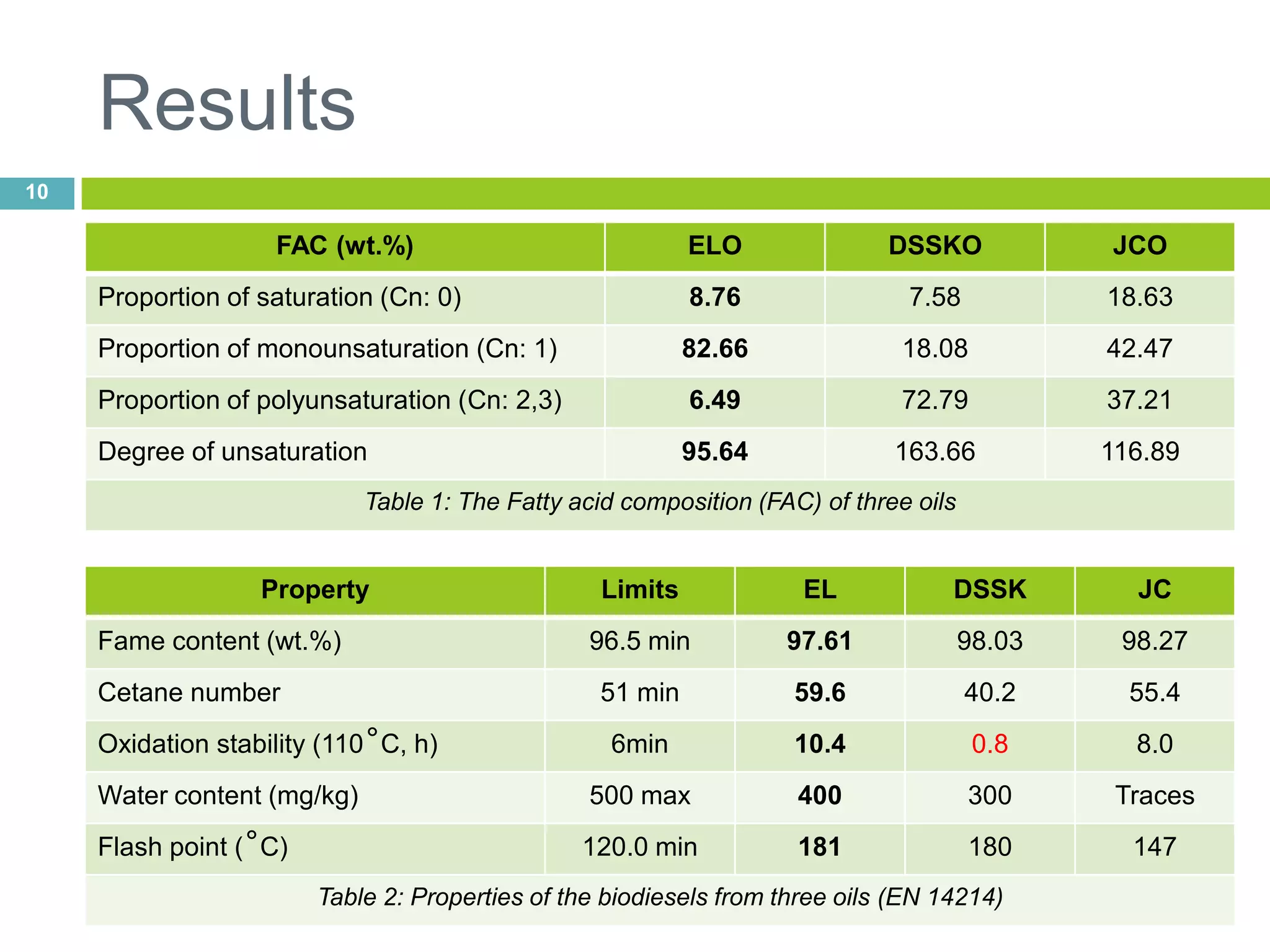
Results10
Discussion11ELO possessed the Highest monounsaturated fatty acid content (82.66 wt.%)Lowest polyunsaturated fatty acid content (6.49 wt.%) Low saturated fatty acid content (8.78 wt.%)High oxidative stability (10.4h)High Cetane number (59.6)Although cetane number (59.6) of ELO biodiesel was lower than palm oil (61) (Rashid et al., 2008)Good cold flow properties
Discussion (Cont…)12(a) Effect of catalyst conc. on esterification reaction. In which conc. Was optimized at 0.8, 0.4, 0.4 wt. % for ELO, DSSKO and JCO.(b) The effect of the methanol to oil ratio on esterification reaction.Optimum result for ELO, DSSKO and JCO were achieved within 1hr at 10:1, 8:1, 8:1 respectively.(c) Effect of reaction time on esterification.15, 30, 45, 60 min were evaluated. In which 45, 30, 30 were optimum for ELO, DSSKO and JCO respectively.(d) The effect of catalyst (KOH) concentration on transesterification.FAME yields of 85.6%, 86.3% and 84.2% were obtained  from ELO, DSSKO and JCO.
Conclusion13Comparatively low cetane number (55.4), oxidative stability (8h) of JCO biodiesel were considered moderate biodiesel. (Table 2)Alternatively, low cetane number (40.2), oxidative stability (0.8h) were observed in DSSK biodiesel is due to low degree of saturation (7.58%) and high degree of polyunsaturation(72.79%) and it did not satisfy standards.The ELO and JCO biodiesels fits EN 14124 standard.The fuel properties of ELO biodiesel were superior than other fuels.Thus E. lathyris L. is promising species for biodiesel feed stock and potential substitute for J. curcas L.
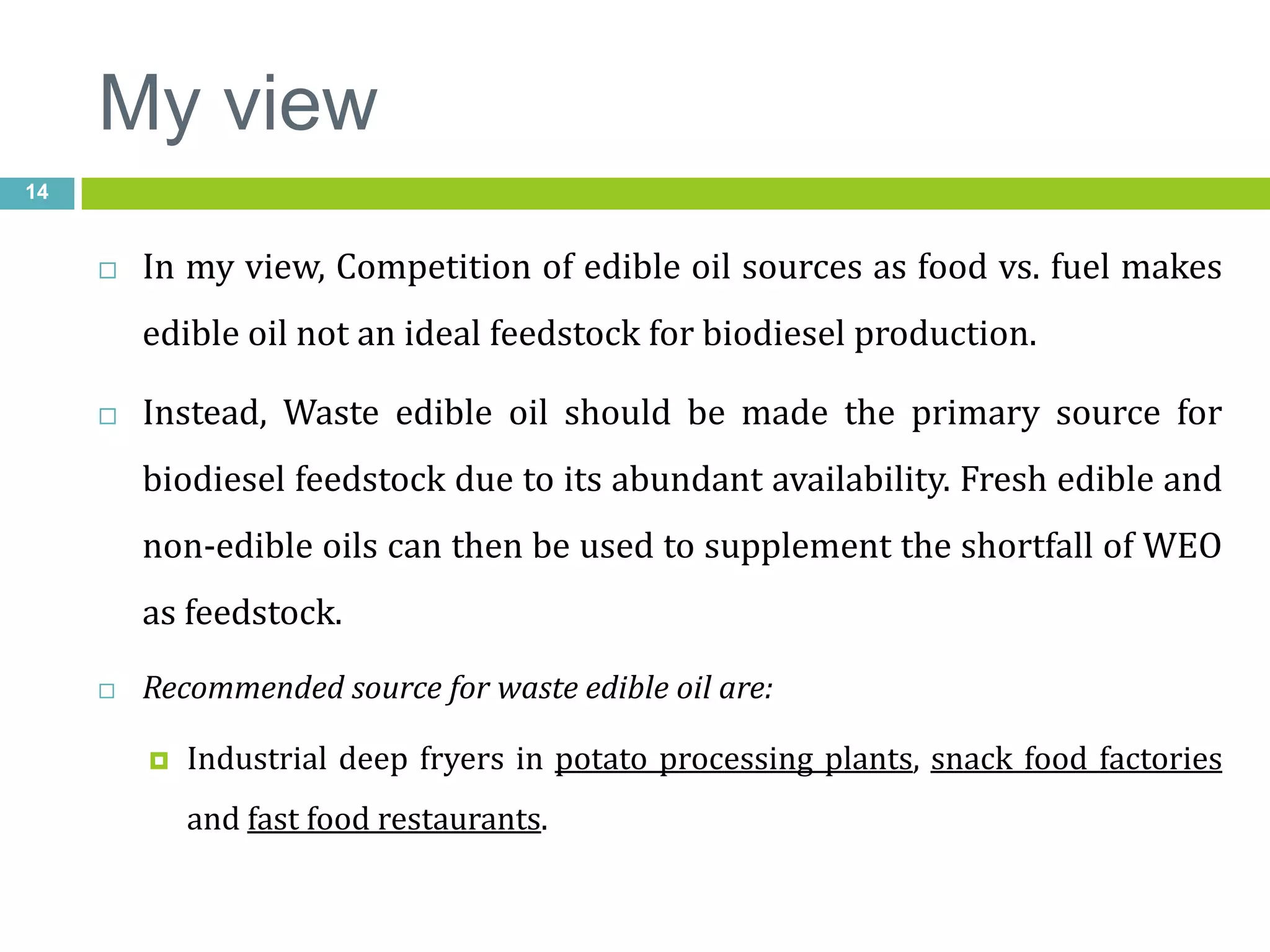
My view14In my view, Competition of edible oil sources as food vs. fuel makes edible oil not an ideal feedstock for biodiesel production. Instead, Waste edible oil should be made the primary source for biodiesel feedstock due to its abundant availability. Fresh edible and non-edible oils can then be used to supplement the shortfall of WEO as feedstock.Recommended source for waste edible oil are:Industrial deep fryers in potato processing plants, snack food factories and fast food restaurants.

renewable energy

  • 1.
    Submitted by :Arun NagarajanProduction and selected fuel properties of biodiesel from promising non-edible oilsRui Wang, Milford A. HannaRenewable energy
  • 2.
    Biodiesel - IntroductionFossilfuel : non renewable resource – million year.But depleted – faster than regenerated.Biodiesel - Alternative fuel for diesel engines.Made from vegetable oil or animal fat.Meets health effect testing (CAA).Lower emissions, High flash point (>300F), Safer.Biodegradable, Essentially non-toxic.Reduces carbon monoxide, hydrocarbon, and sulfur emissions.2(Ma and Hanna, 1999)
  • 3.
    Environmental IssuesCombustion offossil fuels - ↑ atmospheric CO2 level.Fossil fuels are a limited resource.Biodiesel’s Closed Carbon CycleEdited from: http://www.gift-n-garden.com/algae_biodiesel.jpg3
  • 4.
    Reason for study95%Biodiesel produced from EDIBLE OIL.Leads to imbalance between Food & Energy resource.So overall production cost is HIGH (> fossil fuel).To promote global commercialization.LOW COST, NON-EDIBLE OILJatropha curcus, Madhuca indica – best feed stock.High monounsaturated fatty acid (C16:1; C18:1)
  • 5.
    Low polyunsaturated fattyacid (C18:2, C18:3)
  • 6.
    Saturated fatty acids(C16:0, C18:0).Superior character of Non-edible oilHence Non-edible oil is preferred4(Knothe, 2009; Ramos et al., 2009)
  • 7.
    About feed stockFeedstock – Euphorbiaceae – significant amount of oil.Euphorbia lathyris L. (EL) - (Potential source of petroleum crop)Sapiumsebiferum L. (SS) - (Potential source of petroleum crop)Jathropha curcas L. (JC) – (Accepted species for biodiesel)5Jathropha Curcas Euphorbia lathyris SapiumsebiferumReference: Janick and Paul, 2008; All image sources : http://www.kinmatsu.idv.tw/
  • 8.
    About crops6Ayerbeet al.,1984; Rattiet al.,1995; Guand Liu, 2001; Janick and Paul, 2008)
  • 9.
    Drawback7Non-edible oil:Cannot directlytransesterified – basic catalyst.Reason: High content of fatty acids. (Pinziet al., 2009) Hence two-step catalytic process.Pre-esterificationTransesterificationThis two-step process was already involved in J. curcus production (Pinziet al., 2009).
  • 10.
    FAC & FAMEcontents8EL oil & JC oil – Mechanical expression.SS kernel oil – De waxing and crushed to extract oil. (Rajamet al., 2005)Extracted OIL + KOH + Boron tri fluoride  Methylated estersMajor fatty acid components were identified by GC/MS.Agilent GC6890 with HP-innowax and flame ionization detector is used.Yield of FAME:FAME YEILD(%)=Total weight of FAMET𝑜tal weight of oil X 100%FAME is not Biodiesel unless it meets the relevant standards. 
  • 11.
    Production & purification9Product(Pre treated oil)MethanolKOH-CH3OHSeparating columnPretreated oilOil bath(600RPM), 60.0±0.3˚C, 30minOil bath(600RPM)60.0±0.3˚CCooled &Allowed to settleBio DieselAllowed to settleIn separating funnelSeparating column
  • 12.
  • 13.
    Discussion11ELO possessed theHighest monounsaturated fatty acid content (82.66 wt.%)Lowest polyunsaturated fatty acid content (6.49 wt.%) Low saturated fatty acid content (8.78 wt.%)High oxidative stability (10.4h)High Cetane number (59.6)Although cetane number (59.6) of ELO biodiesel was lower than palm oil (61) (Rashid et al., 2008)Good cold flow properties
  • 14.
    Discussion (Cont…)12(a) Effectof catalyst conc. on esterification reaction. In which conc. Was optimized at 0.8, 0.4, 0.4 wt. % for ELO, DSSKO and JCO.(b) The effect of the methanol to oil ratio on esterification reaction.Optimum result for ELO, DSSKO and JCO were achieved within 1hr at 10:1, 8:1, 8:1 respectively.(c) Effect of reaction time on esterification.15, 30, 45, 60 min were evaluated. In which 45, 30, 30 were optimum for ELO, DSSKO and JCO respectively.(d) The effect of catalyst (KOH) concentration on transesterification.FAME yields of 85.6%, 86.3% and 84.2% were obtained from ELO, DSSKO and JCO.
  • 15.
    Conclusion13Comparatively low cetanenumber (55.4), oxidative stability (8h) of JCO biodiesel were considered moderate biodiesel. (Table 2)Alternatively, low cetane number (40.2), oxidative stability (0.8h) were observed in DSSK biodiesel is due to low degree of saturation (7.58%) and high degree of polyunsaturation(72.79%) and it did not satisfy standards.The ELO and JCO biodiesels fits EN 14124 standard.The fuel properties of ELO biodiesel were superior than other fuels.Thus E. lathyris L. is promising species for biodiesel feed stock and potential substitute for J. curcas L.
  • 16.
    My view14In myview, Competition of edible oil sources as food vs. fuel makes edible oil not an ideal feedstock for biodiesel production. Instead, Waste edible oil should be made the primary source for biodiesel feedstock due to its abundant availability. Fresh edible and non-edible oils can then be used to supplement the shortfall of WEO as feedstock.Recommended source for waste edible oil are:Industrial deep fryers in potato processing plants, snack food factories and fast food restaurants.
  • 17.
    References15Ma, F.R., Hanna,M.A., 1999. Biodiesel production: a review. Bioresour. Technol. 70, 1–15.Knothe, G., 2009. Improving biodiesel fuel properties by modifying fatty ester composition. Energy Environ. Sci.2, 759–766.Janick, J., Paul, R.E., 2008. Encyclopedia of Fruits and Nuts. CABI, London.Ayerbe, L., Tenorio, J.L., Ventas, P., Funes, E., Mellado, L., 1984. Euphorbia lathyris as an energy crop-part 1. Vegetative matter and seed productivity. Biomass4, 283–293.Ratti, N., Sidhu, O.P., Behl, H.M., 1995. Quantification of polyisoprenes from some promising euphorbs. Bioresour. Technol.52, 231–235.Gu, Q., Liu, J., 2001. The analysis of correlation between ratio of different parts and their oil contents of Sapiumsebiferumseed and environmental factors. J. Plant Resour. Environ. 14, 14–16.Pinzi, S., Garcia, I.L., Lopez-Gimenez, F.J., Luque de Castro, M.D., Dorado, G., Dorado, M.P., 2009. The ideal vegetable oil-based biodiesel composition: a review of social, economical and technical implications.Energ. Fuel 23, 2325–2341.Rajam, L., Soban Kumar, D.R., Sundaresan, A., Arumughan, C., 2005. A novel process for physically refining rice bran oil through simultaneous degumming and dewaxing. J. Am. Oil Chem. Soc.82, 213–220.Rashid, U., Anwar, F., Moser, B.R., Knothe, G., 2008. Moringaoleiferaoil: a possible source of biodiesel. Bioresour. Technol.99, 8175–8179.
  • 18.