UNDER GUIDANCE-
Mr. HITESH KUMAR
ASST. PROFESSOR
DEPT. OF MECHANICAL ENGINEERING
Mr. H.S.PALI
ASST.PROFESSOR
DEPT. OF MECHANICAL ENGINEERING
PRESENTED BY-
SYED HUR ABBAS NAQVI (1113340216)
SAURABH KUMAR NISHAD (1113340187)
SUSHIL KUMAR PANDEY (1113340215)
SAURAV KUMAR (1113340188)
o INTRODUCTION
o WHY WE USE CASTOR OIL
o WHAT IS BIODIESEL
o HISTORICAL DEVELOPMENT OF BIODIESEL
o ADVANTAGES
o RAW MATERIAL USE
o REACTION INVOLVED
o LITERATURE REVIEW
o OBJECTIVE AND SCOPE OF PROJECT
o PRODUCTION OF BIODIESEL
o ENGINE SETUP FOR TESTING
o CONCLUSION
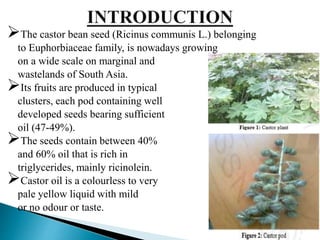
The castor bean seed (Ricinus communis L.) belonging
to Euphorbiaceae family, is nowadays growing
on a wide scale on marginal and
wastelands of South Asia.
Its fruits are produced in typical
clusters, each pod containing well
developed seeds bearing sufficient
oil (47-49%).
The seeds contain between 40%
and 60% oil that is rich in
triglycerides, mainly ricinolein.
Castor oil is a colourless to very
pale yellow liquid with mild
or no odour or taste.
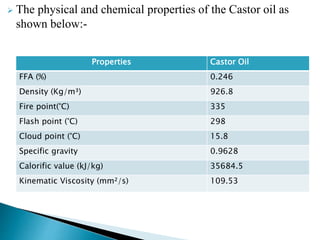
 The physical and chemical properties of the Castor oil as
shown below:-
Properties Castor Oil
FFA (%) 0.246
Density (Kg/m³) 926.8
Fire point(°C) 335
Flash point (°C) 298
Cloud point (°C) 15.8
Specific gravity 0.9628
Calorific value (kJ/kg) 35684.5
Kinematic Viscosity (mm²/s) 109.53
 In the seed, the oil content is about 50% of the total
weight.
 It is the only unique oil which has an unusual chemical
composition of triglyceride of fatty acid i.e,18-carbon
hydroxylated fatty acid with one double bond.
 The plant can stand long periods of drought.
 India is the largest producer of castor in the world.
 The oil has versatile utility such as cosmetics,
lubricants, brake fluids, softener in tanning, textile
company, boots and shoe manufacturing.
 Biodiesel is an alternative fuel similar to conventional or
fossil diesel.
 Biodiesel is a fuel consisting of the alkyl monoesters of
fatty acids derived from vegetable oils and animal fats .
 Biodiesel is produced from the transesterification reaction,
in this process oil is mixed with an alcohol to produce
glycerol ,as a byproduct.
 Rudolf Diesel, the inventor of diesel engine at the world
exhibition in Paris presented the concept of using the bio
fuels in diesel engine in 1890.
 It was a Belgian inventor in 1937 who proposed using
transesterification to convert vegetable oils into fatty acid
alkyl ester.
 Martin Mittelbach further developed biodiesel fuel industry
in the early 1990s.
• Renewable energy source.
• Less polluting.
• Blend with other energy resources and oil.
• Used in heating systems and diesel engines without any
alterations.
• Lubricating property
1. ALCOHOL
Alcohols with string of 1-8 carbons are used for the biodiesel
production. Alcohols used in this process are: methanol, ethanol,
propanol, butanol. We have to use methanol because of :-
- its low viscosity
- it requires less reaction time
- lower cost & better performance
2. CATALYSTS
Catalysts (acid and/or base) are used to speed the reaction. It is
important to note that the acid or base are not consumed by the
transesterification reaction, thus they are not reactants, but catalysts.
Common catalysts for transesterification include sodium
hydroxide, potassium hydroxide, and sodium methoxide.
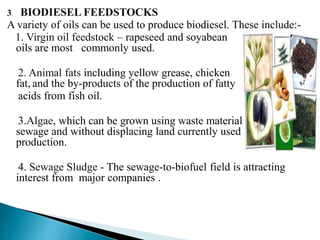
3. BIODIESEL FEEDSTOCKS
A variety of oils can be used to produce biodiesel. These include:-
1. Virgin oil feedstock – rapeseed and soyabean
oils are most commonly used.
2. Animal fats including yellow grease, chicken
fat, and the by-products of the production of fatty
acids from fish oil.
3.Algae, which can be grown using waste materials such as
sewage and without displacing land currently used for food
production.
4. Sewage Sludge - The sewage-to-biofuel field is attracting
interest from major companies .
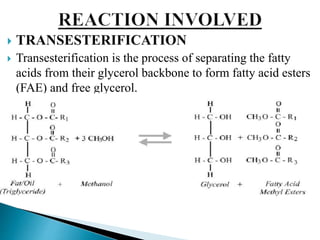
 TRANSESTERIFICATION
 Transesterification is the process of separating the fatty
acids from their glycerol backbone to form fatty acid esters
(FAE) and free glycerol.
S.
No
AUTHORS YEAR/JOURNAL(PU
BLISHER)
TITLE REMARKS
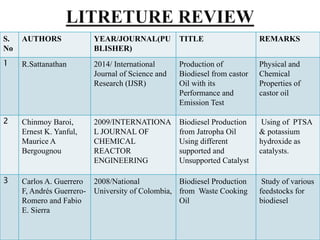
1 R.Sattanathan 2014/ International
Journal of Science and
Research (IJSR)
Production of
Biodiesel from castor
Oil with its
Performance and
Emission Test
Physical and
Chemical
Properties of
castor oil
2 Chinmoy Baroi,
Ernest K. Yanful,
Maurice A
Bergougnou
2009/INTERNATIONA
L JOURNAL OF
CHEMICAL
REACTOR
ENGINEERING
Biodiesel Production
from Jatropha Oil
Using different
supported and
Unsupported Catalyst
Using of PTSA
& potassium
hydroxide as
catalysts.
3 Carlos A. Guerrero
F, Andrés Guerrero-
Romero and Fabio
E. Sierra
2008/National
University of Colombia,
Biodiesel Production
from Waste Cooking
Oil
Study of various
feedstocks for
biodiesel
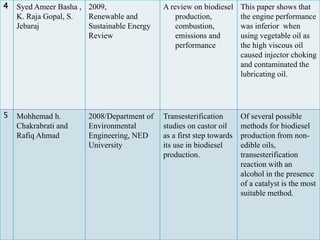
4 Syed Ameer Basha ,
K. Raja Gopal, S.
Jebaraj
2009,
Renewable and
Sustainable Energy
Review
A review on biodiesel
production,
combustion,
emissions and
performance
This paper shows that
the engine performance
was inferior when
using vegetable oil as
the high viscous oil
caused injector choking
and contaminated the
lubricating oil.
5 Mohhemad h.
Chakrabrati and
Rafiq Ahmad
2008/Department of
Environmental
Engineering, NED
University
Transesterification
studies on castor oil
as a first step towards
its use in biodiesel
production.
Of several possible
methods for biodiesel
production from non-
edible oils,
transesterification
reaction with an
alcohol in the presence
of a catalyst is the most
suitable method.
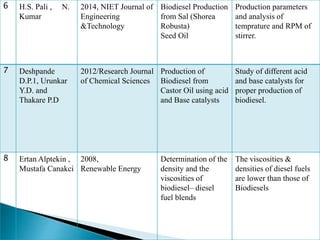
6 H.S. Pali , N.
Kumar
2014, NIET Journal of
Engineering
&Technology
Biodiesel Production
from Sal (Shorea
Robusta)
Seed Oil
Production parameters
and analysis of
temprature and RPM of
stirrer.
7 Deshpande
D.P.1, Urunkar
Y.D. and
Thakare P.D
2012/Research Journal
of Chemical Sciences
Production of
Biodiesel from
Castor Oil using acid
and Base catalysts
Study of different acid
and base catalysts for
proper production of
biodiesel.
8 Ertan Alptekin ,
Mustafa Canakci
2008,
Renewable Energy
Determination of the
density and the
viscosities of
biodiesel– diesel
fuel blends
The viscosities &
densities of diesel fuels
are lower than those of
Biodiesels
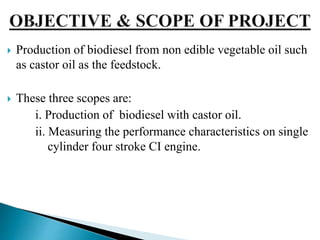
 Production of biodiesel from non edible vegetable oil such
as castor oil as the feedstock.
 These three scopes are:
i. Production of biodiesel with castor oil.
ii. Measuring the performance characteristics on single
cylinder four stroke CI engine.
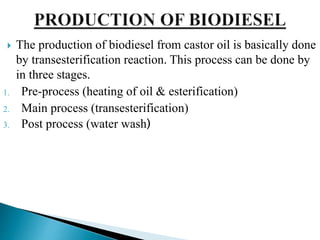
 The production of biodiesel from castor oil is basically done
by transesterification reaction. This process can be done by
in three stages.
1. Pre-process (heating of oil & esterification)
2. Main process (transesterification)
3. Post process (water wash)
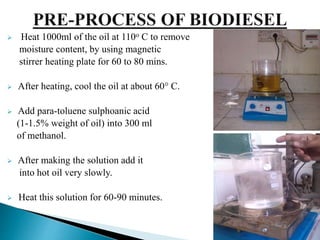
 Heat 1000ml of the oil at 110o C to remove
moisture content, by using magnetic
stirrer heating plate for 60 to 80 mins.
 After heating, cool the oil at about 60° C.
 Add para-toluene sulphoanic acid
(1-1.5% weight of oil) into 300 ml
of methanol.
 After making the solution add it
into hot oil very slowly.
 Heat this solution for 60-90 minutes.
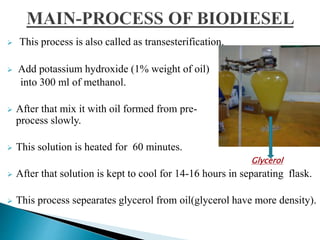
 This process is also called as transesterification.
 Add potassium hydroxide (1% weight of oil)
into 300 ml of methanol.
 After that mix it with oil formed from pre-
process slowly.
 This solution is heated for 60 minutes.
 After that solution is kept to cool for 14-16 hours in separating flask.
 This process sepearates glycerol from oil(glycerol have more density).
Glycerol
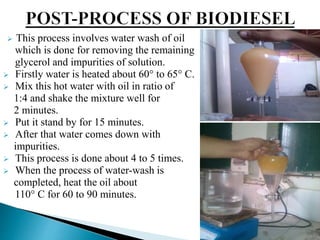
 This process involves water wash of oil
which is done for removing the remaining
glycerol and impurities of solution.
 Firstly water is heated about 60° to 65° C.
 Mix this hot water with oil in ratio of
1:4 and shake the mixture well for
2 minutes.
 Put it stand by for 15 minutes.
 After that water comes down with
impurities.
 This process is done about 4 to 5 times.
 When the process of water-wash is
completed, heat the oil about
110° C for 60 to 90 minutes.
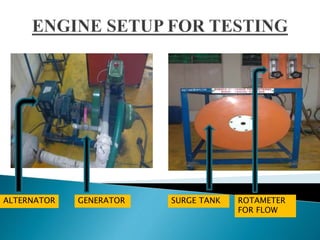
ALTERNATOR GENERATOR ROTAMETER
FOR FLOW
SURGE TANK
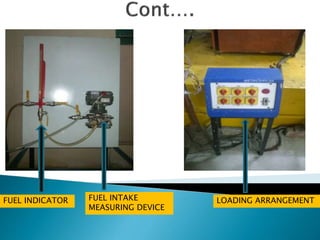
FUEL INDICATOR FUEL INTAKE
MEASURING DEVICE
LOADING ARRANGEMENT
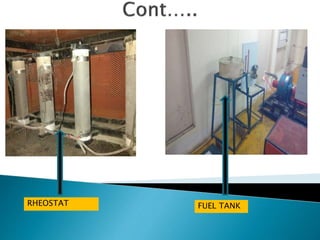
RHEOSTAT FUEL TANK
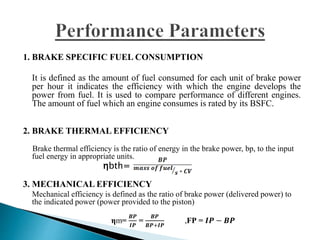
1. BRAKE SPECIFIC FUEL CONSUMPTION
It is defined as the amount of fuel consumed for each unit of brake power
per hour it indicates the efficiency with which the engine develops the
power from fuel. It is used to compare performance of different engines.
The amount of fuel which an engine consumes is rated by its BSFC.
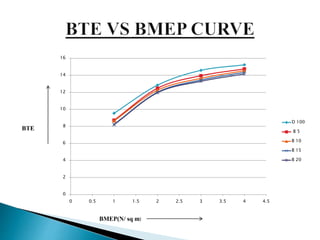
2. BRAKE THERMAL EFFICIENCY
Brake thermal efficiency is the ratio of energy in the brake power, bp, to the input
fuel energy in appropriate units.
ηbth=
3. MECHANICAL EFFICIENCY
Mechanical efficiency is defined as the ratio of brake power (delivered power) to
the indicated power (power provided to the piston)
ηm=
𝑩𝑷
𝑰𝑷
=
𝑩𝑷
𝑩𝑷+𝑰𝑷
,FP = 𝑰𝑷 − 𝑩𝑷
4 . INDICATED THERMAL EFFICIENCY
Indicated thermal efficiency is the ratio of energy in the indicated
power, IP, to the input fuel energy in appropriate units.
ηth =
𝒊𝒏𝒅𝒊𝒄𝒂𝒕𝒆𝒅 𝒑𝒐𝒘𝒆𝒓 [
𝒌𝒋
𝒔]
𝒆𝒏𝒆𝒓𝒈𝒚 𝒊𝒏 𝒇𝒖𝒍 𝒑𝒆𝒓 𝒔𝒆𝒄𝒐𝒏𝒅 [
𝑲𝒋
𝒔]
5. MEAN EFFECTIVE PRESSURE
Mean effective pressure is the average pressure inside the cylinder of an
internal combustion engine based on the calculated or measured power output. It
increases as manifold pressure increases. For any particular engine, operating at a
given speed and power output, there will be a specific indicated mean effective
pressure, imep, and a corresponding brake mean effective pressure.
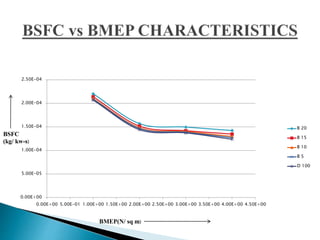
0.00E+00
5.00E-05
1.00E-04
1.50E-04
2.00E-04
2.50E-04
0.00E+00 5.00E-01 1.00E+00 1.50E+00 2.00E+00 2.50E+00 3.00E+00 3.50E+00 4.00E+00 4.50E+00
B 20
B 15
B 10
B 5
D 100
BSFC
(kg/ kw-s)
BMEP(N/ sq m)
0
2
4
6
8
10
12
14
16
0 0.5 1 1.5 2 2.5 3 3.5 4 4.5
D 100
B 5
B 10
B 15
B 20
BTE
BMEP(N/ sq m)
0
10
20
30
40
50
60
70
80
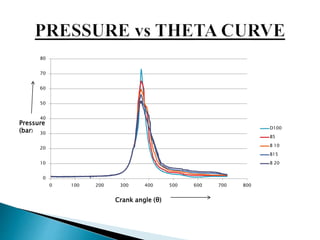
0 100 200 300 400 500 600 700 800
D100
B5
B 10
B15
B 20
Pressure
(bar)
Crank angle (θ)
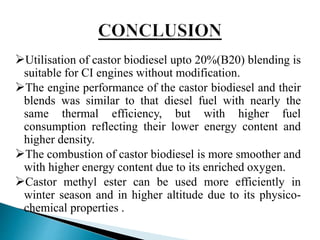
Utilisation of castor biodiesel upto 20%(B20) blending is
suitable for CI engines without modification.
The engine performance of the castor biodiesel and their
blends was similar to that diesel fuel with nearly the
same thermal efficiency, but with higher fuel
consumption reflecting their lower energy content and
higher density.
The combustion of castor biodiesel is more smoother and
with higher energy content due to its enriched oxygen.
Castor methyl ester can be used more efficiently in
winter season and in higher altitude due to its physico-
chemical properties .
Castor biodiesel

Castor biodiesel

  • 1.
    UNDER GUIDANCE- Mr. HITESHKUMAR ASST. PROFESSOR DEPT. OF MECHANICAL ENGINEERING Mr. H.S.PALI ASST.PROFESSOR DEPT. OF MECHANICAL ENGINEERING PRESENTED BY- SYED HUR ABBAS NAQVI (1113340216) SAURABH KUMAR NISHAD (1113340187) SUSHIL KUMAR PANDEY (1113340215) SAURAV KUMAR (1113340188)
  • 2.
    o INTRODUCTION o WHYWE USE CASTOR OIL o WHAT IS BIODIESEL o HISTORICAL DEVELOPMENT OF BIODIESEL o ADVANTAGES o RAW MATERIAL USE o REACTION INVOLVED o LITERATURE REVIEW o OBJECTIVE AND SCOPE OF PROJECT o PRODUCTION OF BIODIESEL o ENGINE SETUP FOR TESTING o CONCLUSION
  • 3.
    The castor beanseed (Ricinus communis L.) belonging to Euphorbiaceae family, is nowadays growing on a wide scale on marginal and wastelands of South Asia. Its fruits are produced in typical clusters, each pod containing well developed seeds bearing sufficient oil (47-49%). The seeds contain between 40% and 60% oil that is rich in triglycerides, mainly ricinolein. Castor oil is a colourless to very pale yellow liquid with mild or no odour or taste.
  • 4.
     The physicaland chemical properties of the Castor oil as shown below:- Properties Castor Oil FFA (%) 0.246 Density (Kg/m³) 926.8 Fire point(°C) 335 Flash point (°C) 298 Cloud point (°C) 15.8 Specific gravity 0.9628 Calorific value (kJ/kg) 35684.5 Kinematic Viscosity (mm²/s) 109.53
  • 5.
     In theseed, the oil content is about 50% of the total weight.  It is the only unique oil which has an unusual chemical composition of triglyceride of fatty acid i.e,18-carbon hydroxylated fatty acid with one double bond.  The plant can stand long periods of drought.  India is the largest producer of castor in the world.  The oil has versatile utility such as cosmetics, lubricants, brake fluids, softener in tanning, textile company, boots and shoe manufacturing.
  • 6.
     Biodiesel isan alternative fuel similar to conventional or fossil diesel.  Biodiesel is a fuel consisting of the alkyl monoesters of fatty acids derived from vegetable oils and animal fats .  Biodiesel is produced from the transesterification reaction, in this process oil is mixed with an alcohol to produce glycerol ,as a byproduct.
  • 7.
     Rudolf Diesel,the inventor of diesel engine at the world exhibition in Paris presented the concept of using the bio fuels in diesel engine in 1890.  It was a Belgian inventor in 1937 who proposed using transesterification to convert vegetable oils into fatty acid alkyl ester.  Martin Mittelbach further developed biodiesel fuel industry in the early 1990s.
  • 8.
    • Renewable energysource. • Less polluting. • Blend with other energy resources and oil. • Used in heating systems and diesel engines without any alterations. • Lubricating property
  • 9.
    1. ALCOHOL Alcohols withstring of 1-8 carbons are used for the biodiesel production. Alcohols used in this process are: methanol, ethanol, propanol, butanol. We have to use methanol because of :- - its low viscosity - it requires less reaction time - lower cost & better performance 2. CATALYSTS Catalysts (acid and/or base) are used to speed the reaction. It is important to note that the acid or base are not consumed by the transesterification reaction, thus they are not reactants, but catalysts. Common catalysts for transesterification include sodium hydroxide, potassium hydroxide, and sodium methoxide.
  • 10.
    3. BIODIESEL FEEDSTOCKS Avariety of oils can be used to produce biodiesel. These include:- 1. Virgin oil feedstock – rapeseed and soyabean oils are most commonly used. 2. Animal fats including yellow grease, chicken fat, and the by-products of the production of fatty acids from fish oil. 3.Algae, which can be grown using waste materials such as sewage and without displacing land currently used for food production. 4. Sewage Sludge - The sewage-to-biofuel field is attracting interest from major companies .
  • 11.
     TRANSESTERIFICATION  Transesterificationis the process of separating the fatty acids from their glycerol backbone to form fatty acid esters (FAE) and free glycerol.
  • 12.
    S. No AUTHORS YEAR/JOURNAL(PU BLISHER) TITLE REMARKS 1R.Sattanathan 2014/ International Journal of Science and Research (IJSR) Production of Biodiesel from castor Oil with its Performance and Emission Test Physical and Chemical Properties of castor oil 2 Chinmoy Baroi, Ernest K. Yanful, Maurice A Bergougnou 2009/INTERNATIONA L JOURNAL OF CHEMICAL REACTOR ENGINEERING Biodiesel Production from Jatropha Oil Using different supported and Unsupported Catalyst Using of PTSA & potassium hydroxide as catalysts. 3 Carlos A. Guerrero F, Andrés Guerrero- Romero and Fabio E. Sierra 2008/National University of Colombia, Biodiesel Production from Waste Cooking Oil Study of various feedstocks for biodiesel
  • 13.
    4 Syed AmeerBasha , K. Raja Gopal, S. Jebaraj 2009, Renewable and Sustainable Energy Review A review on biodiesel production, combustion, emissions and performance This paper shows that the engine performance was inferior when using vegetable oil as the high viscous oil caused injector choking and contaminated the lubricating oil. 5 Mohhemad h. Chakrabrati and Rafiq Ahmad 2008/Department of Environmental Engineering, NED University Transesterification studies on castor oil as a first step towards its use in biodiesel production. Of several possible methods for biodiesel production from non- edible oils, transesterification reaction with an alcohol in the presence of a catalyst is the most suitable method.
  • 14.
    6 H.S. Pali, N. Kumar 2014, NIET Journal of Engineering &Technology Biodiesel Production from Sal (Shorea Robusta) Seed Oil Production parameters and analysis of temprature and RPM of stirrer. 7 Deshpande D.P.1, Urunkar Y.D. and Thakare P.D 2012/Research Journal of Chemical Sciences Production of Biodiesel from Castor Oil using acid and Base catalysts Study of different acid and base catalysts for proper production of biodiesel. 8 Ertan Alptekin , Mustafa Canakci 2008, Renewable Energy Determination of the density and the viscosities of biodiesel– diesel fuel blends The viscosities & densities of diesel fuels are lower than those of Biodiesels
  • 15.
     Production ofbiodiesel from non edible vegetable oil such as castor oil as the feedstock.  These three scopes are: i. Production of biodiesel with castor oil. ii. Measuring the performance characteristics on single cylinder four stroke CI engine.
  • 16.
     The productionof biodiesel from castor oil is basically done by transesterification reaction. This process can be done by in three stages. 1. Pre-process (heating of oil & esterification) 2. Main process (transesterification) 3. Post process (water wash)
  • 17.
     Heat 1000mlof the oil at 110o C to remove moisture content, by using magnetic stirrer heating plate for 60 to 80 mins.  After heating, cool the oil at about 60° C.  Add para-toluene sulphoanic acid (1-1.5% weight of oil) into 300 ml of methanol.  After making the solution add it into hot oil very slowly.  Heat this solution for 60-90 minutes.
  • 18.
     This processis also called as transesterification.  Add potassium hydroxide (1% weight of oil) into 300 ml of methanol.  After that mix it with oil formed from pre- process slowly.  This solution is heated for 60 minutes.  After that solution is kept to cool for 14-16 hours in separating flask.  This process sepearates glycerol from oil(glycerol have more density). Glycerol
  • 19.
     This processinvolves water wash of oil which is done for removing the remaining glycerol and impurities of solution.  Firstly water is heated about 60° to 65° C.  Mix this hot water with oil in ratio of 1:4 and shake the mixture well for 2 minutes.  Put it stand by for 15 minutes.  After that water comes down with impurities.  This process is done about 4 to 5 times.  When the process of water-wash is completed, heat the oil about 110° C for 60 to 90 minutes.
  • 20.
  • 21.
    FUEL INDICATOR FUELINTAKE MEASURING DEVICE LOADING ARRANGEMENT
  • 22.
  • 23.
    1. BRAKE SPECIFICFUEL CONSUMPTION It is defined as the amount of fuel consumed for each unit of brake power per hour it indicates the efficiency with which the engine develops the power from fuel. It is used to compare performance of different engines. The amount of fuel which an engine consumes is rated by its BSFC. 2. BRAKE THERMAL EFFICIENCY Brake thermal efficiency is the ratio of energy in the brake power, bp, to the input fuel energy in appropriate units. ηbth= 3. MECHANICAL EFFICIENCY Mechanical efficiency is defined as the ratio of brake power (delivered power) to the indicated power (power provided to the piston) ηm= 𝑩𝑷 𝑰𝑷 = 𝑩𝑷 𝑩𝑷+𝑰𝑷 ,FP = 𝑰𝑷 − 𝑩𝑷
  • 24.
    4 . INDICATEDTHERMAL EFFICIENCY Indicated thermal efficiency is the ratio of energy in the indicated power, IP, to the input fuel energy in appropriate units. ηth = 𝒊𝒏𝒅𝒊𝒄𝒂𝒕𝒆𝒅 𝒑𝒐𝒘𝒆𝒓 [ 𝒌𝒋 𝒔] 𝒆𝒏𝒆𝒓𝒈𝒚 𝒊𝒏 𝒇𝒖𝒍 𝒑𝒆𝒓 𝒔𝒆𝒄𝒐𝒏𝒅 [ 𝑲𝒋 𝒔] 5. MEAN EFFECTIVE PRESSURE Mean effective pressure is the average pressure inside the cylinder of an internal combustion engine based on the calculated or measured power output. It increases as manifold pressure increases. For any particular engine, operating at a given speed and power output, there will be a specific indicated mean effective pressure, imep, and a corresponding brake mean effective pressure.
  • 25.
    0.00E+00 5.00E-05 1.00E-04 1.50E-04 2.00E-04 2.50E-04 0.00E+00 5.00E-01 1.00E+001.50E+00 2.00E+00 2.50E+00 3.00E+00 3.50E+00 4.00E+00 4.50E+00 B 20 B 15 B 10 B 5 D 100 BSFC (kg/ kw-s) BMEP(N/ sq m)
  • 26.
    0 2 4 6 8 10 12 14 16 0 0.5 11.5 2 2.5 3 3.5 4 4.5 D 100 B 5 B 10 B 15 B 20 BTE BMEP(N/ sq m)
  • 27.
    0 10 20 30 40 50 60 70 80 0 100 200300 400 500 600 700 800 D100 B5 B 10 B15 B 20 Pressure (bar) Crank angle (θ)
  • 28.
    Utilisation of castorbiodiesel upto 20%(B20) blending is suitable for CI engines without modification. The engine performance of the castor biodiesel and their blends was similar to that diesel fuel with nearly the same thermal efficiency, but with higher fuel consumption reflecting their lower energy content and higher density. The combustion of castor biodiesel is more smoother and with higher energy content due to its enriched oxygen. Castor methyl ester can be used more efficiently in winter season and in higher altitude due to its physico- chemical properties .