Instituto Universitario
Politécnico Santiago Mariño
Extensión Porlamar
Estefany Rosales 26.534.993
Chemical Engineering (49)
Section: S1
Optimization of biodiesel production
from sunflower oil
using response surface methodology
(technical English)
The biodiesel
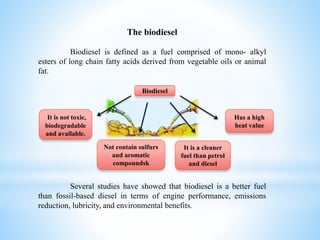
Biodiesel is defined as a fuel comprised of mono- alkyl
esters of long chain fatty acids derived from vegetable oils or animal
fat.
Several studies have showed that biodiesel is a better fuel
than fossil-based diesel in terms of engine performance, emissions
reduction, lubricity, and environmental benefits.
It is not toxic,
biodegradable
and available.
Biodiesel
Not contain sulfurs
and aromatic
compoundsk
Has a high
heat value
It is a cleaner
fuel than petrol
and diesel
Current feeding materials
The current feed stocks of production of biodiesel or mono-
alkyl ester are vegetable oil, animal fats and micro algal oil.
vegetable oíl (Characteristic)
 vegetable oil is currently being used as a sustainable commercial
feedstock.
 Vegetable oil is one of the renewable fuels which have become more
attractive recently because of its environmental benefits and the fact
that it is made from renewable resources.
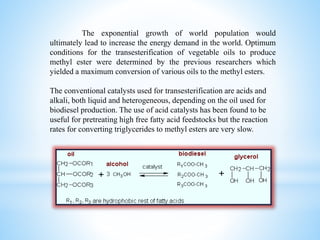
 Vegetable oil has too high a viscosity for use in most existing Diesel
engines as a straight replacement fuel oil. One of the most common
methods used to reduce oil viscosity in the biodiesel industry is
called transesterification.
The exponential growth of world population would
ultimately lead to increase the energy demand in the world. Optimum
conditions for the transesterification of vegetable oils to produce
methyl ester were determined by the previous researchers which
yielded a maximum conversion of various oils to the methyl esters.
The conventional catalysts used for transesterification are acids and
alkali, both liquid and heterogeneous, depending on the oil used for
biodiesel production. The use of acid catalysts has been found to be
useful for pretreating high free fatty acid feedstocks but the reaction
rates for converting triglycerides to methyl esters are very slow.
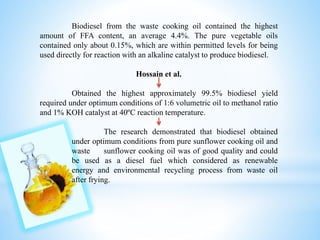
Biodiesel from the waste cooking oil contained the highest
amount of FFA content, an average 4.4%. The pure vegetable oils
contained only about 0.15%, which are within permitted levels for being
used directly for reaction with an alkaline catalyst to produce biodiesel.
Hossain et al.
Obtained the highest approximately 99.5% biodiesel yield
required under optimum conditions of 1:6 volumetric oil to methanol ratio
and 1% KOH catalyst at 40ºC reaction temperature.
The research demonstrated that biodiesel obtained
under optimum conditions from pure sunflower cooking oil and
waste sunflower cooking oil was of good quality and could
be used as a diesel fuel which considered as renewable
energy and environmental recycling process from waste oil
after frying.
Materials: Sunflower oil was
purchased from local shop. Methanol with a
purity of 99.5% and Potassium Hydroxide
(KOH) were purchased from Merck
Company.
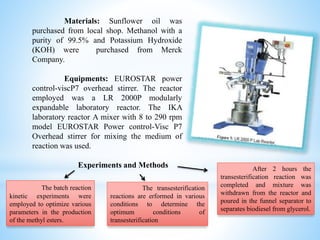
Equipments: EUROSTAR power
control-viscP7 overhead stirrer. The reactor
employed was a LR 2000P modularly
expandable laboratory reactor. The IKA
laboratory reactor A mixer with 8 to 290 rpm
model EUROSTAR Power control-Visc P7
Overhead stirrer for mixing the medium of
reaction was used.
Experiments and Methods
The batch reaction
kinetic experiments were
employed to optimize various
parameters in the production
of the methyl esters.
The transesterification
reactions are erformed in various
conditions to determine the
optimum conditions of
transesterification
After 2 hours the
transesterification reaction was
completed and mixture was
withdrawn from the reactor and
poured in the funnel separator to
separates biodiesel from glycerol.
Physical Properties
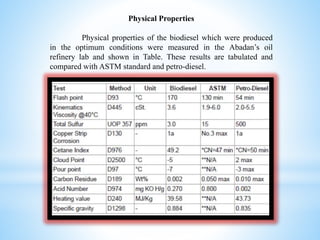
Physical properties of the biodiesel which were produced
in the optimum conditions were measured in the Abadan’s oil
refinery lab and shown in Table. These results are tabulated and
compared with ASTM standard and petro-diesel.
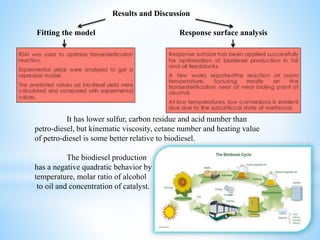
Results and Discussion
Fitting the model Response surface analysis
It has lower sulfur, carbon residue and acid number than
petro-diesel, but kinematic viscosity, cetane number and heating value
of petro-diesel is some better relative to biodiesel.
The biodiesel production
has a negative quadratic behavior by
temperature, molar ratio of alcohol
to oil and concentration of catalyst.

Presentación estefanyrosalesinglestécnico

  • 1.
    Instituto Universitario Politécnico SantiagoMariño Extensión Porlamar Estefany Rosales 26.534.993 Chemical Engineering (49) Section: S1 Optimization of biodiesel production from sunflower oil using response surface methodology (technical English)
  • 2.
    The biodiesel Biodiesel isdefined as a fuel comprised of mono- alkyl esters of long chain fatty acids derived from vegetable oils or animal fat. Several studies have showed that biodiesel is a better fuel than fossil-based diesel in terms of engine performance, emissions reduction, lubricity, and environmental benefits. It is not toxic, biodegradable and available. Biodiesel Not contain sulfurs and aromatic compoundsk Has a high heat value It is a cleaner fuel than petrol and diesel
  • 3.
    Current feeding materials Thecurrent feed stocks of production of biodiesel or mono- alkyl ester are vegetable oil, animal fats and micro algal oil. vegetable oíl (Characteristic)  vegetable oil is currently being used as a sustainable commercial feedstock.  Vegetable oil is one of the renewable fuels which have become more attractive recently because of its environmental benefits and the fact that it is made from renewable resources.  Vegetable oil has too high a viscosity for use in most existing Diesel engines as a straight replacement fuel oil. One of the most common methods used to reduce oil viscosity in the biodiesel industry is called transesterification.
  • 4.
    The exponential growthof world population would ultimately lead to increase the energy demand in the world. Optimum conditions for the transesterification of vegetable oils to produce methyl ester were determined by the previous researchers which yielded a maximum conversion of various oils to the methyl esters. The conventional catalysts used for transesterification are acids and alkali, both liquid and heterogeneous, depending on the oil used for biodiesel production. The use of acid catalysts has been found to be useful for pretreating high free fatty acid feedstocks but the reaction rates for converting triglycerides to methyl esters are very slow.
  • 5.
    Biodiesel from thewaste cooking oil contained the highest amount of FFA content, an average 4.4%. The pure vegetable oils contained only about 0.15%, which are within permitted levels for being used directly for reaction with an alkaline catalyst to produce biodiesel. Hossain et al. Obtained the highest approximately 99.5% biodiesel yield required under optimum conditions of 1:6 volumetric oil to methanol ratio and 1% KOH catalyst at 40ºC reaction temperature. The research demonstrated that biodiesel obtained under optimum conditions from pure sunflower cooking oil and waste sunflower cooking oil was of good quality and could be used as a diesel fuel which considered as renewable energy and environmental recycling process from waste oil after frying.
  • 6.
    Materials: Sunflower oilwas purchased from local shop. Methanol with a purity of 99.5% and Potassium Hydroxide (KOH) were purchased from Merck Company. Equipments: EUROSTAR power control-viscP7 overhead stirrer. The reactor employed was a LR 2000P modularly expandable laboratory reactor. The IKA laboratory reactor A mixer with 8 to 290 rpm model EUROSTAR Power control-Visc P7 Overhead stirrer for mixing the medium of reaction was used. Experiments and Methods The batch reaction kinetic experiments were employed to optimize various parameters in the production of the methyl esters. The transesterification reactions are erformed in various conditions to determine the optimum conditions of transesterification After 2 hours the transesterification reaction was completed and mixture was withdrawn from the reactor and poured in the funnel separator to separates biodiesel from glycerol.
  • 7.
    Physical Properties Physical propertiesof the biodiesel which were produced in the optimum conditions were measured in the Abadan’s oil refinery lab and shown in Table. These results are tabulated and compared with ASTM standard and petro-diesel.
  • 8.
    Results and Discussion Fittingthe model Response surface analysis It has lower sulfur, carbon residue and acid number than petro-diesel, but kinematic viscosity, cetane number and heating value of petro-diesel is some better relative to biodiesel. The biodiesel production has a negative quadratic behavior by temperature, molar ratio of alcohol to oil and concentration of catalyst.