REALIZADO POR:
CARLOS VELASQUEZ
C.I 22652.948
PORLAMAR, NOVIEMBRE 2015
OPTIMIZATION OF BIODIESEL PRODUCTION FROM SUNFLOWER OIL
USING RESPONSE SURFACE METHODOLOGY
ABSTRACT
• Biodiesel is defined as a fuel comprised of mono-
alkyl esters of long chain fatty acids derived from
vegetable oils or animal fats
KEYWORDS
• Biodiesel; Energy; Petro-Diesel;
Transesterification; Vegetable Oil; Response
Surface Methodology; Central Composite Design.
MATERIALS
•Sunflower oil was
purchased from
local shop.
Methanol with a
purity of 99.5% and
Potassium
Hydroxide (KOH)
were purchased
from Merck
Company.
EXPERIMENTS
•The batch reaction
kinetic
experiments were
employed to
optimize various
parameters in the
production of the
methyl esters.
METHODS
•After attaining a
required
temperature, the
potassium
methoxide was
added to the
reactant and was
maintained for 2
hours for
completion of the
reaction.
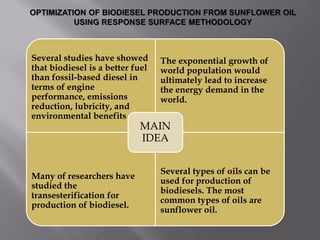
Several studies have showed
that biodiesel is a better fuel
than fossil-based diesel in
terms of engine
performance, emissions
reduction, lubricity, and
environmental benefits
The exponential growth of
world population would
ultimately lead to increase
the energy demand in the
world.
Many of researchers have
studied the
transesterification for
production of biodiesel.
Several types of oils can be
used for production of
biodiesels. The most
common types of oils are
sunflower oil.
MAIN
IDEA
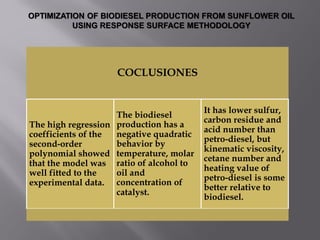
COCLUSIONES
The high regression
coefficients of the
second-order
polynomial showed
that the model was
well fitted to the
experimental data.
The biodiesel
production has a
negative quadratic
behavior by
temperature, molar
ratio of alcohol to
oil and
concentration of
catalyst.
It has lower sulfur,
carbon residue and
acid number than
petro-diesel, but
kinematic viscosity,
cetane number and
heating value of
petro-diesel is some
better relative to
biodiesel.
OPTIMIZATION OF BIODIESEL PRODUCTION FROM SUNFLOWER OIL
USING RESPONSE SURFACE METHODOLOGY
Optimization of biodiesel

Optimization of biodiesel

  • 1.
    REALIZADO POR: CARLOS VELASQUEZ C.I22652.948 PORLAMAR, NOVIEMBRE 2015
  • 2.
    OPTIMIZATION OF BIODIESELPRODUCTION FROM SUNFLOWER OIL USING RESPONSE SURFACE METHODOLOGY ABSTRACT • Biodiesel is defined as a fuel comprised of mono- alkyl esters of long chain fatty acids derived from vegetable oils or animal fats KEYWORDS • Biodiesel; Energy; Petro-Diesel; Transesterification; Vegetable Oil; Response Surface Methodology; Central Composite Design.
  • 3.
    MATERIALS •Sunflower oil was purchasedfrom local shop. Methanol with a purity of 99.5% and Potassium Hydroxide (KOH) were purchased from Merck Company. EXPERIMENTS •The batch reaction kinetic experiments were employed to optimize various parameters in the production of the methyl esters. METHODS •After attaining a required temperature, the potassium methoxide was added to the reactant and was maintained for 2 hours for completion of the reaction.
  • 4.
    Several studies haveshowed that biodiesel is a better fuel than fossil-based diesel in terms of engine performance, emissions reduction, lubricity, and environmental benefits The exponential growth of world population would ultimately lead to increase the energy demand in the world. Many of researchers have studied the transesterification for production of biodiesel. Several types of oils can be used for production of biodiesels. The most common types of oils are sunflower oil. MAIN IDEA
  • 5.
    COCLUSIONES The high regression coefficientsof the second-order polynomial showed that the model was well fitted to the experimental data. The biodiesel production has a negative quadratic behavior by temperature, molar ratio of alcohol to oil and concentration of catalyst. It has lower sulfur, carbon residue and acid number than petro-diesel, but kinematic viscosity, cetane number and heating value of petro-diesel is some better relative to biodiesel. OPTIMIZATION OF BIODIESEL PRODUCTION FROM SUNFLOWER OIL USING RESPONSE SURFACE METHODOLOGY