POWDERS
Dr. A.K. Seth
R.M. Mehta
M.E.Aulton
Definition:
• Powders are solid dosage forms which are applied internally and
externally.
• For Powders Particle size matters as it effects Absorption and efficiency
of drug.
• Smaller particles have larger surface area and dissolves quickly.
• Classification Of Powders:
• Bulk Powders for Internal Use
• Bulk Powders for External Use
• Simple Powders
• Compound Powders
• Powders enclosed in cachets and capsules
• Compressed powders ( Tablets )
POWDERS
• Effervescent and Eflouroscent powders
• Hygroscopic Powders
• Bulk Powders for Internal Use:
• Powders dispensed in bulk when accuracy of dosage is not important.
• Dispensed in wide mouthed containers that permits easy removal of a
spoonful of powders.
• Eg: Antacids
• Laxatives
POWDERS
• Bulk Powders for external use:
• Powders used for external application.
• Dispensed in plastic, glass perforated containers.
• Eg: Dusting Powders
• Insufflations——Medicated dusting powders
• Dentrifices ( tooth powders)
• Dusting Powders:
• Dusting powders are meant for external application to the skin.
• Prepared by mixing two or more ingredients one of which must be starch /
talc.
POWDERS
• Talc dusting powder is a sterile cutaneous powder containing starch
and purified talc in which the talc is sterilised before incorporation
with starch, or the final product is subject to a suitable sterilisation
procedure.
• Medical Dusting Powders——For superficial skin conditions
• Surgical Dusting Powders——used for body cavities & major wounds
• must be sterilised
• Dusting Powders are mainly used for their antiseptic, astringent,
absorbent, antiperspirant and antipruritic action.
• Dusting Powders are dispensed in sifter top containers or aerosol
containers and applied with powder puff or sterilised gauze pad.
POWDERS
• Sterile dusting powders are prepared using methods designed to ensure
sterility and to avoid the contaminants and growth of microorganisms.
• Eg: Starch ( powdered form)- 25gm
• Zinc oxide ( powdered form)– 20gm
• Purified talc ( sterilised)- 50 gm
• Salicylic acid ( powdered form)- 5gm
• Direction of use : Apply two or three times a day on the affected area.
• Method : All ingredients should be ground into powder. The components
talc, starch, zinc oxide, and salicylic acid should be weighed out. Combine
in ascending order of their weights. After mixing again, pass the powder
through sieve no.85. Sift again after mixing lightly.
POWDERS
• Simple powders:
• Simple powders contain only one ingredient either in crystalline form
or amorphous form.
• Simple powders in crystalline form are reduced to fine powder ,
weighed and divided into number of doses.
• Eg: Dispense 6 packets of Aspirin each containing 300 mg
• Prepare aspirin by powdering it and weighing the required amount.
Then the powder is packed in individually wrapped powder paper.
There is 300 mg of aspirin in each packet.
• Direction: Take one powder after every eight hours.
POWDERS
• Compound powders:
• These powders contain two or more than two substances which are mixed
together and then divided into desired number of individual doses which
are dispensed into each powder paper.
• Aspirin + paracetamol + caffeine
• Powders enclosed in cachets:
• These powders are generally called wafer capsules.
• Made with rice flour which is moulded as wafer.
• These are quite hard so softened by dipping in water and then placed on
tongue & swallowed with the help of water.
• After swallowing cachet gets disintegrated & drug is released.
POWDERS
• Wet Seal cachets : Made up of two similar convex halves having flat
edges.
• Contains drug in one half and placed on another half and edges are
moistened with water.
• Dry Seal cachets : Contains two halves. Upper half larger than lower
one.
• Powdered drug in lower half & upper half is fitted over it. Both the
halves are sealed by using machine.
• Powders enclosed in capsules:
• Powders that are nauseous or bitter in taste are enclosed in capsule.
POWDERS
• Medicament in powder form is filled in the body of capsule & cap is
pressed on to form perfect seal.
• Compressed powders ( Tablets ):
• Powders moulded into tablets which are flat and in circular disc
shape.
• Tablet triturates made up of stainless steel / plastic.
• Contains upper and lower plate having similar number of holes/pegs.
• Solid medicament is finely powdered and converted into a stiff paste
with 60% alcohol.
• Paste is filled in the holes of upper plate using spatula and then
placed over lower plate.
POWDERS
• Apply pressure on the top plate which will make the plate move
downward leaving moulded tablets.
• These tablets are finally placed on a clean surface and then dried
using hot air oven.
• Now-a-days automatic tablet triturate machines are available in
industry which can make 2500 tablets per minute.
• Effervescent powders:
• Dispensed in coarse to very coarse powdered or granular form.
• Before administration effervescent granules are suspended or
dissolved in water and thus effervescing liquid is taken immediately.
POWDERS
• Sometimes they are taken when the effervescence has completely ceased.
• In effervescent powders, acids and carbonates or hydrogen carbonates are
generally combined with water to release carbon dioxide when exposed to
it.
• Eg: ENO powder.
• Efflorescent powders:
• Crystalline substances that liberate water of crystallisation wholly or partly
on exposure to humid atmosphere and thus become wet or liquefy.
• Corresponding anhydrous salt or an inert substance is used to mix with
effervescent substance before incorporating with other ingredients.
POWDERS
• Hydrated salts are among the most efflorescent substances.
• Due to loss of water, the hydrated salt becomes powdery, as it loses
these water molecules. This will eventually cause the salt to solidify.
Water becomes gaseous when this occurs.
• Eg: Sodium carbonate, Ferrous sulphate.
• Hygroscopic powders:
• Powders which absorb moisture from atmosphere are called
hygroscopic powders.
• These substances are supplied in granular form in order to expose
less surface area to the atmosphere.
POWDERS
• The water molecules in hygroscopic substances are absorbed into the
crystal structure when water vapour is absorbed. As a consequence,
the size of the substance increases.
• These powders should not be finely powdered.
• Double wrapped using aluminium foil or plastic cover.
• Eg: A salt is an example of a hygroscopic substance.
• Sodium chloride, sodium hydroxide.
POWDERS
• Advantages of Powders:
• Powders are one of the oldest dosage forms that are used internally
and externally.
• Powders are more stable than liquid dosage forms and are dispensed
easily as prescribed by the physician.
• Due to the smaller particle size of Powder, it get dissolved easily in
body fluids. Hence the drug action is rapid when compared with
other solid dosage forms.
• Large quantities of powdered drug can be easily administered to the
patient orally by dissolving or mixing the powder in suitable liquid.
POWDERS
• Powders are more easy to carry than liquid dosage forms.
• Powders are more economical as compared to other solid dosage
forms, because these are prepared extemporaneously without
involving any special machinery and techniques.
• Disadvantages of Powders:
• Drugs that are bitter, nauseous and unpleasant taste cannot be
dispensed in powdered form.
• Hygroscopic drugs that get affected by atmospheric conditions are
not suitable for dispensing in powder forms.
• Powders and granules are not suitable for drugs which are in
inactivated form or cause damage to the stomach. These type of
Powders should be mixed with enteric coated substance.
POWDERS
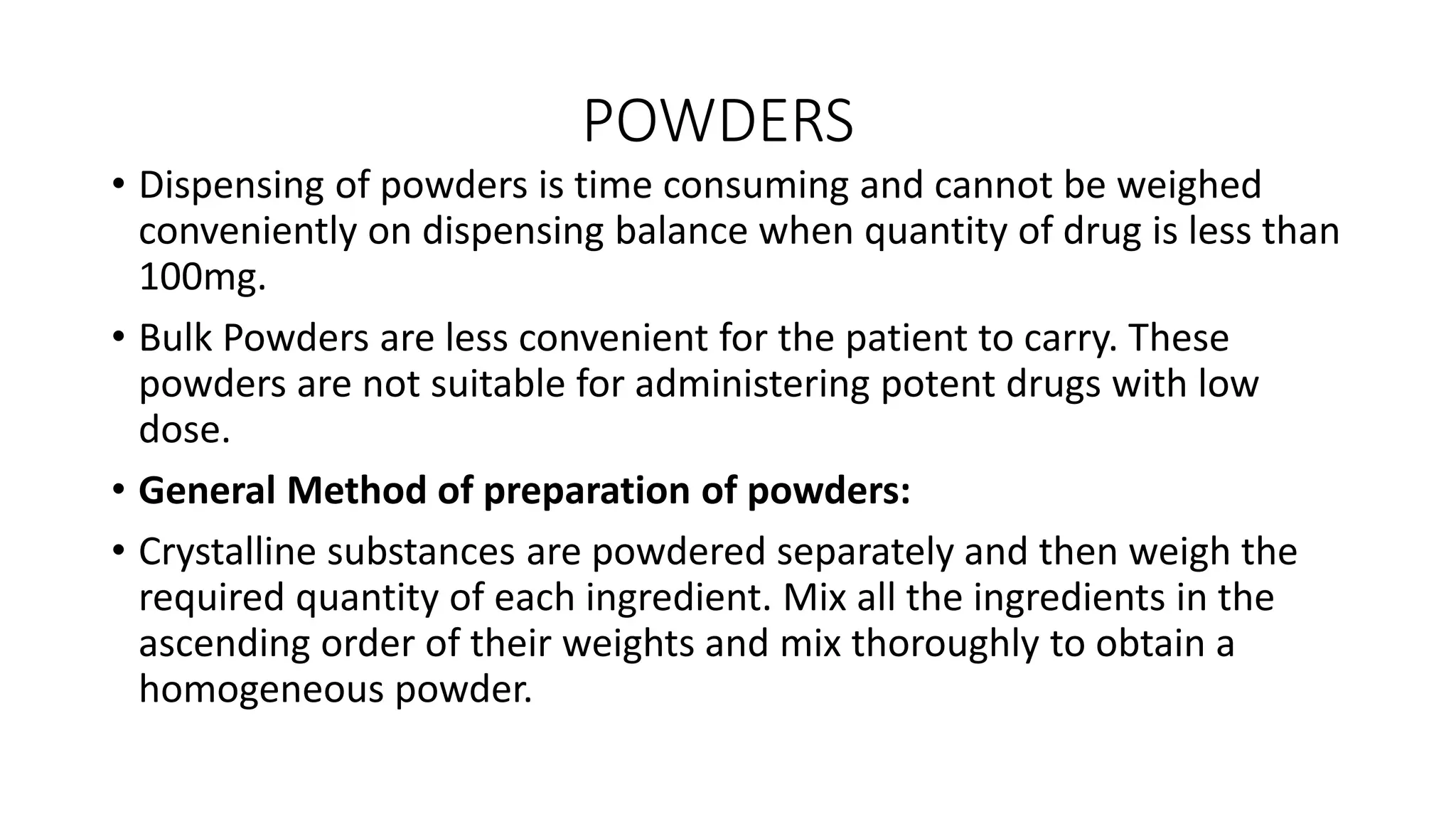
• Dispensing of powders is time consuming and cannot be weighed
conveniently on dispensing balance when quantity of drug is less than
100mg.
• Bulk Powders are less convenient for the patient to carry. These
powders are not suitable for administering potent drugs with low
dose.
• General Method of preparation of powders:
• Crystalline substances are powdered separately and then weigh the
required quantity of each ingredient. Mix all the ingredients in the
ascending order of their weights and mix thoroughly to obtain a
homogeneous powder.
POWDERS
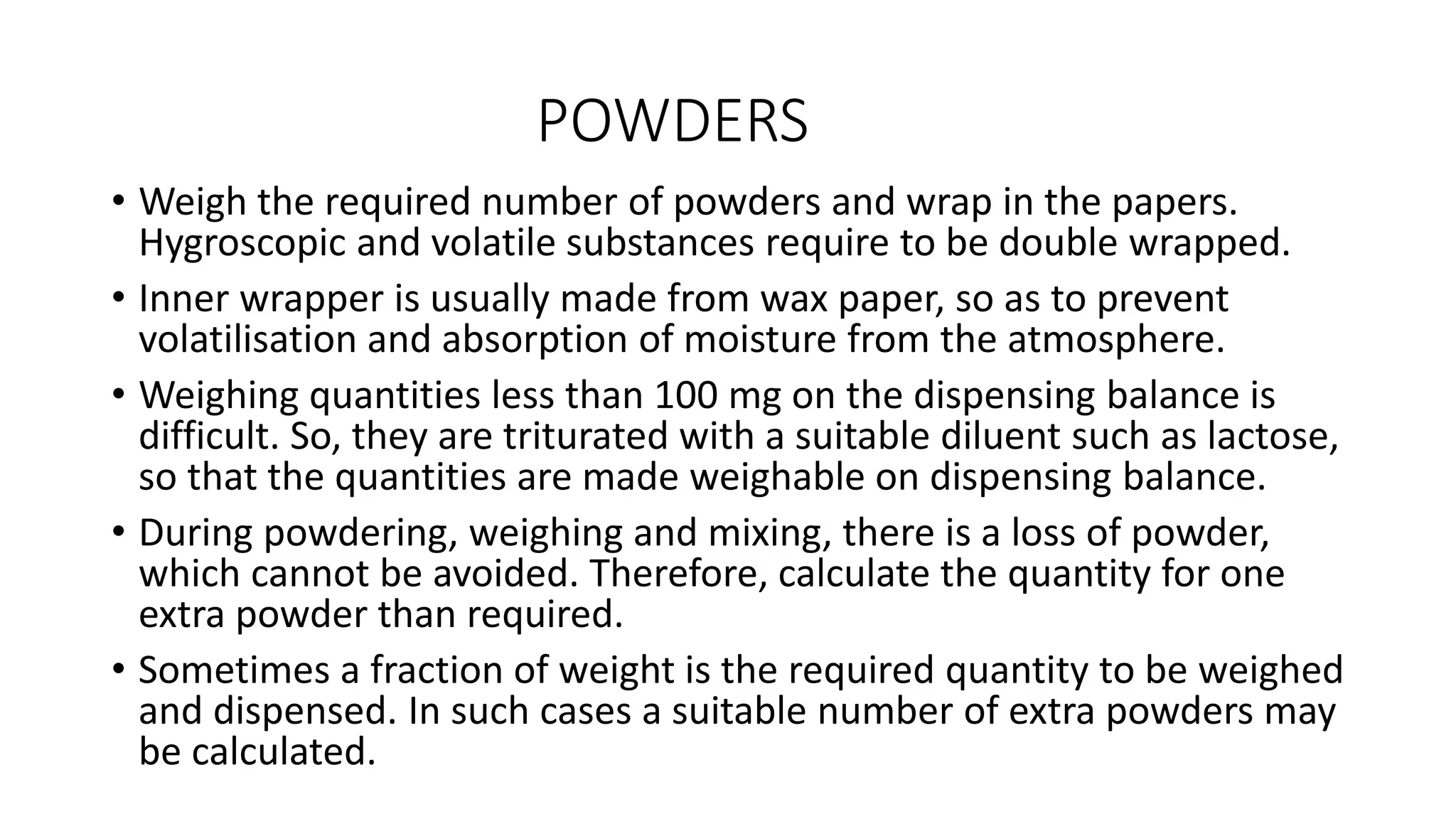
• Weigh the required number of powders and wrap in the papers.
Hygroscopic and volatile substances require to be double wrapped.
• Inner wrapper is usually made from wax paper, so as to prevent
volatilisation and absorption of moisture from the atmosphere.
• Weighing quantities less than 100 mg on the dispensing balance is
difficult. So, they are triturated with a suitable diluent such as lactose,
so that the quantities are made weighable on dispensing balance.
• During powdering, weighing and mixing, there is a loss of powder,
which cannot be avoided. Therefore, calculate the quantity for one
extra powder than required.
• Sometimes a fraction of weight is the required quantity to be weighed
and dispensed. In such cases a suitable number of extra powders may
be calculated.
POWDERS
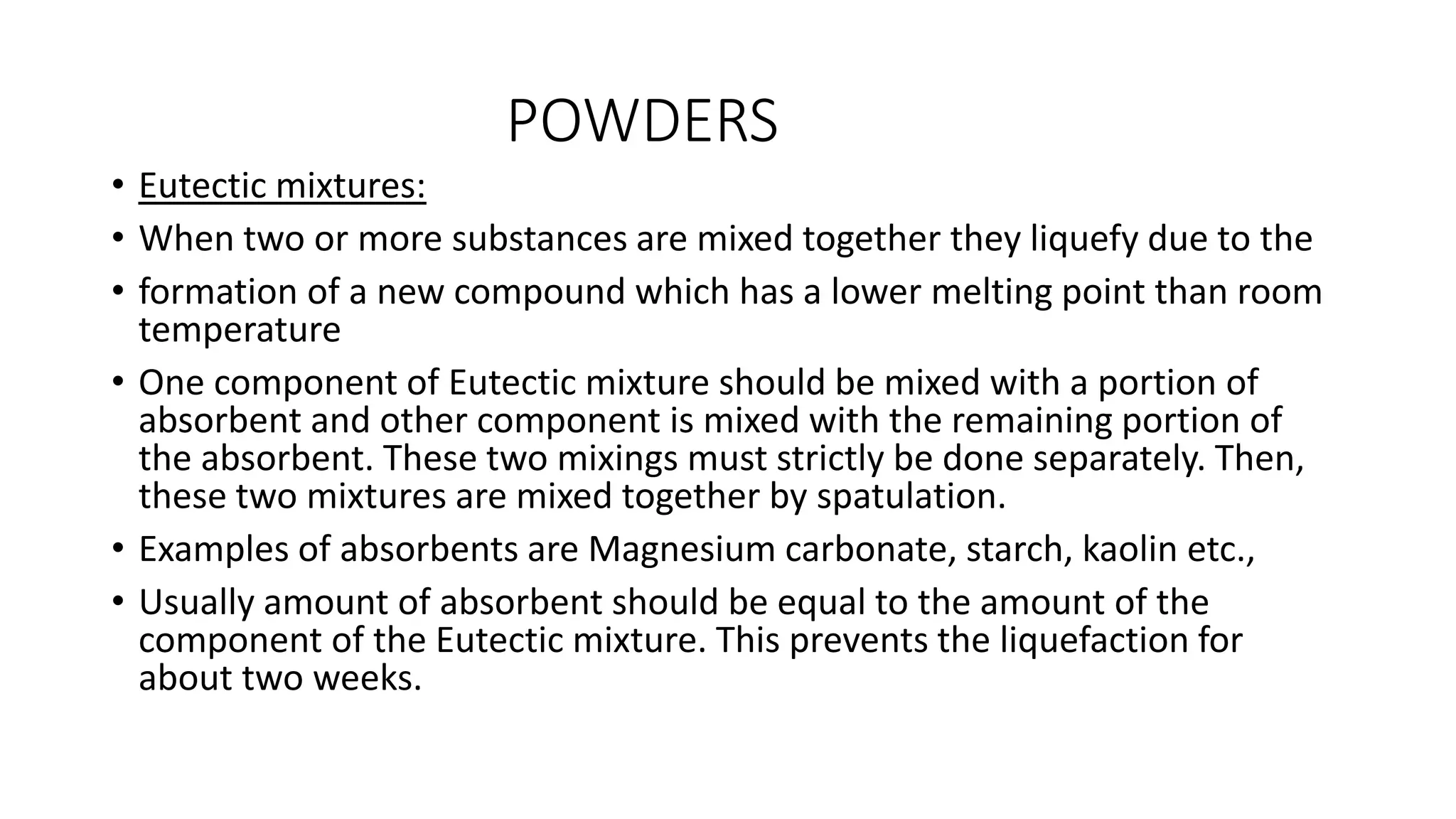
• Eutectic mixtures:
• When two or more substances are mixed together they liquefy due to the
• formation of a new compound which has a lower melting point than room
temperature
• One component of Eutectic mixture should be mixed with a portion of
absorbent and other component is mixed with the remaining portion of
the absorbent. These two mixings must strictly be done separately. Then,
these two mixtures are mixed together by spatulation.
• Examples of absorbents are Magnesium carbonate, starch, kaolin etc.,
• Usually amount of absorbent should be equal to the amount of the
component of the Eutectic mixture. This prevents the liquefaction for
about two weeks.
POWDERS
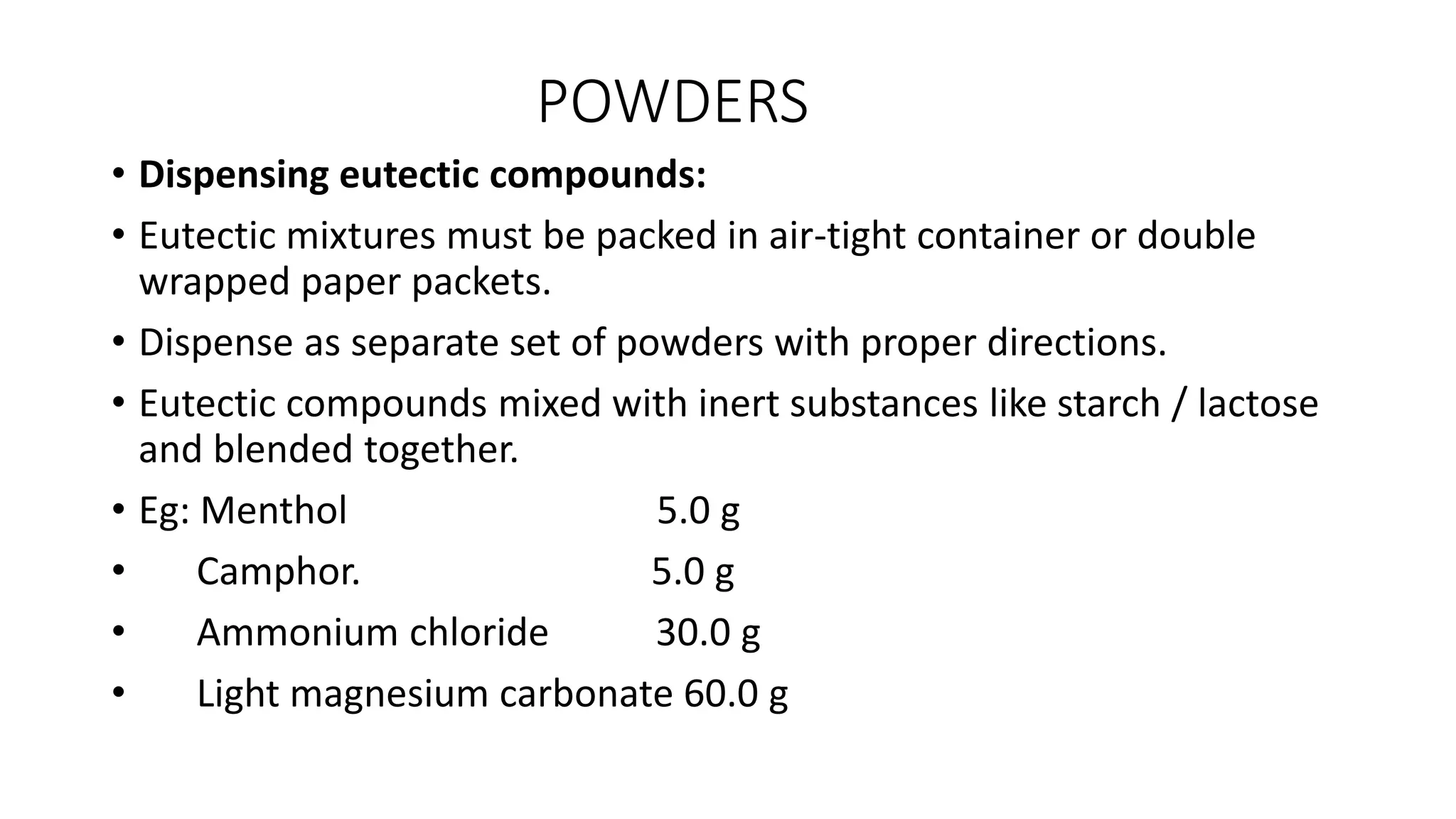
• Dispensing eutectic compounds:
• Eutectic mixtures must be packed in air-tight container or double
wrapped paper packets.
• Dispense as separate set of powders with proper directions.
• Eutectic compounds mixed with inert substances like starch / lactose
and blended together.
• Eg: Menthol 5.0 g
• Camphor. 5.0 g
• Ammonium chloride 30.0 g
• Light magnesium carbonate 60.0 g
POWDERS
• Direction: To be used as directed.
• Method: Seperately powder each ingredient and weigh required
quantity of menthol, camphor and ammonium chloride. Mix them in
ascending order of their weights in a mortar to form a liquid. Add
light magnesium carbonate to make a free flowing powder. Pass the
powder through sieve number 85 and dispense in an air tight
container.
Mixing of Powders
• Spatulation
• Trituration
• Geometric dilution
• Sifting
• Tumbling.
• Trituration: Method used to reduce particle size by mixing using
mortar.
• Geometric Dilution:
• Method used to mix potent substance with large amount of diluent.
• Mixed in different portions.
Mixing of powders
• One portion is mixed with diluent and triturated using mortar.
• Second portion is mixed with diluent and trituated using mortar.
• Process is repeated in steps until all the diluent is incorporated.
• Eg: Mix 100 mg of potent drug with 900 mg of lactose using
geometric dilution.
• 100mg of potent drug + 100mg of lactose = 200mg of mixture.
• 200mg of mixture + 200mg of lactose = 400mg of mixture.
• 400mg of mixture + 400 mg of lactose = 800mg of mixture.
• 800mg of mixture + remaining diluent = 1000 mg of mixture.
Powders Presentation.pptx powders presentation

Powders Presentation.pptx powders presentation

  • 1.
  • 2.
    Definition: • Powders aresolid dosage forms which are applied internally and externally. • For Powders Particle size matters as it effects Absorption and efficiency of drug. • Smaller particles have larger surface area and dissolves quickly. • Classification Of Powders: • Bulk Powders for Internal Use • Bulk Powders for External Use • Simple Powders • Compound Powders • Powders enclosed in cachets and capsules • Compressed powders ( Tablets )
  • 3.
    POWDERS • Effervescent andEflouroscent powders • Hygroscopic Powders • Bulk Powders for Internal Use: • Powders dispensed in bulk when accuracy of dosage is not important. • Dispensed in wide mouthed containers that permits easy removal of a spoonful of powders. • Eg: Antacids • Laxatives
  • 4.
    POWDERS • Bulk Powdersfor external use: • Powders used for external application. • Dispensed in plastic, glass perforated containers. • Eg: Dusting Powders • Insufflations——Medicated dusting powders • Dentrifices ( tooth powders) • Dusting Powders: • Dusting powders are meant for external application to the skin. • Prepared by mixing two or more ingredients one of which must be starch / talc.
  • 5.
    POWDERS • Talc dustingpowder is a sterile cutaneous powder containing starch and purified talc in which the talc is sterilised before incorporation with starch, or the final product is subject to a suitable sterilisation procedure. • Medical Dusting Powders——For superficial skin conditions • Surgical Dusting Powders——used for body cavities & major wounds • must be sterilised • Dusting Powders are mainly used for their antiseptic, astringent, absorbent, antiperspirant and antipruritic action. • Dusting Powders are dispensed in sifter top containers or aerosol containers and applied with powder puff or sterilised gauze pad.
  • 6.
    POWDERS • Sterile dustingpowders are prepared using methods designed to ensure sterility and to avoid the contaminants and growth of microorganisms. • Eg: Starch ( powdered form)- 25gm • Zinc oxide ( powdered form)– 20gm • Purified talc ( sterilised)- 50 gm • Salicylic acid ( powdered form)- 5gm • Direction of use : Apply two or three times a day on the affected area. • Method : All ingredients should be ground into powder. The components talc, starch, zinc oxide, and salicylic acid should be weighed out. Combine in ascending order of their weights. After mixing again, pass the powder through sieve no.85. Sift again after mixing lightly.
  • 7.
    POWDERS • Simple powders: •Simple powders contain only one ingredient either in crystalline form or amorphous form. • Simple powders in crystalline form are reduced to fine powder , weighed and divided into number of doses. • Eg: Dispense 6 packets of Aspirin each containing 300 mg • Prepare aspirin by powdering it and weighing the required amount. Then the powder is packed in individually wrapped powder paper. There is 300 mg of aspirin in each packet. • Direction: Take one powder after every eight hours.
  • 8.
    POWDERS • Compound powders: •These powders contain two or more than two substances which are mixed together and then divided into desired number of individual doses which are dispensed into each powder paper. • Aspirin + paracetamol + caffeine • Powders enclosed in cachets: • These powders are generally called wafer capsules. • Made with rice flour which is moulded as wafer. • These are quite hard so softened by dipping in water and then placed on tongue & swallowed with the help of water. • After swallowing cachet gets disintegrated & drug is released.
  • 9.
    POWDERS • Wet Sealcachets : Made up of two similar convex halves having flat edges. • Contains drug in one half and placed on another half and edges are moistened with water. • Dry Seal cachets : Contains two halves. Upper half larger than lower one. • Powdered drug in lower half & upper half is fitted over it. Both the halves are sealed by using machine. • Powders enclosed in capsules: • Powders that are nauseous or bitter in taste are enclosed in capsule.
  • 10.
    POWDERS • Medicament inpowder form is filled in the body of capsule & cap is pressed on to form perfect seal. • Compressed powders ( Tablets ): • Powders moulded into tablets which are flat and in circular disc shape. • Tablet triturates made up of stainless steel / plastic. • Contains upper and lower plate having similar number of holes/pegs. • Solid medicament is finely powdered and converted into a stiff paste with 60% alcohol. • Paste is filled in the holes of upper plate using spatula and then placed over lower plate.
  • 11.
    POWDERS • Apply pressureon the top plate which will make the plate move downward leaving moulded tablets. • These tablets are finally placed on a clean surface and then dried using hot air oven. • Now-a-days automatic tablet triturate machines are available in industry which can make 2500 tablets per minute. • Effervescent powders: • Dispensed in coarse to very coarse powdered or granular form. • Before administration effervescent granules are suspended or dissolved in water and thus effervescing liquid is taken immediately.
  • 12.
    POWDERS • Sometimes theyare taken when the effervescence has completely ceased. • In effervescent powders, acids and carbonates or hydrogen carbonates are generally combined with water to release carbon dioxide when exposed to it. • Eg: ENO powder. • Efflorescent powders: • Crystalline substances that liberate water of crystallisation wholly or partly on exposure to humid atmosphere and thus become wet or liquefy. • Corresponding anhydrous salt or an inert substance is used to mix with effervescent substance before incorporating with other ingredients.
  • 13.
    POWDERS • Hydrated saltsare among the most efflorescent substances. • Due to loss of water, the hydrated salt becomes powdery, as it loses these water molecules. This will eventually cause the salt to solidify. Water becomes gaseous when this occurs. • Eg: Sodium carbonate, Ferrous sulphate. • Hygroscopic powders: • Powders which absorb moisture from atmosphere are called hygroscopic powders. • These substances are supplied in granular form in order to expose less surface area to the atmosphere.
  • 14.
    POWDERS • The watermolecules in hygroscopic substances are absorbed into the crystal structure when water vapour is absorbed. As a consequence, the size of the substance increases. • These powders should not be finely powdered. • Double wrapped using aluminium foil or plastic cover. • Eg: A salt is an example of a hygroscopic substance. • Sodium chloride, sodium hydroxide.
  • 15.
    POWDERS • Advantages ofPowders: • Powders are one of the oldest dosage forms that are used internally and externally. • Powders are more stable than liquid dosage forms and are dispensed easily as prescribed by the physician. • Due to the smaller particle size of Powder, it get dissolved easily in body fluids. Hence the drug action is rapid when compared with other solid dosage forms. • Large quantities of powdered drug can be easily administered to the patient orally by dissolving or mixing the powder in suitable liquid.
  • 16.
    POWDERS • Powders aremore easy to carry than liquid dosage forms. • Powders are more economical as compared to other solid dosage forms, because these are prepared extemporaneously without involving any special machinery and techniques. • Disadvantages of Powders: • Drugs that are bitter, nauseous and unpleasant taste cannot be dispensed in powdered form. • Hygroscopic drugs that get affected by atmospheric conditions are not suitable for dispensing in powder forms. • Powders and granules are not suitable for drugs which are in inactivated form or cause damage to the stomach. These type of Powders should be mixed with enteric coated substance.
  • 17.
    POWDERS • Dispensing ofpowders is time consuming and cannot be weighed conveniently on dispensing balance when quantity of drug is less than 100mg. • Bulk Powders are less convenient for the patient to carry. These powders are not suitable for administering potent drugs with low dose. • General Method of preparation of powders: • Crystalline substances are powdered separately and then weigh the required quantity of each ingredient. Mix all the ingredients in the ascending order of their weights and mix thoroughly to obtain a homogeneous powder.
  • 18.
    POWDERS • Weigh therequired number of powders and wrap in the papers. Hygroscopic and volatile substances require to be double wrapped. • Inner wrapper is usually made from wax paper, so as to prevent volatilisation and absorption of moisture from the atmosphere. • Weighing quantities less than 100 mg on the dispensing balance is difficult. So, they are triturated with a suitable diluent such as lactose, so that the quantities are made weighable on dispensing balance. • During powdering, weighing and mixing, there is a loss of powder, which cannot be avoided. Therefore, calculate the quantity for one extra powder than required. • Sometimes a fraction of weight is the required quantity to be weighed and dispensed. In such cases a suitable number of extra powders may be calculated.
  • 19.
    POWDERS • Eutectic mixtures: •When two or more substances are mixed together they liquefy due to the • formation of a new compound which has a lower melting point than room temperature • One component of Eutectic mixture should be mixed with a portion of absorbent and other component is mixed with the remaining portion of the absorbent. These two mixings must strictly be done separately. Then, these two mixtures are mixed together by spatulation. • Examples of absorbents are Magnesium carbonate, starch, kaolin etc., • Usually amount of absorbent should be equal to the amount of the component of the Eutectic mixture. This prevents the liquefaction for about two weeks.
  • 20.
    POWDERS • Dispensing eutecticcompounds: • Eutectic mixtures must be packed in air-tight container or double wrapped paper packets. • Dispense as separate set of powders with proper directions. • Eutectic compounds mixed with inert substances like starch / lactose and blended together. • Eg: Menthol 5.0 g • Camphor. 5.0 g • Ammonium chloride 30.0 g • Light magnesium carbonate 60.0 g
  • 21.
    POWDERS • Direction: Tobe used as directed. • Method: Seperately powder each ingredient and weigh required quantity of menthol, camphor and ammonium chloride. Mix them in ascending order of their weights in a mortar to form a liquid. Add light magnesium carbonate to make a free flowing powder. Pass the powder through sieve number 85 and dispense in an air tight container.
  • 22.
    Mixing of Powders •Spatulation • Trituration • Geometric dilution • Sifting • Tumbling. • Trituration: Method used to reduce particle size by mixing using mortar. • Geometric Dilution: • Method used to mix potent substance with large amount of diluent. • Mixed in different portions.
  • 23.
    Mixing of powders •One portion is mixed with diluent and triturated using mortar. • Second portion is mixed with diluent and trituated using mortar. • Process is repeated in steps until all the diluent is incorporated. • Eg: Mix 100 mg of potent drug with 900 mg of lactose using geometric dilution. • 100mg of potent drug + 100mg of lactose = 200mg of mixture. • 200mg of mixture + 200mg of lactose = 400mg of mixture. • 400mg of mixture + 400 mg of lactose = 800mg of mixture. • 800mg of mixture + remaining diluent = 1000 mg of mixture.