SEMINAR
PRESENTED BY
SOUMAVABORAL
Undertheguidanceof
Prof.(Dr.)B.Bhattacharyya
ROLLNO.:-001411702015
REGISTRATIONNO.:-129418OF2014-2015
ProductionEngineeringDepartment
JadavpurUniversity,Kolkata
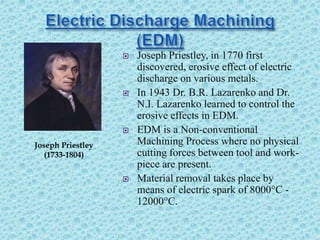
 Joseph Priestley, in 1770 first
discovered, erosive effect of electric
discharge on various metals.
 In 1943 Dr. B.R. Lazarenko and Dr.
N.I. Lazarenko learned to control the
erosive effects in EDM.
 EDM is a Non-conventional
Machining Process where no physical
cutting forces between tool and work-
piece are present.
 Material removal takes place by
means of electric spark of 8000°C -
12000°C.
Joseph Priestley
(1733-1804)
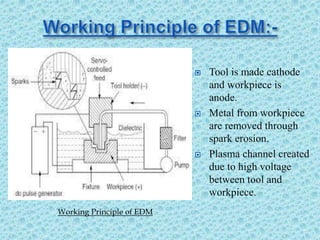
 Tool is made cathode
and workpiece is
anode.
 Metal from workpiece
are removed through
spark erosion.
 Plasma channel created
due to high voltage
between tool and
workpiece.
Working Principle of EDM
 Its a dielectric material in the liquid state.
 They are used as electrical insulators in high voltage
applications.
 Dielectric fluid should provide a oxygen free machining
environment to the workpiece.
 It breaks down and ionized when collided with electrons.
 It helps in initiating discharge, and conveys the spark.
 It helps in cooling the electrode, workpiece and system.
 It carries away the eroded particles with it.
 It may be mineral oils, kerosene, transformer oil, EDM oils
or synthetic oils.
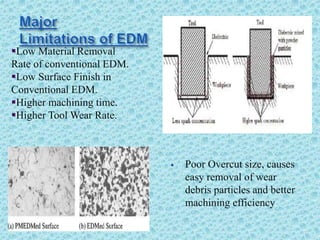
 Poor Overcut size, causes
easy removal of wear
debris particles and better
machining efficiency.
Low Material Removal
Rate of conventional EDM.
Low Surface Finish in
Conventional EDM.
Higher machining time.
Higher Tool Wear Rate.
 The use of semi conductive solid particles in EDM Dielectric
named as PMEDM.
 It is a recent innovation of EDM for enhancing its
capabilities.
 To enhance the machined surface properties by means of fine
powders of Silicon, Graphite, Aluminum are mixed with
dielectric solution.
 Reduces Surface Roughness(SR), Tool Wear Rate(TWR).
 Increases overcut size and Material Removal Rate (MRR).
 Any material that is electrically conductive can be machined
regardless of its hardness, toughness, strength and
microstructure.
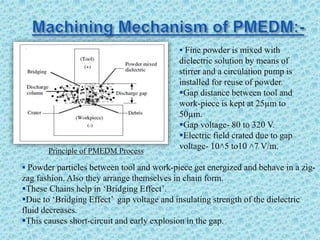
 Fine powder is mixed with
dielectric solution by means of
stirrer and a circulation pump is
installed for reuse of powder.
Gap distance between tool and
work-piece is kept at 25µm to
50µm.
Gap voltage- 80 to 320 V.
Electric field crated due to gap
voltage- 10˄5 to10 ˄7 V/m.
 Powder particles between tool and work-piece get energized and behave in a zig-
zag fashion. Also they arrange themselves in chain form.
These Chains help in ‘Bridging Effect’.
Due to ‘Bridging Effect’ gap voltage and insulating strength of the dielectric
fluid decreases.
This causes short-circuit and early explosion in the gap.
Principle of PMEDM Process
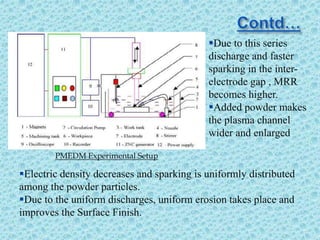
Due to this series
discharge and faster
sparking in the inter-
electrode gap , MRR
becomes higher.
Added powder makes
the plasma channel
wider and enlarged.
Electric density decreases and sparking is uniformly distributed
among the powder particles.
Due to the uniform discharges, uniform erosion takes place and
improves the Surface Finish.
PMEDM Experimental Setup
 Material Removal Rate (MRR) is greatly influenced
by current, pulse-on time and electrode materials. Type of
powder and its concentration have lower contribution to the
MRR improvement.
 Tool Wear Rate(TWR) is basically influenced by powder
concentration, whereas pulse-on time, current, electrode
material and type of powder have less contribution.
 Overcut size improvement is influenced by pulse-on time
and powder concentration.
 Powder concentration and supplied current has significant
effect to improve Surface Roughness (SR).
 Advantages :-
1. Any electrically conductive material can be machined.
2. Stress free complicated geometries can be produced.
3. Eliminates the necessity of grinding and fine surface finish.
 Limitations :-
1. MRR is low making the process economical only for very
hard and difficult to machine materials.
2. Work-piece material must be electrically conductive.
3. Process can not be monitored during machining. Thus high
skilled persons are able to operate.
 In high precision instruments where large area with fine
surface finish are required to be machined.
 Making and machining of micro-products and sophisticated
micro mechanical element such as in micro-pumps, micro-
robot, micro-engines etc.
 It can be used where rough machining is required.
Conclusions :-
 Researches are going on to optimize the input parameters to
get the desired output. Process optimization can integrate
Genetic Algorithm, Taguchi Methodology, Response Surface
Methodology, Grey Relational Analysis.
 Researches are also going on to combine PMEDM with
ultrasonic or abrasive, powder mixed near dry EDM, and
Powder mixed ECDM process.
Powder Mixed Electric Discharge Machining

Powder Mixed Electric Discharge Machining

  • 1.
  • 2.
     Joseph Priestley,in 1770 first discovered, erosive effect of electric discharge on various metals.  In 1943 Dr. B.R. Lazarenko and Dr. N.I. Lazarenko learned to control the erosive effects in EDM.  EDM is a Non-conventional Machining Process where no physical cutting forces between tool and work- piece are present.  Material removal takes place by means of electric spark of 8000°C - 12000°C. Joseph Priestley (1733-1804)
  • 3.
     Tool ismade cathode and workpiece is anode.  Metal from workpiece are removed through spark erosion.  Plasma channel created due to high voltage between tool and workpiece. Working Principle of EDM
  • 4.
     Its adielectric material in the liquid state.  They are used as electrical insulators in high voltage applications.  Dielectric fluid should provide a oxygen free machining environment to the workpiece.  It breaks down and ionized when collided with electrons.  It helps in initiating discharge, and conveys the spark.  It helps in cooling the electrode, workpiece and system.  It carries away the eroded particles with it.  It may be mineral oils, kerosene, transformer oil, EDM oils or synthetic oils.
  • 5.
     Poor Overcutsize, causes easy removal of wear debris particles and better machining efficiency. Low Material Removal Rate of conventional EDM. Low Surface Finish in Conventional EDM. Higher machining time. Higher Tool Wear Rate.
  • 6.
     The useof semi conductive solid particles in EDM Dielectric named as PMEDM.  It is a recent innovation of EDM for enhancing its capabilities.  To enhance the machined surface properties by means of fine powders of Silicon, Graphite, Aluminum are mixed with dielectric solution.  Reduces Surface Roughness(SR), Tool Wear Rate(TWR).  Increases overcut size and Material Removal Rate (MRR).  Any material that is electrically conductive can be machined regardless of its hardness, toughness, strength and microstructure.
  • 7.
     Fine powderis mixed with dielectric solution by means of stirrer and a circulation pump is installed for reuse of powder. Gap distance between tool and work-piece is kept at 25µm to 50µm. Gap voltage- 80 to 320 V. Electric field crated due to gap voltage- 10˄5 to10 ˄7 V/m.  Powder particles between tool and work-piece get energized and behave in a zig- zag fashion. Also they arrange themselves in chain form. These Chains help in ‘Bridging Effect’. Due to ‘Bridging Effect’ gap voltage and insulating strength of the dielectric fluid decreases. This causes short-circuit and early explosion in the gap. Principle of PMEDM Process
  • 8.
    Due to thisseries discharge and faster sparking in the inter- electrode gap , MRR becomes higher. Added powder makes the plasma channel wider and enlarged. Electric density decreases and sparking is uniformly distributed among the powder particles. Due to the uniform discharges, uniform erosion takes place and improves the Surface Finish. PMEDM Experimental Setup
  • 9.
     Material RemovalRate (MRR) is greatly influenced by current, pulse-on time and electrode materials. Type of powder and its concentration have lower contribution to the MRR improvement.  Tool Wear Rate(TWR) is basically influenced by powder concentration, whereas pulse-on time, current, electrode material and type of powder have less contribution.  Overcut size improvement is influenced by pulse-on time and powder concentration.  Powder concentration and supplied current has significant effect to improve Surface Roughness (SR).
  • 10.
     Advantages :- 1.Any electrically conductive material can be machined. 2. Stress free complicated geometries can be produced. 3. Eliminates the necessity of grinding and fine surface finish.  Limitations :- 1. MRR is low making the process economical only for very hard and difficult to machine materials. 2. Work-piece material must be electrically conductive. 3. Process can not be monitored during machining. Thus high skilled persons are able to operate.
  • 11.
     In highprecision instruments where large area with fine surface finish are required to be machined.  Making and machining of micro-products and sophisticated micro mechanical element such as in micro-pumps, micro- robot, micro-engines etc.  It can be used where rough machining is required. Conclusions :-  Researches are going on to optimize the input parameters to get the desired output. Process optimization can integrate Genetic Algorithm, Taguchi Methodology, Response Surface Methodology, Grey Relational Analysis.  Researches are also going on to combine PMEDM with ultrasonic or abrasive, powder mixed near dry EDM, and Powder mixed ECDM process.