Seminar
ELECTRICAL DISCHARGE
MACHINING (EDM): A REVIEW
Introduction
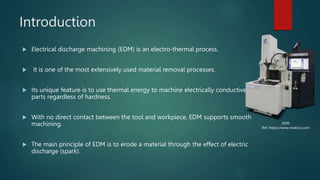
 Electrical discharge machining (EDM) is an electro-thermal process.
 It is one of the most extensively used material removal processes.
 Its unique feature is to use thermal energy to machine electrically conductive
parts regardless of hardness.
 With no direct contact between the tool and workpiece, EDM supports smooth
machining.
 The main principle of EDM is to erode a material through the effect of electric
discharge (spark).
EDM
Ref: https://www.makino.com
History
 The origin of EDM dates back to 1770 when English scientist Joseph Priestly
discovered the erosive effect of electrical discharges.
 Several attempts were made to achieve a controlled EDM process.
 But, These processes were not very precise due to overheating of the
machining area.
 Pioneering work on EDM was carried out in 1943 by two Russian scientists, B.R.
and N.I. Lazarenko at the Moscow University.
 They developed a controlled process for machining materials by vaporizing
and melting its surface.
History (Cont…)
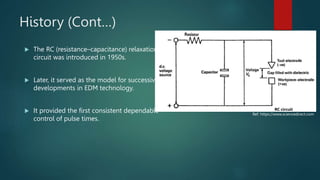
 The RC (resistance–capacitance) relaxation
circuit was introduced in 1950s.
 Later, it served as the model for successive
developments in EDM technology.
 It provided the first consistent dependable
control of pulse times.
RC circuit
Ref: https://www.sciencedirect.com
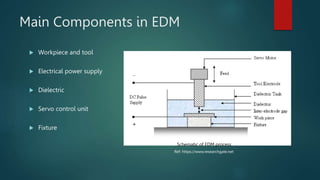
Main Components in EDM
 Workpiece and tool
 Electrical power supply
 Dielectric
 Servo control unit
 Fixture
Ref: https://www.researchgate.net
Schematic of EDM process
Working Principle
 A potential difference is applied between the tool and workpiece.
 Depending upon the applied potential difference and the gap between the tool and
workpiece, an electric field would be established.
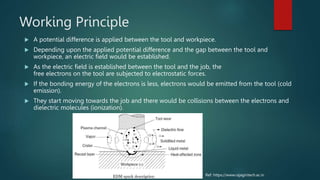
 As the electric field is established between the tool and the job, the
free electrons on the tool are subjected to electrostatic forces.
 If the bonding energy of the electrons is less, electrons would be emitted from the tool (cold
emission).
 They start moving towards the job and there would be collisions between the electrons and
dielectric molecules (ionization).
Ref: https://www.rajagiritech.ac.in
Working Principle (Cont…)
 This cyclic process would increase the concentration of electrons
and ions in the dielectric medium between the tool and the job at
the spark gap.
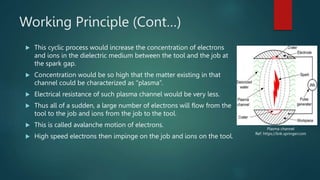
 Concentration would be so high that the matter existing in that
channel could be characterized as “plasma”.
 Electrical resistance of such plasma channel would be very less.
 Thus all of a sudden, a large number of electrons will flow from the
tool to the job and ions from the job to the tool.
 This is called avalanche motion of electrons.
 High speed electrons then impinge on the job and ions on the tool.
Plasma channel
Ref: https://link.springer.com
Working Principle (Cont…)
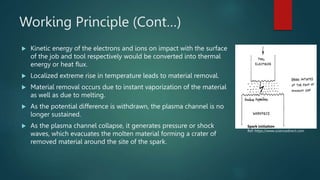
 Kinetic energy of the electrons and ions on impact with the surface
of the job and tool respectively would be converted into thermal
energy or heat flux.
 Localized extreme rise in temperature leads to material removal.
 Material removal occurs due to instant vaporization of the material
as well as due to melting.
 As the potential difference is withdrawn, the plasma channel is no
longer sustained.
 As the plasma channel collapse, it generates pressure or shock
waves, which evacuates the molten material forming a crater of
removed material around the site of the spark.
Spark initiation
Ref: https://www.sciencedirect.com
EDM Process Parameters
Discharge Voltage
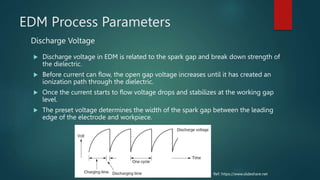
 Discharge voltage in EDM is related to the spark gap and break down strength of
the dielectric.
 Before current can flow, the open gap voltage increases until it has created an
ionization path through the dielectric.
 Once the current starts to flow voltage drops and stabilizes at the working gap
level.
 The preset voltage determines the width of the spark gap between the leading
edge of the electrode and workpiece.
Ref: https://www.slideshare.net
EDM Process Parameters
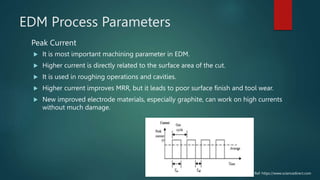
 It is most important machining parameter in EDM.
 Higher current is directly related to the surface area of the cut.
 It is used in roughing operations and cavities.
 Higher current improves MRR, but it leads to poor surface finish and tool wear.
 New improved electrode materials, especially graphite, can work on high currents
without much damage.
Peak Current
Ref: https://www.sciencedirect.com
EDM Process Parameters
Pulse Duration and Pulse Interval
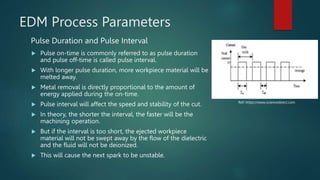
 Pulse on-time is commonly referred to as pulse duration
and pulse off-time is called pulse interval.
 With longer pulse duration, more workpiece material will be
melted away.
 Metal removal is directly proportional to the amount of
energy applied during the on-time.
 Pulse interval will affect the speed and stability of the cut.
 In theory, the shorter the interval, the faster will be the
machining operation.
 But if the interval is too short, the ejected workpiece
material will not be swept away by the flow of the dielectric
and the fluid will not be deionized.
 This will cause the next spark to be unstable.
Ref: https://www.sciencedirect.com
EDM Process Parameters
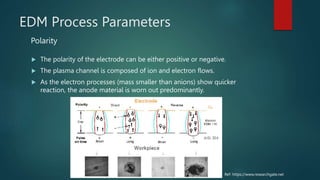
Polarity
 The polarity of the electrode can be either positive or negative.
 The plasma channel is composed of ion and electron flows.
 As the electron processes (mass smaller than anions) show quicker
reaction, the anode material is worn out predominantly.
Ref: https://www.researchgate.net
EDM Process Parameters
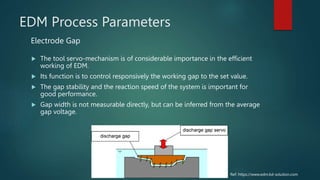
Electrode Gap
 The tool servo-mechanism is of considerable importance in the efficient
working of EDM.
 Its function is to control responsively the working gap to the set value.
 The gap stability and the reaction speed of the system is important for
good performance.
 Gap width is not measurable directly, but can be inferred from the average
gap voltage.
Ref: https://www.edm.kd-solution.com
Properties of Tool Materials
A tool material need to have these properties:
 High electrical conductivity
 High thermal conductivity
 Higher density
 High melting point
 Easy manufacturability
 Graphite is the most commonly used material.
 Other materials are brass, tellurium copper, electrolytic oxygen free
copper etc.
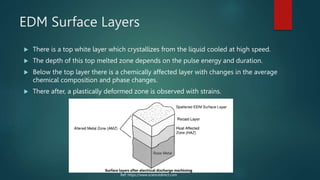
EDM Surface Layers
 There is a top white layer which crystallizes from the liquid cooled at high speed.
 The depth of this top melted zone depends on the pulse energy and duration.
 Below the top layer there is a chemically affected layer with changes in the average
chemical composition and phase changes.
 There after, a plastically deformed zone is observed with strains.
Surface layers after electrical discharge machining
Ref: https://www.sciencedirect.com
Surface Modifications
 When mild steel is eroded in liquid medium paraffin using copper electrode, the
workpiece is coated with a very hard layer.
 Using Titanium powder compact electrodes with carbon steel results increase in
hardness of steel.
 Powder-mixed dielectric is used to facilitate ignition process and get good surface
finish.
 Some powder that is usually used in doping are Ni, Co, Ti, Cr etc.
 Abrasive powders such as silicon carbide and alumina are mixed in the dielectric
to improve the material removal rate.
Product Quality Issues
 surface roughness in EDM would increase with increase in spark energy.
 Surface finish can be improved by decreasing working voltage, working current
and pulse on time.
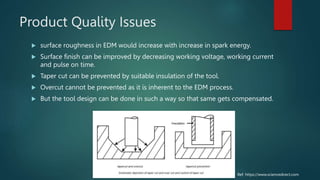
 Taper cut can be prevented by suitable insulation of the tool.
 Overcut cannot be prevented as it is inherent to the EDM process.
 But the tool design can be done in such a way so that same gets compensated.
Ref: https://www.sciencedirect.com
Conclusions
 EDM is a viable machining option of producing highly complex parts.
 Extremely hard materials can also be machined to very close clearances by this.
 Very small workpieces can be machined where conventional tools may damage
the part from excess cutting tool pressure.
 There is no direct contact between tool and work piece.
 Therefore, delicate sections and weak materials can be machined without
perceivable distortion.
Conclusions (Cont…)
 Material removal in EDM mainly occurs due to formation of shock waves
as the plasma channel collapse.
 Material removal depends mainly on thermal properties of the work
material rather than its strength, hardness etc.
 Hybrid processes enhance stability by influencing the flushing.
 Material transfer from electrode bodies and material transfer from
powders suspended dielectric is under research.
 References:
https://www.sciencedirect.com/science/article/pii/S092401360800705X
https://www.slideshare.net/GopinathGuru3/electrical-discharge-machining-70522354
https://www.rajagiritech.ac.in
https://www.sciencedirect.com/science/article/pii/S0890695503001627
https://www.irjet.net/archives/V4/i5/IRJET-V4I521.pdf
https://www.ijser.org/researchpaper/Current-Research-trends-in-Electric-Discharge-Machining-EDM-Review
https://www.sciencedirect.com/topics/engineering/discharge-energy
https://www.edm.kd-solution.com/en_edm08.html
https://nptel.ac.in/courses/112105127
EDM.pptx

EDM.pptx

  • 1.
  • 2.
    Introduction  Electrical dischargemachining (EDM) is an electro-thermal process.  It is one of the most extensively used material removal processes.  Its unique feature is to use thermal energy to machine electrically conductive parts regardless of hardness.  With no direct contact between the tool and workpiece, EDM supports smooth machining.  The main principle of EDM is to erode a material through the effect of electric discharge (spark). EDM Ref: https://www.makino.com
  • 3.
    History  The originof EDM dates back to 1770 when English scientist Joseph Priestly discovered the erosive effect of electrical discharges.  Several attempts were made to achieve a controlled EDM process.  But, These processes were not very precise due to overheating of the machining area.  Pioneering work on EDM was carried out in 1943 by two Russian scientists, B.R. and N.I. Lazarenko at the Moscow University.  They developed a controlled process for machining materials by vaporizing and melting its surface.
  • 4.
    History (Cont…)  TheRC (resistance–capacitance) relaxation circuit was introduced in 1950s.  Later, it served as the model for successive developments in EDM technology.  It provided the first consistent dependable control of pulse times. RC circuit Ref: https://www.sciencedirect.com
  • 5.
    Main Components inEDM  Workpiece and tool  Electrical power supply  Dielectric  Servo control unit  Fixture Ref: https://www.researchgate.net Schematic of EDM process
  • 6.
    Working Principle  Apotential difference is applied between the tool and workpiece.  Depending upon the applied potential difference and the gap between the tool and workpiece, an electric field would be established.  As the electric field is established between the tool and the job, the free electrons on the tool are subjected to electrostatic forces.  If the bonding energy of the electrons is less, electrons would be emitted from the tool (cold emission).  They start moving towards the job and there would be collisions between the electrons and dielectric molecules (ionization). Ref: https://www.rajagiritech.ac.in
  • 7.
    Working Principle (Cont…) This cyclic process would increase the concentration of electrons and ions in the dielectric medium between the tool and the job at the spark gap.  Concentration would be so high that the matter existing in that channel could be characterized as “plasma”.  Electrical resistance of such plasma channel would be very less.  Thus all of a sudden, a large number of electrons will flow from the tool to the job and ions from the job to the tool.  This is called avalanche motion of electrons.  High speed electrons then impinge on the job and ions on the tool. Plasma channel Ref: https://link.springer.com
  • 8.
    Working Principle (Cont…) Kinetic energy of the electrons and ions on impact with the surface of the job and tool respectively would be converted into thermal energy or heat flux.  Localized extreme rise in temperature leads to material removal.  Material removal occurs due to instant vaporization of the material as well as due to melting.  As the potential difference is withdrawn, the plasma channel is no longer sustained.  As the plasma channel collapse, it generates pressure or shock waves, which evacuates the molten material forming a crater of removed material around the site of the spark. Spark initiation Ref: https://www.sciencedirect.com
  • 9.
    EDM Process Parameters DischargeVoltage  Discharge voltage in EDM is related to the spark gap and break down strength of the dielectric.  Before current can flow, the open gap voltage increases until it has created an ionization path through the dielectric.  Once the current starts to flow voltage drops and stabilizes at the working gap level.  The preset voltage determines the width of the spark gap between the leading edge of the electrode and workpiece. Ref: https://www.slideshare.net
  • 10.
    EDM Process Parameters It is most important machining parameter in EDM.  Higher current is directly related to the surface area of the cut.  It is used in roughing operations and cavities.  Higher current improves MRR, but it leads to poor surface finish and tool wear.  New improved electrode materials, especially graphite, can work on high currents without much damage. Peak Current Ref: https://www.sciencedirect.com
  • 11.
    EDM Process Parameters PulseDuration and Pulse Interval  Pulse on-time is commonly referred to as pulse duration and pulse off-time is called pulse interval.  With longer pulse duration, more workpiece material will be melted away.  Metal removal is directly proportional to the amount of energy applied during the on-time.  Pulse interval will affect the speed and stability of the cut.  In theory, the shorter the interval, the faster will be the machining operation.  But if the interval is too short, the ejected workpiece material will not be swept away by the flow of the dielectric and the fluid will not be deionized.  This will cause the next spark to be unstable. Ref: https://www.sciencedirect.com
  • 12.
    EDM Process Parameters Polarity The polarity of the electrode can be either positive or negative.  The plasma channel is composed of ion and electron flows.  As the electron processes (mass smaller than anions) show quicker reaction, the anode material is worn out predominantly. Ref: https://www.researchgate.net
  • 13.
    EDM Process Parameters ElectrodeGap  The tool servo-mechanism is of considerable importance in the efficient working of EDM.  Its function is to control responsively the working gap to the set value.  The gap stability and the reaction speed of the system is important for good performance.  Gap width is not measurable directly, but can be inferred from the average gap voltage. Ref: https://www.edm.kd-solution.com
  • 14.
    Properties of ToolMaterials A tool material need to have these properties:  High electrical conductivity  High thermal conductivity  Higher density  High melting point  Easy manufacturability  Graphite is the most commonly used material.  Other materials are brass, tellurium copper, electrolytic oxygen free copper etc.
  • 15.
    EDM Surface Layers There is a top white layer which crystallizes from the liquid cooled at high speed.  The depth of this top melted zone depends on the pulse energy and duration.  Below the top layer there is a chemically affected layer with changes in the average chemical composition and phase changes.  There after, a plastically deformed zone is observed with strains. Surface layers after electrical discharge machining Ref: https://www.sciencedirect.com
  • 16.
    Surface Modifications  Whenmild steel is eroded in liquid medium paraffin using copper electrode, the workpiece is coated with a very hard layer.  Using Titanium powder compact electrodes with carbon steel results increase in hardness of steel.  Powder-mixed dielectric is used to facilitate ignition process and get good surface finish.  Some powder that is usually used in doping are Ni, Co, Ti, Cr etc.  Abrasive powders such as silicon carbide and alumina are mixed in the dielectric to improve the material removal rate.
  • 17.
    Product Quality Issues surface roughness in EDM would increase with increase in spark energy.  Surface finish can be improved by decreasing working voltage, working current and pulse on time.  Taper cut can be prevented by suitable insulation of the tool.  Overcut cannot be prevented as it is inherent to the EDM process.  But the tool design can be done in such a way so that same gets compensated. Ref: https://www.sciencedirect.com
  • 18.
    Conclusions  EDM isa viable machining option of producing highly complex parts.  Extremely hard materials can also be machined to very close clearances by this.  Very small workpieces can be machined where conventional tools may damage the part from excess cutting tool pressure.  There is no direct contact between tool and work piece.  Therefore, delicate sections and weak materials can be machined without perceivable distortion.
  • 19.
    Conclusions (Cont…)  Materialremoval in EDM mainly occurs due to formation of shock waves as the plasma channel collapse.  Material removal depends mainly on thermal properties of the work material rather than its strength, hardness etc.  Hybrid processes enhance stability by influencing the flushing.  Material transfer from electrode bodies and material transfer from powders suspended dielectric is under research.
  • 20.