PHOENIX
COACHING CENTER
impossible to defeat
Community Development Programmes
2nd Oct 1952 , Started by S.K. Dey
The recommendations of the Fiscal Commission (1949) and the Grow More
Food Enquiry Committee (1952) the CDP was launched on October 2, 1952,
the birth-day of Mahatma Gandhi.
 It operated till September 1956, the basic unit is a block.
 Basic objective of Community Development in India is the development of
people of "Destination Man".
 The main philosophy of the project: co-operation and self-help
 Prime Minister as Chairman.
 Started with 55 community development projects, 400 to 500
miles, comprising 300 villages and a population about 2 lakhs.
 The project area divided into 3 development blocks, each
consisting of about 100 villages and a population of 60 to 70
thousand
 Each project had about 60 multi-purpose village level workers, one
for each group of 5 to 10 villages. CDP failed because of the lack
of participation of peoples
 CDP has 5 stages: Conception, Initiation, Operation,
Consolidation, Finalization
National Extension Service (Oct 2, 1953)
 Started by S.K. Dey. CDP merged with NES.
 Recommended by Grow More Food Committee
 Having wider coverage at less cost and more people participation than CDP
 Started with 100 villages covering a population of 60,000 to 70,000 over 150 to 170 square
miles. All NES blocks became CD blocks that were achieved by October 1963.
 NES covered the Whole country in 1963
 Each NES headed by a Block development officer (BDO).
 NES is an agency (CDP is a method)
Community Development Block
(Oct 2, 1954)
 The concept of the Block Development Officer (BDO) emerged.
 The operational unit is the development block.
 Nalagarh committee recommended merging of NES and CDB
 CDB covered the Whole country in 1963
Young Farmers' Association
 4 H-club was established in 1900 in America to provide
training to youth for agriculture and home development.
 4H means Heart, Head, Hand, and Health as explained by
A.B.Graham.
 On the basis of the 4H-club of the USA, the Young Farmers
association of India was started by P.S Deshmukh in 1956. He
published a magazine 'Rural Youth' and Gram yuvak
Panchayat Raj (Democratic Decentralization)
 The word democracy derived from the Greek word ‘Demos’ means
the people.
• ‘Kratos’ means Rule i.e. Peoples Rule.
 It is governance of the people, by the people, for the people.
 The Term Panchayat Raj was christened by J. L. Nehru
 Mahatma Gandhi coined the term panchayat raj system
(PRS) as ”Gram Swaraj”(village self-governance)
 Balwant Rai Mehta Committee recommended a (1957) three-tier
system of Panchayat raj i.e. Democratic Decentralization. The
recommendation came into force 1st April 1958
 The State of Madras tried this as a pilot project as early as 1957.
 Panchayati Raj was first started on Oct 2, 1959, at Nagaur
(Rajasthan) inaugurated by Pandit Jawahar Lal Nehru. 2nd
state Andhra Pradesh in 1959.
 Village Panchayat is the lowest unit in the structure of Panchayat Raj
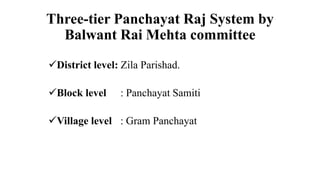
Three-tier Panchayat Raj System by
Balwant Rai Mehta committee
District level: Zila Parishad.
Block level : Panchayat Samiti
Village level : Gram Panchayat
District Collector to be the chairman of Zila Parishad.
Two-tier Panchayat Raj System by Ashok Mehta (1977) –
Karnataka (It exist in districts where the population is < 2 lakh)
District level: Zila Parishad
Grass rootlevel: Mandal Panchayat
Training and Visit System
(T & V system -1974)
 The concept of the T and V system was evolved in 1973 by Israeli extension
expert
• Daniel Benor who was a consultant on extension program in World Bank.
 Assisted by World bank
 Originated in India 1974 & Nepal 1975 by Daniel Banor
 T and V system is also called the Baster and Benor Scheme and firstly
evolved inTurkey by incidental learning.
 T & V system has two phages/ stages- (i) Training and (ii)Visit
 First T & V system introduced in Rajasthan (2nd-MP)
 West Bengal was the first to implementthe system throughout the state
 T& V: Single line of command /Linear model of transfer of technology
 Its Top-downapproach
 Aimed to achieve changes in production technologies
Features: Professionalism, Single line of command .
Extension agent: Farmer's ratio is 1:800-1200.
Ford Foundation in India: 1951-52
 Started by Paul Hoffman
 Ford foundation team-Agricultural production team (Jan 1959) sponsored
by theFord Foundation was invited to study the country’s food production
problems.
 The team submitted a report entitled ‘India’s food crisis and steps to meet it’
in April 1959.
Women and Child Development
Programme
ICDS (Integrated Child Development Scheme) –1975
 The objective is to improve the nutritional and health
status of children below the age of 6 years and
pregnant and lactating mothers
 ICDS Scheme represents one of the world's largest and
most unique programs for early childhood development
DWCRA (Development of Women and Child in Rural
Areas) -1982
 The mid-term review of IRDP indicated that the flow of assistance to
women members of target group households was very marginal.
 The objective is to improve the conditions of women and children in
rural areas through the creation of income.
 It is partly supported by UNICEF and is jointly financed by Union and
State Governments.
 Revolving fund: Rs.25000
RMK (Rashtriya Mahila Kosh)/ National Credit Fund
for Women -1993
 RMK is a micro-credit agency for women sponsored by GOI
(Department of Women and Child Development)
 Objective- assisting women below the poverty line in
undertaking income- generating activities through the provision
of a package of financial and other services, and encourages
promotion women SHGs
 Its head office is in New Delhi.
MSY (Mahila Sambridhi Yojana) – 1993
•Objective – economic empowerment of women by
encouraging saving habits and enabling them to
become self-sufficient.
TANWA: Tamil Nadu Women in Agriculture
 TANWA was signed between the Government of India and
the Royal Danish Government (DANIDA).
 TANWA was signed during June 1986.
 Finally changed into TANWABE: Tamil Nadu Women in Agri-
Business & Extension.
Employment Programmes
NREP (National Rural Employment Programme) -
Year- 1980,Provide wage employment to workers.
RLEGP(Rural Landless Employment Guarantee Programme) –
15th Aug 1983
IAY (Indira Awas Yojana) –(1985-86)
 IAY a sub-plan of RLEGP
 In 1989-90, RLEGP merged with JRY
 But on 1st Jan 1996, IAY was separated from JRY
 Providing shelter to the poor living people.
 Rural Landless Employment Guarantee Programme
JRY (Jawahar Rozgar Yojana) –
1st, April 1989
 JRY = NREP (1980) + RLEGP (1983)
 Expenditure of Central and State 80:20
 Started by Rajiv Gandhi
 Its fund gets distributed among Zila Parishad, Panchayat Samiti,
and Village Panchayat in the ratio of 20: 15: 65
 Work is undertaken under JRY in the ratio for wage and material 60:40.
EAS (Employment Assurance Scheme) – 1993
 Provide wages employment for 100 days during the
lean agricultural season
 Expenditure of Central and State 80:20
PMRY (Prime Minister Rozgar Yojana)–
2nd Oct 1993
Age group to get subsidy 18 –35
SGSY (Swarna Jayanti Gram SwarozgarYojana) –
1st April 1999
 The main program for promoting poverty alleviation through self-employment.
 The program aimed at creating income-generating assets through a mix of bankcredit and
Government Subsidies
 Centre and State Government ratio – 75:25
 The BPL family in SHG formed under SGSY should be 80%
 Bank credit under SGSY available to group corpus up to 4 times
 SGSY replaced IRDP and its allied schemes viz. TRYSEM, DWCRA, SITRA (Supply of
Improved Toolkits to Rural Artisans), GKY, MWS.
Annapurna Yojana – 1999
Providing food security (10 kg food grain) to
senior citizens
AAY (Antiyodaya Anna Yojana) – Dec 2000
Launched for 1 crore BPL families covered Under TPDS
(Target Public Distribution System). 35 kg of food grains
provided at Rs. 2 per kg for wheat and Rs. 3 per kg for rice.
1) Pradhan MantriGram SadakYojana (PMGSY): 2000.
Link allvillagebypukkaroads
2. SGRY (Sampoorna Grameen RozgarYojana) – 25th Sep 2001
 Centre and State govt. Ratio – 75: 25
 JGSY + EAS = SGRY
 The Centre provides food grains to State at free of cost
MGNREGS -Mahatma Gandhi National
Rural Employment Programme
 NREGA (National Rural Employment Guarantee Act) – 7th Sep 2005
 NREGS (National Rural Employment Guarantee Scheme) – 2nd Feb 2006
initially started in 200 districts.
 First started in Anantapur district of Andhra Pradesh by Dr. Manmohan
Singh
 1st April 2008- Whole country covered under NREGA
 Objective – To enhance the livelihood securities through the provision of 100
days of employment to a household in a financial year who is willing to
do unskilled manual labor work (Article 41)
 It provides a legal right for guaranteed employment to the rural population
through an act of Parliament
 Panchayat Raj Institutions have a principal role in planning and
implementation
 NREGA has been renamed as MGNREGA on 2nd Oct 2009
 National food for work program and Sampoorna Grameen rozgar
yojana are merged with MGNREGS.
*********
THANK YOU

Class 6.pptx

  • 1.
  • 2.
    Community Development Programmes 2ndOct 1952 , Started by S.K. Dey The recommendations of the Fiscal Commission (1949) and the Grow More Food Enquiry Committee (1952) the CDP was launched on October 2, 1952, the birth-day of Mahatma Gandhi.  It operated till September 1956, the basic unit is a block.  Basic objective of Community Development in India is the development of people of "Destination Man".  The main philosophy of the project: co-operation and self-help  Prime Minister as Chairman.
  • 3.
     Started with55 community development projects, 400 to 500 miles, comprising 300 villages and a population about 2 lakhs.  The project area divided into 3 development blocks, each consisting of about 100 villages and a population of 60 to 70 thousand  Each project had about 60 multi-purpose village level workers, one for each group of 5 to 10 villages. CDP failed because of the lack of participation of peoples  CDP has 5 stages: Conception, Initiation, Operation, Consolidation, Finalization
  • 4.
    National Extension Service(Oct 2, 1953)  Started by S.K. Dey. CDP merged with NES.  Recommended by Grow More Food Committee  Having wider coverage at less cost and more people participation than CDP  Started with 100 villages covering a population of 60,000 to 70,000 over 150 to 170 square miles. All NES blocks became CD blocks that were achieved by October 1963.  NES covered the Whole country in 1963  Each NES headed by a Block development officer (BDO).  NES is an agency (CDP is a method)
  • 5.
    Community Development Block (Oct2, 1954)  The concept of the Block Development Officer (BDO) emerged.  The operational unit is the development block.  Nalagarh committee recommended merging of NES and CDB  CDB covered the Whole country in 1963
  • 6.
    Young Farmers' Association 4 H-club was established in 1900 in America to provide training to youth for agriculture and home development.  4H means Heart, Head, Hand, and Health as explained by A.B.Graham.  On the basis of the 4H-club of the USA, the Young Farmers association of India was started by P.S Deshmukh in 1956. He published a magazine 'Rural Youth' and Gram yuvak
  • 7.
    Panchayat Raj (DemocraticDecentralization)  The word democracy derived from the Greek word ‘Demos’ means the people. • ‘Kratos’ means Rule i.e. Peoples Rule.  It is governance of the people, by the people, for the people.  The Term Panchayat Raj was christened by J. L. Nehru  Mahatma Gandhi coined the term panchayat raj system (PRS) as ”Gram Swaraj”(village self-governance)
  • 8.
     Balwant RaiMehta Committee recommended a (1957) three-tier system of Panchayat raj i.e. Democratic Decentralization. The recommendation came into force 1st April 1958  The State of Madras tried this as a pilot project as early as 1957.  Panchayati Raj was first started on Oct 2, 1959, at Nagaur (Rajasthan) inaugurated by Pandit Jawahar Lal Nehru. 2nd state Andhra Pradesh in 1959.  Village Panchayat is the lowest unit in the structure of Panchayat Raj
  • 9.
    Three-tier Panchayat RajSystem by Balwant Rai Mehta committee District level: Zila Parishad. Block level : Panchayat Samiti Village level : Gram Panchayat
  • 10.
    District Collector tobe the chairman of Zila Parishad. Two-tier Panchayat Raj System by Ashok Mehta (1977) – Karnataka (It exist in districts where the population is < 2 lakh) District level: Zila Parishad Grass rootlevel: Mandal Panchayat
  • 11.
    Training and VisitSystem (T & V system -1974)  The concept of the T and V system was evolved in 1973 by Israeli extension expert • Daniel Benor who was a consultant on extension program in World Bank.  Assisted by World bank  Originated in India 1974 & Nepal 1975 by Daniel Banor  T and V system is also called the Baster and Benor Scheme and firstly evolved inTurkey by incidental learning.
  • 12.
     T &V system has two phages/ stages- (i) Training and (ii)Visit  First T & V system introduced in Rajasthan (2nd-MP)  West Bengal was the first to implementthe system throughout the state  T& V: Single line of command /Linear model of transfer of technology  Its Top-downapproach  Aimed to achieve changes in production technologies Features: Professionalism, Single line of command . Extension agent: Farmer's ratio is 1:800-1200.
  • 13.
    Ford Foundation inIndia: 1951-52  Started by Paul Hoffman  Ford foundation team-Agricultural production team (Jan 1959) sponsored by theFord Foundation was invited to study the country’s food production problems.  The team submitted a report entitled ‘India’s food crisis and steps to meet it’ in April 1959.
  • 14.
    Women and ChildDevelopment Programme
  • 15.
    ICDS (Integrated ChildDevelopment Scheme) –1975  The objective is to improve the nutritional and health status of children below the age of 6 years and pregnant and lactating mothers  ICDS Scheme represents one of the world's largest and most unique programs for early childhood development
  • 16.
    DWCRA (Development ofWomen and Child in Rural Areas) -1982  The mid-term review of IRDP indicated that the flow of assistance to women members of target group households was very marginal.  The objective is to improve the conditions of women and children in rural areas through the creation of income.  It is partly supported by UNICEF and is jointly financed by Union and State Governments.  Revolving fund: Rs.25000
  • 17.
    RMK (Rashtriya MahilaKosh)/ National Credit Fund for Women -1993  RMK is a micro-credit agency for women sponsored by GOI (Department of Women and Child Development)  Objective- assisting women below the poverty line in undertaking income- generating activities through the provision of a package of financial and other services, and encourages promotion women SHGs  Its head office is in New Delhi.
  • 18.
    MSY (Mahila SambridhiYojana) – 1993 •Objective – economic empowerment of women by encouraging saving habits and enabling them to become self-sufficient.
  • 19.
    TANWA: Tamil NaduWomen in Agriculture  TANWA was signed between the Government of India and the Royal Danish Government (DANIDA).  TANWA was signed during June 1986.  Finally changed into TANWABE: Tamil Nadu Women in Agri- Business & Extension.
  • 20.
  • 21.
    NREP (National RuralEmployment Programme) - Year- 1980,Provide wage employment to workers. RLEGP(Rural Landless Employment Guarantee Programme) – 15th Aug 1983
  • 22.
    IAY (Indira AwasYojana) –(1985-86)  IAY a sub-plan of RLEGP  In 1989-90, RLEGP merged with JRY  But on 1st Jan 1996, IAY was separated from JRY  Providing shelter to the poor living people.  Rural Landless Employment Guarantee Programme
  • 23.
    JRY (Jawahar RozgarYojana) – 1st, April 1989  JRY = NREP (1980) + RLEGP (1983)  Expenditure of Central and State 80:20  Started by Rajiv Gandhi  Its fund gets distributed among Zila Parishad, Panchayat Samiti, and Village Panchayat in the ratio of 20: 15: 65  Work is undertaken under JRY in the ratio for wage and material 60:40.
  • 24.
    EAS (Employment AssuranceScheme) – 1993  Provide wages employment for 100 days during the lean agricultural season  Expenditure of Central and State 80:20
  • 25.
    PMRY (Prime MinisterRozgar Yojana)– 2nd Oct 1993 Age group to get subsidy 18 –35
  • 26.
    SGSY (Swarna JayantiGram SwarozgarYojana) – 1st April 1999  The main program for promoting poverty alleviation through self-employment.  The program aimed at creating income-generating assets through a mix of bankcredit and Government Subsidies  Centre and State Government ratio – 75:25  The BPL family in SHG formed under SGSY should be 80%  Bank credit under SGSY available to group corpus up to 4 times  SGSY replaced IRDP and its allied schemes viz. TRYSEM, DWCRA, SITRA (Supply of Improved Toolkits to Rural Artisans), GKY, MWS.
  • 27.
    Annapurna Yojana –1999 Providing food security (10 kg food grain) to senior citizens
  • 28.
    AAY (Antiyodaya AnnaYojana) – Dec 2000 Launched for 1 crore BPL families covered Under TPDS (Target Public Distribution System). 35 kg of food grains provided at Rs. 2 per kg for wheat and Rs. 3 per kg for rice.
  • 29.
    1) Pradhan MantriGramSadakYojana (PMGSY): 2000. Link allvillagebypukkaroads 2. SGRY (Sampoorna Grameen RozgarYojana) – 25th Sep 2001  Centre and State govt. Ratio – 75: 25  JGSY + EAS = SGRY  The Centre provides food grains to State at free of cost
  • 30.
    MGNREGS -Mahatma GandhiNational Rural Employment Programme  NREGA (National Rural Employment Guarantee Act) – 7th Sep 2005  NREGS (National Rural Employment Guarantee Scheme) – 2nd Feb 2006 initially started in 200 districts.  First started in Anantapur district of Andhra Pradesh by Dr. Manmohan Singh  1st April 2008- Whole country covered under NREGA  Objective – To enhance the livelihood securities through the provision of 100 days of employment to a household in a financial year who is willing to do unskilled manual labor work (Article 41)
  • 31.
     It providesa legal right for guaranteed employment to the rural population through an act of Parliament  Panchayat Raj Institutions have a principal role in planning and implementation  NREGA has been renamed as MGNREGA on 2nd Oct 2009  National food for work program and Sampoorna Grameen rozgar yojana are merged with MGNREGS. *********
  • 32.