Poverty
alleviation
programmes
in India
In 2019, the Indian government
stated that 6.7% of its population
is below its official poverty limit.
A PREVALENT PROBLEM
INTRODUCTION
The poverty alleviation
programs in India can be
categorized based on whether it
is targeted either for rural areas
or urban areas in the country.
Most of the programs are
designed to target rural poverty
as the prevalence of poverty is
high in rural areas. Also
targeting poverty is a great
challenge in rural areas due to
various reasons.
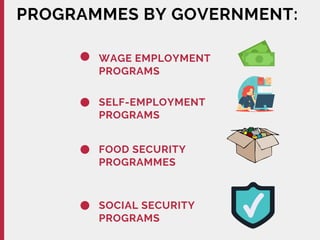
WAGE EMPLOYMENT
PROGRAMS
PROGRAMMES BY GOVERNMENT:
SELF-EMPLOYMENT
PROGRAMS
FOOD SECURITY
PROGRAMMES
SOCIAL SECURITY
PROGRAMS
JAWAHAR GRAM
SAMRIDHI
YOJANA (JGSY)
It was started on 1 April 1999. The
main aim of this program was the
development of rural areas.
Infrastructure like roads to connect
the village to different areas made
the village more accessible and
other social, educational (schools)
and infrastructure like hospitals. Its
secondary objective was to give out
sustained wage employment.
THIS WAS ONLY GIVEN TO BELOW
POVERTY LINE FAMILIES AND THE
FUND WAS TO BE SPENT FOR
INDIVIDUAL BENEFICIARY
SCHEMES FOR SCS AND STS AND
3% FOR THE ESTABLISHMENT OF
BARRIER-FREE INFRASTRUCTURE
FOR THE DISABLED PEOPLE.
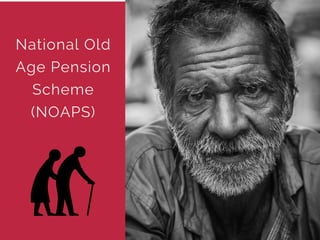
National Old
Age Pension
Scheme
(NOAPS)
NATIONAL OLD AGE PENSION SCHEME (NOAPS)
This scheme came into effect on 15 August 1995.
The scheme provides pensions to all old people who were
above the age of 65 (now 60) who could not fund themselves
and did not have any means of subsistence.
The pension that was given was ₹200 a month (now it is 2000
per month). This pension is given by the central government.
The job of implementation of this scheme in states and union
territories is given to panchayats and municipalities.
The state's contribution may vary depending on the state. The
amount of old-age pension is ₹200 per month for applicants
aged 60–79.
For applicants aged above 80 years, the amount has been
revised to ₹500 a month according to the 2011–2012 Budget. It
is a successful venture.
NATIONAL FAMILY
BENEFIT SCHEME (NFBS)
This scheme was started in August 1995. This
scheme is sponsored by the state government. It
was transferred to the state sector scheme after
2002–03.
It is under the community and rural department.
This scheme provides a sum of ₹20,000 to a person
of a family who becomes the head of the family
after the death of its primary breadwinner.
The breadwinner is defined as a person above 18
who earns the most for the family and whose
earnings the family survives.
This scheme provides a sum of
₹6000 to a pregnant mother in
three installments. The women
should be older than 19 years of
age.
National Maternity Benefit
Scheme
During 1999–2000 the total
allocation of funds for this
scheme was 767.05 crores and
the amount used was ₹4444.13
crore.
It is given normally 12–8 weeks before
the birth and in case of the death of
the child the women can still avail it.
The NMBS is implemented by almost
all states and union territories with the
help of panchayats and municipalities.
It is for families below the
poverty line. The scheme was
updated in 2005-06 into Janani
Suraksha Yojana with ₹1400 for
every institutional birth.
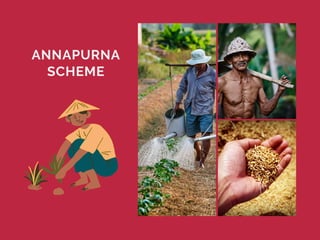
ANNAPURNA
SCHEME
The government started
this scheme in 1999–2000
to provide food to senior
citizens who cannot take
care of themselves and are
not under the National Old
Age Pension Scheme
(NOAPS), and who have no
one to take care of them in
their village.
This scheme would provide
10 kg of free food grains a
month for the eligible senior
citizens. The allocation for
this scheme in 2000-2001
was ₹100 crore.
They mostly target groups
of 'poorest of the poor and
'indigent senior citizens'...
INTEGRATED
RURAL
DEVELOPMENT
PROGRAM (IRDP)
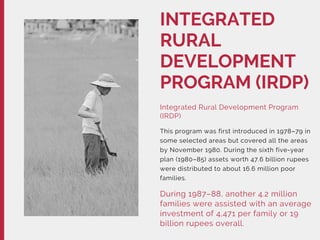
This program was first introduced in 1978–79 in
some selected areas but covered all the areas
by November 1980. During the sixth five-year
plan (1980–85) assets worth 47.6 billion rupees
were distributed to about 16.6 million poor
families.
Integrated Rural Development Program
(IRDP)
During 1987–88, another 4.2 million
families were assisted with an average
investment of 4,471 per family or 19
billion rupees overall.
PRADHAN MANTRI
GRAMIN AWAAS YOJANA
This scheme aimed at creating housing for everyone.
It was initiated in 1985. It aimed at creating 20 lakh
housing units out of which 13 lakhs were in rural areas.
This scheme also would give out loans to people at
subsidized rates to make houses.
It was started in 1999–2000. In 1999–2000, ₹1438.39
crore was used for this scheme, and about 7.98 lakh
units were built. In 2000-01 a central outlay of
₹1710.00 crores was provided for this scheme.
It improved the standard of living of rural areas: health,
primary education, drinking water, housing, and roads.
The scheme has proved to be a major boost in the Indian
rural population's income
A BASIC NEEDS APPROACH IS ALL THE
MORE NECESSARY IN ADDITION TO
FIXING A POVERTY LINE IN RURAL
AREAS GIVEN THAT ACCESS TO
DEVELOPMENTAL PROCESSES AND
FACILITIES MIGHT BE MORE LIMITED IN
FAR-FLUNG RURAL AREAS.
THANK YOU!

Poverty alleviation programmes in India.pdf

  • 1.
  • 2.
    In 2019, theIndian government stated that 6.7% of its population is below its official poverty limit. A PREVALENT PROBLEM
  • 3.
    INTRODUCTION The poverty alleviation programsin India can be categorized based on whether it is targeted either for rural areas or urban areas in the country. Most of the programs are designed to target rural poverty as the prevalence of poverty is high in rural areas. Also targeting poverty is a great challenge in rural areas due to various reasons.
  • 4.
    WAGE EMPLOYMENT PROGRAMS PROGRAMMES BYGOVERNMENT: SELF-EMPLOYMENT PROGRAMS FOOD SECURITY PROGRAMMES SOCIAL SECURITY PROGRAMS
  • 5.
    JAWAHAR GRAM SAMRIDHI YOJANA (JGSY) Itwas started on 1 April 1999. The main aim of this program was the development of rural areas. Infrastructure like roads to connect the village to different areas made the village more accessible and other social, educational (schools) and infrastructure like hospitals. Its secondary objective was to give out sustained wage employment. THIS WAS ONLY GIVEN TO BELOW POVERTY LINE FAMILIES AND THE FUND WAS TO BE SPENT FOR INDIVIDUAL BENEFICIARY SCHEMES FOR SCS AND STS AND 3% FOR THE ESTABLISHMENT OF BARRIER-FREE INFRASTRUCTURE FOR THE DISABLED PEOPLE.
  • 6.
  • 7.
    NATIONAL OLD AGEPENSION SCHEME (NOAPS) This scheme came into effect on 15 August 1995. The scheme provides pensions to all old people who were above the age of 65 (now 60) who could not fund themselves and did not have any means of subsistence. The pension that was given was ₹200 a month (now it is 2000 per month). This pension is given by the central government. The job of implementation of this scheme in states and union territories is given to panchayats and municipalities. The state's contribution may vary depending on the state. The amount of old-age pension is ₹200 per month for applicants aged 60–79. For applicants aged above 80 years, the amount has been revised to ₹500 a month according to the 2011–2012 Budget. It is a successful venture.
  • 8.
    NATIONAL FAMILY BENEFIT SCHEME(NFBS) This scheme was started in August 1995. This scheme is sponsored by the state government. It was transferred to the state sector scheme after 2002–03. It is under the community and rural department. This scheme provides a sum of ₹20,000 to a person of a family who becomes the head of the family after the death of its primary breadwinner. The breadwinner is defined as a person above 18 who earns the most for the family and whose earnings the family survives.
  • 9.
    This scheme providesa sum of ₹6000 to a pregnant mother in three installments. The women should be older than 19 years of age. National Maternity Benefit Scheme During 1999–2000 the total allocation of funds for this scheme was 767.05 crores and the amount used was ₹4444.13 crore. It is given normally 12–8 weeks before the birth and in case of the death of the child the women can still avail it. The NMBS is implemented by almost all states and union territories with the help of panchayats and municipalities. It is for families below the poverty line. The scheme was updated in 2005-06 into Janani Suraksha Yojana with ₹1400 for every institutional birth.
  • 10.
  • 11.
    The government started thisscheme in 1999–2000 to provide food to senior citizens who cannot take care of themselves and are not under the National Old Age Pension Scheme (NOAPS), and who have no one to take care of them in their village. This scheme would provide 10 kg of free food grains a month for the eligible senior citizens. The allocation for this scheme in 2000-2001 was ₹100 crore. They mostly target groups of 'poorest of the poor and 'indigent senior citizens'...
  • 12.
    INTEGRATED RURAL DEVELOPMENT PROGRAM (IRDP) This programwas first introduced in 1978–79 in some selected areas but covered all the areas by November 1980. During the sixth five-year plan (1980–85) assets worth 47.6 billion rupees were distributed to about 16.6 million poor families. Integrated Rural Development Program (IRDP) During 1987–88, another 4.2 million families were assisted with an average investment of 4,471 per family or 19 billion rupees overall.
  • 13.
    PRADHAN MANTRI GRAMIN AWAASYOJANA This scheme aimed at creating housing for everyone. It was initiated in 1985. It aimed at creating 20 lakh housing units out of which 13 lakhs were in rural areas. This scheme also would give out loans to people at subsidized rates to make houses. It was started in 1999–2000. In 1999–2000, ₹1438.39 crore was used for this scheme, and about 7.98 lakh units were built. In 2000-01 a central outlay of ₹1710.00 crores was provided for this scheme. It improved the standard of living of rural areas: health, primary education, drinking water, housing, and roads. The scheme has proved to be a major boost in the Indian rural population's income
  • 14.
    A BASIC NEEDSAPPROACH IS ALL THE MORE NECESSARY IN ADDITION TO FIXING A POVERTY LINE IN RURAL AREAS GIVEN THAT ACCESS TO DEVELOPMENTAL PROCESSES AND FACILITIES MIGHT BE MORE LIMITED IN FAR-FLUNG RURAL AREAS.
  • 15.