RURAL UNEMPLOYMENT
Ms. ARATHI
Assistant Professor
Department of Economics
Ethiraj College for Women
CONTENT
• Introduction of Unemployment
• Unemployment rate and frequency
• Definition of Rural unemployment
• Types of Unemployment
• Causes of unemployment
• Consequences of unemployment
INTRODUCTION
• Most disturbing problem in India has been the
rising rate of unemployment.
• Unemployment - situation where in the able
bodied persons willing to work falls to find a
job that earns their living/situation in which a
person who is physically, mentally willing to
work at existing rate, does not find any job and
is forced to remain unemployed.
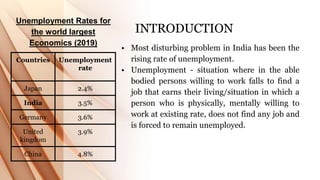
Unemployment Rates for
the world largest
Economics (2019)
Countries Unemployment
rate
Japan 2.4%
India 3.5%
Germany 3.6%
United
kingdom
3.9%
China 4.8%
Unemployment
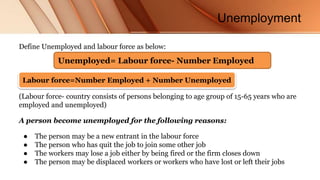
Define Unemployed and labour force as below:
(Labour force- country consists of persons belonging to age group of 15-65 years who are
employed and unemployed)
A person become unemployed for the following reasons:
● The person may be a new entrant in the labour force
● The person who has quit the job to join some other job
● The workers may lose a job either by being fired or the firm closes down
● The person may be displaced workers or workers who have lost or left their jobs
Unemployed= Labour force- Number Employed
Labour force=Number Employed + Number Unemployed
Unemployment Rate and Unemployment Frequency
Unemployment rate- measure of unemployment in a particular country
and is calculated in percentage by dividing the number of unemployed
individual by all individual currently in the labour force.
Unemployment frequency- defined as the average no. of times per
period the workers becomes unemployed.
Unemployed is also considered as one of the lagging factors indicating that
state of economy as its lags behind the business cycle and is the consequence
of economy.
Formula: Unemployment rate= [No. of Unemployed Individual/labour force] x 100
Definition of Rural Unemployment
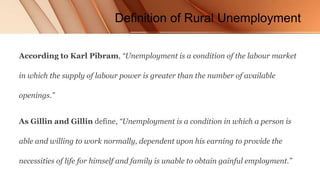
According to Karl Pibram, “Unemployment is a condition of the labour market
in which the supply of labour power is greater than the number of available
openings.”
As Gillin and Gillin define, “Unemployment is a condition in which a person is
able and willing to work normally, dependent upon his earning to provide the
necessities of life for himself and family is unable to obtain gainful employment.”
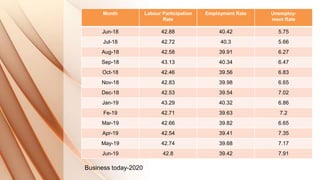
Month Labour Participation
Rate
Employment Rate Unemploy-
ment Rate
Jun-18 42.88 40.42 5.75
Jul-18 42.72 40.3 5.66
Aug-18 42.58 39.91 6.27
Sep-18 43.13 40.34 6.47
Oct-18 42.46 39.56 6.83
Nov-18 42.83 39.98 6.65
Dec-18 42.53 39.54 7.02
Jan-19 43.29 40.32 6.86
Fe-19 42.71 39.63 7.2
Mar-19 42.66 39.82 6.65
Apr-19 42.54 39.41 7.35
May-19 42.74 39.68 7.17
Jun-19 42.8 39.42 7.91
Business today-2020
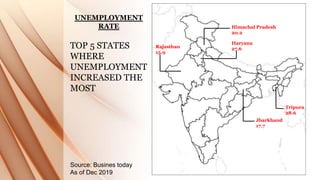
UNEMPLOYMENT
RATE
TOP 5 STATES
WHERE
UNEMPLOYMENT
INCREASED THE
MOST
Source: Busines today
As of Dec 2019
Himachal Pradesh
20.2
Tripura
28.6
Haryana
27.6
Jharkhand
17.7
Rajasthan
15.9
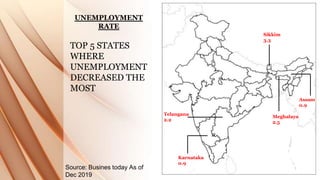
UNEMPLOYMENT
RATE
TOP 5 STATES
WHERE
UNEMPLOYMENT
DECREASED THE
MOST
Source: Busines today As of
Dec 2019
Sikkim
3.3
Assam
0.9
Meghalaya
2.5
Karnataka
0.9
Telangana
2.2
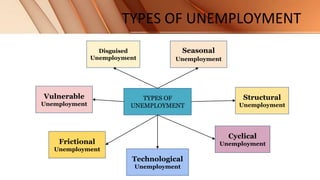
TYPES OF UNEMPLOYMENT
TYPES OF
UNEMPLOYMENT
Seasonal
Unemployment
Cyclical
Unemployment
Technological
Unemployment
Structural
Unemployment
Frictional
Unemployment
Vulnerable
Unemployment
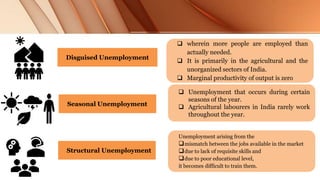
Disguised
Unemployment
Disguised Unemployment
 wherein more people are employed than
actually needed.
 It is primarily in the agricultural and the
unorganized sectors of India.
 Marginal productivity of output is zero
Seasonal Unemployment
 Unemployment that occurs during certain
seasons of the year.
 Agricultural labourers in India rarely work
throughout the year.
Unemployment arising from the
mismatch between the jobs available in the market
due to lack of requisite skills and
due to poor educational level,
it becomes difficult to train them.
Structural Unemployment
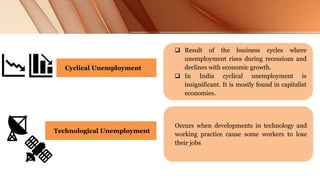
Cyclical Unemployment
 Result of the business cycles where
unemployment rises during recessions and
declines with economic growth.
 In India cyclical unemployment is
insignificant. It is mostly found in capitalist
economies.
Technological Unemployment
Occurs when developments in technology and
working practice cause some workers to lose
their jobs
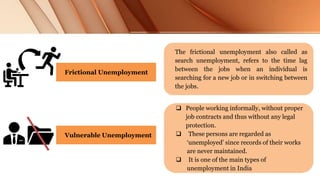
The frictional unemployment also called as
search unemployment, refers to the time lag
between the jobs when an individual is
searching for a new job or in switching between
the jobs.
Frictional Unemployment
Vulnerable Unemployment
 People working informally, without proper
job contracts and thus without any legal
protection.
 These persons are regarded as
‘unemployed’ since records of their works
are never maintained.
 It is one of the main types of
unemployment in India
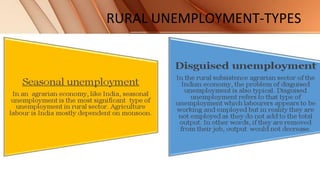
RURAL UNEMPLOYMENT-TYPES
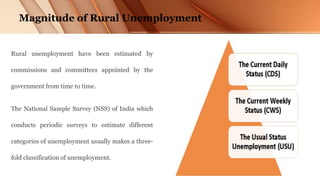
Magnitude of Rural Unemployment
Rural unemployment have been estimated by
commissions and committees appointed by the
government from time to time.
The National Sample Survey (NSS) of India which
conducts periodic surveys to estimate different
categories of unemployment usually makes a three-
fold classification of unemployment.
(i) The Usual Status Unemployment (USU):
It relates to a person who is considered unemployed but has been trying to get the work. Here we
measure it in terms of persons remaining unemployed.
(ii) The Current Weekly Status (CWS):
It relates to a person who has not been able to get employment even for a single hour throughout the
week but wants to get the work. It is measured in terms of the number of persons.
(iii) The Current Daily Status (CDS):
CDS refers to the aggregate of all the unemployment days of all persons in the labour force
during the week. This is a general concept which includes chronic unemployment and under-
employment. It is measured in number of days during the survey week.
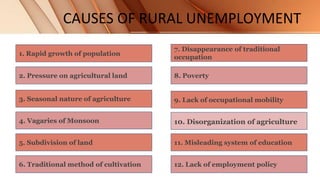
CAUSES OF RURAL UNEMPLOYMENT
1. Rapid growth of population
2. Pressure on agricultural land
3. Seasonal nature of agriculture
4. Vagaries of Monsoon
5. Subdivision of land
6. Traditional method of cultivation
7. Disappearance of traditional
occupation
8. Poverty
9. Lack of occupational mobility
10. Disorganization of agriculture
11. Misleading system of education
12. Lack of employment policy
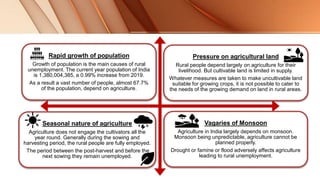
Rapid growth of population
Growth of population is the main causes of rural
unemployment. The current year population of India
is 1,380,004,385, a 0.99% increase from 2019.
As a result a vast number of people, almost 67.7%
of the population, depend on agriculture.
Pressure on agricultural land
Rural people depend largely on agriculture for their
livelihood. But cultivable land is limited in supply.
Whatever measures are taken to make uncultivable land
suitable for growing crops, it is not possible to cater to
the needs of the growing demand on land in rural areas.
Seasonal nature of agriculture
Agriculture does not engage the cultivators all the
year round. Generally during the sowing and
harvesting period, the rural people are fully employed.
The period between the post-harvest and before the
next sowing they remain unemployed.
Vagaries of Monsoon
Agriculture in India largely depends on monsoon.
Monsoon being unpredictable, agriculture cannot be
planned properly.
Drought or famine or flood adversely affects agriculture
leading to rural unemployment.
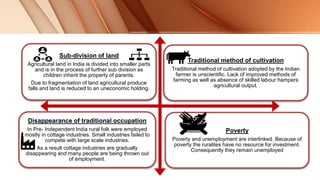
Sub-division of land
Agricultural land in India is divided into smaller parts
and is in the process of further sub division as
children inherit the property of parents.
Due to fragmentation of land agricultural produce
falls and land is reduced to an uneconomic holding.
Traditional method of cultivation
Traditional method of cultivation adopted by the Indian
farmer is unscientific. Lack of improved methods of
farming as well as absence of skilled labour hampers
agricultural output.
Disappearance of traditional occupation
In Pre- Independent India rural folk were employed
mostly in cottage industries. Small industries failed to
compete with large scale industries.
As a result cottage industries are gradually
disappearing and many people are being thrown out
of employment.
Poverty
Poverty and unemployment are interlinked. Because of
poverty the ruralites have no resource for investment.
Consequently they remain unemployed
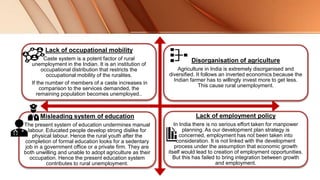
Lack of occupational mobility
Caste system is a potent factor of rural
unemployment in the Indian. It is an institution of
occupational distribution that restricts the
occupational mobility of the ruralites.
If the number of members of a caste increases in
comparison to the services demanded, the
remaining population becomes unemployed..
Disorganisation of agriculture
Agriculture in India is extremely disorganised and
diversified. It follows an inverted economics because the
Indian farmer has to willingly invest more to get less.
This cause rural unemployment.
Misleading system of education
The present system of education undermines manual
labour. Educated people develop strong dislike for
physical labour. Hence the rural youth after the
completion of formal education looks for a sedentary
job in a government office or a private firm. They are
both unwilling and unable to adopt agriculture as their
occupation. Hence the present education system
contributes to rural unemployment.
Lack of employment policy
In India there is no serious effort taken for manpower
planning. As our development plan strategy is
concerned, employment has not been taken into
consideration. It is not linked with the development
process under the assumption that economic growth
itself would lead to creation of employment opportunities.
But this has failed to bring integration between growth
and employment.
Consequences of Rural Unemployment
1. Open and disguised unemployment in rural areas lead to huge
wastage of human resources. This could have been utilised for the purpose
of economic development of the country.
2. Increase in the number of the unemployed increases pressure on
land and other scarce natural resources. In the absence of
gainful industrial activity in rural areas more and more people fall
back upon agricultural activities. This results in further sub-division of
already tiny sized holding. This adversely affects agricultural productivity.
3. The unemployed persons in rural areas are unproductive consumers.
They merely consume without any contribution to production. In the
process they eat away resources which would have been mobilized for
capital formation in rural sector.
Consequences of Rural Unemployment
4. Absence of employment opportunities in rural sector forces people to
migrate to cities in search of jobs. Migratory population crowds the
cities. Slums grow rapidly. Environment gets polluted and cities
become dens of vices.
5. Another consequence of rising unemployment is increase in the
number of crimes in the rural sector, such as drugs abuse.
6. Unemployment fails to maintain the health of the ruralites.
People require nutrients such as protein and vitamins reduce immunity
against diseases and hence the ruralites fall ill more frequently. Their
inability to pay for even minimum medical care reduces the general health
status.
Consequences of Rural Unemployment
7. Unemployment affects the social status, personal life and sentiments
of the unemployed person.
8. Loss of social status tends to isolate the unemployed person from the
existing contacts.
9.Unemployment in a family makes other members are forced to take up
work of any kind for their livelihood without any inhibition.
10. Even temporary unemployment has very serious consequences. It results in
suicide, forcing women to immoral traffic and withdrawal from
social relationships. This acts upon the morale and social life of the
individual, family and community in a very subtle way.
Rural unemployment

Rural unemployment

  • 1.
    RURAL UNEMPLOYMENT Ms. ARATHI AssistantProfessor Department of Economics Ethiraj College for Women
  • 2.
    CONTENT • Introduction ofUnemployment • Unemployment rate and frequency • Definition of Rural unemployment • Types of Unemployment • Causes of unemployment • Consequences of unemployment
  • 3.
    INTRODUCTION • Most disturbingproblem in India has been the rising rate of unemployment. • Unemployment - situation where in the able bodied persons willing to work falls to find a job that earns their living/situation in which a person who is physically, mentally willing to work at existing rate, does not find any job and is forced to remain unemployed. Unemployment Rates for the world largest Economics (2019) Countries Unemployment rate Japan 2.4% India 3.5% Germany 3.6% United kingdom 3.9% China 4.8%
  • 4.
    Unemployment Define Unemployed andlabour force as below: (Labour force- country consists of persons belonging to age group of 15-65 years who are employed and unemployed) A person become unemployed for the following reasons: ● The person may be a new entrant in the labour force ● The person who has quit the job to join some other job ● The workers may lose a job either by being fired or the firm closes down ● The person may be displaced workers or workers who have lost or left their jobs Unemployed= Labour force- Number Employed Labour force=Number Employed + Number Unemployed
  • 5.
    Unemployment Rate andUnemployment Frequency Unemployment rate- measure of unemployment in a particular country and is calculated in percentage by dividing the number of unemployed individual by all individual currently in the labour force. Unemployment frequency- defined as the average no. of times per period the workers becomes unemployed. Unemployed is also considered as one of the lagging factors indicating that state of economy as its lags behind the business cycle and is the consequence of economy. Formula: Unemployment rate= [No. of Unemployed Individual/labour force] x 100
  • 6.
    Definition of RuralUnemployment According to Karl Pibram, “Unemployment is a condition of the labour market in which the supply of labour power is greater than the number of available openings.” As Gillin and Gillin define, “Unemployment is a condition in which a person is able and willing to work normally, dependent upon his earning to provide the necessities of life for himself and family is unable to obtain gainful employment.”
  • 7.
    Month Labour Participation Rate EmploymentRate Unemploy- ment Rate Jun-18 42.88 40.42 5.75 Jul-18 42.72 40.3 5.66 Aug-18 42.58 39.91 6.27 Sep-18 43.13 40.34 6.47 Oct-18 42.46 39.56 6.83 Nov-18 42.83 39.98 6.65 Dec-18 42.53 39.54 7.02 Jan-19 43.29 40.32 6.86 Fe-19 42.71 39.63 7.2 Mar-19 42.66 39.82 6.65 Apr-19 42.54 39.41 7.35 May-19 42.74 39.68 7.17 Jun-19 42.8 39.42 7.91 Business today-2020
  • 8.
    UNEMPLOYMENT RATE TOP 5 STATES WHERE UNEMPLOYMENT INCREASEDTHE MOST Source: Busines today As of Dec 2019 Himachal Pradesh 20.2 Tripura 28.6 Haryana 27.6 Jharkhand 17.7 Rajasthan 15.9
  • 9.
    UNEMPLOYMENT RATE TOP 5 STATES WHERE UNEMPLOYMENT DECREASEDTHE MOST Source: Busines today As of Dec 2019 Sikkim 3.3 Assam 0.9 Meghalaya 2.5 Karnataka 0.9 Telangana 2.2
  • 10.
    TYPES OF UNEMPLOYMENT TYPESOF UNEMPLOYMENT Seasonal Unemployment Cyclical Unemployment Technological Unemployment Structural Unemployment Frictional Unemployment Vulnerable Unemployment Disguised Unemployment
  • 11.
    Disguised Unemployment  whereinmore people are employed than actually needed.  It is primarily in the agricultural and the unorganized sectors of India.  Marginal productivity of output is zero Seasonal Unemployment  Unemployment that occurs during certain seasons of the year.  Agricultural labourers in India rarely work throughout the year. Unemployment arising from the mismatch between the jobs available in the market due to lack of requisite skills and due to poor educational level, it becomes difficult to train them. Structural Unemployment
  • 12.
    Cyclical Unemployment  Resultof the business cycles where unemployment rises during recessions and declines with economic growth.  In India cyclical unemployment is insignificant. It is mostly found in capitalist economies. Technological Unemployment Occurs when developments in technology and working practice cause some workers to lose their jobs
  • 13.
    The frictional unemploymentalso called as search unemployment, refers to the time lag between the jobs when an individual is searching for a new job or in switching between the jobs. Frictional Unemployment Vulnerable Unemployment  People working informally, without proper job contracts and thus without any legal protection.  These persons are regarded as ‘unemployed’ since records of their works are never maintained.  It is one of the main types of unemployment in India
  • 14.
  • 15.
    Magnitude of RuralUnemployment Rural unemployment have been estimated by commissions and committees appointed by the government from time to time. The National Sample Survey (NSS) of India which conducts periodic surveys to estimate different categories of unemployment usually makes a three- fold classification of unemployment.
  • 16.
    (i) The UsualStatus Unemployment (USU): It relates to a person who is considered unemployed but has been trying to get the work. Here we measure it in terms of persons remaining unemployed. (ii) The Current Weekly Status (CWS): It relates to a person who has not been able to get employment even for a single hour throughout the week but wants to get the work. It is measured in terms of the number of persons.
  • 17.
    (iii) The CurrentDaily Status (CDS): CDS refers to the aggregate of all the unemployment days of all persons in the labour force during the week. This is a general concept which includes chronic unemployment and under- employment. It is measured in number of days during the survey week.
  • 18.
    CAUSES OF RURALUNEMPLOYMENT 1. Rapid growth of population 2. Pressure on agricultural land 3. Seasonal nature of agriculture 4. Vagaries of Monsoon 5. Subdivision of land 6. Traditional method of cultivation 7. Disappearance of traditional occupation 8. Poverty 9. Lack of occupational mobility 10. Disorganization of agriculture 11. Misleading system of education 12. Lack of employment policy
  • 19.
    Rapid growth ofpopulation Growth of population is the main causes of rural unemployment. The current year population of India is 1,380,004,385, a 0.99% increase from 2019. As a result a vast number of people, almost 67.7% of the population, depend on agriculture. Pressure on agricultural land Rural people depend largely on agriculture for their livelihood. But cultivable land is limited in supply. Whatever measures are taken to make uncultivable land suitable for growing crops, it is not possible to cater to the needs of the growing demand on land in rural areas. Seasonal nature of agriculture Agriculture does not engage the cultivators all the year round. Generally during the sowing and harvesting period, the rural people are fully employed. The period between the post-harvest and before the next sowing they remain unemployed. Vagaries of Monsoon Agriculture in India largely depends on monsoon. Monsoon being unpredictable, agriculture cannot be planned properly. Drought or famine or flood adversely affects agriculture leading to rural unemployment.
  • 20.
    Sub-division of land Agriculturalland in India is divided into smaller parts and is in the process of further sub division as children inherit the property of parents. Due to fragmentation of land agricultural produce falls and land is reduced to an uneconomic holding. Traditional method of cultivation Traditional method of cultivation adopted by the Indian farmer is unscientific. Lack of improved methods of farming as well as absence of skilled labour hampers agricultural output. Disappearance of traditional occupation In Pre- Independent India rural folk were employed mostly in cottage industries. Small industries failed to compete with large scale industries. As a result cottage industries are gradually disappearing and many people are being thrown out of employment. Poverty Poverty and unemployment are interlinked. Because of poverty the ruralites have no resource for investment. Consequently they remain unemployed
  • 21.
    Lack of occupationalmobility Caste system is a potent factor of rural unemployment in the Indian. It is an institution of occupational distribution that restricts the occupational mobility of the ruralites. If the number of members of a caste increases in comparison to the services demanded, the remaining population becomes unemployed.. Disorganisation of agriculture Agriculture in India is extremely disorganised and diversified. It follows an inverted economics because the Indian farmer has to willingly invest more to get less. This cause rural unemployment. Misleading system of education The present system of education undermines manual labour. Educated people develop strong dislike for physical labour. Hence the rural youth after the completion of formal education looks for a sedentary job in a government office or a private firm. They are both unwilling and unable to adopt agriculture as their occupation. Hence the present education system contributes to rural unemployment. Lack of employment policy In India there is no serious effort taken for manpower planning. As our development plan strategy is concerned, employment has not been taken into consideration. It is not linked with the development process under the assumption that economic growth itself would lead to creation of employment opportunities. But this has failed to bring integration between growth and employment.
  • 22.
    Consequences of RuralUnemployment 1. Open and disguised unemployment in rural areas lead to huge wastage of human resources. This could have been utilised for the purpose of economic development of the country. 2. Increase in the number of the unemployed increases pressure on land and other scarce natural resources. In the absence of gainful industrial activity in rural areas more and more people fall back upon agricultural activities. This results in further sub-division of already tiny sized holding. This adversely affects agricultural productivity. 3. The unemployed persons in rural areas are unproductive consumers. They merely consume without any contribution to production. In the process they eat away resources which would have been mobilized for capital formation in rural sector.
  • 23.
    Consequences of RuralUnemployment 4. Absence of employment opportunities in rural sector forces people to migrate to cities in search of jobs. Migratory population crowds the cities. Slums grow rapidly. Environment gets polluted and cities become dens of vices. 5. Another consequence of rising unemployment is increase in the number of crimes in the rural sector, such as drugs abuse. 6. Unemployment fails to maintain the health of the ruralites. People require nutrients such as protein and vitamins reduce immunity against diseases and hence the ruralites fall ill more frequently. Their inability to pay for even minimum medical care reduces the general health status.
  • 24.
    Consequences of RuralUnemployment 7. Unemployment affects the social status, personal life and sentiments of the unemployed person. 8. Loss of social status tends to isolate the unemployed person from the existing contacts. 9.Unemployment in a family makes other members are forced to take up work of any kind for their livelihood without any inhibition. 10. Even temporary unemployment has very serious consequences. It results in suicide, forcing women to immoral traffic and withdrawal from social relationships. This acts upon the morale and social life of the individual, family and community in a very subtle way.