FACTORS AFFECTING
POTENTIAL and
KINETIC ENERGY
Week 3
OBJECTIVES
•Identify and explain the factors that affect
potential and kinetic energy;
•Define energy;
•Solve problems involving potential and
kinetic energy; and
•Value the energy on earth.
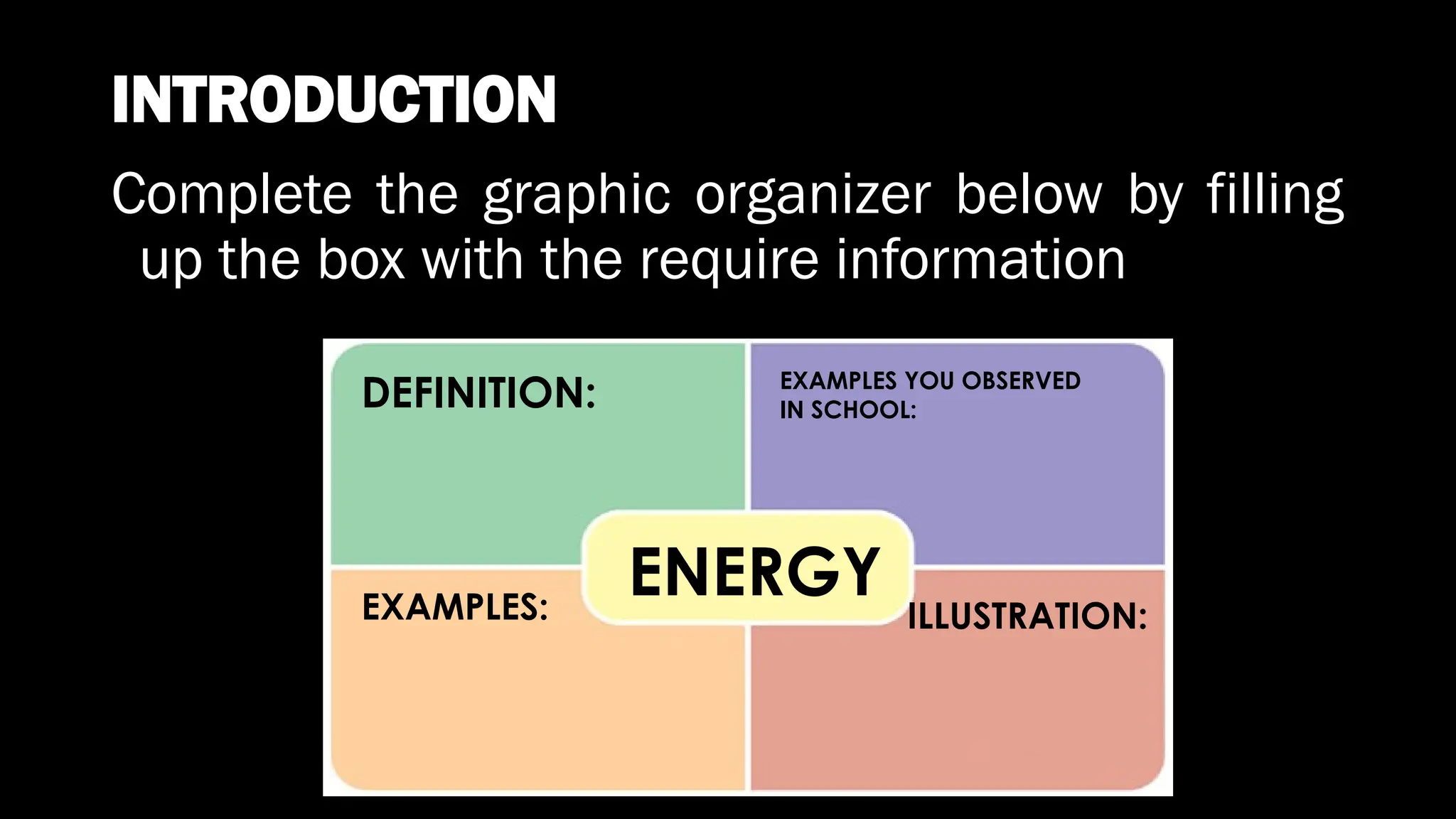
INTRODUCTION
Complete the graphic organizer below by filling
up the box with the require information
ENERGY
DEFINITION: EXAMPLES YOU OBSERVED
IN SCHOOL:
EXAMPLES: ILLUSTRATION:
WHAT IS ENERGY?
ENERGY
•It is the ability to do work.
•Without energy, you cannot do any work.
•When work is done by an object it loses
energy and it gains energy.
•When work is done, energy is transferred.
POTENTIAL
ENERGY
KINETIC
ENERGY
•The energy that
possessed by an object
by the virtue of its
position.
•An energy when the work
is WAITING to be done, or
when there is the
potential to be
performed.
•STORED ENERGY
POTENTIAL
ENERGY
FACTORS AFFECTING
POTENTIAL ENERGY
•Mass
•Gravity
•Height
POTENTIAL
ENERGY
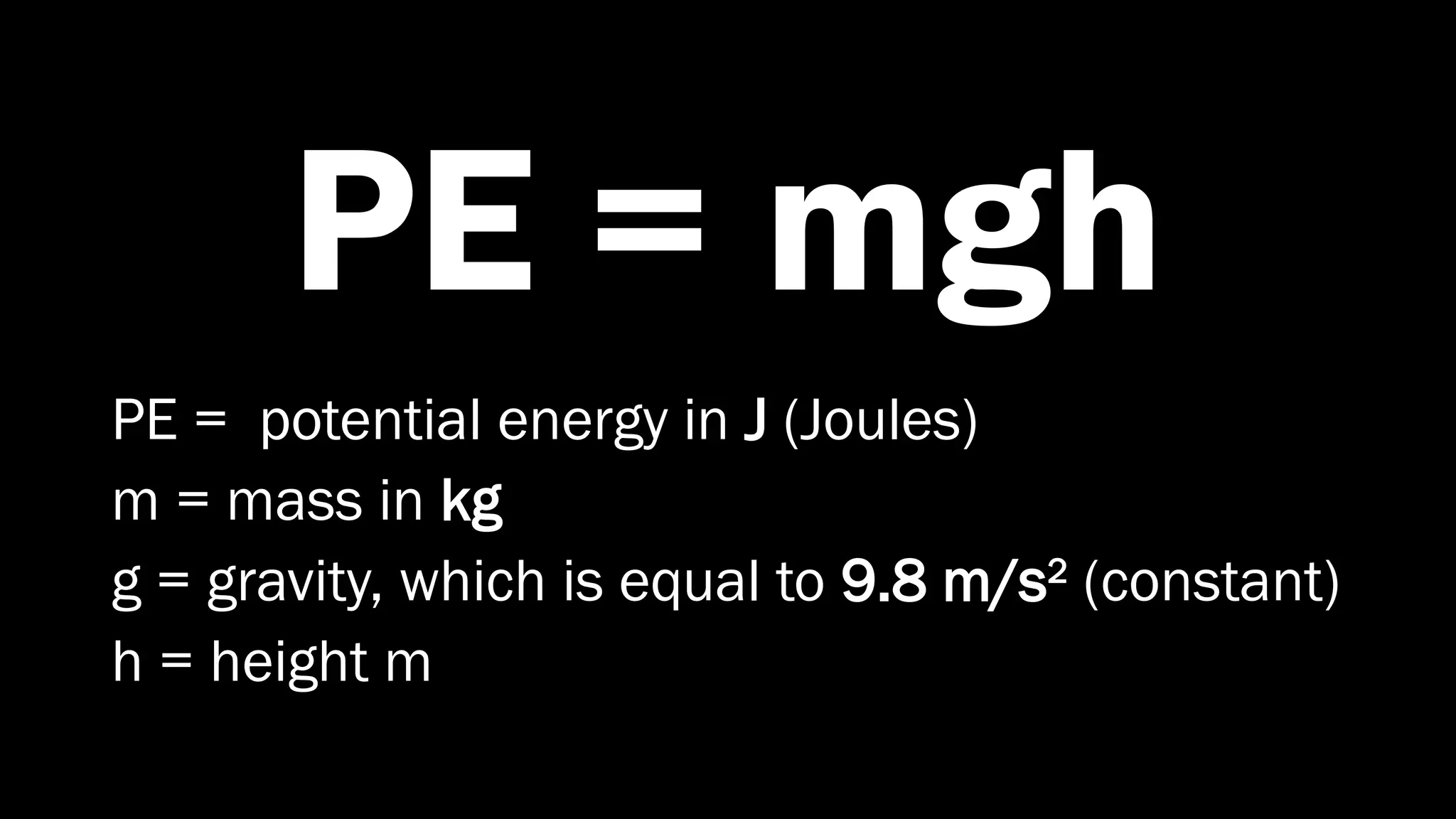
PE = mgh
PE = potential energy in J (Joules)
m = mass in kg
g = gravity, which is equal to 9.8 m/s2
(constant)
h = height m
PE = mgh
NOTE: The Potential Energy is directly proportional
to the mass and height of an object.
MEANING: The greater the mass and the height of
an object, the higher the potential energy.
PE = mgh
NOTE: Joules = kg . m/s2
. m
SOLVE THE PROBLEM
How much potential energy
does a 1.8 kg object has
from a height of 3 meters?
Given:
m = 1.8 kg
h = 3 meters
g = 9.8 m/s2
PE = ?
Solution:
PE = mgh
= (1.8 kg)(9.8 m/s2
)(3 meters)
= 52.92 J
ANSWER: 52.92 J
SOLVE THE PROBLEM
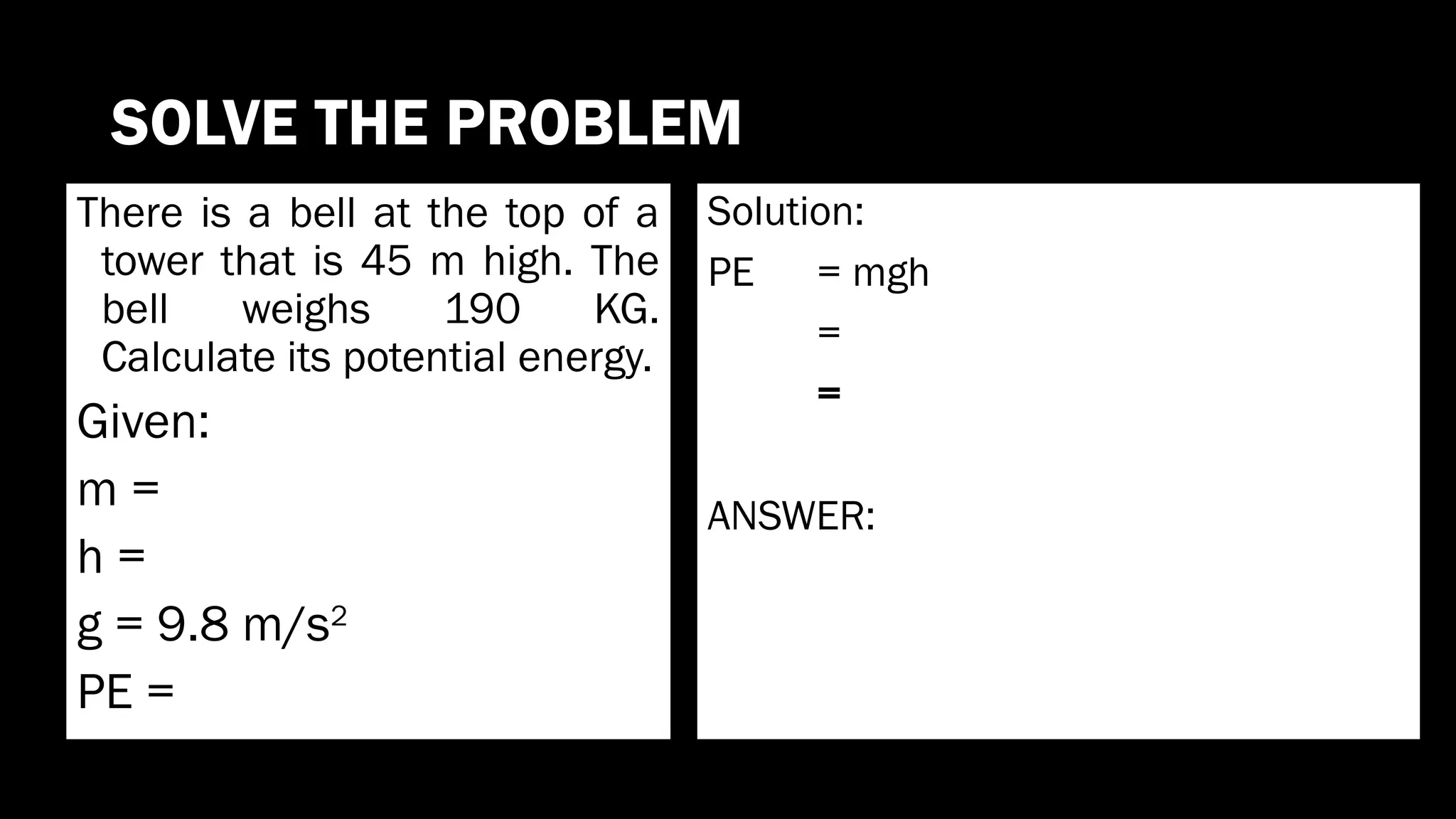
There is a bell at the top of a
tower that is 45 m high. The
bell weighs 190 KG.
Calculate its potential energy.
Given:
m =
h =
g = 9.8 m/s2
PE =
Solution:
PE = mgh
=
=
ANSWER:
•The energy that
present in moving
objects.
•This means that
whether an object is
accelerating or in
constant motion, as
long as it moves, then
it has kinetic energy.
KINETIC
ENERGY
FACTORS AFFECTING
KINETIC ENERGY
•Mass
•Velocity
KINETIC
ENERGY
KE = mv2
KE = kinetyic energy in J (Joules)
m = mass in kg
v = speed in meter per second (m/s)
NOTE: Do not forget to square the speed when you solve for
kinetic energy.
SOLVE THE PROBLEM
How much kinetic energy
is present in a 3.5 kg
object with a constant
speed of 4 m/s?
Given:
m = 3.5 kg.
v = 4 m/s
KE = ?
Solution:
KE = mv2
=
= 28 J
ANSWER: 28 J
SOLVE THE PROBLEM
You serve a volleyball with a
mass of 0.05 kg. The ball
leaves your hand with a speed
of 30 m/s. What is its kinetic
energy?
Given:
m =
v =
KE = ?
Solution:
KE = mv2
=
=
ANSWER:
•It state that energy is
neither created nor
destroyed but it is
converted from one
to form to another.
Law of
Conservation of
Energy
SHORT QUIZ
Classify the following as a type of
potential energy or kinetic energy
(use the letters K or P)
1. A bicyclist pedaling up a hill.
2. An archer with his bow drawn.
3. A volleyball player spiking a ball.
SHORT QUIZ
4. A baseball thrown to second
base.
5. The chemical bonds in sugar.
6. The wind blowing through
your hair.
SHORT QUIZ
7. Walking down the street.
8. Sitting in the top of a tree.
9. A bowling ball rolling down
the alley.
10. A bowling ball sitting on the
rack.
THANK YOU FOR
LISTENING!
FACTORS AFFECTING POTENTIAL and KINETIC ENERGY

FACTORS-AFFECTING-POTENTIAL-and-KINETIC-ENERGY.pptx

  • 1.
  • 2.
    OBJECTIVES •Identify and explainthe factors that affect potential and kinetic energy; •Define energy; •Solve problems involving potential and kinetic energy; and •Value the energy on earth.
  • 3.
    INTRODUCTION Complete the graphicorganizer below by filling up the box with the require information ENERGY DEFINITION: EXAMPLES YOU OBSERVED IN SCHOOL: EXAMPLES: ILLUSTRATION:
  • 4.
  • 5.
    ENERGY •It is theability to do work. •Without energy, you cannot do any work. •When work is done by an object it loses energy and it gains energy. •When work is done, energy is transferred.
  • 6.
  • 7.
    •The energy that possessedby an object by the virtue of its position. •An energy when the work is WAITING to be done, or when there is the potential to be performed. •STORED ENERGY POTENTIAL ENERGY
  • 8.
  • 9.
    PE = mgh PE= potential energy in J (Joules) m = mass in kg g = gravity, which is equal to 9.8 m/s2 (constant) h = height m
  • 10.
    PE = mgh NOTE:The Potential Energy is directly proportional to the mass and height of an object. MEANING: The greater the mass and the height of an object, the higher the potential energy.
  • 11.
    PE = mgh NOTE:Joules = kg . m/s2 . m
  • 12.
    SOLVE THE PROBLEM Howmuch potential energy does a 1.8 kg object has from a height of 3 meters? Given: m = 1.8 kg h = 3 meters g = 9.8 m/s2 PE = ? Solution: PE = mgh = (1.8 kg)(9.8 m/s2 )(3 meters) = 52.92 J ANSWER: 52.92 J
  • 13.
    SOLVE THE PROBLEM Thereis a bell at the top of a tower that is 45 m high. The bell weighs 190 KG. Calculate its potential energy. Given: m = h = g = 9.8 m/s2 PE = Solution: PE = mgh = = ANSWER:
  • 14.
    •The energy that presentin moving objects. •This means that whether an object is accelerating or in constant motion, as long as it moves, then it has kinetic energy. KINETIC ENERGY
  • 15.
  • 16.
    KE = mv2 KE= kinetyic energy in J (Joules) m = mass in kg v = speed in meter per second (m/s) NOTE: Do not forget to square the speed when you solve for kinetic energy.
  • 17.
    SOLVE THE PROBLEM Howmuch kinetic energy is present in a 3.5 kg object with a constant speed of 4 m/s? Given: m = 3.5 kg. v = 4 m/s KE = ? Solution: KE = mv2 = = 28 J ANSWER: 28 J
  • 18.
    SOLVE THE PROBLEM Youserve a volleyball with a mass of 0.05 kg. The ball leaves your hand with a speed of 30 m/s. What is its kinetic energy? Given: m = v = KE = ? Solution: KE = mv2 = = ANSWER:
  • 21.
    •It state thatenergy is neither created nor destroyed but it is converted from one to form to another. Law of Conservation of Energy
  • 23.
    SHORT QUIZ Classify thefollowing as a type of potential energy or kinetic energy (use the letters K or P) 1. A bicyclist pedaling up a hill. 2. An archer with his bow drawn. 3. A volleyball player spiking a ball.
  • 24.
    SHORT QUIZ 4. Abaseball thrown to second base. 5. The chemical bonds in sugar. 6. The wind blowing through your hair.
  • 25.
    SHORT QUIZ 7. Walkingdown the street. 8. Sitting in the top of a tree. 9. A bowling ball rolling down the alley. 10. A bowling ball sitting on the rack.
  • 26.
    THANK YOU FOR LISTENING! FACTORSAFFECTING POTENTIAL and KINETIC ENERGY