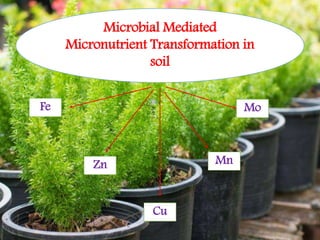
Microbial Mediated
Micronutrient Transformation in
soil
Fe
Zn
Cu
Mo
Mn
• Plants require some elements in such minute or smaller
amounts that these element have been designated as
minor/trace element or Micro nutrient.
• Plants absorbed micronutrient in lower concentration ppm
level.
Micronutrient
Iron, Zinc, Copper, Manganese, Boron, Molybdenum, Nickel, Chloride
• Source- Goethite, Haematite, Magnetite, Limonite,
Olivine
• Forms of Fe- Ferrous & Ferric (Two oxidation state)
• Two fraction- Organic & mineral
• Sufficient range of Fe in plants : 50 – 250 ppm.
• Below 50 ppm – Deficiency appears young leaves-
Interveinal chlorosis.
• Above 250 ppm- Leaf bronzing.
Iron (Fe)
Fe in soil
Mineral Fe
• 4th most abundant element in earth crust 5%
• Solubility is low.
Soil solution
• Well drained , oxidised soil has a more Fe3+
• Water logged soil – More Fe2+
Iron bacteria (micro organisms) play a major role
in transformation
 Bacteria & fungi oxidise ferrous state to ferric
state.
Heterotrophic microorganism attacks soluble
organic Fe in to inorganic Fe salts.
Bacteria & fungi produce specific enzyme.
Transformation of iron in soil by
Micro organisms
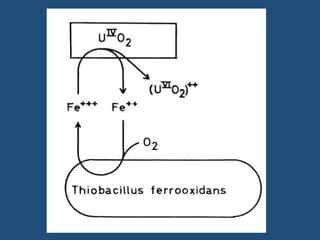
Bacteria oxidise ferrous Fe to ferric Fe state which
precipitate as ferric hydroxide – Iron Bacteria
• Gallinonella
• Siderocapsa
• Siderosphaera
• Ferribacterium
• Naumanniela
• Sideromonas
• Ferro-bacillus
• Siderobacter
• Siderococus
• Obligate Chemoautotrophs- Capable of utilizing
energy released in the process of ferric hydroxide
formation.
(E.g) Gallionella ferruginea
Thiobacillus ferroxidans
Ferrobacillus ferroxidans
Classification
• Facultative Chemoautotrophs-Utilizing energy
derived in the process of ferric hydroxide formation
or from organic matter.
• (E,g) Leptothrix ochraceae
• Heterotrophs- Do not energy derived in the process
of ferric hydroxide formation but depend on
organic matter for nutrition.
• (E.g) Naumanniela
• Cyanophycea
• Volvocales
• Chlorococcales
• Eugleninaea
• Conjugales
Transform ferrous salts to ferric salt
Algae
• Source: Limestone, Sandstone.
• Forms: Zn2+
• Sufficient range of Zn in plants : 25 – 150 ppm
• Mineral: Zn in lithosphere is 80 ppm
• Soil solution: Depends on the soil pH . If pH is more
Zn2+ availability is more.
Zinc (Zn)
Two fraction
Organic- Small amount 0.01%- 0.05%
Inorganic- Source is Zinc sulphate- soluble in soil
Below and above the range cause Rosetting or clustering of
young leaves.
Young leaves become chlorotic spot.
• Omnipotent bacteria- Increase concentration of Zn
• Fungi also influence solubilize the mineral from of
Zn in soil by production of organic acids.
• Organic material increase the availability of micro
organisms in soil
• Increase the availability of Zn in soil
Transformation of Zinc in soil by
Micro organisms
• Several zinc solubilizing bacteria (ZSB)- Tropical
and temperate soils to provide plant available Zn.
(Hafeez et al., 2013).
• Gluconacetobacter – sugarcane.
• Bacillus, Pseudomonas - Soybean, rice and wheat
capable of solubilizing Zn. (Saravanan et al., 2011).
Omnipotent bacteria
Zinc solubilizing bacteria
• Pseudomonas
• Bacillus
• Gluconacetobacter
• Burkholderia
• Acinetobacter
• Serratia
• Flavobacter
• Enterobacter
Comparison
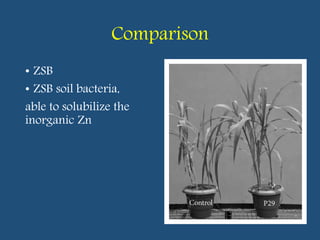
• ZSB
• ZSB soil bacteria,
able to solubilize the
inorganic Zn
• These ZSB strains produce variety of low molecular
weight organic acids, particularly gluconic acid,
dissolute the insoluble Zn
• Reduce the pH of the soil solution - increase the plant
available zinc (Hafeez et al., 2013).
• Zn-fertilizers - 1-5% use efficiency for most of the crops
• ZSB soil bacteria, able to solubilize the inorganic Zn and
thereby increase the bioavailability for crop assimilation.
• Source: Pyrolusite, Hausmannite, Manganite.
• Forms: Mn2+
• Sufficient range of plant: 20 – 500 ppm.
• Fraction: Solution, Exchangeable, Organic, Mineral
Manganese
Mineral Mn
• Mn is found in most Fe-Mg rocks- weathering of primary
mineral.
• Pyrolusite
• Manganite
Soil solution Mn:
• MnSO4 is the most common Mn sources in soil.
• Most common form Mn2+ - 90%.
• High pH- Solubility of Mn2+ is low
• Manganese transformation include bacteria, fungi and
yeasts.
• Bacteria – Leptothrix mobilis - aquatic environment-
oxidizing both iron, manganese. (Nelson et al. 1998)
• Oxidize manganous compounds to manganic oxides
(MnO.,) at pH values as low as 6 & some times below 6.
(Mulder 1964, Mulder and van Veen 1963).
Transformation of Manganese in soil
by Micro organisms
• Manganese oxidation by a mixture of two bacteria
Corynebacterium sp. Chromobacterium sp. has been
recorded by Bromfield and Skerman (1950)
• Roots of living plants may promote the solubilization of
MnO, by excreting organic acids or other compounds
stimulating bacterial activity.
• Source: Malachite, Cupric ferrite, Carbonates,
Silicates, Sulfates, Chlorides.
• Sufficient range in plants: 5 to 20 ppm.
• Forms: Cuprous (Cu+), Cupric (Cu2+)
Copper
• Availability of copper in soil related with the presence of
black organic humus.
• H2S forming microorganisms may be involved in copper
precipitation.
Transformation of Copper in soil by
Micro organisms
Copper precipitation by hydrogen-sulphide-
producing bacteria
• Clostridia, Proteus vulgaris, Escherichia coli - producing
H2S from sulphur-containing amino acids (cystine,
methionine, glutathion, etc.)- precipitate the Cu
• Sulphate-reducing bacteria- precipitate the Cu- Insoluble
form- Assimilatory sulfate reduction
• Sulfate-reducing bacteria are responsible - hydrogen
sulfide will react with metal ions to produce metal
sulphides. These metal sulphides- insoluble
Soil fertility

Soil fertility

  • 1.
  • 2.
    • Plants requiresome elements in such minute or smaller amounts that these element have been designated as minor/trace element or Micro nutrient. • Plants absorbed micronutrient in lower concentration ppm level. Micronutrient Iron, Zinc, Copper, Manganese, Boron, Molybdenum, Nickel, Chloride
  • 3.
    • Source- Goethite,Haematite, Magnetite, Limonite, Olivine • Forms of Fe- Ferrous & Ferric (Two oxidation state) • Two fraction- Organic & mineral • Sufficient range of Fe in plants : 50 – 250 ppm. • Below 50 ppm – Deficiency appears young leaves- Interveinal chlorosis. • Above 250 ppm- Leaf bronzing. Iron (Fe)
  • 4.
    Fe in soil MineralFe • 4th most abundant element in earth crust 5% • Solubility is low. Soil solution • Well drained , oxidised soil has a more Fe3+ • Water logged soil – More Fe2+
  • 5.
    Iron bacteria (microorganisms) play a major role in transformation  Bacteria & fungi oxidise ferrous state to ferric state. Heterotrophic microorganism attacks soluble organic Fe in to inorganic Fe salts. Bacteria & fungi produce specific enzyme. Transformation of iron in soil by Micro organisms
  • 6.
    Bacteria oxidise ferrousFe to ferric Fe state which precipitate as ferric hydroxide – Iron Bacteria • Gallinonella • Siderocapsa • Siderosphaera • Ferribacterium • Naumanniela • Sideromonas • Ferro-bacillus • Siderobacter • Siderococus
  • 7.
    • Obligate Chemoautotrophs-Capable of utilizing energy released in the process of ferric hydroxide formation. (E.g) Gallionella ferruginea Thiobacillus ferroxidans Ferrobacillus ferroxidans Classification
  • 8.
    • Facultative Chemoautotrophs-Utilizingenergy derived in the process of ferric hydroxide formation or from organic matter. • (E,g) Leptothrix ochraceae • Heterotrophs- Do not energy derived in the process of ferric hydroxide formation but depend on organic matter for nutrition. • (E.g) Naumanniela
  • 9.
    • Cyanophycea • Volvocales •Chlorococcales • Eugleninaea • Conjugales Transform ferrous salts to ferric salt Algae
  • 11.
    • Source: Limestone,Sandstone. • Forms: Zn2+ • Sufficient range of Zn in plants : 25 – 150 ppm • Mineral: Zn in lithosphere is 80 ppm • Soil solution: Depends on the soil pH . If pH is more Zn2+ availability is more. Zinc (Zn)
  • 12.
    Two fraction Organic- Smallamount 0.01%- 0.05% Inorganic- Source is Zinc sulphate- soluble in soil Below and above the range cause Rosetting or clustering of young leaves. Young leaves become chlorotic spot.
  • 13.
    • Omnipotent bacteria-Increase concentration of Zn • Fungi also influence solubilize the mineral from of Zn in soil by production of organic acids. • Organic material increase the availability of micro organisms in soil • Increase the availability of Zn in soil Transformation of Zinc in soil by Micro organisms
  • 14.
    • Several zincsolubilizing bacteria (ZSB)- Tropical and temperate soils to provide plant available Zn. (Hafeez et al., 2013). • Gluconacetobacter – sugarcane. • Bacillus, Pseudomonas - Soybean, rice and wheat capable of solubilizing Zn. (Saravanan et al., 2011). Omnipotent bacteria
  • 15.
    Zinc solubilizing bacteria •Pseudomonas • Bacillus • Gluconacetobacter • Burkholderia • Acinetobacter • Serratia • Flavobacter • Enterobacter
  • 16.
    Comparison • ZSB • ZSBsoil bacteria, able to solubilize the inorganic Zn
  • 17.
    • These ZSBstrains produce variety of low molecular weight organic acids, particularly gluconic acid, dissolute the insoluble Zn • Reduce the pH of the soil solution - increase the plant available zinc (Hafeez et al., 2013). • Zn-fertilizers - 1-5% use efficiency for most of the crops • ZSB soil bacteria, able to solubilize the inorganic Zn and thereby increase the bioavailability for crop assimilation.
  • 18.
    • Source: Pyrolusite,Hausmannite, Manganite. • Forms: Mn2+ • Sufficient range of plant: 20 – 500 ppm. • Fraction: Solution, Exchangeable, Organic, Mineral Manganese
  • 19.
    Mineral Mn • Mnis found in most Fe-Mg rocks- weathering of primary mineral. • Pyrolusite • Manganite Soil solution Mn: • MnSO4 is the most common Mn sources in soil. • Most common form Mn2+ - 90%. • High pH- Solubility of Mn2+ is low
  • 20.
    • Manganese transformationinclude bacteria, fungi and yeasts. • Bacteria – Leptothrix mobilis - aquatic environment- oxidizing both iron, manganese. (Nelson et al. 1998) • Oxidize manganous compounds to manganic oxides (MnO.,) at pH values as low as 6 & some times below 6. (Mulder 1964, Mulder and van Veen 1963). Transformation of Manganese in soil by Micro organisms
  • 21.
    • Manganese oxidationby a mixture of two bacteria Corynebacterium sp. Chromobacterium sp. has been recorded by Bromfield and Skerman (1950) • Roots of living plants may promote the solubilization of MnO, by excreting organic acids or other compounds stimulating bacterial activity.
  • 22.
    • Source: Malachite,Cupric ferrite, Carbonates, Silicates, Sulfates, Chlorides. • Sufficient range in plants: 5 to 20 ppm. • Forms: Cuprous (Cu+), Cupric (Cu2+) Copper
  • 23.
    • Availability ofcopper in soil related with the presence of black organic humus. • H2S forming microorganisms may be involved in copper precipitation. Transformation of Copper in soil by Micro organisms
  • 24.
    Copper precipitation byhydrogen-sulphide- producing bacteria • Clostridia, Proteus vulgaris, Escherichia coli - producing H2S from sulphur-containing amino acids (cystine, methionine, glutathion, etc.)- precipitate the Cu • Sulphate-reducing bacteria- precipitate the Cu- Insoluble form- Assimilatory sulfate reduction • Sulfate-reducing bacteria are responsible - hydrogen sulfide will react with metal ions to produce metal sulphides. These metal sulphides- insoluble