WHAT IS TANNING?
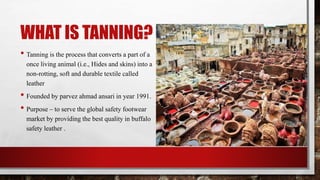
• Tanning is the process that converts a part of a
once living animal (i.e., Hides and skins) into a
non-rotting, soft and durable textile called
leather
• Founded by parvez ahmad ansari in year 1991.
• Purpose – to serve the global safety footwear
market by providing the best quality in buffalo
safety leather .
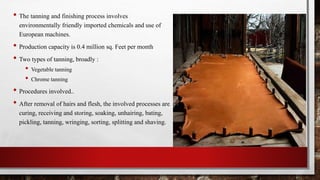
• The tanning and finishing process involves
environmentally friendly imported chemicals and use of
European machines.
• Production capacity is 0.4 million sq. Feet per month
• Two types of tanning, broadly :
• Vegetable tanning
• Chrome tanning
• Procedures involved..
• After removal of hairs and flesh, the involved processes are
curing, receiving and storing, soaking, unhairing, bating,
pickling, tanning, wringing, sorting, splitting and shaving.
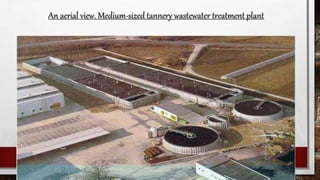
An aerial view. Medium-sized tannery wastewater treatment plant
MAJOR TANNERY INDUSTRIS IN
BANGALORE:
• The epicentre of tannery industry of bangalore is the famous tannery road.
• Tannery road is located north east in the bangalore cantonment, india. It is a 4 km long narrow
road (about 40 ft. Wide) with around 700 shops, named after the tanneries of the british
India period located at the end of the road. now tannery road was officially renamed as dr B S
ambedkar road,
Coordinates: 13.0049°N 77.6123°E
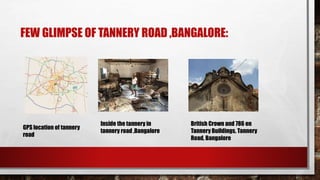
FEW GLIMPSE OF TANNERY ROAD ,BANGALORE:
British Crown and 786 on
Tannery Buildings, Tannery
Road, Bangalore
Inside the tannery in
tannery road ,Bangalore
GPS location of tannery
road
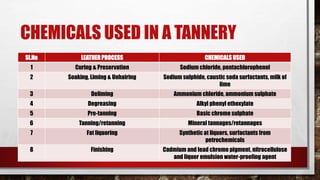
CHEMICALS USED IN A TANNERY
Sl.No LEATHER PROCESS CHEMICALS USED
1 Curing & Preservation Sodium chloride, pentachlorophenol
2 Soaking, Liming & Unhairing Sodium sulphide, caustic soda surfactants, milk of
lime
3 Deliming Ammonium chloride, ammonium sulphate
4 Degreasing Alkyl phenyl ethoxylate
5 Pre-tanning Basic chrome sulphate
6 Tanning/retanning Mineral tannages/retannages
7 Fat liquoring Synthetic at liquors, surfactants from
petrochemicals
8 Finishing Cadmium and lead chrome pigment, nitrocellulose
and liquor emulsion water-proofing agent
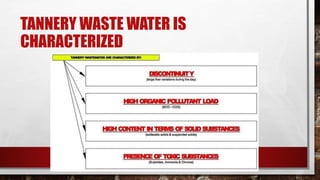
TANNERY WASTE WATER IS
CHARACTERIZED
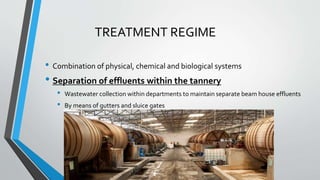
TREATMENT REGIME
• Combination of physical, chemical and biological systems
• Separation of effluents within the tannery
• Wastewater collection within departments to maintain separate beam house effluents
• By means of gutters and sluice gates
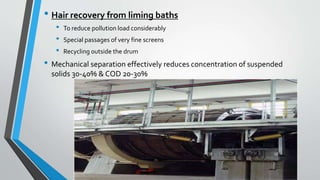
• Hair recovery from liming baths
• To reduce pollution load considerably
• Special passages of very fine screens
• Recycling outside the drum
• Mechanical separation effectively reduces concentration of suspended
solids 30-40% & COD 20-30%
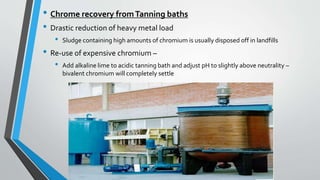
• Chrome recovery fromTanning baths
• Drastic reduction of heavy metal load
• Sludge containing high amounts of chromium is usually disposed off in landfills
• Re-use of expensive chromium –
• Add alkaline lime to acidic tanning bath and adjust pH to slightly above neutrality –
bivalent chromium will completely settle
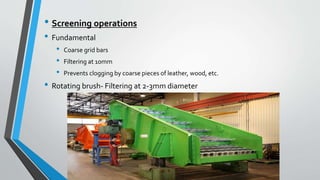
• Screening operations
• Fundamental
• Coarse grid bars
• Filtering at 10mm
• Prevents clogging by coarse pieces of leather, wood, etc.
• Rotating brush- Filtering at 2-3mm diameter
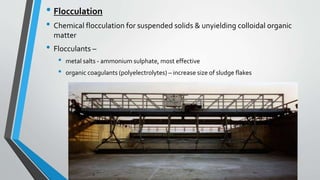
• Flocculation
• Chemical flocculation for suspended solids & unyielding colloidal organic
matter
• Flocculants –
• metal salts - ammonium sulphate, most effective
• organic coagulants (polyelectrolytes) – increase size of sludge flakes
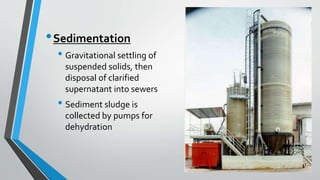
•Sedimentation
• Gravitational settling of
suspended solids, then
disposal of clarified
supernatant into sewers
• Sediment sludge is
collected by pumps for
dehydration
• Sludge treatment
• Natural drying beds
• Sludge is distributed in layers a few cm high and loses water by
filtration on a bed of sand and gravel and natural evaporation
• Frequently used in geographical zones with dry hot climate
• Mechanized systems, e.g., filter prosses, continuous belt
prosses, centrifugal decanters
• Used when the quantity of sludge produced each day is high,
because the area needed would be excessive
• Biological treatments
• To reduce the soluble and suspended or colloidal organic matter in effluents into
carbon dioxide and minerals
• Bubble aeration systems
• Lagoon systems
• Sequencing batch biofilm reactor (SBBR)
• Combined with chemical oxidation by ozone.The treatment was carried out at laboratory scale
on a real primary effluent coming from a centralized plant treating the wastewater of a large
tannery district in Northern Italy
• Microbial consortia
• Fungal and bacterial biosorptive degradation
• Bacillus, Rhizopus, Aspergillus, Streptovertcillum, Saccharomyces
Tanning industry waste

Tanning industry waste

  • 2.
    WHAT IS TANNING? •Tanning is the process that converts a part of a once living animal (i.e., Hides and skins) into a non-rotting, soft and durable textile called leather • Founded by parvez ahmad ansari in year 1991. • Purpose – to serve the global safety footwear market by providing the best quality in buffalo safety leather .
  • 3.
    • The tanningand finishing process involves environmentally friendly imported chemicals and use of European machines. • Production capacity is 0.4 million sq. Feet per month • Two types of tanning, broadly : • Vegetable tanning • Chrome tanning • Procedures involved.. • After removal of hairs and flesh, the involved processes are curing, receiving and storing, soaking, unhairing, bating, pickling, tanning, wringing, sorting, splitting and shaving.
  • 4.
    An aerial view.Medium-sized tannery wastewater treatment plant
  • 5.
    MAJOR TANNERY INDUSTRISIN BANGALORE: • The epicentre of tannery industry of bangalore is the famous tannery road. • Tannery road is located north east in the bangalore cantonment, india. It is a 4 km long narrow road (about 40 ft. Wide) with around 700 shops, named after the tanneries of the british India period located at the end of the road. now tannery road was officially renamed as dr B S ambedkar road, Coordinates: 13.0049°N 77.6123°E Coordinates: 13.0049°N 77.6123°E
  • 6.
    FEW GLIMPSE OFTANNERY ROAD ,BANGALORE: British Crown and 786 on Tannery Buildings, Tannery Road, Bangalore Inside the tannery in tannery road ,Bangalore GPS location of tannery road
  • 7.
    CHEMICALS USED INA TANNERY Sl.No LEATHER PROCESS CHEMICALS USED 1 Curing & Preservation Sodium chloride, pentachlorophenol 2 Soaking, Liming & Unhairing Sodium sulphide, caustic soda surfactants, milk of lime 3 Deliming Ammonium chloride, ammonium sulphate 4 Degreasing Alkyl phenyl ethoxylate 5 Pre-tanning Basic chrome sulphate 6 Tanning/retanning Mineral tannages/retannages 7 Fat liquoring Synthetic at liquors, surfactants from petrochemicals 8 Finishing Cadmium and lead chrome pigment, nitrocellulose and liquor emulsion water-proofing agent
  • 8.
    TANNERY WASTE WATERIS CHARACTERIZED
  • 9.
    TREATMENT REGIME • Combinationof physical, chemical and biological systems • Separation of effluents within the tannery • Wastewater collection within departments to maintain separate beam house effluents • By means of gutters and sluice gates
  • 10.
    • Hair recoveryfrom liming baths • To reduce pollution load considerably • Special passages of very fine screens • Recycling outside the drum • Mechanical separation effectively reduces concentration of suspended solids 30-40% & COD 20-30%
  • 11.
    • Chrome recoveryfromTanning baths • Drastic reduction of heavy metal load • Sludge containing high amounts of chromium is usually disposed off in landfills • Re-use of expensive chromium – • Add alkaline lime to acidic tanning bath and adjust pH to slightly above neutrality – bivalent chromium will completely settle
  • 12.
    • Screening operations •Fundamental • Coarse grid bars • Filtering at 10mm • Prevents clogging by coarse pieces of leather, wood, etc. • Rotating brush- Filtering at 2-3mm diameter
  • 13.
    • Flocculation • Chemicalflocculation for suspended solids & unyielding colloidal organic matter • Flocculants – • metal salts - ammonium sulphate, most effective • organic coagulants (polyelectrolytes) – increase size of sludge flakes
  • 14.
    •Sedimentation • Gravitational settlingof suspended solids, then disposal of clarified supernatant into sewers • Sediment sludge is collected by pumps for dehydration
  • 15.
    • Sludge treatment •Natural drying beds • Sludge is distributed in layers a few cm high and loses water by filtration on a bed of sand and gravel and natural evaporation • Frequently used in geographical zones with dry hot climate • Mechanized systems, e.g., filter prosses, continuous belt prosses, centrifugal decanters • Used when the quantity of sludge produced each day is high, because the area needed would be excessive
  • 16.
    • Biological treatments •To reduce the soluble and suspended or colloidal organic matter in effluents into carbon dioxide and minerals • Bubble aeration systems • Lagoon systems • Sequencing batch biofilm reactor (SBBR) • Combined with chemical oxidation by ozone.The treatment was carried out at laboratory scale on a real primary effluent coming from a centralized plant treating the wastewater of a large tannery district in Northern Italy • Microbial consortia • Fungal and bacterial biosorptive degradation • Bacillus, Rhizopus, Aspergillus, Streptovertcillum, Saccharomyces