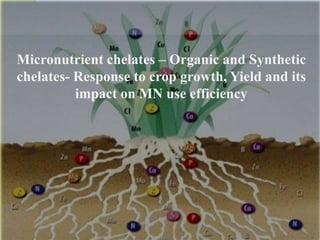
Micronutrient chelates – Organic and Synthetic
chelates- Response to crop growth, Yield and its
impact on MN use efficiency
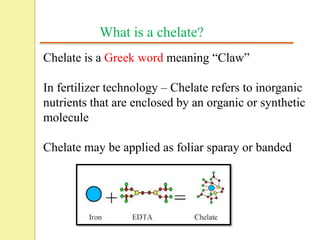
What is a chelate?
Chelate is a Greek word meaning “Claw”
In fertilizer technology – Chelate refers to inorganic
nutrients that are enclosed by an organic or synthetic
molecule
Chelate may be applied as foliar sparay or banded
Synthetic and organic chelates
SYNTHETIC
CHELATES
•EDTA is the most common synthetic chelating agent and is
used for both soil and foliar applied nutrients.
• DTPA is used mainly for chelates applied to alkaline soils.It is
more effective than EDTA but is usually more expensive.
• Iron chelates made with HEDTA and EDDHA are the most
effective iron fertilizers on high pH soils but are also the most
expensive.
ORGANIC
CHELATES
•There are a number of natural products used as chelating
agents.
•Lignosulfonates, phenols and polyflavinoid chelates are
produced using fermented by-products mainly from the wood
pulp industry.
• Citric acid and other organic acids are also used .
•Organic agents shows more penetration rate than synthetic
chelates, due to larger molecules such as EDTA, DTPA,EDDHA
penetrate at slower rate.
•Organic chelates are biodegradable and non - toxic to the
environment-
Eg:EDTA forms chemically and microbiologically stable
complexes that poses a threat of underwater contamination.
•Organic chelates can be used as a food source to the micro -
organisms while the synthetic cannot.
•Organic chelating agents are more stable in comparison to
synthetic chelating agents.
Organic Vs Synthetic Chelating Agents
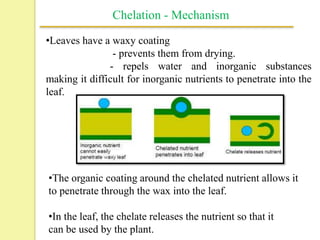
Chelation - Mechanism
•Leaves have a waxy coating
- prevents them from drying.
- repels water and inorganic substances
making it difficult for inorganic nutrients to penetrate into the
leaf.
•The organic coating around the chelated nutrient allows it
to penetrate through the wax into the leaf.
•In the leaf, the chelate releases the nutrient so that it
can be used by the plant.
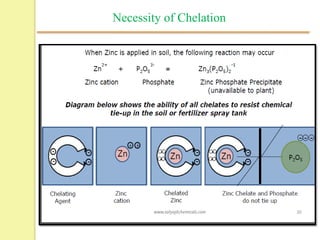
Necessity of Chelation
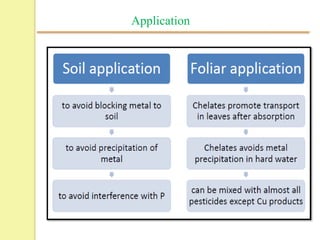
Application
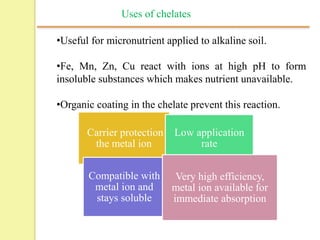
Uses of chelates
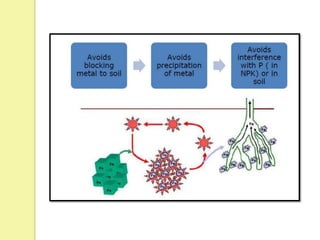
•Useful for micronutrient applied to alkaline soil.
•Fe, Mn, Zn, Cu react with ions at high pH to form
insoluble substances which makes nutrient unavailable.
•Organic coating in the chelate prevent this reaction.
Carrier protection
the metal ion
Low application
rate
Compatible with
metal ion and
stays soluble
Very high efficiency,
metal ion available for
immediate absorption
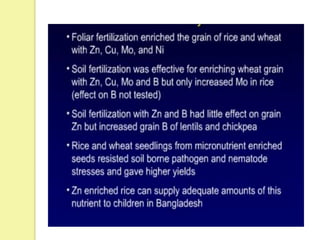
Response to crop growth and yield
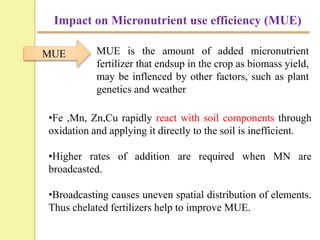
Impact on Micronutrient use efficiency (MUE)
•Fe ,Mn, Zn,Cu rapidly react with soil components through
oxidation and applying it directly to the soil is inefficient.
•Higher rates of addition are required when MN are
broadcasted.
•Broadcasting causes uneven spatial distribution of elements.
Thus chelated fertilizers help to improve MUE.
MUE MUE is the amount of added micronutrient
fertilizer that endsup in the crop as biomass yield,
may be inflenced by other factors, such as plant
genetics and weather
Reference
•Kaushik preeti, Use of Natural Organic and Synthetic
Chelating Agents for Efficient Phytoremediation, International
Journal of Enhanced Research in Science Technology &
Engineering, ISSN: 2319-7463, Vol. 4 Issue 6, June -2015, pp:
(99-101)
•Wallace A, Shannon L. M, Lunt, O. R, Impey, R. L. Some
Aspects Of The Use Of Metal Chelates As Micronutrient
Fertilizer Sources. Soil Science – An interdisciplinary approach
to Soils Research, Vol. 84 Issue 1, pp. 27-42
•http://www.agroservicesinternational.com/Articles/Chelates.pdf

Micronutrient chelate (1)

  • 1.
    Micronutrient chelates –Organic and Synthetic chelates- Response to crop growth, Yield and its impact on MN use efficiency
  • 2.
    What is achelate? Chelate is a Greek word meaning “Claw” In fertilizer technology – Chelate refers to inorganic nutrients that are enclosed by an organic or synthetic molecule Chelate may be applied as foliar sparay or banded
  • 3.
    Synthetic and organicchelates SYNTHETIC CHELATES •EDTA is the most common synthetic chelating agent and is used for both soil and foliar applied nutrients. • DTPA is used mainly for chelates applied to alkaline soils.It is more effective than EDTA but is usually more expensive. • Iron chelates made with HEDTA and EDDHA are the most effective iron fertilizers on high pH soils but are also the most expensive.
  • 4.
    ORGANIC CHELATES •There are anumber of natural products used as chelating agents. •Lignosulfonates, phenols and polyflavinoid chelates are produced using fermented by-products mainly from the wood pulp industry. • Citric acid and other organic acids are also used .
  • 5.
    •Organic agents showsmore penetration rate than synthetic chelates, due to larger molecules such as EDTA, DTPA,EDDHA penetrate at slower rate. •Organic chelates are biodegradable and non - toxic to the environment- Eg:EDTA forms chemically and microbiologically stable complexes that poses a threat of underwater contamination. •Organic chelates can be used as a food source to the micro - organisms while the synthetic cannot. •Organic chelating agents are more stable in comparison to synthetic chelating agents. Organic Vs Synthetic Chelating Agents
  • 6.
    Chelation - Mechanism •Leaveshave a waxy coating - prevents them from drying. - repels water and inorganic substances making it difficult for inorganic nutrients to penetrate into the leaf. •The organic coating around the chelated nutrient allows it to penetrate through the wax into the leaf. •In the leaf, the chelate releases the nutrient so that it can be used by the plant.
  • 7.
  • 9.
  • 10.
    Uses of chelates •Usefulfor micronutrient applied to alkaline soil. •Fe, Mn, Zn, Cu react with ions at high pH to form insoluble substances which makes nutrient unavailable. •Organic coating in the chelate prevent this reaction. Carrier protection the metal ion Low application rate Compatible with metal ion and stays soluble Very high efficiency, metal ion available for immediate absorption
  • 11.
    Response to cropgrowth and yield
  • 13.
    Impact on Micronutrientuse efficiency (MUE) •Fe ,Mn, Zn,Cu rapidly react with soil components through oxidation and applying it directly to the soil is inefficient. •Higher rates of addition are required when MN are broadcasted. •Broadcasting causes uneven spatial distribution of elements. Thus chelated fertilizers help to improve MUE. MUE MUE is the amount of added micronutrient fertilizer that endsup in the crop as biomass yield, may be inflenced by other factors, such as plant genetics and weather
  • 14.
    Reference •Kaushik preeti, Useof Natural Organic and Synthetic Chelating Agents for Efficient Phytoremediation, International Journal of Enhanced Research in Science Technology & Engineering, ISSN: 2319-7463, Vol. 4 Issue 6, June -2015, pp: (99-101) •Wallace A, Shannon L. M, Lunt, O. R, Impey, R. L. Some Aspects Of The Use Of Metal Chelates As Micronutrient Fertilizer Sources. Soil Science – An interdisciplinary approach to Soils Research, Vol. 84 Issue 1, pp. 27-42 •http://www.agroservicesinternational.com/Articles/Chelates.pdf