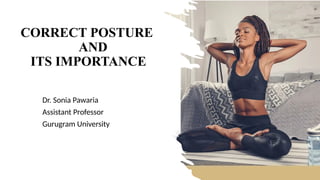
CORRECT POSTURE
AND
ITS IMPORTANCE
Dr. Sonia Pawaria
Assistant Professor
Gurugram University
Table of Content
• Welcome and brief overview of the session
• Importance of understanding correct posture
• Definition of posture
• Key components of correct posture
• Importance of Correct Posture
• Common Postural Problems
• Tips for Maintaining Correct Posture.
• Simple Exercises to Improve Posture
• Demonstration
Engage Fully: Participate actively in
discussions, demonstrations, and
practical activities.
Ask Questions: Feel free to ask
questions if you need clarification or
further explanation.
Share Your Experiences: Feel free to
share personal experiences related to
posture and its impact on daily life.
Safe Practice: Perform all physical
adjustments and movements safely to
avoid strain or injury.
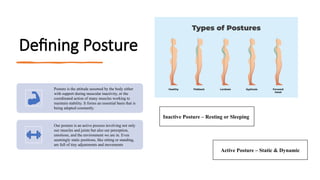
Defining Posture
Inactive Posture – Resting or Sleeping
Active Posture – Static & Dynamic
Posture is the attitude assumed by the body either
with support during muscular inactivity, or the
coordinated action of many muscles working to
maintain stability. It forms an essential basis that is
being adapted constantly.
Our posture is an active process involving not only
our muscles and joints but also our perception,
emotions, and the environment we are in. Even
seemingly static positions, like sitting or standing,
are full of tiny adjustments and movements
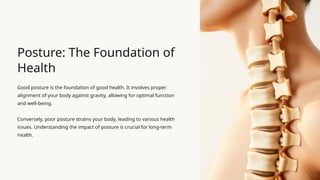
Posture: The Foundation of
Health
Good posture is the foundation of good health. It involves proper
alignment of your body against gravity, allowing for optimal function
and well-being.
Conversely, poor posture strains your body, leading to various health
issues. Understanding the impact of posture is crucial for long-term
health.
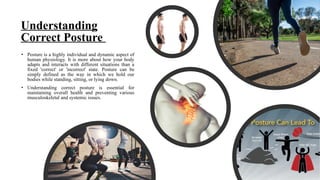
Understanding
Correct Posture
• Posture is a highly individual and dynamic aspect of
human physiology. It is more about how your body
adapts and interacts with different situations than a
fixed 'correct' or 'incorrect' state. Posture can be
simply defined as the way in which we hold our
bodies while standing, sitting, or lying down.
• Understanding correct posture is essential for
maintaining overall health and preventing various
musculoskeletal and systemic issues.
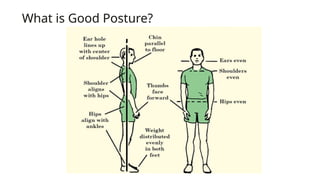
What is Good Posture?
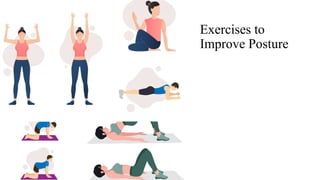
Exercises to
Improve Posture
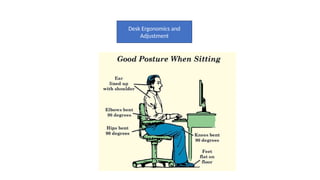
Desk Ergonomics and
Adjustment
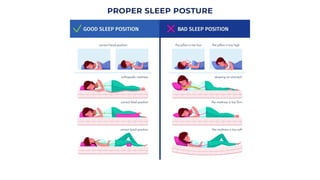
Tips for proper sitting, standing &
sleeping
Video
https://www.youtube.com/watch?v=smGQ-2EE9is
Activity for Learners (3 minutes)
• Pair Learners: Each learner pairs up with a
partner to assess and correct each other’s
posture.
• Let’s discuss your findings and any
challenges you faced while adjusting your
posture.
Good Posture & better body
Alignment
• Perform postural correction exercises
several times daily to attain and maintain
better body alignment
• You can combine 2-3 exercises at one
time; for example, Bucket, Show-off and
Think taller
• Practice exercises anytime, anywhere, e.g.
standing in line at the supermarket, after
brushing your teeth or combing your hair,
while talking on the telephone.
• Use good posture when both seated and
standing (reading, driving, waiting in line,
etc.)
A Good Motto is:
Sit less, stand more, and, when you can’t do that,
lie down on your back and exercise to strengthen
it.
Thank You

Posture Definition, Ergonomic for posture

  • 1.
    CORRECT POSTURE AND ITS IMPORTANCE Dr.Sonia Pawaria Assistant Professor Gurugram University
  • 2.
    Table of Content •Welcome and brief overview of the session • Importance of understanding correct posture • Definition of posture • Key components of correct posture • Importance of Correct Posture • Common Postural Problems • Tips for Maintaining Correct Posture. • Simple Exercises to Improve Posture • Demonstration
  • 3.
    Engage Fully: Participateactively in discussions, demonstrations, and practical activities. Ask Questions: Feel free to ask questions if you need clarification or further explanation. Share Your Experiences: Feel free to share personal experiences related to posture and its impact on daily life. Safe Practice: Perform all physical adjustments and movements safely to avoid strain or injury.
  • 5.
    Defining Posture Inactive Posture– Resting or Sleeping Active Posture – Static & Dynamic Posture is the attitude assumed by the body either with support during muscular inactivity, or the coordinated action of many muscles working to maintain stability. It forms an essential basis that is being adapted constantly. Our posture is an active process involving not only our muscles and joints but also our perception, emotions, and the environment we are in. Even seemingly static positions, like sitting or standing, are full of tiny adjustments and movements
  • 6.
    Posture: The Foundationof Health Good posture is the foundation of good health. It involves proper alignment of your body against gravity, allowing for optimal function and well-being. Conversely, poor posture strains your body, leading to various health issues. Understanding the impact of posture is crucial for long-term health.
  • 7.
    Understanding Correct Posture • Postureis a highly individual and dynamic aspect of human physiology. It is more about how your body adapts and interacts with different situations than a fixed 'correct' or 'incorrect' state. Posture can be simply defined as the way in which we hold our bodies while standing, sitting, or lying down. • Understanding correct posture is essential for maintaining overall health and preventing various musculoskeletal and systemic issues.
  • 8.
    What is GoodPosture?
  • 23.
  • 24.
  • 25.
    Tips for propersitting, standing & sleeping
  • 29.
  • 31.
    Activity for Learners(3 minutes) • Pair Learners: Each learner pairs up with a partner to assess and correct each other’s posture. • Let’s discuss your findings and any challenges you faced while adjusting your posture.
  • 32.
    Good Posture &better body Alignment • Perform postural correction exercises several times daily to attain and maintain better body alignment • You can combine 2-3 exercises at one time; for example, Bucket, Show-off and Think taller • Practice exercises anytime, anywhere, e.g. standing in line at the supermarket, after brushing your teeth or combing your hair, while talking on the telephone. • Use good posture when both seated and standing (reading, driving, waiting in line, etc.)
  • 33.
    A Good Mottois: Sit less, stand more, and, when you can’t do that, lie down on your back and exercise to strengthen it.
  • 34.