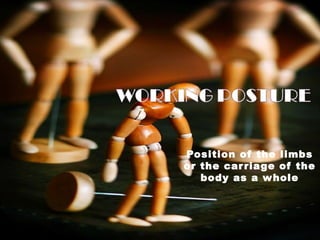
Position of the limbs
or the carriage of the
body as a whole
PRESENTED BY:
RIFAT HUMAYUN
rifat_humayun
Rifat Humayun
 Posture is defined as "the position or bearing of thePosture is defined as "the position or bearing of the
body" (Webster’s Medical Dictionary ) and refers tobody" (Webster’s Medical Dictionary ) and refers to
the overall alignment of the various body parts to eachthe overall alignment of the various body parts to each
other when the person is standing in a relaxed stance.other when the person is standing in a relaxed stance.
 Posture is the result of many underlying processes andPosture is the result of many underlying processes and
tensional relationships throughout the body.tensional relationships throughout the body.
 As such posture becomes a mesure of the overallAs such posture becomes a mesure of the overall
balances in the body and can be used as a tool to assessbalances in the body and can be used as a tool to assess
if interventions have resulted in a change in overallif interventions have resulted in a change in overall
body balancebody balance..
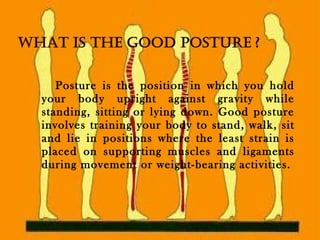
Posture is the position in which you hold
your body upright against gravity while
standing, sitting or lying down. Good posture
involves training your body to stand, walk, sit
and lie in positions where the least strain is
placed on supporting muscles and ligaments
during movement or weight-bearing activities.
 Helps decrease the abnormal wearing of joint surfaces
that could result in arthritis.
 Decreases the stress on the ligaments holding the joints
of the spine together.
 Prevents the spine from becoming fixed in abnormal
positions.
 Keeps bones and joints in the correct alignment so that
muscles are being used properly.
 Prevents fatigue because muscles are being used
more efficiently, allowing the body to use less
energy.
 Prevents strain or overuse problems.
 Prevents backache and muscular pain.
 Contributes to a good appearance.
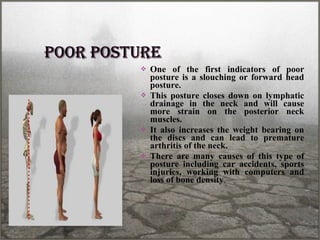
 One of the first indicators of poor
posture is a slouching or forward head
posture.
 This posture closes down on lymphatic
drainage in the neck and will cause
more strain on the posterior neck
muscles.
 It also increases the weight bearing on
the discs and can lead to premature
arthritis of the neck.
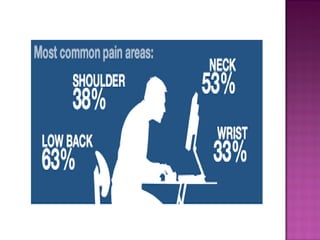
 There are many causes of this type of
posture including car accidents, sports
injuries, working with computers and
loss of bone density.
Structural Causes
Permanent anatomical deformities not amenable to correction
by conservative treatments
Positional Causes
 Poor postural habit--for whatever reason, the individual does
not maintain a correct posture
 Psychological factors, especially self-esteem.
 Respiratory conditions
 General weakness
 Loss of the ability to perceive the position of your body
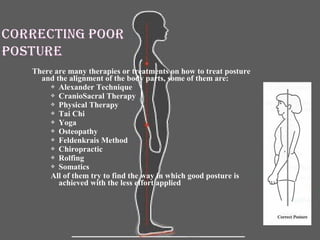
There are many therapies or treatments on how to treat posture
and the alignment of the body parts, some of them are:
 Alexander Technique
 CranioSacral Therapy
 Physical Therapy
 Tai Chi
 Yoga
 Osteopathy
 Feldenkrais Method
 Chiropractic
 Rolfing
 Somatics
All of them try to find the way in which good posture is
achieved with the less effort applied
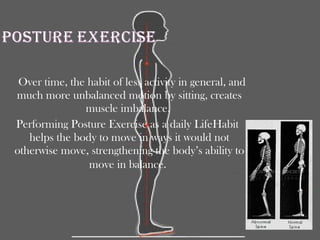
  Over time, the habit of less activity in general, and
much more unbalanced motion by sitting, creates
muscle imbalance.
Performing Posture Exercise as a daily LifeHabit
helps the body to move in ways it would not
otherwise move, strengthening the body’s ability to
move in balance.
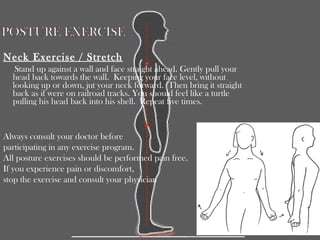
Neck Exercise / Stretch
Stand up against a wall and face straight ahead. Gently pull your
head back towards the wall. Keeping your face level, without
looking up or down, jut your neck forward. Then bring it straight
back as if were on railroad tracks. You should feel like a turtle
pulling his head back into his shell. Repeat five times.
Always consult your doctor before
participating in any exercise program.
All posture exercises should be performed pain free.
If you experience pain or discomfort,
stop the exercise and consult your physician
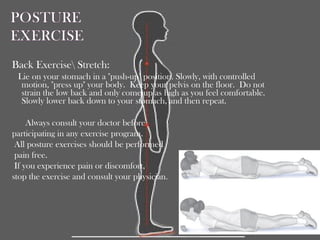
Back Exercise Stretch:
Lie on your stomach in a "push-up" position. Slowly, with controlled
motion, "press up" your body. Keep your pelvis on the floor. Do not
strain the low back and only come up as high as you feel comfortable.
Slowly lower back down to your stomach, and then repeat.
Always consult your doctor before
participating in any exercise program.
All posture exercises should be performed
pain free.
If you experience pain or discomfort,
stop the exercise and consult your physician.
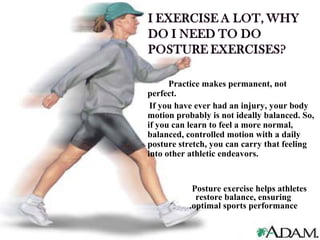
Practice makes permanent, not
perfect.
If you have ever had an injury, your body
motion probably is not ideally balanced. So,
if you can learn to feel a more normal,
balanced, controlled motion with a daily
posture stretch, you can carry that feeling
into other athletic endeavors.
Posture exercise helps athletes
restore balance, ensuring
optimal sports performance.
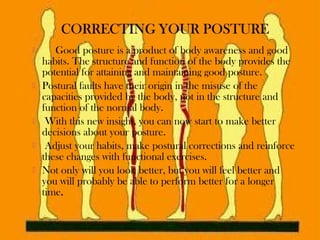
 Good posture is a product of body awareness and good
habits. The structure and function of the body provides the
potential for attaining and maintaining good posture.
 Postural faults have their origin in the misuse of the
capacities provided by the body, not in the structure and
function of the normal body.
 With this new insight, you can now start to make better
decisions about your posture.
 Adjust your habits, make postural corrections and reinforce
these changes with functional exercises.
 Not only will you look better, but you will feel better and
you will probably be able to perform better for a longer
time.
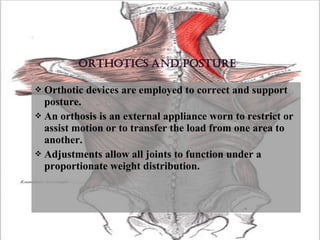
 Orthotic devices are employed to correct and support
posture.
 An orthosis is an external appliance worn to restrict or
assist motion or to transfer the load from one area to
another.
 Adjustments allow all joints to function under a
proportionate weight distribution.
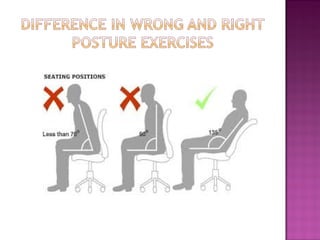
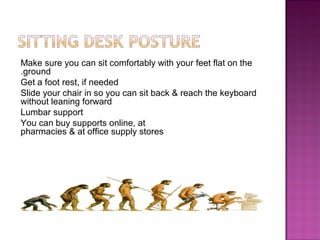
Make sure you can sit comfortably with your feet flat on the
ground.
Get a foot rest, if needed
Slide your chair in so you can sit back & reach the keyboard
without leaning forward
Lumbar support
You can buy supports online, at
pharmacies & at office supply stores
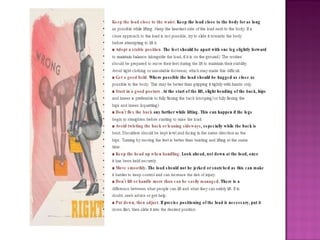
Working posture
Working posture

Working posture

  • 2.
    Position of thelimbs or the carriage of the body as a whole
  • 3.
  • 4.
     Posture isdefined as "the position or bearing of thePosture is defined as "the position or bearing of the body" (Webster’s Medical Dictionary ) and refers tobody" (Webster’s Medical Dictionary ) and refers to the overall alignment of the various body parts to eachthe overall alignment of the various body parts to each other when the person is standing in a relaxed stance.other when the person is standing in a relaxed stance.  Posture is the result of many underlying processes andPosture is the result of many underlying processes and tensional relationships throughout the body.tensional relationships throughout the body.  As such posture becomes a mesure of the overallAs such posture becomes a mesure of the overall balances in the body and can be used as a tool to assessbalances in the body and can be used as a tool to assess if interventions have resulted in a change in overallif interventions have resulted in a change in overall body balancebody balance..
  • 5.
    Posture is theposition in which you hold your body upright against gravity while standing, sitting or lying down. Good posture involves training your body to stand, walk, sit and lie in positions where the least strain is placed on supporting muscles and ligaments during movement or weight-bearing activities.
  • 6.
     Helps decreasethe abnormal wearing of joint surfaces that could result in arthritis.  Decreases the stress on the ligaments holding the joints of the spine together.  Prevents the spine from becoming fixed in abnormal positions.  Keeps bones and joints in the correct alignment so that muscles are being used properly.  Prevents fatigue because muscles are being used more efficiently, allowing the body to use less energy.  Prevents strain or overuse problems.  Prevents backache and muscular pain.  Contributes to a good appearance.
  • 7.
     One ofthe first indicators of poor posture is a slouching or forward head posture.  This posture closes down on lymphatic drainage in the neck and will cause more strain on the posterior neck muscles.  It also increases the weight bearing on the discs and can lead to premature arthritis of the neck.  There are many causes of this type of posture including car accidents, sports injuries, working with computers and loss of bone density.
  • 8.
    Structural Causes Permanent anatomicaldeformities not amenable to correction by conservative treatments Positional Causes  Poor postural habit--for whatever reason, the individual does not maintain a correct posture  Psychological factors, especially self-esteem.  Respiratory conditions  General weakness  Loss of the ability to perceive the position of your body
  • 9.
    There are manytherapies or treatments on how to treat posture and the alignment of the body parts, some of them are:  Alexander Technique  CranioSacral Therapy  Physical Therapy  Tai Chi  Yoga  Osteopathy  Feldenkrais Method  Chiropractic  Rolfing  Somatics All of them try to find the way in which good posture is achieved with the less effort applied
  • 10.
      Over time,the habit of less activity in general, and much more unbalanced motion by sitting, creates muscle imbalance. Performing Posture Exercise as a daily LifeHabit helps the body to move in ways it would not otherwise move, strengthening the body’s ability to move in balance.
  • 11.
    Neck Exercise /Stretch Stand up against a wall and face straight ahead. Gently pull your head back towards the wall. Keeping your face level, without looking up or down, jut your neck forward. Then bring it straight back as if were on railroad tracks. You should feel like a turtle pulling his head back into his shell. Repeat five times. Always consult your doctor before participating in any exercise program. All posture exercises should be performed pain free. If you experience pain or discomfort, stop the exercise and consult your physician
  • 12.
    Back Exercise Stretch: Lieon your stomach in a "push-up" position. Slowly, with controlled motion, "press up" your body. Keep your pelvis on the floor. Do not strain the low back and only come up as high as you feel comfortable. Slowly lower back down to your stomach, and then repeat. Always consult your doctor before participating in any exercise program. All posture exercises should be performed pain free. If you experience pain or discomfort, stop the exercise and consult your physician.
  • 13.
    Practice makes permanent,not perfect. If you have ever had an injury, your body motion probably is not ideally balanced. So, if you can learn to feel a more normal, balanced, controlled motion with a daily posture stretch, you can carry that feeling into other athletic endeavors. Posture exercise helps athletes restore balance, ensuring optimal sports performance.
  • 14.
     Good postureis a product of body awareness and good habits. The structure and function of the body provides the potential for attaining and maintaining good posture.  Postural faults have their origin in the misuse of the capacities provided by the body, not in the structure and function of the normal body.  With this new insight, you can now start to make better decisions about your posture.  Adjust your habits, make postural corrections and reinforce these changes with functional exercises.  Not only will you look better, but you will feel better and you will probably be able to perform better for a longer time.
  • 15.
     Orthotic devicesare employed to correct and support posture.  An orthosis is an external appliance worn to restrict or assist motion or to transfer the load from one area to another.  Adjustments allow all joints to function under a proportionate weight distribution.
  • 23.
    Make sure youcan sit comfortably with your feet flat on the ground. Get a foot rest, if needed Slide your chair in so you can sit back & reach the keyboard without leaning forward Lumbar support You can buy supports online, at pharmacies & at office supply stores