POSTURAL RE EDUCATION
By
Arathy k m
Ass.prof. , physiotherapy
LIMSAR
PRINCIPLES OF RE-EDUCATION
The measures which can be taken by the physiotherapist to combat poor posture and
to train another and more efficient postural pattern depend largely on the cause. The
success of any physical treatment invariably depends on her ability to gain the co-
operation of the patient.
IMPAIRED POSTURE
Structural and Functional Impairments
• Pain from mechanical stress to sensitive structures and from muscle tension
• Impaired mobility from muscle, joint, or fascial restrictions
• Impaired muscle performance associated with an imbalance in muscle length and
strength between antagonistic muscle groups
• Impaired muscle performance associated with poor muscular endurance
• Insufficient postural control of scapular and trunk stabilizing muscles
• Decreased cardiopulmonary endurance
• Altered kinesthetic sense of posture associated with poor neuromuscular control and
prolonged faulty postural habits
• Lack of knowledge of healthy spinal control and mechanics
PLAN OF CARE
• 1. Develop awareness and control of spinal posture
• 2. Educate the patient about the relationship between
• faulty posture and symptoms
• 3. Increase mobility in restricting muscles, joints, fascia
• 4. Develop neuromuscular control, strength, and
• endurance in postural and extremity muscles
5. Teach safe body mechanics
6. Ergonomic assessment of home, work, recreational environments
7. Stress management/relaxation
8. Identify safe aerobic activities
9. Promote healthy exercise habits for self-maintenance
RELAXATION
• The ability to relax is an important factor in re-education, as some degree of useless
and unnecessary tension is nearly always associated with poor posture. To begin
with, general relaxation with the body in horizontal positions reduces muscular
tension and gives a feeling of alignment. Voluntary relaxation of specific muscle
groups can then be taught and practiced so that the patient learns to recognize
tension and is able to relax at will, if and when it develops during the maintenance
of either static or dynamic postures.
Examples of Relaxation Methods
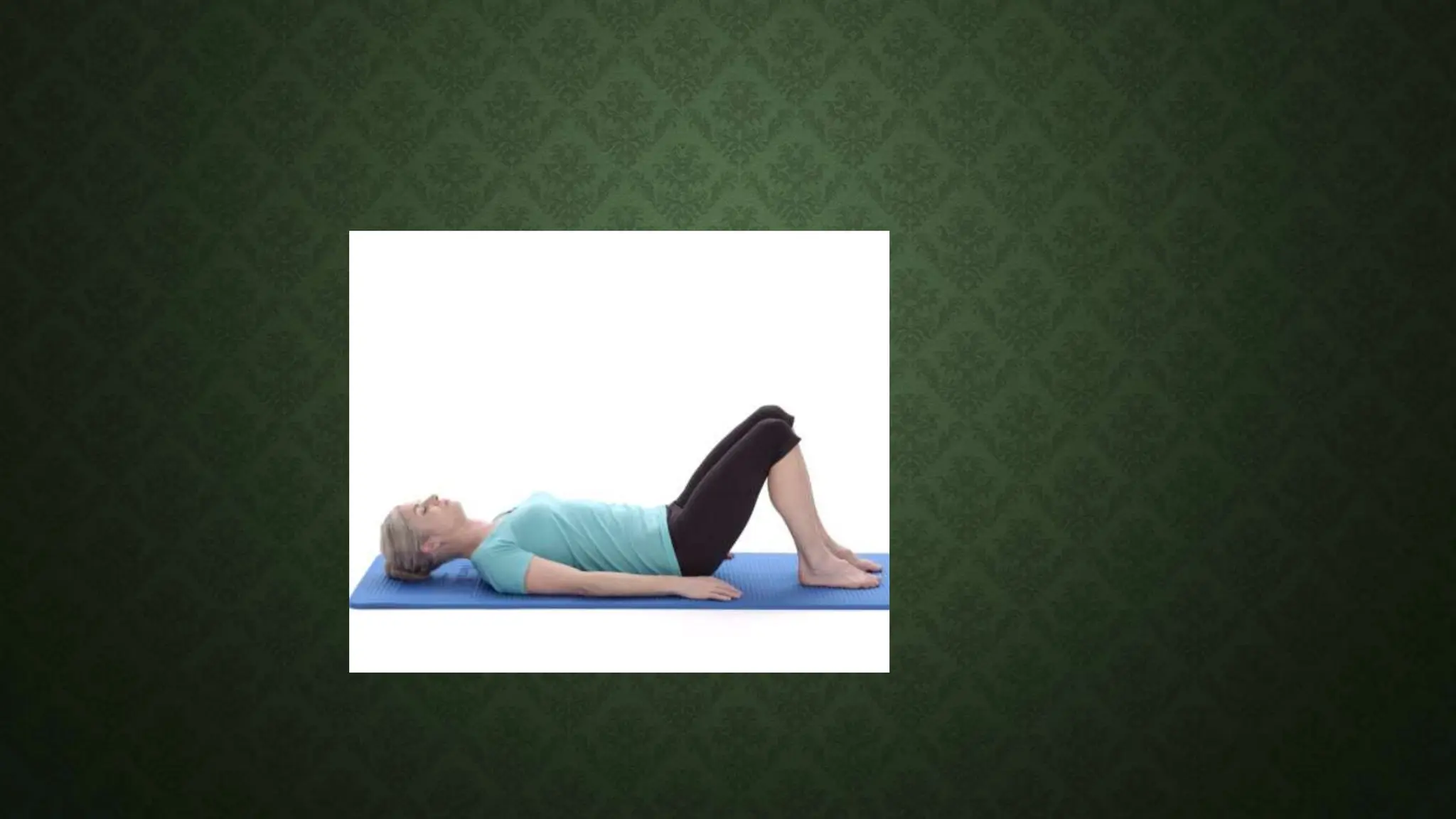
a. crook lying, lying or prone lying; general relaxation.
b. crook lying ; relax Shoulders to supporting surface, with expiration.
c. Forehead support prone lying; Head raising and lowering with relaxation.
d. sitting; Shoulder shrugging and retraction followed by relaxation.
MOBILITY
• Common muscle imbalances in length and strength were described in the previous
section on impaired postures.
• It is critical that specific mobility restrictions are identified so that stretching
techniques can be selective. For example, the transition areas between the
cervicothoracic, thoracolumbar, and lumbosacral regions typically have greater
mobility. When faulty postural habits dominate, the segmental mobility in these
areas tends to become exaggerated in the direction of the faulty posture. Stretching
should proceed cautiously so as not to accentuate the problem while attempting to
correct the tissues with decreased mobility.
• Specific spinal mobilization/manipulation techniques directed at specific
hypomobile segments.
Example for stretching :
• Levator scapulae: self-stretch with scapular depression and cervical flexion and
rotation to the opposite side.
• Pectoralis major and anterior thorax: self-stretch with corner stretches or while
lying supine on a foam roll placed longitudinally under the spine
MUSCLE POWER
• Typically impaired postural muscles that support the body in sustained postures
succumb to the effects of gravity, become less active, and develop stretch weakness
• exercises for muscular endurance are necessary to prepare the muscles to function
over an extended period of time.
ERGONOMICS: RELIEF AND PREVENTION
• It is critical to help the patient adapt postures and activities that are performed on a
sustained or repetitive basis at work, at home, recreationally, or socially if they are
contributing to the postural stresses and musculoskeletal disorders.
• It may be necessary to use a lumbar pillow for support or to modify the work
environment (workstation) to relieve sustained stressful postures.
POSTURAL TRAINING TECHNIQUE
• Isolate each body segment and train the patient to properly move that segment. If
one region is out of alignment, it is likely that there are compensatory deviations in
the alignment throughout the spine. Therefore, total posture correction, including
upper and lower extremity alignment , should be emphasized. Direct the patient’s
attention to the feel of proper movement and muscle contraction and relaxation.
 Verbal reinforcement. As you interact with the patient, frequently interpret the
sensations of muscle contraction and spinal positions that he or she should be
feeling.
■ Tactile reinforcement. Help the patient position the head and trunk in correct
alignment and touch the muscles that need to contract to move and hold the parts in
place.
■ Visual reinforcement. Use mirrors so the patient can see how he or she looks, what it
takes to assume correct alignment, and then how it feels when properly aligned.
PRESENTATION OF GOOD POSTURE
• There is no one method of teaching any one patient to assume and experience the
feeling of good posture. The method and the technique selected for a particular
patient must depend on the patient and the physiotherapist.
THE HEAD : Axial Extension (Cervical Retraction) to Decrease a Forward Head
Posture
• Patient position and procedure: Sitting or standing, with arms relaxed at the side.
Lightly touch above the lip under the nose and ask the patient to lift the head up
and away as if a string was pulling their head upward. Verbally reinforce the correct
posture, and draw attention to the way it feels. Have the patient move to the
extreme of the correct posture and then return to midline.
Scapular Retraction
• Patient position and procedure: Sitting or standing. For tactile and proprioceptive cues, gently
resist movement of the inferior angle of the scapulae and ask the patient to pinch them together
(retraction).
• Pelvic Tilt and Neutral Spine
• Patient position and procedure: Sitting, then standing with the back against a wall. Teach the
patient to roll the pelvis forward and backward to isolate an anterior and posterior pelvic tilt. After
the patient has learned to isolate the movement, instruct him or her to practice control of the pelvis
and lumbar spine by moving from extreme lordosis to extreme flat back and then assume mild
lordosis. Identify the mid position as the “neutral spine,”
Thoracic Spine
• Patient position and procedure: Standing. The position of the thorax affects the
posture of the lumbar spine and pelvis; consequently, the feel of thoracic movement
is incorporated in posture training for the lumbar spine. As the patient assumes a
mildly lordotic posture, have him or her breathe in and lift the rib cage (extension).
Guide him or her to a balanced posture, not an extremely extended posture.
Standing with the back against a wall (as in the pelvic tilt training above)
encourages thoracic extension.
The Feet
• Painless, mobile and strong feet form a stable base on which the weight of the body
is balanced and supported. The arches are braced, and the weight of the body
adjusted so that it falls through the summit of the arch and is distributed evenly to
the areas of the feet which are designed for weight-bearing.
The Complete Picture
• Where the complete pattern of good posture does not emerge as the result of the
adjustment of any one of the areas which have been already mentioned, it must be
built up gradually and progressively from complete relaxation. A state of balanced
tension and much concentration is required at first, but the effort and tension are
progressively reduced by repetition.

posture -Postural re education tech.pptx

  • 1.
    POSTURAL RE EDUCATION By Arathyk m Ass.prof. , physiotherapy LIMSAR
  • 2.
    PRINCIPLES OF RE-EDUCATION Themeasures which can be taken by the physiotherapist to combat poor posture and to train another and more efficient postural pattern depend largely on the cause. The success of any physical treatment invariably depends on her ability to gain the co- operation of the patient.
  • 3.
    IMPAIRED POSTURE Structural andFunctional Impairments • Pain from mechanical stress to sensitive structures and from muscle tension • Impaired mobility from muscle, joint, or fascial restrictions • Impaired muscle performance associated with an imbalance in muscle length and strength between antagonistic muscle groups
  • 4.
    • Impaired muscleperformance associated with poor muscular endurance • Insufficient postural control of scapular and trunk stabilizing muscles • Decreased cardiopulmonary endurance • Altered kinesthetic sense of posture associated with poor neuromuscular control and prolonged faulty postural habits • Lack of knowledge of healthy spinal control and mechanics
  • 5.
    PLAN OF CARE •1. Develop awareness and control of spinal posture • 2. Educate the patient about the relationship between • faulty posture and symptoms • 3. Increase mobility in restricting muscles, joints, fascia • 4. Develop neuromuscular control, strength, and • endurance in postural and extremity muscles
  • 6.
    5. Teach safebody mechanics 6. Ergonomic assessment of home, work, recreational environments 7. Stress management/relaxation 8. Identify safe aerobic activities 9. Promote healthy exercise habits for self-maintenance
  • 7.
    RELAXATION • The abilityto relax is an important factor in re-education, as some degree of useless and unnecessary tension is nearly always associated with poor posture. To begin with, general relaxation with the body in horizontal positions reduces muscular tension and gives a feeling of alignment. Voluntary relaxation of specific muscle groups can then be taught and practiced so that the patient learns to recognize tension and is able to relax at will, if and when it develops during the maintenance of either static or dynamic postures.
  • 8.
    Examples of RelaxationMethods a. crook lying, lying or prone lying; general relaxation. b. crook lying ; relax Shoulders to supporting surface, with expiration. c. Forehead support prone lying; Head raising and lowering with relaxation. d. sitting; Shoulder shrugging and retraction followed by relaxation.
  • 10.
    MOBILITY • Common muscleimbalances in length and strength were described in the previous section on impaired postures. • It is critical that specific mobility restrictions are identified so that stretching techniques can be selective. For example, the transition areas between the cervicothoracic, thoracolumbar, and lumbosacral regions typically have greater mobility. When faulty postural habits dominate, the segmental mobility in these areas tends to become exaggerated in the direction of the faulty posture. Stretching should proceed cautiously so as not to accentuate the problem while attempting to correct the tissues with decreased mobility.
  • 11.
    • Specific spinalmobilization/manipulation techniques directed at specific hypomobile segments. Example for stretching : • Levator scapulae: self-stretch with scapular depression and cervical flexion and rotation to the opposite side. • Pectoralis major and anterior thorax: self-stretch with corner stretches or while lying supine on a foam roll placed longitudinally under the spine
  • 12.
    MUSCLE POWER • Typicallyimpaired postural muscles that support the body in sustained postures succumb to the effects of gravity, become less active, and develop stretch weakness • exercises for muscular endurance are necessary to prepare the muscles to function over an extended period of time.
  • 13.
    ERGONOMICS: RELIEF ANDPREVENTION • It is critical to help the patient adapt postures and activities that are performed on a sustained or repetitive basis at work, at home, recreationally, or socially if they are contributing to the postural stresses and musculoskeletal disorders. • It may be necessary to use a lumbar pillow for support or to modify the work environment (workstation) to relieve sustained stressful postures.
  • 14.
    POSTURAL TRAINING TECHNIQUE •Isolate each body segment and train the patient to properly move that segment. If one region is out of alignment, it is likely that there are compensatory deviations in the alignment throughout the spine. Therefore, total posture correction, including upper and lower extremity alignment , should be emphasized. Direct the patient’s attention to the feel of proper movement and muscle contraction and relaxation.
  • 15.
     Verbal reinforcement.As you interact with the patient, frequently interpret the sensations of muscle contraction and spinal positions that he or she should be feeling. ■ Tactile reinforcement. Help the patient position the head and trunk in correct alignment and touch the muscles that need to contract to move and hold the parts in place. ■ Visual reinforcement. Use mirrors so the patient can see how he or she looks, what it takes to assume correct alignment, and then how it feels when properly aligned.
  • 16.
    PRESENTATION OF GOODPOSTURE • There is no one method of teaching any one patient to assume and experience the feeling of good posture. The method and the technique selected for a particular patient must depend on the patient and the physiotherapist.
  • 17.
    THE HEAD :Axial Extension (Cervical Retraction) to Decrease a Forward Head Posture • Patient position and procedure: Sitting or standing, with arms relaxed at the side. Lightly touch above the lip under the nose and ask the patient to lift the head up and away as if a string was pulling their head upward. Verbally reinforce the correct posture, and draw attention to the way it feels. Have the patient move to the extreme of the correct posture and then return to midline.
  • 18.
    Scapular Retraction • Patientposition and procedure: Sitting or standing. For tactile and proprioceptive cues, gently resist movement of the inferior angle of the scapulae and ask the patient to pinch them together (retraction). • Pelvic Tilt and Neutral Spine • Patient position and procedure: Sitting, then standing with the back against a wall. Teach the patient to roll the pelvis forward and backward to isolate an anterior and posterior pelvic tilt. After the patient has learned to isolate the movement, instruct him or her to practice control of the pelvis and lumbar spine by moving from extreme lordosis to extreme flat back and then assume mild lordosis. Identify the mid position as the “neutral spine,”
  • 19.
    Thoracic Spine • Patientposition and procedure: Standing. The position of the thorax affects the posture of the lumbar spine and pelvis; consequently, the feel of thoracic movement is incorporated in posture training for the lumbar spine. As the patient assumes a mildly lordotic posture, have him or her breathe in and lift the rib cage (extension). Guide him or her to a balanced posture, not an extremely extended posture. Standing with the back against a wall (as in the pelvic tilt training above) encourages thoracic extension.
  • 20.
    The Feet • Painless,mobile and strong feet form a stable base on which the weight of the body is balanced and supported. The arches are braced, and the weight of the body adjusted so that it falls through the summit of the arch and is distributed evenly to the areas of the feet which are designed for weight-bearing.
  • 21.
    The Complete Picture •Where the complete pattern of good posture does not emerge as the result of the adjustment of any one of the areas which have been already mentioned, it must be built up gradually and progressively from complete relaxation. A state of balanced tension and much concentration is required at first, but the effort and tension are progressively reduced by repetition.