POSTMODERNISM
MODERNISM- Art / social-political movement that aimed to reinvent culture that
had become outdated.
- Roughly occurred between 1890s - 1960s.
- A rejection against realism.
- Divisions of modernism include avant-garde and surrealism.
- Films / novels / art were self-reflexive of society.
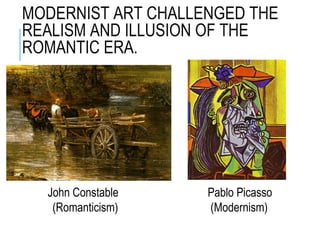
MODERNIST ART CHALLENGED THE
REALISM AND ILLUSION OF THE
ROMANTIC ERA.
John Constable Pablo Picasso
(Romanticism) (Modernism)
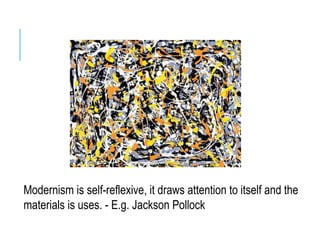
Modernism is self-reflexive, it draws attention to itself and the
materials is uses. - E.g. Jackson Pollock
POSTMODERNISM
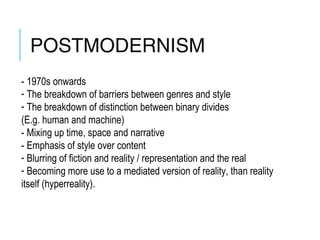
- 1970s onwards
- The breakdown of barriers between genres and style
- The breakdown of distinction between binary divides
(E.g. human and machine)
- Mixing up time, space and narrative
- Emphasis of style over content
- Blurring of fiction and reality / representation and the real
- Becoming more use to a mediated version of reality, than reality
itself (hyperreality).
KEY TERMS
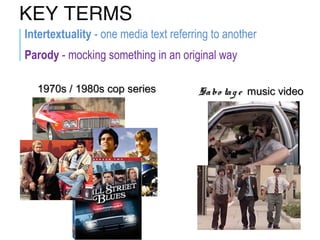
Intertextuality - one media text referring to another
Parody - mocking something in an original way
1970s / 1980s cop series1970s / 1980s cop series Sabo tag eSabo tag e music videomusic video
PARODY
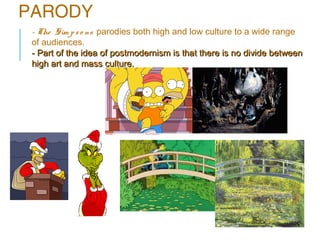
- The Sim pso ns parodies both high and low culture to a wide range
of audiences.
- Part of the idea of postmodernism is that there is no divide between- Part of the idea of postmodernism is that there is no divide between
high art and mass culture.high art and mass culture.
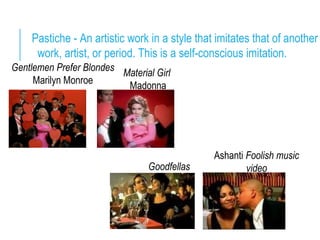
Pastiche - An artistic work in a style that imitates that of another
work, artist, or period. This is a self-conscious imitation.
Gentlemen Prefer Blondes
Marilyn Monroe
Material Girl
Madonna
Ashanti Foolish music
videoGoodfellas
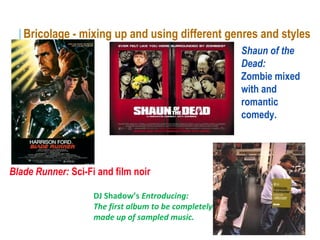
Bricolage - mixing up and using different genres and styles
Shaun of the
Dead:
Zombie mixed
with and
romantic
comedy.
Blade Runner: Sci-Fi and film noir
DJ Shadow’s Entroducing:
The first album to be completely
made up of sampled music.
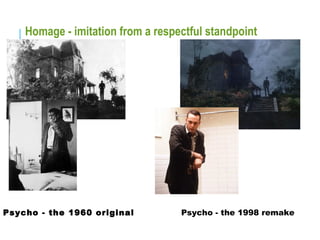
Homage - imitation from a respectful standpoint
Psycho - the 1960 original Psycho - the 1998 remake

Postmoderninsm Powerpoint

  • 1.
  • 2.
    MODERNISM- Art /social-political movement that aimed to reinvent culture that had become outdated. - Roughly occurred between 1890s - 1960s. - A rejection against realism. - Divisions of modernism include avant-garde and surrealism. - Films / novels / art were self-reflexive of society.
  • 3.
    MODERNIST ART CHALLENGEDTHE REALISM AND ILLUSION OF THE ROMANTIC ERA. John Constable Pablo Picasso (Romanticism) (Modernism)
  • 4.
    Modernism is self-reflexive,it draws attention to itself and the materials is uses. - E.g. Jackson Pollock
  • 5.
    POSTMODERNISM - 1970s onwards -The breakdown of barriers between genres and style - The breakdown of distinction between binary divides (E.g. human and machine) - Mixing up time, space and narrative - Emphasis of style over content - Blurring of fiction and reality / representation and the real - Becoming more use to a mediated version of reality, than reality itself (hyperreality).
  • 6.
    KEY TERMS Intertextuality -one media text referring to another Parody - mocking something in an original way 1970s / 1980s cop series1970s / 1980s cop series Sabo tag eSabo tag e music videomusic video
  • 7.
    PARODY - The Simpso ns parodies both high and low culture to a wide range of audiences. - Part of the idea of postmodernism is that there is no divide between- Part of the idea of postmodernism is that there is no divide between high art and mass culture.high art and mass culture.
  • 8.
    Pastiche - Anartistic work in a style that imitates that of another work, artist, or period. This is a self-conscious imitation. Gentlemen Prefer Blondes Marilyn Monroe Material Girl Madonna Ashanti Foolish music videoGoodfellas
  • 9.
    Bricolage - mixingup and using different genres and styles Shaun of the Dead: Zombie mixed with and romantic comedy. Blade Runner: Sci-Fi and film noir DJ Shadow’s Entroducing: The first album to be completely made up of sampled music.
  • 10.
    Homage - imitationfrom a respectful standpoint Psycho - the 1960 original Psycho - the 1998 remake