Lesson Objective:   to understand the 3 approaches to postmodernism   to understand the difference between modernism and postmodernism   to know the basic theories of the postmodern
What is postmodernism?   You have 10 minutes to research the term postmodernism.    Make a note of all definitions you find, ready to feedback to the class.
Postmodernism is a notoriously difficult concept to define. There are 3 approaches:   Historical   Stylistic    Theoretical
Historical Postmodernism is a reaction to modernism.  Therefore to understand postmodernism from a historical point of view, we need to first understand modernism. So …
What is modernism?   Experimenting with representations of reality   Early part of the 20 th  century   Value judgements (e.g. High culture= good, low culture = bad)   A lot of what is generally accepted as ‘the norm’
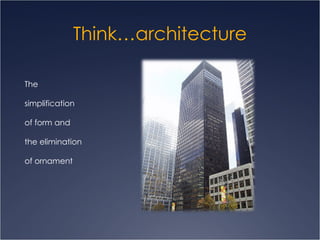
Think…architecture The  simplification  of form and  the elimination  of ornament
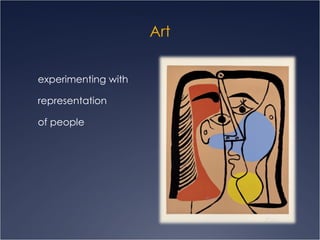
Art experimenting with representation  of people
Nuclear family
So is that’s modernism, what is postmodernism? Think…
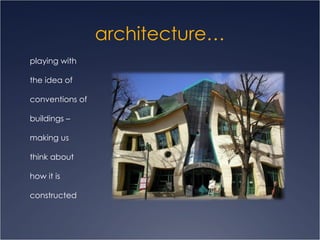
architecture… playing with the idea of  conventions of  buildings –  making us  think about  how it is  constructed
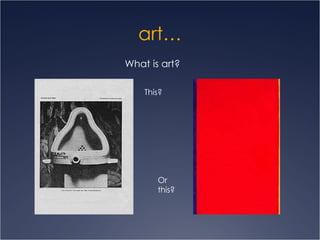
art… What is art? This? Or this?
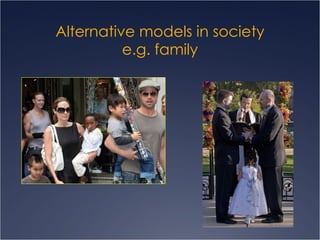
Alternative models in society e.g. family
So how can we define postmodernism? Subject of postmodern media texts:   Postmodern texts embody scepticism towards the ideas and ideals of the modern era, especially the ideas of progress, objectivity, reason certainty, personal identity and grand narratives (more on this later) Style of postmodern media texts:   Postmodernism takes pleasure in playing with convention, pointing out nature of how everything is a construction.
Theoretical Approach Main theorists:   Lyotard   Baudrillard   Jameson These 3 theorists offer interpretations of postmodernism which will help us in considering postmodern media.
10 mins to research theorists   Find out what postmodern theories these theorists came up with.
Jean- François  Lyotard (1924-1998)   Rejection of ‘grand or meta-narratives’   These are large-scale theories and philosophies of the world, such as the progress of history, the knowability of everything by science, and the possibility of absolute freedom.    Therefore, all ‘grand narratives’ should be viewed with suspicion.   The truth therefore needs to be ‘deconstructed’ so that we can challenge dominant ideas that people claim as truth.
Jean Baudrillard (1929-2007)   There is no longer a distinction between reality and its representing image, or simulacrum.    Hyperreality – there is only surface meaning; there is no longer any original thing for the sign to represent; the sign is the meaning.
Frederic Jameson (b. 1934)   Historical viewpoint – postmodernism is a development of modernism.    Postmodernist works are often characterized by lack of depth, which has been replaced by a surfeit of surface.   Jameson catalogs key features of postmodern culture, as self-referentiality, irony, pastiche, and parody.   Jameson refers to this cultural recycling as  historicism —the random cannibalization of various past styles – erasing historical depth.
Stylistic Approach    Postmodernism comprises of a set of core ideas and key concepts that work collaboratively to shape it.    The more of these ideas and key concepts it embellishes, the more of a post-modern text it becomes; these are largely derived from the above theorists.
Key concepts  generic blurring  intertextuality and bricolage  playfulness e.g. parody and pastiche  hyperreality  hyperconciousness  eclecticism  death of representation  uncertainty and the loss of  context
So which approach will we go with? A combination of all  of them, as appropriate. To consider whether a text is ‘postmodern’ or not we will largely rely on a stylistic approach, which themselves are a product of historical and theoretical approaches. We will also keep the other approaches in mind and look at how a postmodern viewpoint, from either a historical or theoretical point of view affects the way in which the audience and the industry produce and consume the media.
From what you have learnt today, which texts do you think could be described as ‘postmodern’?
Homework  Read and learn terms from glossary.  Start on ‘reading’ list.

Post-Modernism Session1

  • 1.
    Lesson Objective:  to understand the 3 approaches to postmodernism  to understand the difference between modernism and postmodernism  to know the basic theories of the postmodern
  • 2.
    What is postmodernism? You have 10 minutes to research the term postmodernism.  Make a note of all definitions you find, ready to feedback to the class.
  • 3.
    Postmodernism is anotoriously difficult concept to define. There are 3 approaches:  Historical  Stylistic  Theoretical
  • 4.
    Historical Postmodernism isa reaction to modernism. Therefore to understand postmodernism from a historical point of view, we need to first understand modernism. So …
  • 5.
    What is modernism? Experimenting with representations of reality  Early part of the 20 th century  Value judgements (e.g. High culture= good, low culture = bad)  A lot of what is generally accepted as ‘the norm’
  • 6.
    Think…architecture The simplification of form and the elimination of ornament
  • 7.
    Art experimenting withrepresentation of people
  • 8.
  • 9.
    So is that’smodernism, what is postmodernism? Think…
  • 10.
    architecture… playing withthe idea of conventions of buildings – making us think about how it is constructed
  • 11.
    art… What isart? This? Or this?
  • 12.
    Alternative models insociety e.g. family
  • 13.
    So how canwe define postmodernism? Subject of postmodern media texts:  Postmodern texts embody scepticism towards the ideas and ideals of the modern era, especially the ideas of progress, objectivity, reason certainty, personal identity and grand narratives (more on this later) Style of postmodern media texts:  Postmodernism takes pleasure in playing with convention, pointing out nature of how everything is a construction.
  • 14.
    Theoretical Approach Maintheorists:  Lyotard  Baudrillard  Jameson These 3 theorists offer interpretations of postmodernism which will help us in considering postmodern media.
  • 15.
    10 mins toresearch theorists  Find out what postmodern theories these theorists came up with.
  • 16.
    Jean- François Lyotard (1924-1998)  Rejection of ‘grand or meta-narratives’  These are large-scale theories and philosophies of the world, such as the progress of history, the knowability of everything by science, and the possibility of absolute freedom.  Therefore, all ‘grand narratives’ should be viewed with suspicion.  The truth therefore needs to be ‘deconstructed’ so that we can challenge dominant ideas that people claim as truth.
  • 17.
    Jean Baudrillard (1929-2007) There is no longer a distinction between reality and its representing image, or simulacrum.  Hyperreality – there is only surface meaning; there is no longer any original thing for the sign to represent; the sign is the meaning.
  • 18.
    Frederic Jameson (b.1934)  Historical viewpoint – postmodernism is a development of modernism.  Postmodernist works are often characterized by lack of depth, which has been replaced by a surfeit of surface.  Jameson catalogs key features of postmodern culture, as self-referentiality, irony, pastiche, and parody.  Jameson refers to this cultural recycling as historicism —the random cannibalization of various past styles – erasing historical depth.
  • 19.
    Stylistic Approach  Postmodernism comprises of a set of core ideas and key concepts that work collaboratively to shape it.  The more of these ideas and key concepts it embellishes, the more of a post-modern text it becomes; these are largely derived from the above theorists.
  • 20.
    Key concepts generic blurring  intertextuality and bricolage  playfulness e.g. parody and pastiche  hyperreality  hyperconciousness  eclecticism  death of representation  uncertainty and the loss of context
  • 21.
    So which approachwill we go with? A combination of all of them, as appropriate. To consider whether a text is ‘postmodern’ or not we will largely rely on a stylistic approach, which themselves are a product of historical and theoretical approaches. We will also keep the other approaches in mind and look at how a postmodern viewpoint, from either a historical or theoretical point of view affects the way in which the audience and the industry produce and consume the media.
  • 22.
    From what youhave learnt today, which texts do you think could be described as ‘postmodern’?
  • 23.
    Homework  Readand learn terms from glossary.  Start on ‘reading’ list.

Editor's Notes

  • #3 At end of slide, feedback – this will probably be very confused – that is as expected.
  • #16 Students research a theorist and their theories of postmodernism individually and report back to class
  • #21 Explain terms – help on glossary sheet