Definition of Serology
Serologyis the scientific study of blood serum, especially with respect
to the response of the immune system to pathogens or introduced
substances. The term "serology" typically refers to the diagnostic
examination of blood serum to identify antibodies, antigens, and other
immunological components.
3.
Purpose of Serology
Serologyis essential for understanding the body’s immune response to
infections, diagnosing diseases, and monitoring immunity. It's
commonly used in infectious disease diagnosis, transfusion medicine,
and autoimmune disorder identification.
4.
Principles of Serology
Thefield is based on antigen-antibody reactions, where specific
antibodies in the blood will bind to specific antigens, allowing for the
detection of pathogens or immune responses. Various tests are designed
to measure these interactions, helping to confirm exposure to bacteria,
viruses, and other microorganisms.
5.
Applications of Serology:
•Infectious Disease Diagnosis: Identifies exposure to viruses (e.g.,
HIV, hepatitis), bacteria, and other pathogens.
• Blood Typing: Essential for safe blood transfusions.
• Vaccine Response Monitoring: Helps assess immunity post-
vaccination by detecting antibodies.
• Autoimmune Disease Detection: Detects antibodies directed against
the body’s own tissues, aiding in autoimmune disease diagnosis.
6.
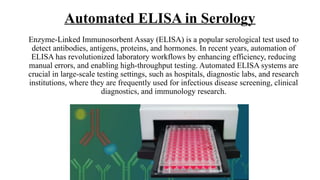
Automated ELISA inSerology
Enzyme-Linked Immunosorbent Assay (ELISA) is a popular serological test used to
detect antibodies, antigens, proteins, and hormones. In recent years, automation of
ELISA has revolutionized laboratory workflows by enhancing efficiency, reducing
manual errors, and enabling high-throughput testing. Automated ELISA systems are
crucial in large-scale testing settings, such as hospitals, diagnostic labs, and research
institutions, where they are frequently used for infectious disease screening, clinical
diagnostics, and immunology research.
7.
Benefits of ELISAAutomation
•Increased Throughput: Automated ELISA systems can process
numerous samples simultaneously, enabling faster processing of high
sample volumes, which is essential in outbreak scenarios or large-scale
screenings.
• Consistency and Reduced Human Error: Automation reduces
variability introduced by manual handling. Consistent pipetting,
incubation times, and washing steps improve the accuracy and
reproducibility of results.
8.
Benefits of ELISAAutomation
•Time Efficiency: Automation minimizes the time needed for each
step, from sample preparation to data analysis, allowing laboratory
staff to focus on other critical tasks.
• Enhanced Data Management: Many automated ELISA platforms are
integrated with software that can store and manage data, generating
reports and enabling easy retrieval for future analysis.
9.
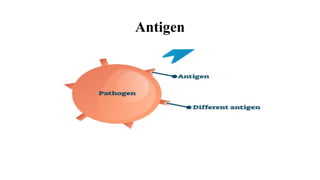
Definition of Antigen
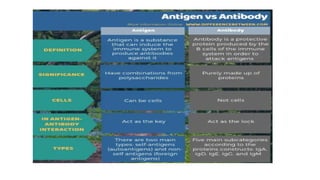
Anantigen is any substance that triggers an immune response in the
body, especially by stimulating the production of antibodies. Antigens
are typically foreign substances, such as bacteria, viruses, fungi, toxins,
or even proteins from transplanted tissues, which the immune system
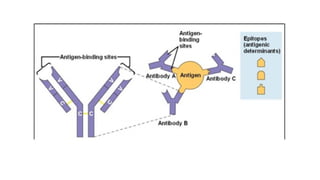
recognizes as "non-self." Each antigen has specific sites, known as
epitopes, that bind to antibodies or immune cell receptors, initiating an
immune response to neutralize or eliminate the threat. Antigens are
essential in the body’s defense mechanisms and play a key role in
diagnostics and vaccine development.
Definition of Antibody
Anantibody is a specialized protein produced by the immune system in
response to foreign substances, known as antigens, such as bacteria,
viruses, or toxins. Antibodies recognize and bind to specific antigens
with high specificity, neutralizing or marking them for destruction by
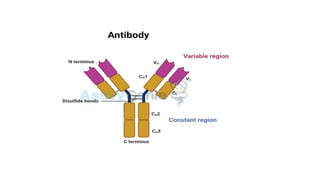
other immune cells. Structurally, antibodies are Y-shaped molecules
composed of two heavy chains and two light chains, with a variable
region that allows them to bind uniquely to different antigens. They play
a critical role in immunity by identifying and helping eliminate
pathogens and are also called immunoglobulins (Ig).
13.
Types of Antibodies
Thereare five main classes of antibodies, also known as
immunoglobulins (Ig).
Each type has a specific structure and function in the immune system:
1) IgG (Immunoglobulin G)
• The most abundant antibody in the blood and extracellular fluid.
• Provides long-term immunity and can cross the placenta to protect the
fetus.
14.
2) IgA (ImmunoglobulinA)
• Found in mucous membranes, saliva, tears, and breast milk.
• Protects body surfaces exposed to foreign substances, such as
respiratory and digestive tracts.
3) IgM (Immunoglobulin M)
• The first antibody produced in response to an infection.
• Primarily found in the blood and lymph fluid, it is effective in forming
complexes with pathogens.
15.
4) IgE (ImmunoglobulinE) Involved in allergic reactions and defense
against parasitic infections. Binds to allergens and triggers histamine
release from mast cells and basophils.
5) IgD (Immunoglobulin D) Found on the surface of immature B cells.
Plays a role in the initiation and regulation of immune responses.
Types of SerologicalTests:
• Anti HAV (Antibodies against the Hepatitis A virus (HAV).
• Anti HCV (Antibodies against Hepatitis C Virus (HCV).
• HBsAg (Hepatitis B Surface Antigen)
• Typhidot
• Widal tests (typhoid fever or enteric fever)
• Anti HEV (Antibodies against Hepatitis E Virus (HEV)
• HIV (Human Immunodeficiency Virus)
• CRP (C-Reactive Protein)
• RA factor (Rheumatoid Factor)
• ASOT (Rheumatoid Factor) chronic inflammatory disorder that can affect more than just your
joints
20.
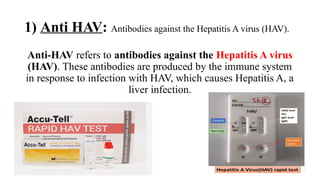
1) Anti HAV:Antibodies against the Hepatitis A virus (HAV).
Anti-HAV refers to antibodies against the Hepatitis A virus
(HAV). These antibodies are produced by the immune system
in response to infection with HAV, which causes Hepatitis A, a
liver infection.
21.
There are twomain types of Anti-HAV antibodies:
1) Anti-HAV IgM:
• Appears early in the infection and indicates an acute or recent infection
with Hepatitis A.
• It is often used as a marker for recent exposure to HAV and usually
declines after a few months as the infection resolves.
2) Anti-HAV IgG:
• Develops later in the infection and usually remains in the blood for life,
providing immunity against future HAV infections.
• Its presence indicates past exposure or immunity, which can result from
a previous infection or vaccination.
22.
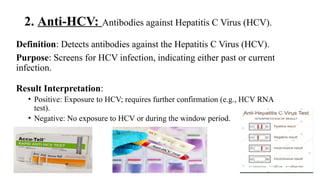
2. Anti-HCV: Antibodiesagainst Hepatitis C Virus (HCV).
Definition: Detects antibodies against the Hepatitis C Virus (HCV).
Purpose: Screens for HCV infection, indicating either past or current
infection.
Result Interpretation:
• Positive: Exposure to HCV; requires further confirmation (e.g., HCV RNA
test).
• Negative: No exposure to HCV or during the window period.
23.
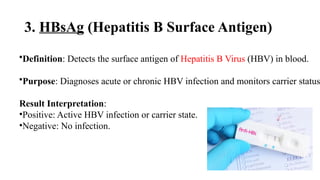
3. HBsAg (HepatitisB Surface Antigen)
•Definition: Detects the surface antigen of Hepatitis B Virus (HBV) in blood.
•Purpose: Diagnoses acute or chronic HBV infection and monitors carrier status
Result Interpretation:
•Positive: Active HBV infection or carrier state.
•Negative: No infection.
24.
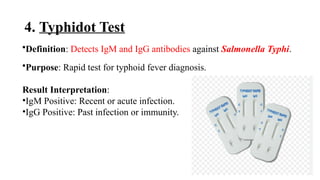
4. Typhidot Test
•Definition:Detects IgM and IgG antibodies against Salmonella Typhi.
•Purpose: Rapid test for typhoid fever diagnosis.
Result Interpretation:
•IgM Positive: Recent or acute infection.
•IgG Positive: Past infection or immunity.
25.
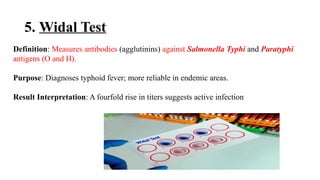
5. Widal Test
Definition:Measures antibodies (agglutinins) against Salmonella Typhi and Paratyphi
antigens (O and H).
Purpose: Diagnoses typhoid fever; more reliable in endemic areas.
Result Interpretation: A fourfold rise in titers suggests active infection
26.
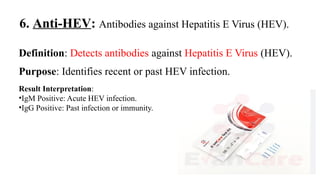
6. Anti-HEV: Antibodiesagainst Hepatitis E Virus (HEV).
Definition: Detects antibodies against Hepatitis E Virus (HEV).
Purpose: Identifies recent or past HEV infection.
Result Interpretation:
•IgM Positive: Acute HEV infection.
•IgG Positive: Past infection or immunity.
27.
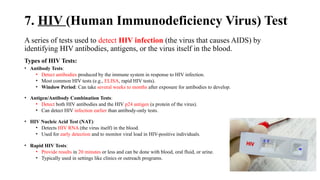
7. HIV (HumanImmunodeficiency Virus) Test
A series of tests used to detect HIV infection (the virus that causes AIDS) by
identifying HIV antibodies, antigens, or the virus itself in the blood.
Types of HIV Tests:
• Antibody Tests:
• Detect antibodies produced by the immune system in response to HIV infection.
• Most common HIV tests (e.g., ELISA, rapid HIV tests).
• Window Period: Can take several weeks to months after exposure for antibodies to develop.
• Antigen/Antibody Combination Tests:
• Detect both HIV antibodies and the HIV p24 antigen (a protein of the virus).
• Can detect HIV infection earlier than antibody-only tests.
• HIV Nucleic Acid Test (NAT):
• Detects HIV RNA (the virus itself) in the blood.
• Used for early detection and to monitor viral load in HIV-positive individuals.
• Rapid HIV Tests:
• Provide results in 20 minutes or less and can be done with blood, oral fluid, or urine.
• Typically used in settings like clinics or outreach programs.
28.
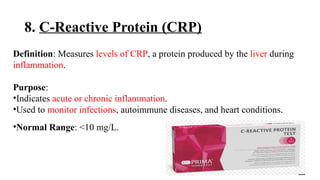
8. C-Reactive Protein(CRP)
Definition: Measures levels of CRP, a protein produced by the liver during
inflammation.
Purpose:
•Indicates acute or chronic inflammation.
•Used to monitor infections, autoimmune diseases, and heart conditions.
•Normal Range: <10 mg/L.
29.
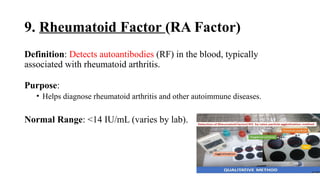
9. Rheumatoid Factor(RA Factor)
Definition: Detects autoantibodies (RF) in the blood, typically
associated with rheumatoid arthritis.
Purpose:
• Helps diagnose rheumatoid arthritis and other autoimmune diseases.
Normal Range: <14 IU/mL (varies by lab).
30.
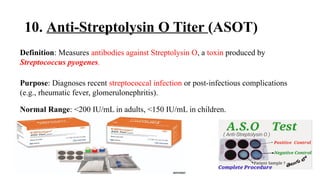
10. Anti-Streptolysin OTiter (ASOT)
Definition: Measures antibodies against Streptolysin O, a toxin produced by
Streptococcus pyogenes.
Purpose: Diagnoses recent streptococcal infection or post-infectious complications
(e.g., rheumatic fever, glomerulonephritis).
Normal Range: <200 IU/mL in adults, <150 IU/mL in children.