Post operative nausea and
vomiting
Presenter - Dr Tanmay Patil
Moderator- Dr Ravi Khandelwal
DEFINITIONS
 VOMITING : Forceful expulsion of gastric contents
through mouth and nose
 NAUSEA : Sensation of unease and discomfort in stomach
with urge to vomit
 RETCHING : similar to vomiting with the exception that
no gastric content enters the pharynx.
 PONV is typically used to describe nausea and
vomiting or retching in post anaesthesia care unit
or in immediate 24 postoperative hrs.
 PONV can delay recovery room discharge or may
required unanticipated hospital stay.
 These can leads to rare but serious conditions like
wound dehiscence ,esophageal rupture,
aspiration, subcutaneous emphysema or
pneumothorax .
Introduction
 Without a prophylaxis, Postoperative nausea and
vomiting (PONV) occurs in approximately 20% to 30% of
general surgical population and up to 70-80% in patients
with predisposing risk factors.
 PONV is second most common (pain is most common)
complaint reported after surgery. As anesthetic
duration increases, so too, does PONV risk .
 When the risk is sufficiently great, prophylactic anti
emetic medications are administered and strategies to
reduce its incidence are initiated.
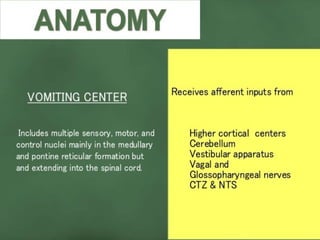
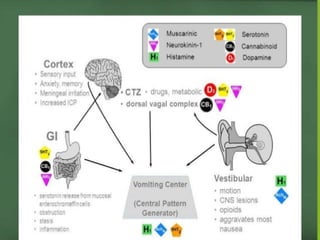
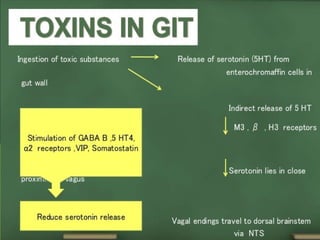
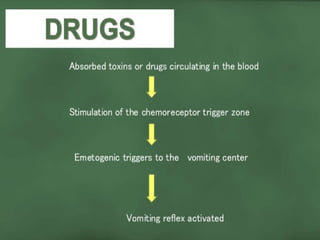
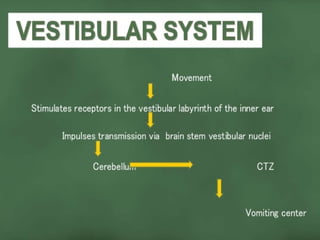
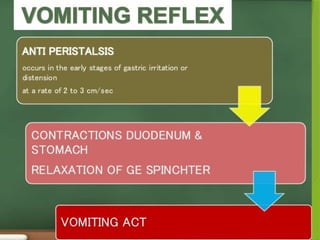
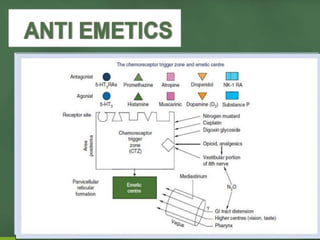
 Nausea and vomiting may be induced through various
pathways , which finally stimulate vomiting center in
brain stem.
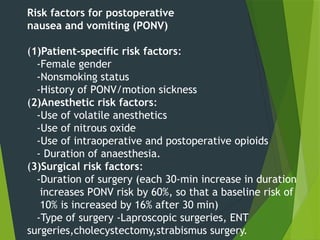
Risk factors for postoperative
nausea and vomiting (PONV)
(1)Patient-specific risk factors:
-Female gender
-Nonsmoking status
-History of PONV/motion sickness
(2)Anesthetic risk factors:
-Use of volatile anesthetics
-Use of nitrous oxide
-Use of intraoperative and postoperative opioids
- Duration of anaesthesia.
(3)Surgical risk factors:
-Duration of surgery (each 30-min increase in duration
increases PONV risk by 60%, so that a baseline risk of
10% is increased by 16% after 30 min)
-Type of surgery -Laproscopic surgeries, ENT
surgeries,cholecystectomy,strabismus surgery.
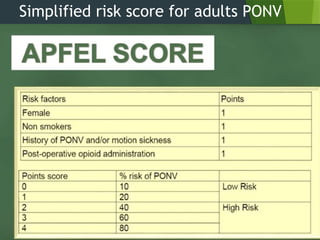
Simplified risk score for adults PONV
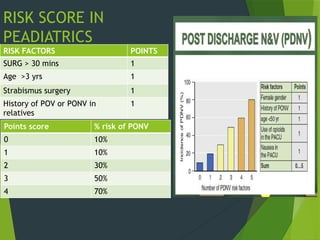
RISK SCORE IN
PEADIATRICS
RISK FACTORS POINTS
SURG > 30 mins 1
Age >3 yrs 1
Strabismus surgery 1
History of POV or PONV in
relatives
1
Points score % risk of PONV
0 10%
1 10%
2 30%
3 50%
4 70%
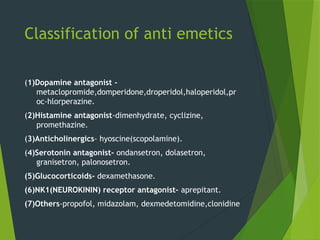
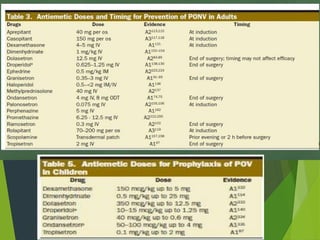
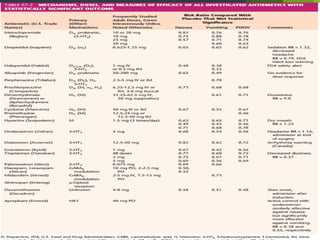
Classification of anti emetics
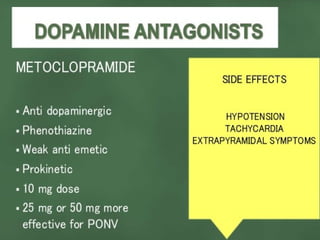
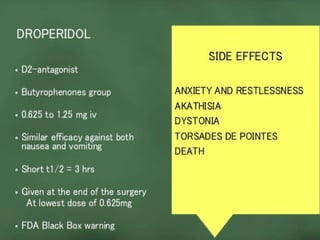
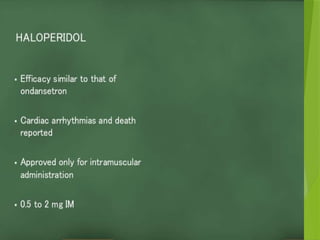
(1)Dopamine antagonist -
metaclopromide,domperidone,droperidol,haloperidol,pr
oc-hlorperazine.
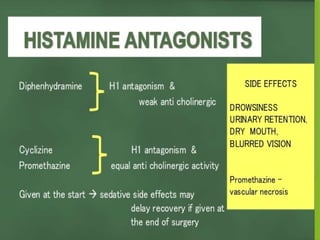
(2)Histamine antagonist-dimenhydrate, cyclizine,
promethazine.
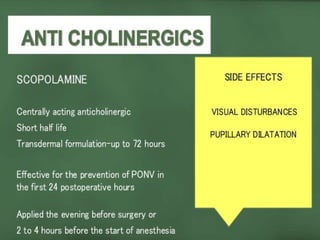
(3)Anticholinergics- hyoscine(scopolamine).
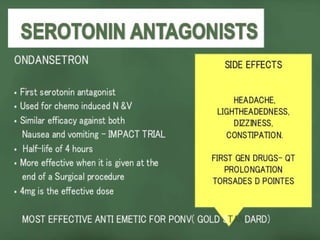
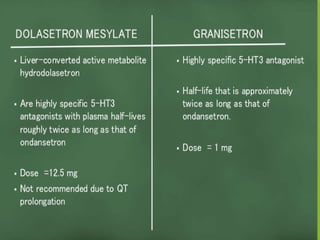
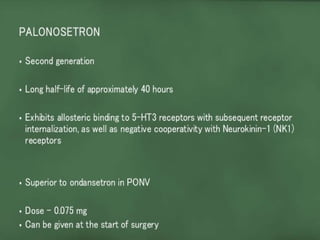
(4)Serotonin antagonist- ondansetron, dolasetron,
granisetron, palonosetron.
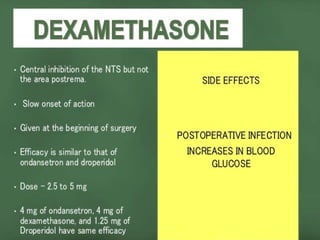
(5)Glucocorticoids- dexamethasone.
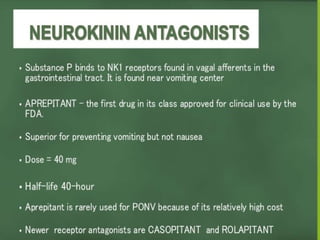
(6)NK1(NEUROKININ) receptor antagonist- aprepitant.
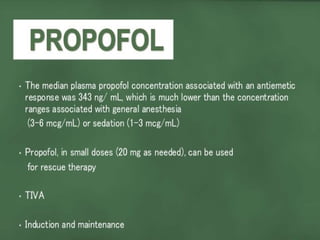
(7)Others-propofol, midazolam, dexmedetomidine,clonidine
Combination and multimodal
therapy
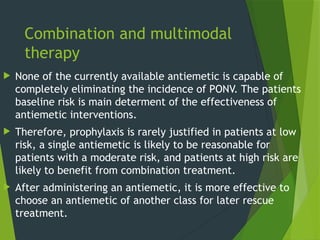
 None of the currently available antiemetic is capable of
completely eliminating the incidence of PONV. The patients
baseline risk is main determent of the effectiveness of
antiemetic interventions.
 Therefore, prophylaxis is rarely justified in patients at low
risk, a single antiemetic is likely to be reasonable for
patients with a moderate risk, and patients at high risk are
likely to benefit from combination treatment.
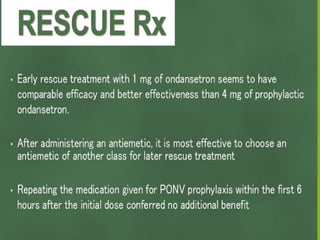
 After administering an antiemetic, it is more effective to
choose an antiemetic of another class for later rescue
treatment.
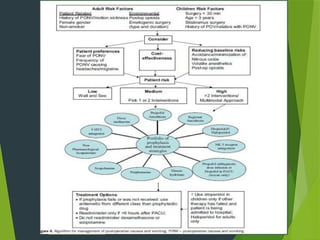
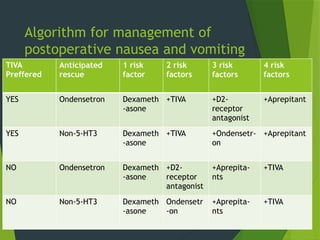
Algorithm for management of
postoperative nausea and vomiting
TIVA
Preffered
Anticipated
rescue
1 risk
factor
2 risk
factors
3 risk
factors
4 risk
factors
YES Ondensetron Dexameth
-asone
+TIVA +D2-
receptor
antagonist
+Aprepitant
YES Non-5-HT3 Dexameth
-asone
+TIVA +Ondensetr-
on
+Aprepitant
NO Ondensetron Dexameth
-asone
+D2-
receptor
antagonist
+Aprepita-
nts
+TIVA
NO Non-5-HT3 Dexameth
-asone
Ondensetr
-on
+Aprepita-
nts
+TIVA
Thanks

post operative nausea and vomiting .pptx

  • 1.
    Post operative nauseaand vomiting Presenter - Dr Tanmay Patil Moderator- Dr Ravi Khandelwal
  • 2.
    DEFINITIONS  VOMITING :Forceful expulsion of gastric contents through mouth and nose  NAUSEA : Sensation of unease and discomfort in stomach with urge to vomit  RETCHING : similar to vomiting with the exception that no gastric content enters the pharynx.
  • 3.
     PONV istypically used to describe nausea and vomiting or retching in post anaesthesia care unit or in immediate 24 postoperative hrs.  PONV can delay recovery room discharge or may required unanticipated hospital stay.  These can leads to rare but serious conditions like wound dehiscence ,esophageal rupture, aspiration, subcutaneous emphysema or pneumothorax .
  • 4.
    Introduction  Without aprophylaxis, Postoperative nausea and vomiting (PONV) occurs in approximately 20% to 30% of general surgical population and up to 70-80% in patients with predisposing risk factors.  PONV is second most common (pain is most common) complaint reported after surgery. As anesthetic duration increases, so too, does PONV risk .  When the risk is sufficiently great, prophylactic anti emetic medications are administered and strategies to reduce its incidence are initiated.  Nausea and vomiting may be induced through various pathways , which finally stimulate vomiting center in brain stem.
  • 11.
    Risk factors forpostoperative nausea and vomiting (PONV) (1)Patient-specific risk factors: -Female gender -Nonsmoking status -History of PONV/motion sickness (2)Anesthetic risk factors: -Use of volatile anesthetics -Use of nitrous oxide -Use of intraoperative and postoperative opioids - Duration of anaesthesia. (3)Surgical risk factors: -Duration of surgery (each 30-min increase in duration increases PONV risk by 60%, so that a baseline risk of 10% is increased by 16% after 30 min) -Type of surgery -Laproscopic surgeries, ENT surgeries,cholecystectomy,strabismus surgery.
  • 12.
    Simplified risk scorefor adults PONV
  • 14.
    RISK SCORE IN PEADIATRICS RISKFACTORS POINTS SURG > 30 mins 1 Age >3 yrs 1 Strabismus surgery 1 History of POV or PONV in relatives 1 Points score % risk of PONV 0 10% 1 10% 2 30% 3 50% 4 70%
  • 18.
    Classification of antiemetics (1)Dopamine antagonist - metaclopromide,domperidone,droperidol,haloperidol,pr oc-hlorperazine. (2)Histamine antagonist-dimenhydrate, cyclizine, promethazine. (3)Anticholinergics- hyoscine(scopolamine). (4)Serotonin antagonist- ondansetron, dolasetron, granisetron, palonosetron. (5)Glucocorticoids- dexamethasone. (6)NK1(NEUROKININ) receptor antagonist- aprepitant. (7)Others-propofol, midazolam, dexmedetomidine,clonidine
  • 32.
    Combination and multimodal therapy None of the currently available antiemetic is capable of completely eliminating the incidence of PONV. The patients baseline risk is main determent of the effectiveness of antiemetic interventions.  Therefore, prophylaxis is rarely justified in patients at low risk, a single antiemetic is likely to be reasonable for patients with a moderate risk, and patients at high risk are likely to benefit from combination treatment.  After administering an antiemetic, it is more effective to choose an antiemetic of another class for later rescue treatment.
  • 34.
    Algorithm for managementof postoperative nausea and vomiting TIVA Preffered Anticipated rescue 1 risk factor 2 risk factors 3 risk factors 4 risk factors YES Ondensetron Dexameth -asone +TIVA +D2- receptor antagonist +Aprepitant YES Non-5-HT3 Dexameth -asone +TIVA +Ondensetr- on +Aprepitant NO Ondensetron Dexameth -asone +D2- receptor antagonist +Aprepita- nts +TIVA NO Non-5-HT3 Dexameth -asone Ondensetr -on +Aprepita- nts +TIVA
  • 36.