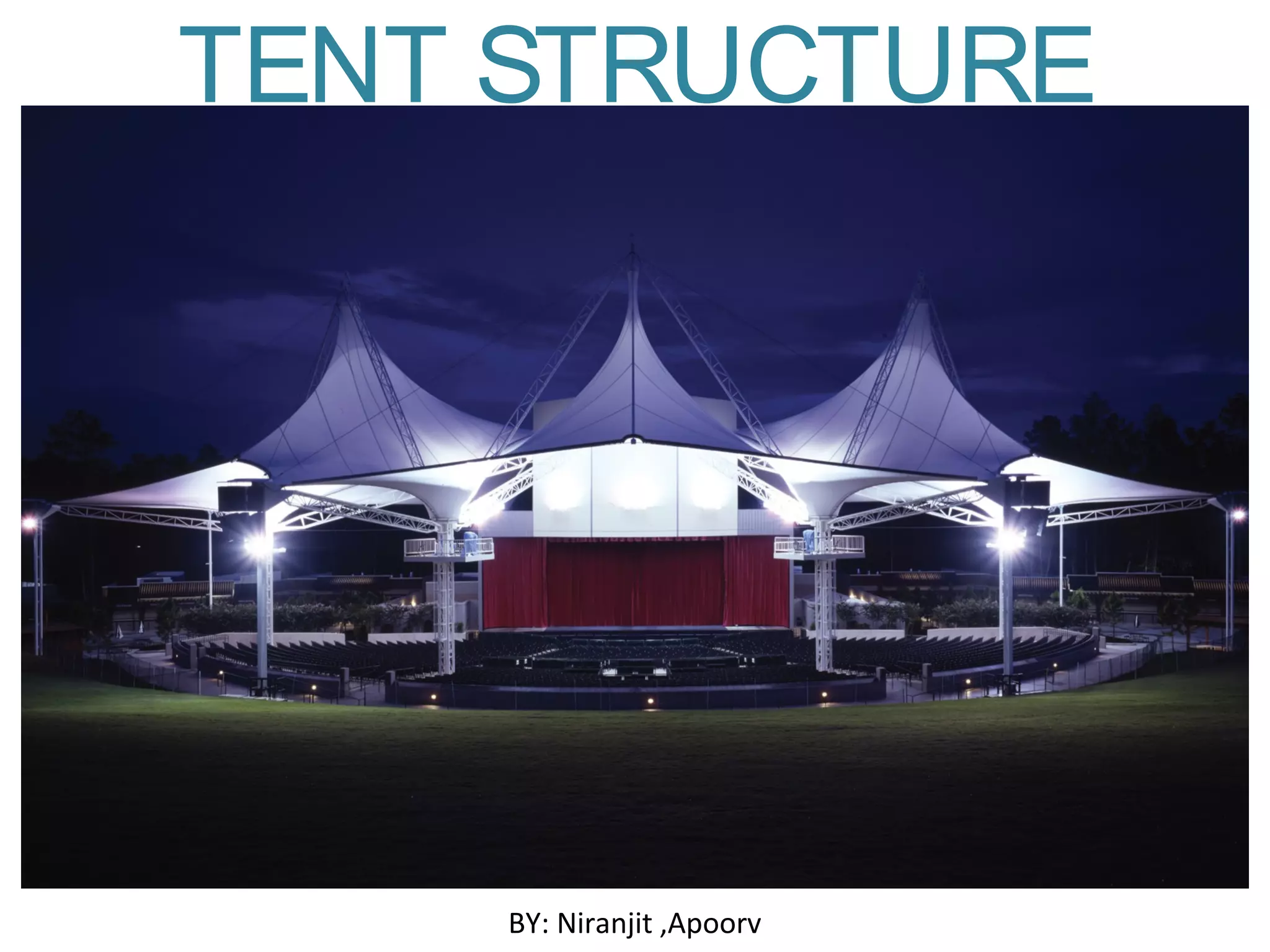
TENT STRUCTURE
BY: Niranjit ,Apoorv
contents
Introduction
What is tent structure system
Types
Components and Materials
Advantages and Disadvantages
Introduction
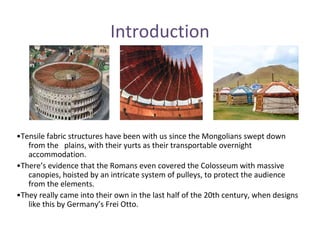
•Tensile fabric structures have been with us since the Mongolians swept down
from the plains, with their yurts as their transportable overnight
accommodation.
•There’s evidence that the Romans even covered the Colosseum with massive
canopies, hoisted by an intricate system of pulleys, to protect the audience
from the elements.
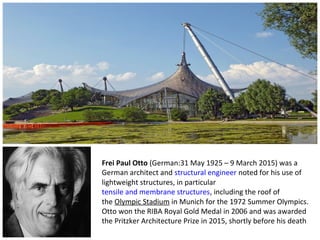
•They really came into their own in the last half of the 20th century, when designs
like this by Germany’s Frei Otto.
Frei Paul Otto (German:31 May 1925 – 9 March 2015) was a
German architect and structural engineer noted for his use of
lightweight structures, in particular
tensile and membrane structures, including the roof of
the Olympic Stadium in Munich for the 1972 Summer Olympics.
Otto won the RIBA Royal Gold Medal in 2006 and was awarded
the Pritzker Architecture Prize in 2015, shortly before his death..
DEFINITION
A tent is a shelter, consisting of sheets of fabric or other materials draped over or attached to
a frame of poles and/or ropes . Some tents styles are free-standing, whole others are
attached to the ground using guy ropes tied to stakes (pegs). Tents were first used as
portable homes by nomadic peoples, but today, their main application is for armed forces
and creational camping Modern tents are usually made of fire-retardant material.
Notes:
 Fabric structures cannot take
heavy weather conditions is an
incorrect statement.
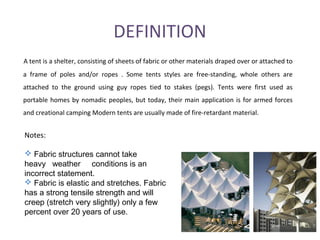
 Fabric is elastic and stretches. Fabric
has a strong tensile strength and will
creep (stretch very slightly) only a few
percent over 20 years of use.
Types of Tent Structure :
Saddle roof
Mast supported
Arc supported
Combinations
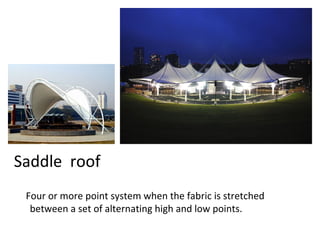
Saddle roof
Four or more point system when the fabric is stretched
between a set of alternating high and low points.
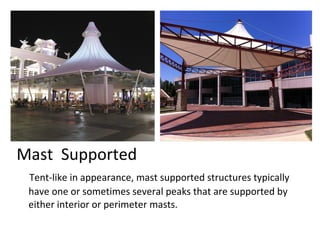
Mast Supported
Tent-like in appearance, mast supported structures typically
have one or sometimes several peaks that are supported by
either interior or perimeter masts.
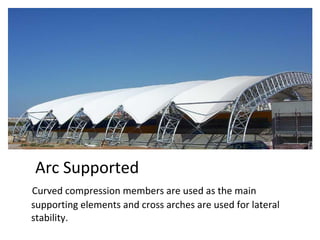
Arc Supported
Curved compression members are used as the main
supporting elements and cross arches are used for lateral
stability.
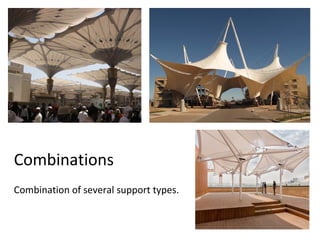
Combinations
Combination of several support types.
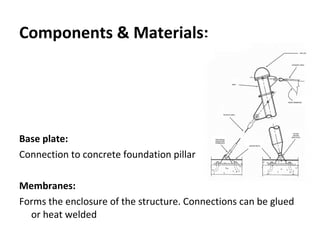
Components & Materials:
Base plate:
Connection to concrete foundation pillar
Membranes:
Forms the enclosure of the structure. Connections can be glued
or heat welded
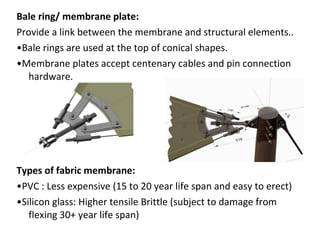
Bale ring/ membrane plate:
Provide a link between the membrane and structural elements..
•Bale rings are used at the top of conical shapes.
•Membrane plates accept centenary cables and pin connection
hardware.
Types of fabric membrane:
•PVC : Less expensive (15 to 20 year life span and easy to erect)
•Silicon glass: Higher tensile Brittle (subject to damage from
flexing 30+ year life span)
ADVANTAGES DISADVANTAGES
Longer life cycles of materials. Little to no rigidity.
Materials can be re-used in form. Loss of tension is dangerous for stability.
Most materials are completely recyclable. Thermal values limit use
Less impact on site. Load Transfer on Fabric Structures
Unique designs. Attachment Weaknesses in Mono cover
Fabric Structures
Lightweight and flexible.
Less construction debris after demolition.
Environmentally sensitive.
High strength weight ratio.

Tent structure

  • 1.
  • 2.
    contents Introduction What is tentstructure system Types Components and Materials Advantages and Disadvantages
  • 3.
    Introduction •Tensile fabric structureshave been with us since the Mongolians swept down from the plains, with their yurts as their transportable overnight accommodation. •There’s evidence that the Romans even covered the Colosseum with massive canopies, hoisted by an intricate system of pulleys, to protect the audience from the elements. •They really came into their own in the last half of the 20th century, when designs like this by Germany’s Frei Otto.
  • 4.
    Frei Paul Otto(German:31 May 1925 – 9 March 2015) was a German architect and structural engineer noted for his use of lightweight structures, in particular tensile and membrane structures, including the roof of the Olympic Stadium in Munich for the 1972 Summer Olympics. Otto won the RIBA Royal Gold Medal in 2006 and was awarded the Pritzker Architecture Prize in 2015, shortly before his death..
  • 5.
    DEFINITION A tent isa shelter, consisting of sheets of fabric or other materials draped over or attached to a frame of poles and/or ropes . Some tents styles are free-standing, whole others are attached to the ground using guy ropes tied to stakes (pegs). Tents were first used as portable homes by nomadic peoples, but today, their main application is for armed forces and creational camping Modern tents are usually made of fire-retardant material. Notes:  Fabric structures cannot take heavy weather conditions is an incorrect statement.  Fabric is elastic and stretches. Fabric has a strong tensile strength and will creep (stretch very slightly) only a few percent over 20 years of use.
  • 6.
    Types of TentStructure : Saddle roof Mast supported Arc supported Combinations
  • 7.
    Saddle roof Four ormore point system when the fabric is stretched between a set of alternating high and low points.
  • 8.
    Mast Supported Tent-like inappearance, mast supported structures typically have one or sometimes several peaks that are supported by either interior or perimeter masts.
  • 9.
    Arc Supported Curved compressionmembers are used as the main supporting elements and cross arches are used for lateral stability.
  • 10.
  • 11.
    Components & Materials: Baseplate: Connection to concrete foundation pillar Membranes: Forms the enclosure of the structure. Connections can be glued or heat welded
  • 12.
    Bale ring/ membraneplate: Provide a link between the membrane and structural elements.. •Bale rings are used at the top of conical shapes. •Membrane plates accept centenary cables and pin connection hardware. Types of fabric membrane: •PVC : Less expensive (15 to 20 year life span and easy to erect) •Silicon glass: Higher tensile Brittle (subject to damage from flexing 30+ year life span)
  • 13.
    ADVANTAGES DISADVANTAGES Longer lifecycles of materials. Little to no rigidity. Materials can be re-used in form. Loss of tension is dangerous for stability. Most materials are completely recyclable. Thermal values limit use Less impact on site. Load Transfer on Fabric Structures Unique designs. Attachment Weaknesses in Mono cover Fabric Structures Lightweight and flexible. Less construction debris after demolition. Environmentally sensitive. High strength weight ratio.