Shaza A.Othman,
ICU clinical pharmacist
BPS, Pharmacotherapy
Care plan edited, May 2014
ARDS Acute Respiratory Distress Syndrome Care plan
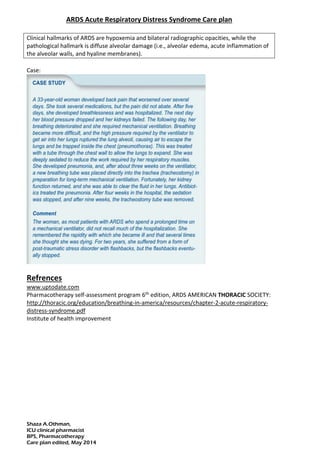
Clinical hallmarks of ARDS are hypoxemia and bilateral radiographic opacities, while the
pathological hallmark is diffuse alveolar damage (i.e., alveolar edema, acute inflammation of
the alveolar walls, and hyaline membranes).
Case:
Refrences
www.uptodate.com
Pharmacotherapy self-assessment program 6th edition, ARDS AMERICAN THORACIC SOCIETY:
http://thoracic.org/education/breathing-in-america/resources/chapter-2-acute-respiratory-
distress-syndrome.pdf
Institute of health improvement
Shaza A.Othman,
ICU clinical pharmacist
BPS, Pharmacotherapy
Care plan edited, May 2014
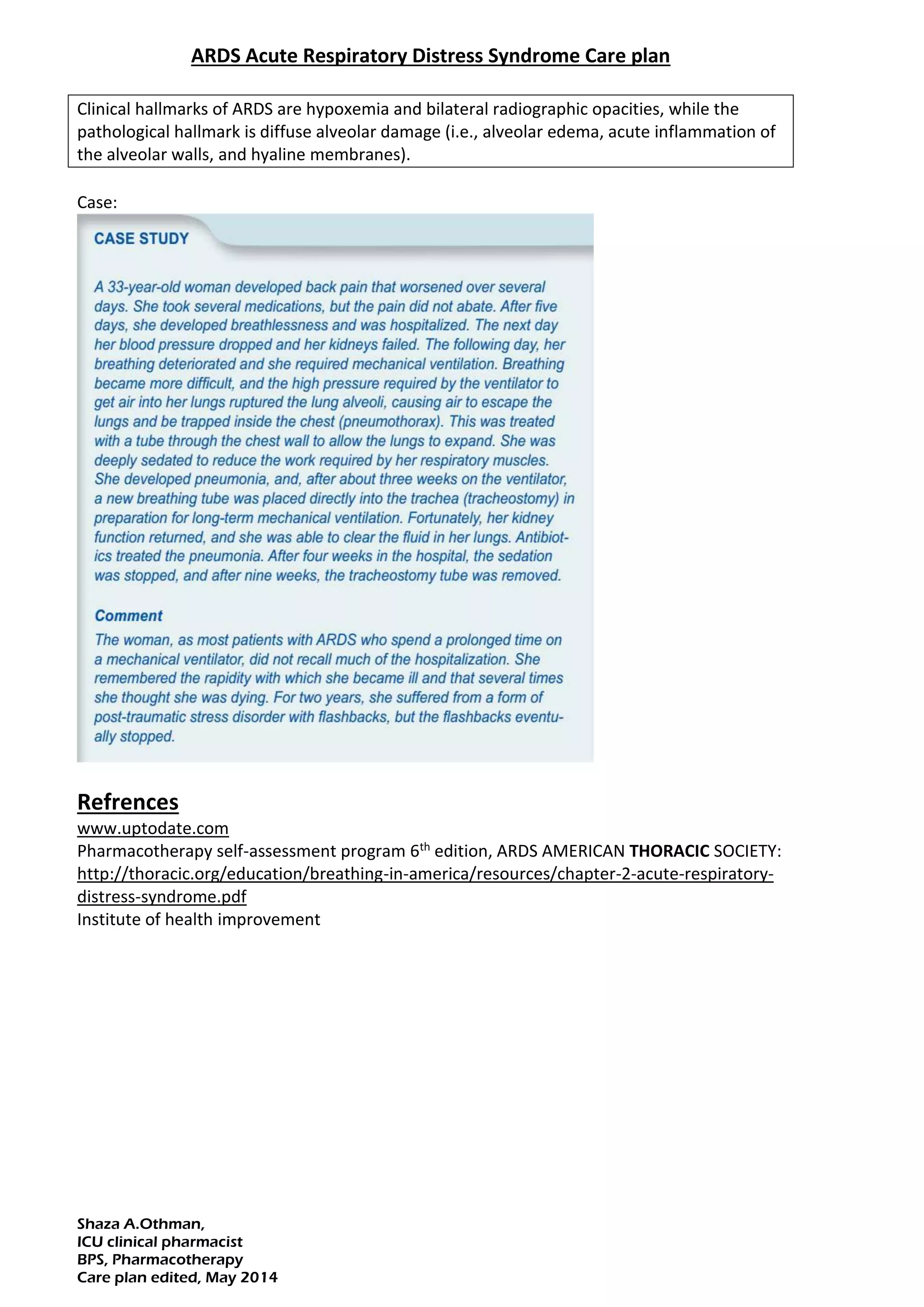
Medical Conditions or healthcare need: (Signs, symptoms, laboratory values)
Therapeutic goals: (acute goals of pharmacotherapy)
Monitoring parameters, desired endpoints, and frequency: (clinical parameters necessary to
evaluate the efficacy of the patient's therapy)
Monitoring parameters and follow up
 Respiratory distress is usually evident, including tachypnea, tachycardia, diaphoresis, and use of accessory
muscles of respiration. A cough and chest pain may also exist.
 Arterial blood gases reveal hypoxemia, often accompanied by acute respiratory alkalosis and an elevated
alveolar-arterial oxygen gradient
 Bilateral opacities consistent with pulmonary edema present on a chest radiograph
 Clinical findings related to the precipitant may also exist at presentation. As an example, in patients with
ARDS due to sepsis, there may be fever, hypotension, leukocytosis, lactic acidosis, and disseminated
intravascular coagulation (DIC)
1. SUPPORTIVE CARE and preventing 2ry complications:
 Improve tolerance of mechanical ventilation and decrease oxygen consumption , Sedation and analgesia can be useful
in patients with ARDS to the extent that they Paralysis,
 Nutritional needs to be met
 Glucose control,
 expeditious evaluation and treatment of nosocomial pneumonia
 DVT prophylaxis, GI prophylaxis,
 Preventing ventilator and venous access complications
 Optimize antimicrobial selection and dosing
2. MANAGEMENT OF HYPOXEMIA:
 Supplemental oxygen/ MV
 Fluid management, decreasing lung water / preload filling pressure PCWP, target a central venous pressure
of <4 mmHg or a pulmonary artery occlusion pressure <8 mmHg although it may be difficult
 Decrease oxygen consumption
 Lung protective ventilation targeting p plat of 30 cm H2O, low tidal volume is a standard of care
 Hemodynamic monitoring: guided by a central venous catheter (CVC)
 Observe and follow improvements in oxygenation by
1. following daily PF ratio
Worst PF ratio of the day regardless of PEEP should be used to assess improvement in
oxygenation, PF (Pao2/Fio2 ratio) improvement of 20 % or more during 48 hrs is considered a
significant response
2. Follow declining of Pplat and PPeak pressure on ventilator, pharmacist can identify
signs of improving lung compliance
Shaza A.Othman,
ICU clinical pharmacist
BPS, Pharmacotherapy
Care plan edited, May 2014
Therapeutic options (nondrug therapies /feasible pharmacotherapeutic alternatives
available for treatment)
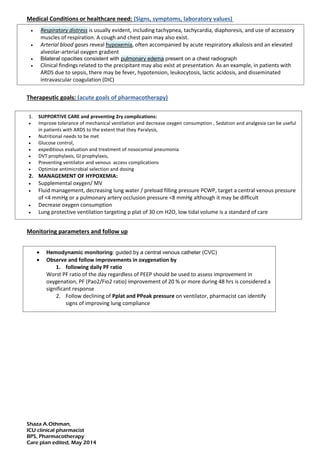
 Sedation: -
- Implement and follow up analog sedation protocol
- Long-acting relatively inexpensive agents such as lorazepam a logical choice
- Opioids (such as fentanyl or morphine) may be needed to treat pain. Opioids also provide synergy and may
decrease the amount of benzodiazepine required
 Beta-adrenergic agonist: High dose dose aersolised albuterol (salbutamol) >2200 mcg/day, should be
reserved for those with clinical evidence of bronchospasm(wheezing) or ventilator increased airflow
resistance
 Corticosteroides: While the effects of systemic glucocorticoids administered within the first two weeks of
ARDS are uncertain and require further study, systemic glucocorticoids administered two weeks or later
appear to be harmful. We suggest NOT administering systemic glucocorticoids to patients 14 days or longer
after the onset of ARDS (Grade 2C)
 In case of Ventilator associated pneumoniaVAP/HAP, treatment options are:
a. Early onset (less than 5 days) and no risk factors for multidrug-resistant (MDR)*
i. Third-generation cephalosporin (ceftriaxone)
ii. Fluoroquinolone(levofloxacin,moxifloxacin,ciprofloxacin)
iii. Ampicillin/sulbactam
iv. Ertapenem
b. Late onset (5 days or longer) or risk factors for MDR organisms.
i. Ceftazidime or cefepime plus aminoglycoside or fluoroquinolone (ciprofloxacin,levofloxacin)
ii. Imipenem, meropenem, or doripenem plus aminoglycoside or fluoroquinolone
iii. Piperacillin/tazobactam plus aminoglycoside orfluoroquinolone
iv. Vancomycin or linezolid should be added to the above regimens
only if MRSA risk factors
(e.g., history of MRSA infection/colonization, recent hospitalization or antibiotic use, presence of invasive health
care devices) are present or there is a high incidence locally (greater than 10%–15%).
c. Treatment duration—Efforts should be made to decrease therapy duration to as short as 7or8 days
(14 days for pneumonia secondary to P. aeruginosa).
Pharmacological antibiotic options:
 3.1a Aerosolized antibiotics
 3.1c Intravenous antibiotics alone

3.2 Oral antiseptic
 3.2a Chlorohexidine
 3.2b Povidone-Iodine
Shaza A.Othman,
ICU clinical pharmacist
BPS, Pharmacotherapy
Care plan edited, May 2014
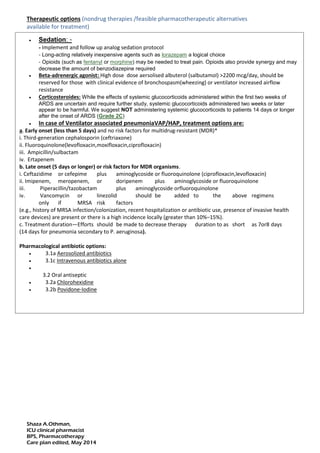
Optimal Plan: Recommendations and interventions:
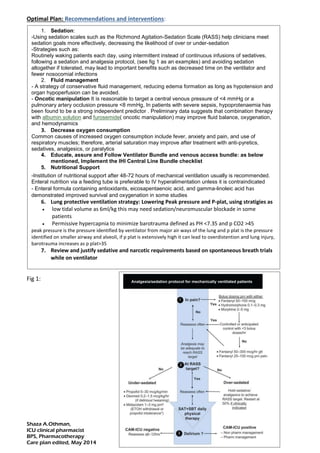
Fig 1:
1. Sedation:
-Using sedation scales such as the Richmond Agitation-Sedation Scale (RASS) help clinicians meet
sedation goals more effectively, decreasing the likelihood of over or under-sedation
-Strategies such as:
Routinely waking patients each day, using intermittent instead of continuous infusions of sedatives,
following a sedation and analgesia protocol, (see fig 1 as an examples) and avoiding sedation
altogether if tolerated, may lead to important benefits such as decreased time on the ventilator and
fewer nosocomial infections
2. Fluid management
- A strategy of conservative fluid management, reducing edema formation as long as hypotension and
organ hypoperfusion can be avoided.
- Oncotic manipulation It is reasonable to target a central venous pressure of <4 mmHg or a
pulmonary artery occlusion pressure <8 mmHg, In patients with severe sepsis, hypoprotenaemia has
been found to be a strong independent predictor . Preliminary data suggests that combination therapy
with albumin solution and furosemide( oncotic manipulation) may improve fluid balance, oxygenation,
and hemodynamics
3. Decrease oxygen consumption
Common causes of increased oxygen consumption include fever, anxiety and pain, and use of
respiratory muscles; therefore, arterial saturation may improve after treatment with anti-pyretics,
sedatives, analgesics, or paralytics
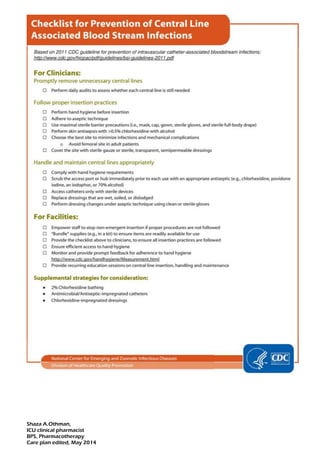
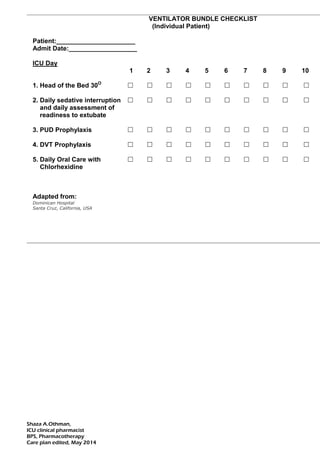
4. Educate, assure and Follow Ventilator Bundle and venous access bundle: as below
mentioned, Implement the IHI Central Line Bundle checklist
5. Nutritional Support
-Institution of nutritional support after 48-72 hours of mechanical ventilation usually is recommended.
Enteral nutrition via a feeding tube is preferable to IV hyperalimentation unless it is contraindicated
- Enteral formula containing antioxidants, eicosapentaenoic acid, and gamma-linoleic acid has
demonstrated improved survival and oxygenation in some studies
6. Lung protective ventilation strategy: Lowering Peak pressure and P-plat, using stratigies as
 low tidal volume as 6ml/kg this may need sedation/neuromuscular blockade in some
patients
 Permissive hypercapnia to minimize barotrauma defined as PH <7.35 and p CO2 >45
peak pressure is the pressure identified by ventilator from major air ways of the lung and p plat is the pressure
identified on smaller airway and alveoli, if p plat is extensively high it can lead to overdistention and lung injury,
barotrauma increases as p plat>35
7. Review and justify sedative and narcotic requirements based on spontaneous breath trials
while on ventilator
Shaza A.Othman,
ICU clinical pharmacist
BPS, Pharmacotherapy
Care plan edited, May 2014
Shaza A.Othman,
ICU clinical pharmacist
BPS, Pharmacotherapy
Care plan edited, May 2014
VENTILATOR BUNDLE CHECKLIST
(Individual Patient)
Patient:______________________
Admit Date:___________________
ICU Day
1 2 3 4 5 6 7 8 9 10
1. Head of the Bed 30O
         
2. Daily sedative interruption          
and daily assessment of
readiness to extubate
3. PUD Prophylaxis          
4. DVT Prophylaxis          
5. Daily Oral Care with          
Chlorhexidine
Adapted from:
Dominican Hospital
Santa Cruz, California, USA

Ards

  • 1.
    Shaza A.Othman, ICU clinicalpharmacist BPS, Pharmacotherapy Care plan edited, May 2014 ARDS Acute Respiratory Distress Syndrome Care plan Clinical hallmarks of ARDS are hypoxemia and bilateral radiographic opacities, while the pathological hallmark is diffuse alveolar damage (i.e., alveolar edema, acute inflammation of the alveolar walls, and hyaline membranes). Case: Refrences www.uptodate.com Pharmacotherapy self-assessment program 6th edition, ARDS AMERICAN THORACIC SOCIETY: http://thoracic.org/education/breathing-in-america/resources/chapter-2-acute-respiratory- distress-syndrome.pdf Institute of health improvement
  • 2.
    Shaza A.Othman, ICU clinicalpharmacist BPS, Pharmacotherapy Care plan edited, May 2014 Medical Conditions or healthcare need: (Signs, symptoms, laboratory values) Therapeutic goals: (acute goals of pharmacotherapy) Monitoring parameters, desired endpoints, and frequency: (clinical parameters necessary to evaluate the efficacy of the patient's therapy) Monitoring parameters and follow up  Respiratory distress is usually evident, including tachypnea, tachycardia, diaphoresis, and use of accessory muscles of respiration. A cough and chest pain may also exist.  Arterial blood gases reveal hypoxemia, often accompanied by acute respiratory alkalosis and an elevated alveolar-arterial oxygen gradient  Bilateral opacities consistent with pulmonary edema present on a chest radiograph  Clinical findings related to the precipitant may also exist at presentation. As an example, in patients with ARDS due to sepsis, there may be fever, hypotension, leukocytosis, lactic acidosis, and disseminated intravascular coagulation (DIC) 1. SUPPORTIVE CARE and preventing 2ry complications:  Improve tolerance of mechanical ventilation and decrease oxygen consumption , Sedation and analgesia can be useful in patients with ARDS to the extent that they Paralysis,  Nutritional needs to be met  Glucose control,  expeditious evaluation and treatment of nosocomial pneumonia  DVT prophylaxis, GI prophylaxis,  Preventing ventilator and venous access complications  Optimize antimicrobial selection and dosing 2. MANAGEMENT OF HYPOXEMIA:  Supplemental oxygen/ MV  Fluid management, decreasing lung water / preload filling pressure PCWP, target a central venous pressure of <4 mmHg or a pulmonary artery occlusion pressure <8 mmHg although it may be difficult  Decrease oxygen consumption  Lung protective ventilation targeting p plat of 30 cm H2O, low tidal volume is a standard of care  Hemodynamic monitoring: guided by a central venous catheter (CVC)  Observe and follow improvements in oxygenation by 1. following daily PF ratio Worst PF ratio of the day regardless of PEEP should be used to assess improvement in oxygenation, PF (Pao2/Fio2 ratio) improvement of 20 % or more during 48 hrs is considered a significant response 2. Follow declining of Pplat and PPeak pressure on ventilator, pharmacist can identify signs of improving lung compliance
  • 3.
    Shaza A.Othman, ICU clinicalpharmacist BPS, Pharmacotherapy Care plan edited, May 2014 Therapeutic options (nondrug therapies /feasible pharmacotherapeutic alternatives available for treatment)  Sedation: - - Implement and follow up analog sedation protocol - Long-acting relatively inexpensive agents such as lorazepam a logical choice - Opioids (such as fentanyl or morphine) may be needed to treat pain. Opioids also provide synergy and may decrease the amount of benzodiazepine required  Beta-adrenergic agonist: High dose dose aersolised albuterol (salbutamol) >2200 mcg/day, should be reserved for those with clinical evidence of bronchospasm(wheezing) or ventilator increased airflow resistance  Corticosteroides: While the effects of systemic glucocorticoids administered within the first two weeks of ARDS are uncertain and require further study, systemic glucocorticoids administered two weeks or later appear to be harmful. We suggest NOT administering systemic glucocorticoids to patients 14 days or longer after the onset of ARDS (Grade 2C)  In case of Ventilator associated pneumoniaVAP/HAP, treatment options are: a. Early onset (less than 5 days) and no risk factors for multidrug-resistant (MDR)* i. Third-generation cephalosporin (ceftriaxone) ii. Fluoroquinolone(levofloxacin,moxifloxacin,ciprofloxacin) iii. Ampicillin/sulbactam iv. Ertapenem b. Late onset (5 days or longer) or risk factors for MDR organisms. i. Ceftazidime or cefepime plus aminoglycoside or fluoroquinolone (ciprofloxacin,levofloxacin) ii. Imipenem, meropenem, or doripenem plus aminoglycoside or fluoroquinolone iii. Piperacillin/tazobactam plus aminoglycoside orfluoroquinolone iv. Vancomycin or linezolid should be added to the above regimens only if MRSA risk factors (e.g., history of MRSA infection/colonization, recent hospitalization or antibiotic use, presence of invasive health care devices) are present or there is a high incidence locally (greater than 10%–15%). c. Treatment duration—Efforts should be made to decrease therapy duration to as short as 7or8 days (14 days for pneumonia secondary to P. aeruginosa). Pharmacological antibiotic options:  3.1a Aerosolized antibiotics  3.1c Intravenous antibiotics alone  3.2 Oral antiseptic  3.2a Chlorohexidine  3.2b Povidone-Iodine
  • 4.
    Shaza A.Othman, ICU clinicalpharmacist BPS, Pharmacotherapy Care plan edited, May 2014 Optimal Plan: Recommendations and interventions: Fig 1: 1. Sedation: -Using sedation scales such as the Richmond Agitation-Sedation Scale (RASS) help clinicians meet sedation goals more effectively, decreasing the likelihood of over or under-sedation -Strategies such as: Routinely waking patients each day, using intermittent instead of continuous infusions of sedatives, following a sedation and analgesia protocol, (see fig 1 as an examples) and avoiding sedation altogether if tolerated, may lead to important benefits such as decreased time on the ventilator and fewer nosocomial infections 2. Fluid management - A strategy of conservative fluid management, reducing edema formation as long as hypotension and organ hypoperfusion can be avoided. - Oncotic manipulation It is reasonable to target a central venous pressure of <4 mmHg or a pulmonary artery occlusion pressure <8 mmHg, In patients with severe sepsis, hypoprotenaemia has been found to be a strong independent predictor . Preliminary data suggests that combination therapy with albumin solution and furosemide( oncotic manipulation) may improve fluid balance, oxygenation, and hemodynamics 3. Decrease oxygen consumption Common causes of increased oxygen consumption include fever, anxiety and pain, and use of respiratory muscles; therefore, arterial saturation may improve after treatment with anti-pyretics, sedatives, analgesics, or paralytics 4. Educate, assure and Follow Ventilator Bundle and venous access bundle: as below mentioned, Implement the IHI Central Line Bundle checklist 5. Nutritional Support -Institution of nutritional support after 48-72 hours of mechanical ventilation usually is recommended. Enteral nutrition via a feeding tube is preferable to IV hyperalimentation unless it is contraindicated - Enteral formula containing antioxidants, eicosapentaenoic acid, and gamma-linoleic acid has demonstrated improved survival and oxygenation in some studies 6. Lung protective ventilation strategy: Lowering Peak pressure and P-plat, using stratigies as  low tidal volume as 6ml/kg this may need sedation/neuromuscular blockade in some patients  Permissive hypercapnia to minimize barotrauma defined as PH <7.35 and p CO2 >45 peak pressure is the pressure identified by ventilator from major air ways of the lung and p plat is the pressure identified on smaller airway and alveoli, if p plat is extensively high it can lead to overdistention and lung injury, barotrauma increases as p plat>35 7. Review and justify sedative and narcotic requirements based on spontaneous breath trials while on ventilator
  • 5.
    Shaza A.Othman, ICU clinicalpharmacist BPS, Pharmacotherapy Care plan edited, May 2014
  • 6.
    Shaza A.Othman, ICU clinicalpharmacist BPS, Pharmacotherapy Care plan edited, May 2014 VENTILATOR BUNDLE CHECKLIST (Individual Patient) Patient:______________________ Admit Date:___________________ ICU Day 1 2 3 4 5 6 7 8 9 10 1. Head of the Bed 30O           2. Daily sedative interruption           and daily assessment of readiness to extubate 3. PUD Prophylaxis           4. DVT Prophylaxis           5. Daily Oral Care with           Chlorhexidine Adapted from: Dominican Hospital Santa Cruz, California, USA