FST 415: VEGETABLE
PROCESSING
• Vegetables are the edible portion of plants eaten with (or as) the
main course. They are in salads and soups.
• Ranked next to the cereal crops wheat, rice, and corn, potatoes
are the most prolific vegetable crop grown for human
• Vegetables may be processed into beverages or vegetable
starches, eaten fresh or lightly processed, dried, pickled, or
frozen.
• They impart their own characteristic flavor, color, and texture to
diets and undergo changes during storage and cooking.
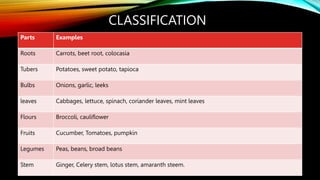
CLASSIFICATION
Parts Examples
Roots Carrots, beet root, colocasia
Tubers Potatoes, sweet potato, tapioca
Bulbs Onions, garlic, leeks
leaves Cabbages, lettuce, spinach, coriander leaves, mint leaves
Flours Broccoli, cauliflower
Fruits Cucumber, Tomatoes, pumpkin
Legumes Peas, beans, broad beans
Stem Ginger, Celery stem, lotus stem, amaranth steem.
REASONS FOR PROCESSING AND STORAGE OF VEGETABLES
• i) to extend the availability of fresh produce in
the market,
• (ii) to ensure continuous supply of quality raw material to the
processors,
• (iii) to extend the length of the processing season,
• (iv) to hold raw material obtained during favorable price
situations,
• (v) to condition certain commodities such as potatoes, onions,
and garlic,
PREPROCESSING OPERATION
• SELECTION
• The desirable characteristics of different vegetables is as follows:- • Beans : tender, fresh,
crisp, clean, firm velvety to touch, seeds, should be less than half grown, should break
easily with sharp sound.
• Cabbage: fresh, should be compact, no insect holes, no yellow or withered
leaves.
• Carrots: firm, fresh, smooth, yellow orange in colour, there should not be any wilted, soft
or flabby portion.
• Cauliflower: compact, no insect, fine heads, tender green leaves, should not be rough,
flowers should not be spread out. The flowers should not be yellow.
• Greens: tender, fresh dark bright green, no holes in the leaves, no withered leaves, not with
too much water, no soft portion of leaves.
• Greens should be crisp and stems should be thin.
• Tomatoes: bright red in colour, firm, should not be soft, plump body with uniform red
colour, no holes, no over ripened, no cracks.ours indicates over maturity.
• Peeling and stringing:
• These methods involve the removal of non-edible or fibrous portion of fruits or vegetables.
• It may be done (a) by hand ;(b) with steam 7 or boiling water ;(c) with lye or alkalis (NaOH,
KOH) ; and (d) by mechanical means.
• Peeling facilitates the operation of cutting the raw material into pieces or into slices before
processing.
• Cleaning and Washing
• The main goals of cleaning are
• (i) to eliminate surface dirt and soil particles and contaminants,
• (ii) to remove residues of pesticides, fertilizers, and chemicals used
during production,
• (iii) to reduce the microbial load, and
• (iv) to enhance the appearance of the produce.
• Cleaning can be accomplished using air (dry) or water (washing).
• Dry brushing with or without air blast may be used to remove loose
scales, soil, or dust in products such as onions, garlic, potato, sweet
potato, cantaloupes, and melons.
• The effectiveness of the washing depends on the amount of water used,
characteristics of water (acidity, hardness, mineral content, temperature,
and the initial level of contamination), force applied, use of brushing
and rubbing aids, etc.
• Washing is not an effective method for removing fungi from the
infected tissues and may even predispose produce to decay organisms
and deplete the protective wax layer.
• Washing may also lead to a water-soaked appearance and moisture
penetration, which may aid in pathogen access through the wounds.
• This is the reason why strawberries, mushrooms, cucumber, and cherries
are not generally washed.
• Coating and Waxing
• Presence of surface wax is a natural defense mechanism in fruits and vegetables
against water loss and invasion from pests and disease-causing organisms.
• Rough handling, approaching senescence, and washing deplete natural waxes.
• Surface coating using wax or hydrophobic substances has been used since ancient
times to improve the appeal and acceptability by the consumer, and the ease of
packing and handling; and to extend the shelf life by reducing weight (water) loss.
Retention of color, firmness, and flavor and the prevention of loss of weight result
from
• (i) reduction in the rates of respiration and transpiration,
• (ii) protection from insects, pests, and fungi that cause diseases and deterioration,
(iii) generation of a local modified atmosphere,
• (iv) protection from mechanical injuries, and
• v) curing tiny injuries and scratches on the surface
• However, coating may not be always favorable as modification of the internal
atmosphere can reduce the available oxygen leading to fermentation, which
can be precluded by only a thin layer of wax to allow gas exchange through it.
• Commercial formulations used in coating consist of long-chain fatty alcohols,
synthetic resins, chitosans, and other sugar derivatives as active coating
agents, and substances to assist in coating, for example, emulsifying and
wetting agents.
• Commonly used waxes for coatings are Carnauba, Shellac, Candelilia, beeswax,
paraffin wax, and vegetable oils.
• Cooling
• After harvest, the most immediate concern is
• reducing the temperature to preserve product quality.
• Rapidly cooling many types of fresh
fruits and vegetables to refrigeration temper-
atures will decrease water loss and reduce
both the rate of respiration and the rate of
ethylene production which will, in turn, slow
the ripening process with these lower tem-
peratures also minimizing the growth of
both spoilage and pathogenic bacteria.
• Commonly used commercial cooling methods which vary for different
types of fruits and vegetables in-clude refrigerated storage rooms
with appro-priate air circulation (e.g., tomatoes, apples,berries), forced
air cooling (e.g., tomatoes, berries , peppers), vacuum cooling (e.g.,
leafygreens, peppers), hydrocooling (e.g., leafy greens, cantaloupes,
peppers, carrots, aspara-gus), and packing in ice (e.g., asparagus,
• broccoli).
• However, both spoilage an pathogenic bacteria can still betransmitted
via air, condensate, and waterdroplets.
•
• Ethylene removal through active packaging
• Ethylene Removal
• Ethylene, a plant hormone, affects physiological processes of ripening and senescence,
which signals cell death.
• Exposure to ethylene (1 ppm) can reduce the postharvest life of many fruits and vegetables
by hastening the onset and increasing the rate of senescence,
softening, and loss of green color.
• Damaged or diseased fruits produce more ethylene and have catalytic effect in
stimulating thefollowing symptoms: softening of tissues, discoloration, bitterness due
to production of isocoumarins in carrots, russet spotting in lettuce, browning of
tissues in vegetables such as eggplant, sweet potatoes, sprouting of potatoes,
development of woodiness in asparagus, shattering of berries such as
blackberries and raspberries, loss of green color in vegetables, and stimulation of
growth of fungi (Penicillium italicum in oranges, Botrytis cineria on strawberries).
• MODIFIED ATMOSPHERE PACKAGING The normal composition of air is
78 percent nitrogen, 21 percent oxygen, 0.03 percent carbon dioxide
and traces of noble gases.
• MAP(modified atmosphere packaging) is the method for extending the
shelf life of perishable and semi-perishable food products by altering
the relative proportions of atmospheric gases that surround the food.
• One common method is to adjust the permeability of the packaging to
match the respiration of the vegetables so that oxygen and carbon
dioxide inside is optimally maintained
• . The proportion of oxygen inside the package has to be lower than in
air and of carbon dioxide higher. Such a mixture reduces the rate of
respiration, inhibits the synthesis and retards microbial growth.

Vegetables Preprocessing lecture guides.

  • 1.
  • 2.
    • Vegetables arethe edible portion of plants eaten with (or as) the main course. They are in salads and soups. • Ranked next to the cereal crops wheat, rice, and corn, potatoes are the most prolific vegetable crop grown for human • Vegetables may be processed into beverages or vegetable starches, eaten fresh or lightly processed, dried, pickled, or frozen. • They impart their own characteristic flavor, color, and texture to diets and undergo changes during storage and cooking.
  • 3.
    CLASSIFICATION Parts Examples Roots Carrots,beet root, colocasia Tubers Potatoes, sweet potato, tapioca Bulbs Onions, garlic, leeks leaves Cabbages, lettuce, spinach, coriander leaves, mint leaves Flours Broccoli, cauliflower Fruits Cucumber, Tomatoes, pumpkin Legumes Peas, beans, broad beans Stem Ginger, Celery stem, lotus stem, amaranth steem.
  • 4.
    REASONS FOR PROCESSINGAND STORAGE OF VEGETABLES • i) to extend the availability of fresh produce in the market, • (ii) to ensure continuous supply of quality raw material to the processors, • (iii) to extend the length of the processing season, • (iv) to hold raw material obtained during favorable price situations, • (v) to condition certain commodities such as potatoes, onions, and garlic,
  • 5.
    PREPROCESSING OPERATION • SELECTION •The desirable characteristics of different vegetables is as follows:- • Beans : tender, fresh, crisp, clean, firm velvety to touch, seeds, should be less than half grown, should break easily with sharp sound. • Cabbage: fresh, should be compact, no insect holes, no yellow or withered leaves. • Carrots: firm, fresh, smooth, yellow orange in colour, there should not be any wilted, soft or flabby portion. • Cauliflower: compact, no insect, fine heads, tender green leaves, should not be rough, flowers should not be spread out. The flowers should not be yellow. • Greens: tender, fresh dark bright green, no holes in the leaves, no withered leaves, not with too much water, no soft portion of leaves. • Greens should be crisp and stems should be thin. • Tomatoes: bright red in colour, firm, should not be soft, plump body with uniform red colour, no holes, no over ripened, no cracks.ours indicates over maturity.
  • 6.
    • Peeling andstringing: • These methods involve the removal of non-edible or fibrous portion of fruits or vegetables. • It may be done (a) by hand ;(b) with steam 7 or boiling water ;(c) with lye or alkalis (NaOH, KOH) ; and (d) by mechanical means. • Peeling facilitates the operation of cutting the raw material into pieces or into slices before processing.
  • 7.
    • Cleaning andWashing • The main goals of cleaning are • (i) to eliminate surface dirt and soil particles and contaminants, • (ii) to remove residues of pesticides, fertilizers, and chemicals used during production, • (iii) to reduce the microbial load, and • (iv) to enhance the appearance of the produce. • Cleaning can be accomplished using air (dry) or water (washing).
  • 8.
    • Dry brushingwith or without air blast may be used to remove loose scales, soil, or dust in products such as onions, garlic, potato, sweet potato, cantaloupes, and melons. • The effectiveness of the washing depends on the amount of water used, characteristics of water (acidity, hardness, mineral content, temperature, and the initial level of contamination), force applied, use of brushing and rubbing aids, etc. • Washing is not an effective method for removing fungi from the infected tissues and may even predispose produce to decay organisms and deplete the protective wax layer. • Washing may also lead to a water-soaked appearance and moisture penetration, which may aid in pathogen access through the wounds. • This is the reason why strawberries, mushrooms, cucumber, and cherries are not generally washed.
  • 9.
    • Coating andWaxing • Presence of surface wax is a natural defense mechanism in fruits and vegetables against water loss and invasion from pests and disease-causing organisms. • Rough handling, approaching senescence, and washing deplete natural waxes. • Surface coating using wax or hydrophobic substances has been used since ancient times to improve the appeal and acceptability by the consumer, and the ease of packing and handling; and to extend the shelf life by reducing weight (water) loss. Retention of color, firmness, and flavor and the prevention of loss of weight result from • (i) reduction in the rates of respiration and transpiration, • (ii) protection from insects, pests, and fungi that cause diseases and deterioration, (iii) generation of a local modified atmosphere, • (iv) protection from mechanical injuries, and • v) curing tiny injuries and scratches on the surface
  • 10.
    • However, coatingmay not be always favorable as modification of the internal atmosphere can reduce the available oxygen leading to fermentation, which can be precluded by only a thin layer of wax to allow gas exchange through it. • Commercial formulations used in coating consist of long-chain fatty alcohols, synthetic resins, chitosans, and other sugar derivatives as active coating agents, and substances to assist in coating, for example, emulsifying and wetting agents. • Commonly used waxes for coatings are Carnauba, Shellac, Candelilia, beeswax, paraffin wax, and vegetable oils.
  • 11.
    • Cooling • Afterharvest, the most immediate concern is • reducing the temperature to preserve product quality. • Rapidly cooling many types of fresh fruits and vegetables to refrigeration temper- atures will decrease water loss and reduce both the rate of respiration and the rate of ethylene production which will, in turn, slow the ripening process with these lower tem- peratures also minimizing the growth of both spoilage and pathogenic bacteria.
  • 12.
    • Commonly usedcommercial cooling methods which vary for different types of fruits and vegetables in-clude refrigerated storage rooms with appro-priate air circulation (e.g., tomatoes, apples,berries), forced air cooling (e.g., tomatoes, berries , peppers), vacuum cooling (e.g., leafygreens, peppers), hydrocooling (e.g., leafy greens, cantaloupes, peppers, carrots, aspara-gus), and packing in ice (e.g., asparagus, • broccoli). • However, both spoilage an pathogenic bacteria can still betransmitted via air, condensate, and waterdroplets. •
  • 13.
    • Ethylene removalthrough active packaging • Ethylene Removal • Ethylene, a plant hormone, affects physiological processes of ripening and senescence, which signals cell death. • Exposure to ethylene (1 ppm) can reduce the postharvest life of many fruits and vegetables by hastening the onset and increasing the rate of senescence, softening, and loss of green color. • Damaged or diseased fruits produce more ethylene and have catalytic effect in stimulating thefollowing symptoms: softening of tissues, discoloration, bitterness due to production of isocoumarins in carrots, russet spotting in lettuce, browning of tissues in vegetables such as eggplant, sweet potatoes, sprouting of potatoes, development of woodiness in asparagus, shattering of berries such as blackberries and raspberries, loss of green color in vegetables, and stimulation of growth of fungi (Penicillium italicum in oranges, Botrytis cineria on strawberries).
  • 14.
    • MODIFIED ATMOSPHEREPACKAGING The normal composition of air is 78 percent nitrogen, 21 percent oxygen, 0.03 percent carbon dioxide and traces of noble gases. • MAP(modified atmosphere packaging) is the method for extending the shelf life of perishable and semi-perishable food products by altering the relative proportions of atmospheric gases that surround the food. • One common method is to adjust the permeability of the packaging to match the respiration of the vegetables so that oxygen and carbon dioxide inside is optimally maintained • . The proportion of oxygen inside the package has to be lower than in air and of carbon dioxide higher. Such a mixture reduces the rate of respiration, inhibits the synthesis and retards microbial growth.