SUBMITTED BY
S.THIRUMOORTHY
I M.TECH (FOOD TECHNOLOGY)
FST 505 FOOD PROCESSING
MICROWAVE AND
RADIOFREQUENCY PROCESSING
MICROWAVE PROCESSING
Definition
 Microwaves are defined as a part of electromagnetic waves
which have frequency range between 300 MHz and 300 GHz.
 The word Microwave means very short wave, which is the
shortest wavelength region of the radio spectrum and a part of
the electromagnetic spectrum.
 Microwave frequencies of 915 MHz and 2.45 GHz can be
utilized for industrial, scientific, and medical applications.
 Microwaves have been applied in a broad range of food
processing such as drying, tempering, blanching, cooking,
pasteurization, sterilization, and baking.
Microwave generation
 The microwaves are generated by special
oscillator tubes called "Magnetrons and
Kystron”.
 These are devices that convert low
frequency electrical energy into hundreds
and thousands of megacycles.
Basic structure of microwave oven
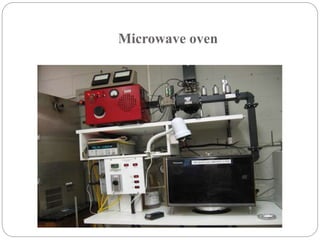
Microwave oven
Microwave oven generally consists of the following basic
components
(i) power supply and control: it controls the power to be fed to the
magnetron as well as the cooking time;
(ii) magnetron: it is a vacuum tube in which electrical energy is
converted to an oscillating electromagnetic field.
(iii) waveguide: it is a rectangular metal tube which directs the
microwaves generated from the magnetron to the cooking
cavity. It helps prevent direct exposure of the magnetron to
food.
(iv) stirrer: it is commonly used to distribute microwaves
from the waveguide and allow more uniform heating of
food
(v) turntable: it rotates the food products inside the cooking
cavity and allows the food products to be evenly exposed
to microwaves
(vi) cooking cavity: it is a space inside which the food is
heated when exposed to microwaves
(vii) door and choke: it allows the access of food to the
cooking cavity. They prevent microwaves from leaking
through the gap between the door and the cooking cavity.
Mechanism of microwave heating
 Heating with microwave frequency involves primarily two mechanisms
dielectric and ionic.
 Water in the food is often the primary component responsible for
dielectric heating.
 Due to their dipolar nature, water molecules try to follow the electric
field associated with electromagnetic radiation as it oscillates at the
very high frequency. Such oscillation of trip molecules produces heat.
 The second major mechanism of heating with microwave frequency is
through the oscillatory migration of ions in the food that generate heat
under the influence of the oscillating electric field. Kinetic energy is ac-
tually imparted to the ions by the electric field so that the field is
alternating rapidly heat.
 Microwaves penetrate materials and release their energy in the form of
heat as the polar molecules (ones with positively and negatively
charged ends - such as water) vibrate at high frequency to align
themselves with the frequency of the microwave field.
MICROWAVE HEATING RATE
13
 Microwave heating rate can be varied depending on dielectric
properties of food.
 The dielectric properties describe the ability of a material to absorb,
transmit, and reflect electromagnetic energy.
 Dielectric properties can be defined as:
 ε =ε '− jε "
 where ε is the dielectric properties
 ε’ the dielectric constant
 ε” the dielectric loss factor
 The dielectric constant (ε’) is associated to the material’s
capability to store electric energy (for vacuum ε’=1), while the
dielectric loss factor (ε”) is related to dissipation of electric energy
due to different mechanisms.
Advantages
 Speedy: microwave cookers heat food more quickly than any
other conventional oven.
 Smell free: because food is contained within the cooker cavity
 Easy to use: once controls and cooking techniques are mastered,
microwave cookers are extremely easy to use.
 Higher capacity: due to shorter residence time
 Less space requirement by up to 50-90% against other methods
 Better hygiene of working environment
 Easier and faster maintenance
 Savings of electric energy in comparison with conventional
methods are frequently within the range of 25-50%.
 Waste elimination and lower consumption of fossil fuels, causing
lowering of environmental stress.
Disadvantages
 Because of speed, and the way in which microwave energy
cooks, food cooked in a microwave oven will not be brown,
so no crust formation or browning in case of bread or meat
(in such cases microwave with grilling can be used).
 High initial cost.
 Short cooking time does not allow flavors to develop and
this makes food unacceptable.
Applications
 Pasteurizing
 Puffing and foaming
 Tempering of frozen foods
 Dehydration of low moisture solids
 Enzyme inactivation (blanching)
 Freeze drying
 Baking
 Curing
 Thawing
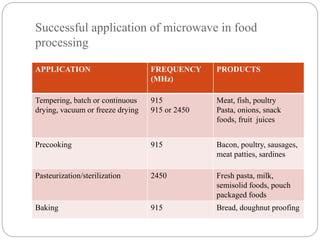
Successful application of microwave in food
processing
APPLICATION FREQUENCY
(MHz)
PRODUCTS
Tempering, batch or continuous
drying, vacuum or freeze drying
915
915 or 2450
Meat, fish, poultry
Pasta, onions, snack
foods, fruit juices
Precooking 915 Bacon, poultry, sausages,
meat patties, sardines
Pasteurization/sterilization 2450 Fresh pasta, milk,
semisolid foods, pouch
packaged foods
Baking 915 Bread, doughnut proofing
RADIO FREQUENCY HEATING
Introduction
 Radio frequency (RF) heating is an advanced and emerging
technology for food application.
 Radio frequency (RF) is known as high frequency dielectric
heating refer to the heating of dielectric material (water) with
electromagnetic energy at frequency between 1 to 300 MHz
 It have higher penetration power than microwave.
 Prime goal- food preservation by ensuring its safety and
quality.
History of radio frequency heating
 RF heating was first used in 1895 as a medical treatment
method.
 In food processing, its was first explored for blanching and
then for cooking and dehydrating.
 In the 1960s, many attempts were made to use RF to thaw
frozen foods.
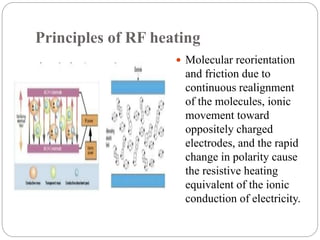
Principles of RF heating
 Molecular reorientation
and friction due to
continuous realignment
of the molecules, ionic
movement toward
oppositely charged
electrodes, and the rapid
change in polarity cause
the resistive heating
equivalent of the ionic
conduction of electricity.
Radiofrequency equipment
 Generator : for the generation of RF
waves.
 Applicator : For the application of RF
power to the food; main part is the
electrodes.
 The shape of the electrodes determine the
shape of the generated field; rod electrodes
and plate electrodes are commonly used.
 The electric field strength is determined by
the frequency, applied voltage and
distance of the electrodes.
 The distance of the electrodes is limited by
the applied voltage.
 The maximum electrode distance and thus
the maximum product thickness is
determined by the necessity to avoid
arcing between the electrodes.
Mechanism
 The electromagnetic energy transfers directly into the product
therefore it induce volumetric heating due to frictional
interaction between molecules.
 In RF heating the food is placed between two capacitor plates
or electrodes. It plays the role of a dielectric where a high
frequency alternating electric field is applied.
 Such field will force polar molecules (water) to constantly
realign themselves with the electric field.
 This molecular movement is very fast due to the high
frequency of the field.
 It will cause for the generation of heat within the food by
energy dissipation caused by molecular friction.
Difference between RF heating and Microwave heating
Radio frequency heating Microwave heating
Lower frequency(1-300MHz)
and high penetration depth.
Higher frequency(300 MHz-30
GHz) and low penetration.
One Directional heating All directional heating.
Generally 10-15MHz frequency
range used in industry for food
heating.
Generally 915-2450 MHz
frequency range used in
industry for food heating.
RF Penetration depths
At 27.12 MHz- 20cm
MW Penetration depths
At 915MHz- 8 to 22cm
At 2450MHz- 3-8 cm
Factors influencing RF heating
 Dielectric Properties
Dielectric properties of food materials can be divided
into two parts.
 Permeability
 Permittivity (𝜖)
 Permeability- It shows free space and are not assumed to
contribute to heating.
 Permittivity (𝜖) - Reported in terms of dielectric constant(𝜖′)
and loss factor(𝜖′′) influences the heating rates.
(Permittivity)𝜖 = 𝜖′ − j𝜖′′
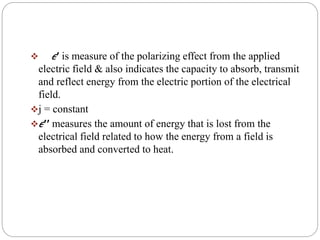
 𝜖′ is measure of the polarizing effect from the applied
electric field & also indicates the capacity to absorb, transmit
and reflect energy from the electric portion of the electrical
field.
j = constant
𝜖′′ measures the amount of energy that is lost from the
electrical field related to how the energy from a field is
absorbed and converted to heat.
 Dielectric properties also influences by
Moisture content
Frequency of applied alternating field
Temperature and chemical composition of the material
 Another physical factors also affect the RF heating systems
such as
 Shape of product
 Geometry and
 Product position
Advantages of using RF in food processing
 Radio Frequency heating and drying benefits over conventional
heating and drying methods:
 Faster heating and reduces drying times
 More uniform heating and drying
 High efficiency
 Selective heating
 Energy efficiency
 Contactless heating
 Deep penetration heating.
 Avoiding overheating on the surface of the product
Disadvantages of using RF in food
processing
 Equipment and operating cost:
 RF heating equipment is more expensive and operating cost is
higher than conventional convection, radiation or steam heating
systems.
 It is also more expensive than an equivalent ohmic heating
system.
Similarities between RF and MW heating
 RF and MW heating are rapid and volumetric.
 RF waves and MWs transfer to treated products by
radiation.
 RF and MW heating takes place due to the polarisation
effect of the EM field radiation
 RF and MW systems are capable of instantaneously
applying and removing the heat source.
 MW systems have been recognized to be 50-70%
heating efficient in comparison with 10% efficiency
with conventional ovens.
 Both RF and MW heating are non- ionizing radiations.
Application of RF heating in food industry
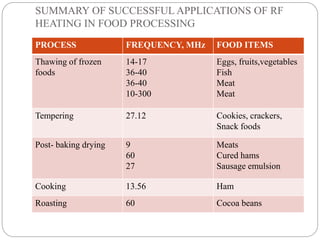
SUMMARY OF SUCCESSFUL APPLICATIONS OF RF
HEATING IN FOOD PROCESSING
PROCESS FREQUENCY, MHz FOOD ITEMS
Thawing of frozen
foods
14-17
36-40
36-40
10-300
Eggs, fruits,vegetables
Fish
Meat
Meat
Tempering 27.12 Cookies, crackers,
Snack foods
Post- baking drying 9
60
27
Meats
Cured hams
Sausage emulsion
Cooking 13.56 Ham
Roasting 60 Cocoa beans
Conclusion
 The industrial application of RF is still limited towards meat,
disinfection of agricultural commodities and post baking where
there is large potential source available in utilization RF
heating.
 RF power is provide a greater challenge to engineer to develop
large scale production unit for industrial application.
 RF heating system can take the modern market on food
processing without any reason of concern.
 Microwave heating has been established in a number of
industrial sectors such as Tempering, Blanching, Steaming,
Cooking, Puffing.
REFERENCE
34
 Microwave Applications in Thermal Food Processing, chapter
1,Mohamed S. Shaheen, Khaled F. El-Massry, Ahmed H. El-Ghorab
and Faqir M. Anjum
 Microwave (and RF) Heating in Food Processing
Applications,Juming Tang, Ph.D., Department of Biological Systems
Engineering, Washington State University, Pullman WA
 Microwave Sterilization Technology, Dr. Juming Tang, Professor of
Food Engineering, Dept. of Biological Systems Engineering,
Washington State University, Pullman
 Potentials of Microwave Heating Technology for Select Food
Processing Applications - a Brief Overview and Update,Pradeep
Puligundla1,4, Seerwan AAbdullah2, Won Choi3, Soojin Jun3, Sang-
Eun Oh4 and Sanghoon Ko1*1Department of Food Science and
Technology, Sejong University, 98 Gunja-dong, Gwangjin-gu, Seoul
143-747, Korea
 Microwave food processing—A review,S. Chandrasekaran, S.
Ramanathan, Tanmay Basak ,Department of Chemical Engineering,
Indian Institute of Technology Madras, Chennai 600 036, India

MICROWAVE AND RADIOFREQUENCY PROCESSING (1).pptx

  • 1.
    SUBMITTED BY S.THIRUMOORTHY I M.TECH(FOOD TECHNOLOGY) FST 505 FOOD PROCESSING MICROWAVE AND RADIOFREQUENCY PROCESSING
  • 2.
  • 3.
    Definition  Microwaves aredefined as a part of electromagnetic waves which have frequency range between 300 MHz and 300 GHz.  The word Microwave means very short wave, which is the shortest wavelength region of the radio spectrum and a part of the electromagnetic spectrum.  Microwave frequencies of 915 MHz and 2.45 GHz can be utilized for industrial, scientific, and medical applications.  Microwaves have been applied in a broad range of food processing such as drying, tempering, blanching, cooking, pasteurization, sterilization, and baking.
  • 7.
    Microwave generation  Themicrowaves are generated by special oscillator tubes called "Magnetrons and Kystron”.  These are devices that convert low frequency electrical energy into hundreds and thousands of megacycles.
  • 8.
    Basic structure ofmicrowave oven
  • 9.
  • 10.
    Microwave oven generallyconsists of the following basic components (i) power supply and control: it controls the power to be fed to the magnetron as well as the cooking time; (ii) magnetron: it is a vacuum tube in which electrical energy is converted to an oscillating electromagnetic field. (iii) waveguide: it is a rectangular metal tube which directs the microwaves generated from the magnetron to the cooking cavity. It helps prevent direct exposure of the magnetron to food.
  • 11.
    (iv) stirrer: itis commonly used to distribute microwaves from the waveguide and allow more uniform heating of food (v) turntable: it rotates the food products inside the cooking cavity and allows the food products to be evenly exposed to microwaves (vi) cooking cavity: it is a space inside which the food is heated when exposed to microwaves (vii) door and choke: it allows the access of food to the cooking cavity. They prevent microwaves from leaking through the gap between the door and the cooking cavity.
  • 12.
    Mechanism of microwaveheating  Heating with microwave frequency involves primarily two mechanisms dielectric and ionic.  Water in the food is often the primary component responsible for dielectric heating.  Due to their dipolar nature, water molecules try to follow the electric field associated with electromagnetic radiation as it oscillates at the very high frequency. Such oscillation of trip molecules produces heat.  The second major mechanism of heating with microwave frequency is through the oscillatory migration of ions in the food that generate heat under the influence of the oscillating electric field. Kinetic energy is ac- tually imparted to the ions by the electric field so that the field is alternating rapidly heat.  Microwaves penetrate materials and release their energy in the form of heat as the polar molecules (ones with positively and negatively charged ends - such as water) vibrate at high frequency to align themselves with the frequency of the microwave field.
  • 13.
    MICROWAVE HEATING RATE 13 Microwave heating rate can be varied depending on dielectric properties of food.  The dielectric properties describe the ability of a material to absorb, transmit, and reflect electromagnetic energy.  Dielectric properties can be defined as:  ε =ε '− jε "  where ε is the dielectric properties  ε’ the dielectric constant  ε” the dielectric loss factor  The dielectric constant (ε’) is associated to the material’s capability to store electric energy (for vacuum ε’=1), while the dielectric loss factor (ε”) is related to dissipation of electric energy due to different mechanisms.
  • 14.
    Advantages  Speedy: microwavecookers heat food more quickly than any other conventional oven.  Smell free: because food is contained within the cooker cavity  Easy to use: once controls and cooking techniques are mastered, microwave cookers are extremely easy to use.  Higher capacity: due to shorter residence time  Less space requirement by up to 50-90% against other methods  Better hygiene of working environment  Easier and faster maintenance  Savings of electric energy in comparison with conventional methods are frequently within the range of 25-50%.  Waste elimination and lower consumption of fossil fuels, causing lowering of environmental stress.
  • 15.
    Disadvantages  Because ofspeed, and the way in which microwave energy cooks, food cooked in a microwave oven will not be brown, so no crust formation or browning in case of bread or meat (in such cases microwave with grilling can be used).  High initial cost.  Short cooking time does not allow flavors to develop and this makes food unacceptable.
  • 16.
    Applications  Pasteurizing  Puffingand foaming  Tempering of frozen foods  Dehydration of low moisture solids  Enzyme inactivation (blanching)  Freeze drying  Baking  Curing  Thawing
  • 17.
    Successful application ofmicrowave in food processing APPLICATION FREQUENCY (MHz) PRODUCTS Tempering, batch or continuous drying, vacuum or freeze drying 915 915 or 2450 Meat, fish, poultry Pasta, onions, snack foods, fruit juices Precooking 915 Bacon, poultry, sausages, meat patties, sardines Pasteurization/sterilization 2450 Fresh pasta, milk, semisolid foods, pouch packaged foods Baking 915 Bread, doughnut proofing
  • 18.
  • 19.
    Introduction  Radio frequency(RF) heating is an advanced and emerging technology for food application.  Radio frequency (RF) is known as high frequency dielectric heating refer to the heating of dielectric material (water) with electromagnetic energy at frequency between 1 to 300 MHz  It have higher penetration power than microwave.  Prime goal- food preservation by ensuring its safety and quality.
  • 20.
    History of radiofrequency heating  RF heating was first used in 1895 as a medical treatment method.  In food processing, its was first explored for blanching and then for cooking and dehydrating.  In the 1960s, many attempts were made to use RF to thaw frozen foods.
  • 21.
    Principles of RFheating  Molecular reorientation and friction due to continuous realignment of the molecules, ionic movement toward oppositely charged electrodes, and the rapid change in polarity cause the resistive heating equivalent of the ionic conduction of electricity.
  • 22.
    Radiofrequency equipment  Generator: for the generation of RF waves.  Applicator : For the application of RF power to the food; main part is the electrodes.  The shape of the electrodes determine the shape of the generated field; rod electrodes and plate electrodes are commonly used.  The electric field strength is determined by the frequency, applied voltage and distance of the electrodes.  The distance of the electrodes is limited by the applied voltage.  The maximum electrode distance and thus the maximum product thickness is determined by the necessity to avoid arcing between the electrodes.
  • 23.
    Mechanism  The electromagneticenergy transfers directly into the product therefore it induce volumetric heating due to frictional interaction between molecules.  In RF heating the food is placed between two capacitor plates or electrodes. It plays the role of a dielectric where a high frequency alternating electric field is applied.  Such field will force polar molecules (water) to constantly realign themselves with the electric field.  This molecular movement is very fast due to the high frequency of the field.  It will cause for the generation of heat within the food by energy dissipation caused by molecular friction.
  • 24.
    Difference between RFheating and Microwave heating Radio frequency heating Microwave heating Lower frequency(1-300MHz) and high penetration depth. Higher frequency(300 MHz-30 GHz) and low penetration. One Directional heating All directional heating. Generally 10-15MHz frequency range used in industry for food heating. Generally 915-2450 MHz frequency range used in industry for food heating. RF Penetration depths At 27.12 MHz- 20cm MW Penetration depths At 915MHz- 8 to 22cm At 2450MHz- 3-8 cm
  • 25.
    Factors influencing RFheating  Dielectric Properties Dielectric properties of food materials can be divided into two parts.  Permeability  Permittivity (𝜖)  Permeability- It shows free space and are not assumed to contribute to heating.  Permittivity (𝜖) - Reported in terms of dielectric constant(𝜖′) and loss factor(𝜖′′) influences the heating rates. (Permittivity)𝜖 = 𝜖′ − j𝜖′′
  • 26.
     𝜖′ ismeasure of the polarizing effect from the applied electric field & also indicates the capacity to absorb, transmit and reflect energy from the electric portion of the electrical field. j = constant 𝜖′′ measures the amount of energy that is lost from the electrical field related to how the energy from a field is absorbed and converted to heat.
  • 27.
     Dielectric propertiesalso influences by Moisture content Frequency of applied alternating field Temperature and chemical composition of the material  Another physical factors also affect the RF heating systems such as  Shape of product  Geometry and  Product position
  • 28.
    Advantages of usingRF in food processing  Radio Frequency heating and drying benefits over conventional heating and drying methods:  Faster heating and reduces drying times  More uniform heating and drying  High efficiency  Selective heating  Energy efficiency  Contactless heating  Deep penetration heating.  Avoiding overheating on the surface of the product
  • 29.
    Disadvantages of usingRF in food processing  Equipment and operating cost:  RF heating equipment is more expensive and operating cost is higher than conventional convection, radiation or steam heating systems.  It is also more expensive than an equivalent ohmic heating system.
  • 30.
    Similarities between RFand MW heating  RF and MW heating are rapid and volumetric.  RF waves and MWs transfer to treated products by radiation.  RF and MW heating takes place due to the polarisation effect of the EM field radiation  RF and MW systems are capable of instantaneously applying and removing the heat source.  MW systems have been recognized to be 50-70% heating efficient in comparison with 10% efficiency with conventional ovens.  Both RF and MW heating are non- ionizing radiations.
  • 31.
    Application of RFheating in food industry
  • 32.
    SUMMARY OF SUCCESSFULAPPLICATIONS OF RF HEATING IN FOOD PROCESSING PROCESS FREQUENCY, MHz FOOD ITEMS Thawing of frozen foods 14-17 36-40 36-40 10-300 Eggs, fruits,vegetables Fish Meat Meat Tempering 27.12 Cookies, crackers, Snack foods Post- baking drying 9 60 27 Meats Cured hams Sausage emulsion Cooking 13.56 Ham Roasting 60 Cocoa beans
  • 33.
    Conclusion  The industrialapplication of RF is still limited towards meat, disinfection of agricultural commodities and post baking where there is large potential source available in utilization RF heating.  RF power is provide a greater challenge to engineer to develop large scale production unit for industrial application.  RF heating system can take the modern market on food processing without any reason of concern.  Microwave heating has been established in a number of industrial sectors such as Tempering, Blanching, Steaming, Cooking, Puffing.
  • 34.
    REFERENCE 34  Microwave Applicationsin Thermal Food Processing, chapter 1,Mohamed S. Shaheen, Khaled F. El-Massry, Ahmed H. El-Ghorab and Faqir M. Anjum  Microwave (and RF) Heating in Food Processing Applications,Juming Tang, Ph.D., Department of Biological Systems Engineering, Washington State University, Pullman WA  Microwave Sterilization Technology, Dr. Juming Tang, Professor of Food Engineering, Dept. of Biological Systems Engineering, Washington State University, Pullman  Potentials of Microwave Heating Technology for Select Food Processing Applications - a Brief Overview and Update,Pradeep Puligundla1,4, Seerwan AAbdullah2, Won Choi3, Soojin Jun3, Sang- Eun Oh4 and Sanghoon Ko1*1Department of Food Science and Technology, Sejong University, 98 Gunja-dong, Gwangjin-gu, Seoul 143-747, Korea  Microwave food processing—A review,S. Chandrasekaran, S. Ramanathan, Tanmay Basak ,Department of Chemical Engineering, Indian Institute of Technology Madras, Chennai 600 036, India