Egg powder
Egg powder
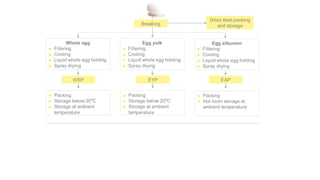
• An egg consists of 3 main parts: the shell (10%), the albumen or egg white (60%) and the yolk (30%). An average
egg weighs about 55-60 gram. Egg, in full or parts, is used to prepare powder used in different industries:
Whole egg powder (WEP) is used in classical food applications where rising qualities are
not essential, such as crackers, cookies and pasta.
Egg yolk powder (EYP) is used as a substitute for fresh egg yolk to obtain colour, texture, and
emulsion capacity. Egg yolk powder is most frequently used in mayonnaise, dressings, sauces and croissants.
Egg albumen powders (EAP) is used in a range of items from fish, meat, and potato
preparations to bakery and pastry products.
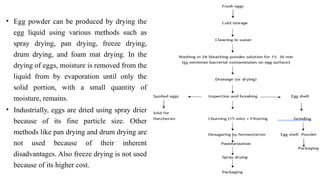
• Egg powder can be produced by drying the
egg liquid using various methods such as
spray drying, pan drying, freeze drying,
drum drying, and foam mat drying. In the
drying of eggs, moisture is removed from the
liquid from by evaporation until only the
solid portion, with a small quantity of
moisture, remains.
• Industrially, eggs are dried using spray drier
because of its fine particle size. Other
methods like pan drying and drum drying are
not used because of their inherent
disadvantages. Also freeze drying is not used
because of its higher cost.
• PREPARING EGG FOR DRYING
Eggs are drawn from the cold storage room to the holding room. After that Eggs are examined for their quality
attributes. For this purpose Flash handler is used. During examination spoiled eggs are removed and sold for
hatcheries. After examine eggs are going to washing section. In this section water is sprayed at higher force for
clean the surface dust free and avoid microbial growth. After washing it was going to drying. Here hot air was
passed and eggs are dried.
• DESUGARING
The cleaned eggs are going for breaking. The egg breaker, break 30,000 eggs per hour and separate the egg yolk and
white and collected in separate tanks. After this, egg liquid is going for desugarization. This is done by to prevent
maillard reaction. The activated dry yeast at 0.5% of egg liquid was added to egg mélange. Fermentation was
carried out at 36°C for 90 min
PASTEURIZATION
•After Desugaring pasteurization is done. This is achieved by heating at a minimum temperature of 64.4°C for at
least 2.5 min. This time/ temperature relationship effectively destroys all pathogens and reduces total bacterial
counts to a low level. After pasteurization, the egg is cooled to below 4°C to spray drying.
• SPRAY DRYING
•Spray drying is the most important method of producing dried egg products. In spray drying, the liquid is finally
atomized into a stream of hot air. Because of the enormous surface area created by atomization, evaporation of
water is very rapid. Although this system is simple, the complete system of the component parts is rather complex.
The spray drying technology involves:
I. feed concentration before spray drying process;
II. feed atomization to create the favorable conditions for feed evaporation to a dried
powdered product having desirable characteristics;
III. in the chamber air-droplet contact, the liquid which is atomized brought in contact
with hot gases, which results in 95% evaporation of the water remained in the
droplets within a few seconds;
IV. the drying of droplets and evaporation of moisture takes place in 2 stages, a) rate of
evaporation is relatively constant during the first stage and there is sufficient
moisture in the drop to replace the liquid evaporated at the surface (Keey and
Pham, 1976), and b) the second moisture evaporation stage begins when there is no
longer enough moisture to maintain saturated conditions at the droplet surface,
causing a dried shell to form at the surface. The rate of evaporation depends on
moisture diffusion through the shell, which increases in thickness as the evaporation
proceeds. The final step in a conventional spray drying process is
V. Separation stage; in this use of cyclones, bag filters, and electrostatic precipitators
are used
• PACKAGING
•For this commercial use, dried egg products are generally packed in fiber drums with polythene liner.
• PRODUCTS FROM EGG LIQUID
 Whole egg powder
 Egg white powder
 Egg yolk powder
• ADVANTAGES OF EGG POWDER
 They can be stored at low cost under dry storage or refrigeration with reduced space requirement.
 Transportation cost is low because water has been removed.
 They are easy and clean to use.
 They can be used in and are necessary for the many new convenience foods
Utilization of whole egg powder in bakery Products:
Within the bakery sector, increased competition, in combination with
evolving expectations of the consumer, particularly regarding convenience and
health, has continued to effect trend of market. Consumers of today are expecting
improvements and developments in manufactured product.
Most important characteristic specifications of products include a longer
shelf life, a fresh appearance, convenience tastiness, crunchiness, healthiness and,
of course, a lower price. In baking industry, ingredients work in collaboration to
obtain the desired texture and structure of bakery products (Abdullah, 2008).
PACKAGING CONTAMINATION
• The presence of Salmonella contamination in egg-packing plants
presents a contamination hazard for eggs from Salmonella-free flocks.
• Egg-packing plants must be registered and must be suitably
constructed to permit proper cleaning and disinfection (ACMSF 2001
), but there appears to be no readily available evidence of the
effectiveness of these procedures and on many of the farms visited in
this study, there was no formal arrangement for cleaning and
disinfection.
• it was observed that packing plants where eggs had travelled a long
distance on conveyor systems were less contaminated than plants
where shorter distances were involved.
• Egg trays have also been shown to be contaminated in other studies (
Viora et al. 1993),
The egg-packing process involves various levels of mechanized equipment similar to
that operating in a food-processing environment. In these systems, formation of
bacterial biofilms on equipment, particularly plastic but also stainless steel
equipment, is a problem (Carpentier and Cerf 1993; Joseph et al. 2001).
Organisms incorporated in these biofilms are partially protected from disinfectants
and other noxious agents .
It is difficult to raise standards of cleaning by training alone (Ehiri et al. 1997)
so improvements in the design of equipment, perhaps including a whole-room
fumigation capacity, would be desirable.
There may, however, be negative aspects involved in wet cleaning of egg-handling
equipment unless it can be thoroughly dried before re-use.
The results of the current study suggest that creating a moist environment,
even in the presence of disinfectant, may increase the contamination rate of
eggs, probably by increasing the adherence of material from the packing
equipment to eggshells.
A moist environment may also encourage the growth of coliform organisms (Rusin
et al. 1998) and poor cleaning technique, especially when pressure washers are
used, may disseminate contamination more widely (Scott and Bloomfield 1990).
Food-grade disinfectants such as hypochlorites may persist well on
surfaces (Mariscal et al. 1999; Rossoni and Gaylarde 2000) but are
more likely to be inhibited by residual organic matter, particularly
adherent egg albumen (Gutierrez et al. 1995).
Disinfectant products also vary considerably within a chemical group (
Ahlstrom et al. 1999) and on-site trials with a chosen product are
required to be sure that it will be effective (Taylor et al. 1999).
Disinfectants must be directly applied to all surfaces to be effective, and
techniques such as fogging with non-fuming disinfectants only achieve
a good effect on horizontal surfaces, rather than vertical or less
accessible surfaces (Anon. 1998).
Packing environment as dry as possible is preferable, but effective
cleaning and disinfection followed by full drying should be carried out
as frequently as is practicable. It is possible that in the future, treatment
of eggs with non-toxic substances such as ultra-violet light, electrolysed
oxidizing water or antibacterial herbal extracts
Eggs arriving at weighing and packing machine Weighing and packing machine
• 1. Eggs enter the packing/storage room. Eggs from production are brought into the
packing/storage facility. Eggs can be brought in by hand or by conveyor belt. In intensive
egg production, the birds lay eggs that roll out of the cage onto conveyor belts, which
transport the eggs directly to the packing/storage facilities.
• 2. Temporary storage room. Here eggs are stored temporarily before they are moved
to the candling room.
• 3. Candling room. Eggs are brought into the candling room, where candlers verify the
interior and external quality of eggs. represent candling benches. The candling machine
in fully mechanized or semi-mechanized systems, where the eggs are brought onto the
candling machine by a conveyor belt.
• 4. Cleaning/weighing room. After candling, eggs are transported by conveyor belts to
the cleaning/weighing room. Here eggs are cleaned with abrasives, where possible, and
sorted by weight. Usually the size indicates which category eggs should fall into - small,
medium or large. This can be done by hand; however, automated weighing machinery is
available.
• 5. Packaging area. After weighing, the eggs are taken to the packaging area.. Each
machine is set to pack only predetermined egg weights. For example, machine No.1
packs only 60-gram eggs. If the eggs are below that weight, they will be conveyed to
machine No. 2 . The eggs are then packed automatically.
Spoilage of egg
• The egg is very perishable and the quality can be severely reduced during
the time of storage (i.e. both chemical changes or non-microbial spoilage
and microbial spoilage).
• The changes occurring in the egg are affected by the environmental
conditions, temperature, moisture, the material used for packaging, and
storage time.
• Their high water content (74 %) and high nutrient content make them
susceptible to microbial spoilage.
• When an egg is broken it loses all its antimicrobial property which makes it
prone to microbial spoilage.
Non-microbial spoilage of eggs:
• These include loss of moisture and hence loss of weight during long
term storage.
• Change in physical state of egg contents also occur during long term
storage.
• They include thinning of egg white and breaking of yolk membrane.
• As the yolk membrane weaken and break, yolk becomes flat and
homogenously mixed in egg white.
Microbial spoilage of eggs:
• In order to cause spoilage of shell of egg, microorganisms must
contaminate the shell, penetrate through the pores in shell and inner
membrane, reach the eggwhite and yolk and grow there.
• Some microorganisms cannot grow in egg white but can grow rapidly
in egg yolk.
• Change in storage temperature facilitates penetration of organism
through shell and hence facilitates microbial spoilage.
Bacterial spoilage of egg:
• Bacteria are more common spoilage organism than mold.
• Bacteria cause rots in egg.
• When bacteria grow within the egg, they decompose the content and form byproduct.
• This result in characteristic odor, appearance or color from which various microorganisms acquire their name:
• Green rot:
• It is caused by Pseudomonas fluorescence.
• Green egg white shows fluorescence when exposed to UV light.
• In later stage of spoilage, egg yolk disintegrates and mask green color of egg white.
• Odor is lacking or fruity or sweetish.
• Colorless rot:
• It may be caused by Pseudomonas, Acetobacter, Acinatobacter and coliform.
• In later stage of spoilage, egg yolk disintegrates or at least have incrustations.
• Black rot:
• It is caused by Proteus and sometimes Pseudomonas and aeromonas.
• Egg yolk blackens and then breakdown to give whole egg content muddy brown color.
• Odor is putrified due to H2S.
• Pink rot:
• It is caused by Pseudomonas usually at the later stage of green rot.
• They are similar to colorless rot except that pink coloration occurs in yolk and white.
• Red rot:
• It is caused by Serrotia marcesceus.
• These eggs are distinguished by a rod dissociation of egg white and the surface of the yolk in ammonical i.e. putrified odor.
• Custard rot:
• In this rot, yolk is incrusted with custard like material and occasionally have green to olive pigment.
• The albumin become thin with orange coloration.
• This type of spoilage is caused by Citrobacter and Proteus vulgaris.
• Fungal spoilage of egg:
• Fungal spoilage goes through following stages:
• Pin spot molding:
• In this case, small compact colonies of mold appear on the shell and usually just inside
the shell.
• The color of pin spots varies with the type of mold. For example: Cladosporium give
black spot and Sporotrichum give pink spot.
• Superficial fungal spoilage:
• This occurs if eggs are stored in atmosphere of high humidity.
• In this case, molds grow on shell in the form of whiskers.
• Fungal rotting:
• It is the final stage of spoilage by mold.
• In this case, mycelium of the mold grows through the pores and cracks in the shell.
• Jellying of egg white may occur and colored spots may be produced.
• Hypha of mold grows through the yolk membrane and rupture it, so that yolk mixes
with the white.
• Molds causing spoilage of egg include Penicillium, Sporotrichum, Mucor,
Botrytis, Alternaria, Thamnidium etc.
GREEN ROT
PIN SPOT MOLDING
Sl. No Name of the Insecticide Food Maximum Residue Limit
(MRL) in mg/kg
1 2,4-Dichlorophenoxy Acetic
Acid
EGG 2,4-Dichlorophenoxy Acetic
Acid
2 Carbendazim EGG 0.1(shell free basis)
3 Edifenphos Eggs 0.01(shell free basis)
4 Ethion(Residues to be
determined as ethion and its
oxygen analogue and
expressed as ethion)
Eggs 0.2 (shell free basis)
5 Phenthoate Eggs 0.05 (shell free basis)
6 Phorate (sum of Phorate, its
oxygen analogue and their
sulphoxides and sulphones,
expressed as phorate)
Eggs 0.05 (shell free basis)
7 Pirimiphos-methyl Eggs 0.05 (shell free basis)
1.Residues
SL.NO Name of the antibiotics and veterinary
drugs
Food Tolerance limit (mg/Kg)
1 Colistin Eggs 0.3
2 Chlortetracycline/Oxytetracy
cline/Tetracycline
Eggs 0.4
3 Erythromycin Eggs 0.05
4 Spectinomycin Eggs 2
Antibiotics

egg powder processsing utilization production

  • 1.
  • 2.
    Egg powder • Anegg consists of 3 main parts: the shell (10%), the albumen or egg white (60%) and the yolk (30%). An average egg weighs about 55-60 gram. Egg, in full or parts, is used to prepare powder used in different industries: Whole egg powder (WEP) is used in classical food applications where rising qualities are not essential, such as crackers, cookies and pasta. Egg yolk powder (EYP) is used as a substitute for fresh egg yolk to obtain colour, texture, and emulsion capacity. Egg yolk powder is most frequently used in mayonnaise, dressings, sauces and croissants. Egg albumen powders (EAP) is used in a range of items from fish, meat, and potato preparations to bakery and pastry products.
  • 4.
    • Egg powdercan be produced by drying the egg liquid using various methods such as spray drying, pan drying, freeze drying, drum drying, and foam mat drying. In the drying of eggs, moisture is removed from the liquid from by evaporation until only the solid portion, with a small quantity of moisture, remains. • Industrially, eggs are dried using spray drier because of its fine particle size. Other methods like pan drying and drum drying are not used because of their inherent disadvantages. Also freeze drying is not used because of its higher cost.
  • 5.
    • PREPARING EGGFOR DRYING Eggs are drawn from the cold storage room to the holding room. After that Eggs are examined for their quality attributes. For this purpose Flash handler is used. During examination spoiled eggs are removed and sold for hatcheries. After examine eggs are going to washing section. In this section water is sprayed at higher force for clean the surface dust free and avoid microbial growth. After washing it was going to drying. Here hot air was passed and eggs are dried. • DESUGARING The cleaned eggs are going for breaking. The egg breaker, break 30,000 eggs per hour and separate the egg yolk and white and collected in separate tanks. After this, egg liquid is going for desugarization. This is done by to prevent maillard reaction. The activated dry yeast at 0.5% of egg liquid was added to egg mélange. Fermentation was carried out at 36°C for 90 min PASTEURIZATION •After Desugaring pasteurization is done. This is achieved by heating at a minimum temperature of 64.4°C for at least 2.5 min. This time/ temperature relationship effectively destroys all pathogens and reduces total bacterial counts to a low level. After pasteurization, the egg is cooled to below 4°C to spray drying. • SPRAY DRYING •Spray drying is the most important method of producing dried egg products. In spray drying, the liquid is finally atomized into a stream of hot air. Because of the enormous surface area created by atomization, evaporation of water is very rapid. Although this system is simple, the complete system of the component parts is rather complex.
  • 7.
    The spray dryingtechnology involves: I. feed concentration before spray drying process; II. feed atomization to create the favorable conditions for feed evaporation to a dried powdered product having desirable characteristics; III. in the chamber air-droplet contact, the liquid which is atomized brought in contact with hot gases, which results in 95% evaporation of the water remained in the droplets within a few seconds; IV. the drying of droplets and evaporation of moisture takes place in 2 stages, a) rate of evaporation is relatively constant during the first stage and there is sufficient moisture in the drop to replace the liquid evaporated at the surface (Keey and Pham, 1976), and b) the second moisture evaporation stage begins when there is no longer enough moisture to maintain saturated conditions at the droplet surface, causing a dried shell to form at the surface. The rate of evaporation depends on moisture diffusion through the shell, which increases in thickness as the evaporation proceeds. The final step in a conventional spray drying process is V. Separation stage; in this use of cyclones, bag filters, and electrostatic precipitators are used
  • 8.
    • PACKAGING •For thiscommercial use, dried egg products are generally packed in fiber drums with polythene liner. • PRODUCTS FROM EGG LIQUID  Whole egg powder  Egg white powder  Egg yolk powder • ADVANTAGES OF EGG POWDER  They can be stored at low cost under dry storage or refrigeration with reduced space requirement.  Transportation cost is low because water has been removed.  They are easy and clean to use.  They can be used in and are necessary for the many new convenience foods
  • 9.
    Utilization of wholeegg powder in bakery Products: Within the bakery sector, increased competition, in combination with evolving expectations of the consumer, particularly regarding convenience and health, has continued to effect trend of market. Consumers of today are expecting improvements and developments in manufactured product. Most important characteristic specifications of products include a longer shelf life, a fresh appearance, convenience tastiness, crunchiness, healthiness and, of course, a lower price. In baking industry, ingredients work in collaboration to obtain the desired texture and structure of bakery products (Abdullah, 2008).
  • 12.
    PACKAGING CONTAMINATION • Thepresence of Salmonella contamination in egg-packing plants presents a contamination hazard for eggs from Salmonella-free flocks. • Egg-packing plants must be registered and must be suitably constructed to permit proper cleaning and disinfection (ACMSF 2001 ), but there appears to be no readily available evidence of the effectiveness of these procedures and on many of the farms visited in this study, there was no formal arrangement for cleaning and disinfection. • it was observed that packing plants where eggs had travelled a long distance on conveyor systems were less contaminated than plants where shorter distances were involved. • Egg trays have also been shown to be contaminated in other studies ( Viora et al. 1993),
  • 13.
    The egg-packing processinvolves various levels of mechanized equipment similar to that operating in a food-processing environment. In these systems, formation of bacterial biofilms on equipment, particularly plastic but also stainless steel equipment, is a problem (Carpentier and Cerf 1993; Joseph et al. 2001). Organisms incorporated in these biofilms are partially protected from disinfectants and other noxious agents . It is difficult to raise standards of cleaning by training alone (Ehiri et al. 1997) so improvements in the design of equipment, perhaps including a whole-room fumigation capacity, would be desirable. There may, however, be negative aspects involved in wet cleaning of egg-handling equipment unless it can be thoroughly dried before re-use. The results of the current study suggest that creating a moist environment, even in the presence of disinfectant, may increase the contamination rate of eggs, probably by increasing the adherence of material from the packing equipment to eggshells. A moist environment may also encourage the growth of coliform organisms (Rusin et al. 1998) and poor cleaning technique, especially when pressure washers are used, may disseminate contamination more widely (Scott and Bloomfield 1990).
  • 14.
    Food-grade disinfectants suchas hypochlorites may persist well on surfaces (Mariscal et al. 1999; Rossoni and Gaylarde 2000) but are more likely to be inhibited by residual organic matter, particularly adherent egg albumen (Gutierrez et al. 1995). Disinfectant products also vary considerably within a chemical group ( Ahlstrom et al. 1999) and on-site trials with a chosen product are required to be sure that it will be effective (Taylor et al. 1999). Disinfectants must be directly applied to all surfaces to be effective, and techniques such as fogging with non-fuming disinfectants only achieve a good effect on horizontal surfaces, rather than vertical or less accessible surfaces (Anon. 1998). Packing environment as dry as possible is preferable, but effective cleaning and disinfection followed by full drying should be carried out as frequently as is practicable. It is possible that in the future, treatment of eggs with non-toxic substances such as ultra-violet light, electrolysed oxidizing water or antibacterial herbal extracts
  • 16.
    Eggs arriving atweighing and packing machine Weighing and packing machine
  • 17.
    • 1. Eggsenter the packing/storage room. Eggs from production are brought into the packing/storage facility. Eggs can be brought in by hand or by conveyor belt. In intensive egg production, the birds lay eggs that roll out of the cage onto conveyor belts, which transport the eggs directly to the packing/storage facilities. • 2. Temporary storage room. Here eggs are stored temporarily before they are moved to the candling room. • 3. Candling room. Eggs are brought into the candling room, where candlers verify the interior and external quality of eggs. represent candling benches. The candling machine in fully mechanized or semi-mechanized systems, where the eggs are brought onto the candling machine by a conveyor belt. • 4. Cleaning/weighing room. After candling, eggs are transported by conveyor belts to the cleaning/weighing room. Here eggs are cleaned with abrasives, where possible, and sorted by weight. Usually the size indicates which category eggs should fall into - small, medium or large. This can be done by hand; however, automated weighing machinery is available. • 5. Packaging area. After weighing, the eggs are taken to the packaging area.. Each machine is set to pack only predetermined egg weights. For example, machine No.1 packs only 60-gram eggs. If the eggs are below that weight, they will be conveyed to machine No. 2 . The eggs are then packed automatically.
  • 18.
    Spoilage of egg •The egg is very perishable and the quality can be severely reduced during the time of storage (i.e. both chemical changes or non-microbial spoilage and microbial spoilage). • The changes occurring in the egg are affected by the environmental conditions, temperature, moisture, the material used for packaging, and storage time. • Their high water content (74 %) and high nutrient content make them susceptible to microbial spoilage. • When an egg is broken it loses all its antimicrobial property which makes it prone to microbial spoilage.
  • 19.
    Non-microbial spoilage ofeggs: • These include loss of moisture and hence loss of weight during long term storage. • Change in physical state of egg contents also occur during long term storage. • They include thinning of egg white and breaking of yolk membrane. • As the yolk membrane weaken and break, yolk becomes flat and homogenously mixed in egg white.
  • 20.
    Microbial spoilage ofeggs: • In order to cause spoilage of shell of egg, microorganisms must contaminate the shell, penetrate through the pores in shell and inner membrane, reach the eggwhite and yolk and grow there. • Some microorganisms cannot grow in egg white but can grow rapidly in egg yolk. • Change in storage temperature facilitates penetration of organism through shell and hence facilitates microbial spoilage.
  • 21.
    Bacterial spoilage ofegg: • Bacteria are more common spoilage organism than mold. • Bacteria cause rots in egg. • When bacteria grow within the egg, they decompose the content and form byproduct. • This result in characteristic odor, appearance or color from which various microorganisms acquire their name: • Green rot: • It is caused by Pseudomonas fluorescence. • Green egg white shows fluorescence when exposed to UV light. • In later stage of spoilage, egg yolk disintegrates and mask green color of egg white. • Odor is lacking or fruity or sweetish. • Colorless rot: • It may be caused by Pseudomonas, Acetobacter, Acinatobacter and coliform. • In later stage of spoilage, egg yolk disintegrates or at least have incrustations. • Black rot: • It is caused by Proteus and sometimes Pseudomonas and aeromonas. • Egg yolk blackens and then breakdown to give whole egg content muddy brown color. • Odor is putrified due to H2S. • Pink rot: • It is caused by Pseudomonas usually at the later stage of green rot. • They are similar to colorless rot except that pink coloration occurs in yolk and white. • Red rot: • It is caused by Serrotia marcesceus. • These eggs are distinguished by a rod dissociation of egg white and the surface of the yolk in ammonical i.e. putrified odor. • Custard rot: • In this rot, yolk is incrusted with custard like material and occasionally have green to olive pigment. • The albumin become thin with orange coloration. • This type of spoilage is caused by Citrobacter and Proteus vulgaris.
  • 22.
    • Fungal spoilageof egg: • Fungal spoilage goes through following stages: • Pin spot molding: • In this case, small compact colonies of mold appear on the shell and usually just inside the shell. • The color of pin spots varies with the type of mold. For example: Cladosporium give black spot and Sporotrichum give pink spot. • Superficial fungal spoilage: • This occurs if eggs are stored in atmosphere of high humidity. • In this case, molds grow on shell in the form of whiskers. • Fungal rotting: • It is the final stage of spoilage by mold. • In this case, mycelium of the mold grows through the pores and cracks in the shell. • Jellying of egg white may occur and colored spots may be produced. • Hypha of mold grows through the yolk membrane and rupture it, so that yolk mixes with the white. • Molds causing spoilage of egg include Penicillium, Sporotrichum, Mucor, Botrytis, Alternaria, Thamnidium etc.
  • 24.
  • 26.
  • 27.
    Sl. No Nameof the Insecticide Food Maximum Residue Limit (MRL) in mg/kg 1 2,4-Dichlorophenoxy Acetic Acid EGG 2,4-Dichlorophenoxy Acetic Acid 2 Carbendazim EGG 0.1(shell free basis) 3 Edifenphos Eggs 0.01(shell free basis) 4 Ethion(Residues to be determined as ethion and its oxygen analogue and expressed as ethion) Eggs 0.2 (shell free basis) 5 Phenthoate Eggs 0.05 (shell free basis) 6 Phorate (sum of Phorate, its oxygen analogue and their sulphoxides and sulphones, expressed as phorate) Eggs 0.05 (shell free basis) 7 Pirimiphos-methyl Eggs 0.05 (shell free basis) 1.Residues
  • 28.
    SL.NO Name ofthe antibiotics and veterinary drugs Food Tolerance limit (mg/Kg) 1 Colistin Eggs 0.3 2 Chlortetracycline/Oxytetracy cline/Tetracycline Eggs 0.4 3 Erythromycin Eggs 0.05 4 Spectinomycin Eggs 2 Antibiotics