







LOGO

                                Chapter 7

       International Strategy:
                          Creating Value in
                            Global Markets


        Arriola, Alice Elaine
        Caparida, Regine
        Guintaran, Christy
        Hamelarin, Irene
        Igoy, Carolyn
Topics


 Why international expansion?
 Determinants of national competitive
  advantage.
 Motivations and risks of global expansion.
 Two opposing forces—cost reduction and
  adaptation to local markets.
 International Strategies.
 Entry strategies
Drivers of Globalization

 increased similarity of lifestyles
 global communications
 fast communication
 pressures to reduce costs
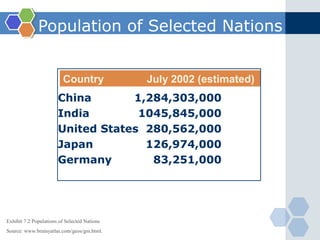
Population of Selected Nations


                          Country             July 2002 (estimated)
                       China       1,284,303,000
                       India        1045,845,000
                       United States 280,562,000
                       Japan         126,974,000
                       Germany        83,251,000


Exhibit 7.2 Populations of Selected Nations
Source: www.brainyatlas.com/geos/gm.html.
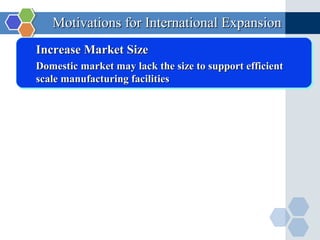
Motivations for International Expansion
Increase Market Size
Domestic market may lack the size to support efficient
scale manufacturing facilities
Motivations for International Expansion

Increase Market Size
Domestic market may lack the size to support efficient
scale manufacturing facilities
Japanese electronics or automobile manufacturers
Motivations for International Expansion

Increase Market Size
Domestic market may lack the size to support efficient
scale manufacturing facilities
    Japanese electronics or automobile manufacturers

Return on Investment
Large investment projects may require global markets to
justify the capital outlays
Motivations for International Expansion

Increase Market Size
Domestic market may lack the size to support efficient
scale manufacturing facilities
    Japanese electronics or automobile manufacturers

Return on Investment
Large investment projects may require global markets to
justify the capital outlays
   Aircraft manufacturers Boeing or Airbus
Motivations for International Expansion
Economies of Scale or Learning
Expanding size or scope of markets helps to achieve
economies of scale in manufacturing as well as
marketing, R & D or distribution
    - Can spread costs over a larger sales base
    - Increase profit per unit
Motives for Int’l Expansion
 Optimize the physical location for
  every activity in its value chain
   Performance enhancement
   Cost reduction
   Risk reduction
Porter’s Determinants of National Advantage


Home country of origin is crucial to
         International success
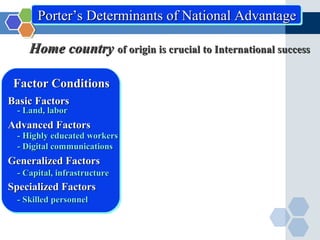
Porter’s Determinants of National Advantage

     Home country of origin is crucial to International success

 Factor Conditions
Basic Factors
  - Land, labor
Advanced Factors
  - Highly educated workers
  - Digital communications
Generalized Factors
  - Capital, infrastructure
Specialized Factors
  - Skilled personnel
Factor Conditions
 To achieve competitive advantage,
  factors of production must be created
    Industry specific
    Firm specific
    Pool of resources at a firm’s or country’s
     disposal is less important than the speed and
     efficiency with which the resources are
     deployed
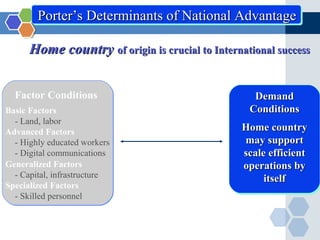
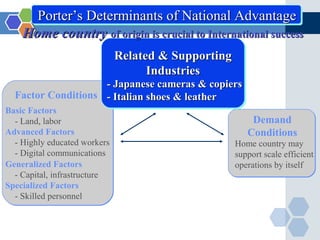
Porter’s Determinants of National Advantage

      Home country of origin is crucial to International success


  Factor Conditions                                 Demand
Basic Factors                                      Conditions
  - Land, labor
Advanced Factors                                 Home country
  - Highly educated workers                      may support
  - Digital communications                       scale efficient
Generalized Factors                              operations by
  - Capital, infrastructure                           itself
Specialized Factors
  - Skilled personnel
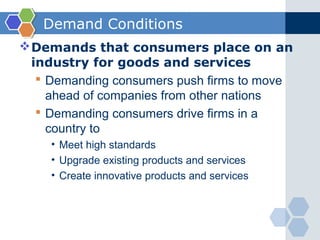
Demand Conditions
 Demands that consumers place on an
  industry for goods and services
    Demanding consumers push firms to move
     ahead of companies from other nations
    Demanding consumers drive firms in a
     country to
     • Meet high standards
     • Upgrade existing products and services
     • Create innovative products and services
Porter’s Determinants of National Advantage
    Home country of origin is crucial to International success
                              Related & Supporting
                                    Industries
                    - Japanese cameras & copiers
  Factor Conditions - Italian shoes & leather
Basic Factors
  - Land, labor                                          Demand
Advanced Factors                                        Conditions
  - Highly educated workers                          Home country may
  - Digital communications                           support scale efficient
Generalized Factors                                  operations by itself
  - Capital, infrastructure
Specialized Factors
  - Skilled personnel
Related and Supporting Industries
 Related and supporting industries
   Enable firms to manage inputs more
    effectively
     • Strong supplier base adds efficiency to
       downstream activities
     • Competitive supplier base lets a firm obtain inputs
       using cost-effective, timely methods
   Allow joint efforts among firms
   Create the probability that new entrants will
    enter the market
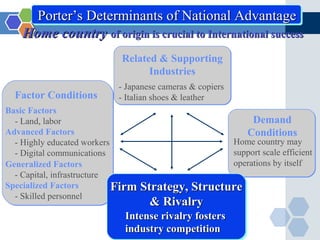
Porter’s Determinants of National Advantage
    Home country of origin is crucial to International success
                           Related & Supporting
                                 Industries
                          - Japanese cameras & copiers
  Factor Conditions       - Italian shoes & leather
Basic Factors
  - Land, labor                                        Demand
Advanced Factors                                     Conditions
  - Highly educated workers                       Home country may
  - Digital communications                        support scale efficient
Generalized Factors                               operations by itself
  - Capital, infrastructure
Specialized Factors         Firm Strategy, Structure
  - Skilled personnel
                                  & Rivalry
                            Intense rivalry fosters
                            industry competition
Firm Strategy, Structure and Rivalry

 Rivalry is intense in nations with
  conditions of
    Strong consumer demand
    Strong supplier bases
    High new entrant potential from related
     industries
 Competitive rivalry increases the
  efficiency with which firms develop,
  market, and distribute products and
  services within the home country
Firm Strategy, Structure and Rivalry

 Competitive rivalry increases the
  efficiency with which firms
   Develop within the home country
   Market within the home country
   Distribute products and services within the
    home country
Firm Strategy, Structure and Rivalry

 Domestic rivalry provides a strong
  impetus for firms to
    Innovate
    Find new sources of competitive advantage
 Domestic rivalry forces firms to look
  beyond national borders for new
  markets
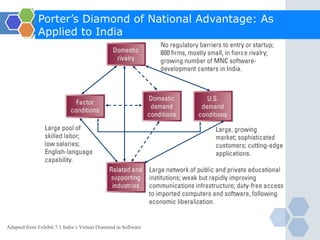
Porter’s Diamond of National Advantage: As
              Applied to India


Adapted from Exhibit 7.1 India’s Virtual Diamond in Software
Potential Risks of International Expansion


 Political and economic risk
   Social unrest
   Military turmoil
   Demonstrations
   Violent conflict and terrorism
   Laws and their enforcement
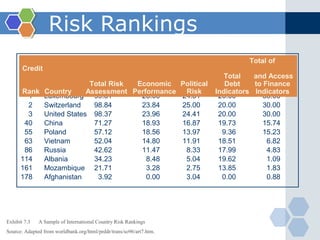
Risk Rankings
                                                                              Total of
       Credit
                                                                        Total   and Access
                         Total Risk Economic Political                  Debt    to Finance
      Rank Country      Assessment Performance Risk                  Indicators Indicators
        1  Luxembourg 99.51          25.00     24.51                  20.00        30.00
        2  Switzerland    98.84      23.84     25.00                  20.00        30.00
        3  United States 98.37       23.96     24.41                  20.00        30.00
       40  China          71.27      18.93     16.87                  19.73        15.74
       55  Poland         57.12      18.56     13.97                   9.36        15.23
       63  Vietnam        52.04      14.80     11.91                  18.51         6.82
       86  Russia         42.62      11.47      8.33                  17.99         4.83
      114  Albania        34.23        8.48     5.04                  19.62         1.09
      161  Mozambique 21.71            3.28     2.75                  13.85         1.83
      178  Afghanistan     3.92        0.00     3.04                   0.00         0.88


Exhibit 7.3   A Sample of International Country Risk Rankings
Source: Adapted from worldbank.org/html/prddr/trans/so96/art7.htm.
Potential Risks of International Expansion


 Currency risks
   Currency exchange fluctuations
   Appreciation of the U.S. dollar
 Management risks
   Culture          • Income levels
   Customs
                     • Customer preferences
   Language
                     • Distribution system
Strategy Implementation


                     Power distance (PD)

 Hofstede’s       Uncertainty avoidance (UA)
Dimensions of
   National     Individualism-collectivism (I-C)
   Culture
                 Masculinity-femininity (M-F)

                  Long-term orientation (LT)
Two Opposing Pressures: Reducing
    Costs and Adapting to Local Markets

 Strategies that favor global products
  and brands
   Should standardize all of a firm’s products for all
    of their worldwide markets
   Should reduce a firm’s overall costs by
    spreading investments over a larger market
Two Opposing Pressures: Reducing
   Costs and Adapting to Local Markets

 Strategies that favor global products
  and brands
   • Are based on three assumptions
      Customer needs and interests worldwide are
       becoming more homogeneous
      People (worldwide) prefer lower prices at high

       quality
      Economies of scale in production and marketing

       can be achieved through supplying global
       markets
Two Opposing Pressures: Reducing
   Costs and Adapting to Local Markets

 But those three assumptions may
  not always be true
   Product markets vary widely between nations
    (customer needs and interests?)
   In many product and service markets there appears
    to be a growing interest in multiple product features,
    quality and service (preference for low price?)
   Technology permits flexible production, cost of
    production may not be critical to product cost, and
    firm’s strategy should not be product-driven
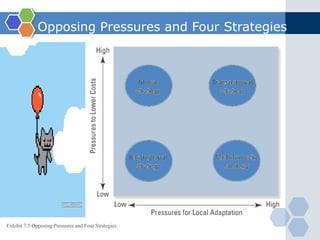
Opposing Pressures and Four Strategies


Exhibit 7.5 Opposing Pressures and Four Strategies
International Strategy
 Pressure for both local adaptation and
  low costs are rather low
 Different activities in the value chain
  have different optimal locations
 Susceptible to higher levels of
  currency and political risks
Global Strategy
 Competitive strategy is centralized
          and controlled largely by
  corporate office
 Emphasizes economies of scale
 Advantages
     Larger production plants
     Efficient logistics and distribution networks
     Supports high levels of investment in R&D
     Standard level of quality throughout the world
Global Strategy
 Competitive strategy is centralized and
   controlled largely by corporate office
 Emphasizes economies of scale
 Disadvantages
  • Concentration on scale-sensitive resources and
    activities in one or few locations leads to higher
    transportation and tariff costs
  • Activity is isolated from targeted markets
  • The rest of the firm becomes dependent on that
    geographically isolated location
Multidomestic Strategy
 Emphasis is differentiating
  products and services to adapt to
  local markets
 Authority is more decentralized
 Risks include
    Increased cost structure
    Potential problems with local adaptations
    Finding optimal degree of local adaptation is
     difficult
Transnational Strategy
 Optimization of tradeoffs associated
  with efficiency, local adaptation, and
  learning
 Firm’s assets and capabilities are
  dispersed according to the most
  beneficial location for a specific
  activity
 Avoids the tendency to either
   Concentrate activities in a central location
   Disperse them across many locations to enhance
    adaptation
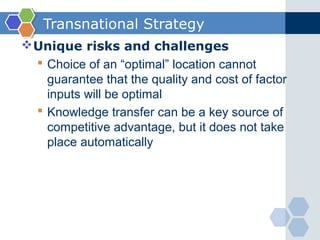
Transnational Strategy
 Unique risks and challenges
   Choice of an “optimal” location cannot
    guarantee that the quality and cost of factor
    inputs will be optimal
   Knowledge transfer can be a key source of
    competitive advantage, but it does not take
    place automatically
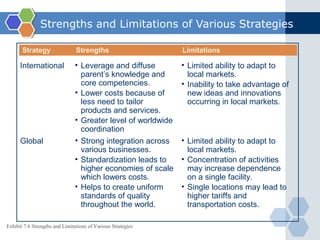
Strengths and Limitations of Various Strategies

       Strategy                 Strengths                      Limitations

      International             • Leverage and diffuse         • Limited ability to adapt to
                                  parent’s knowledge and         local markets.
                                  core competencies.           • Inability to take advantage of
                                • Lower costs because of         new ideas and innovations
                                  less need to tailor            occurring in local markets.
                                  products and services.
                                • Greater level of worldwide
                                  coordination
      Global                    • Strong integration across    • Limited ability to adapt to
                                  various businesses.            local markets.
                                • Standardization leads to     • Concentration of activities
                                  higher economies of scale      may increase dependence
                                  which lowers costs.            on a single facility.
                                • Helps to create uniform      • Single locations may lead to
                                  standards of quality           higher tariffs and
                                  throughout the world.          transportation costs.

Exhibit 7.6 Strengths and Limitations of Various Strategies
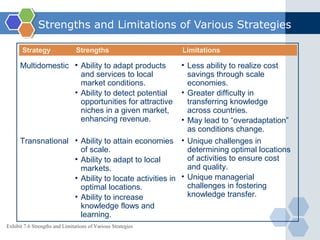
Strengths and Limitations of Various Strategies

       Strategy                 Strengths                         Limitations

      Multidomestic • Ability to adapt products                     • Less ability to realize cost
                      and services to local                           savings through scale
                      market conditions.                              economies.
                    • Ability to detect potential                   • Greater difficulty in
                      opportunities for attractive                    transferring knowledge
                      niches in a given market,                       across countries.
                      enhancing revenue.                            • May lead to “overadaptation”
                                                                      as conditions change.
      Transnational •               Ability to attain economies • Unique challenges in
                                    of scale.                         determining optimal locations
                                •   Ability to adapt to local         of activities to ensure cost
                                    markets.                          and quality.
                                •   Ability to locate activities in • Unique managerial
                                    optimal locations.                challenges in fostering
                                •   Ability to increase               knowledge transfer.
                                    knowledge flows and
                                    learning.
Exhibit 7.6 Strengths and Limitations of Various Strategies
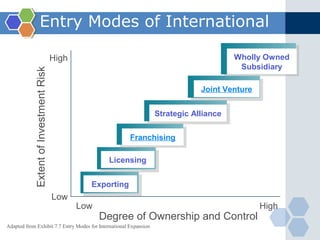
Entry Modes of International
                     Expansion
                                        High                                            Wholly Owned
                                                                                         Subsidiary
            Extent of Investment Risk


                                                                               Joint Venture


                                                                   Strategic Alliance

                                                             Franchising

                                                      Licensing


                                                 Exporting
                                        Low
                                               Low                                             High
                                                     Degree of Ownership and Control
Adapted from Exhibit 7.7 Entry Modes for International Expansion
Exporting
 Consists of producing goods n one
  country to sell in another.
 Beach Head Strategy
 Local Partnership
 Successful distributors
   Carry product lines that complement the
    multinational’s products
   Behave as if they are business partners with the
    multinationals.
   Invest in training, information systems, and
    advertising and promotion
Licensing and Franchising
 Franchisor receives a royalty or fee
 Franchisee gets to use trademark,
  patent, trade secret or other valuable
  intellectual property
 Disadvantages
   Loss of control over its product
   Licensee may become a competitor
   Threat to brand name and reputation of products
 Advantages
   Limited risk exposure
   Expanded revenue base
Strategic Alliances and Joint Ventures

 Partnerships that enable firms to share
  risks and potential revenues and profits
 Partners
   gain exposure to new knowledge and technologies
   Develop core competencies that can lead to competitive
    advantages
   Gain information on local markets conditions
• Partnerships that enable firms to share risks
  and potential revenues and profits
Strategic Alliances and Joint Ventures
 Risks
  • Needs to be clearly defined strategy supported by
    both partners
  • Needs to be clear understanding of capabilities and
    resources that will be central to the partnership
  • Must be trust between partners
  • Cultural issues that can potentially lead to conflict
    and dysfunctional behavior need to be addressed.
  • The success of a firm’s alliance SHOULD NOT BE
    LEFT TO CHANCE.
Wholly Owned Subsidiaries

 Business owned by only one
  multinational company
     Acquire an existing company in the home country
     Develop a totally new operation (greenfield venture)
     Most expensive and risky of all global entry strategies
     Greatest control over all activities
International Strategy: Creating Value in Global Markets

International Strategy: Creating Value in Global Markets

  • 1.
    LOGO Chapter 7 International Strategy: Creating Value in Global Markets Arriola, Alice Elaine Caparida, Regine Guintaran, Christy Hamelarin, Irene Igoy, Carolyn
  • 2.
    Topics  Why internationalexpansion?  Determinants of national competitive advantage.  Motivations and risks of global expansion.  Two opposing forces—cost reduction and adaptation to local markets.  International Strategies.  Entry strategies
  • 3.
    Drivers of Globalization increased similarity of lifestyles  global communications  fast communication  pressures to reduce costs
  • 4.
    Population of SelectedNations Country July 2002 (estimated) China 1,284,303,000 India 1045,845,000 United States 280,562,000 Japan 126,974,000 Germany 83,251,000 Exhibit 7.2 Populations of Selected Nations Source: www.brainyatlas.com/geos/gm.html.
  • 5.
    Motivations for InternationalExpansion Increase Market Size Domestic market may lack the size to support efficient scale manufacturing facilities
  • 6.
    Motivations for InternationalExpansion Increase Market Size Domestic market may lack the size to support efficient scale manufacturing facilities Japanese electronics or automobile manufacturers
  • 7.
    Motivations for InternationalExpansion Increase Market Size Domestic market may lack the size to support efficient scale manufacturing facilities Japanese electronics or automobile manufacturers Return on Investment Large investment projects may require global markets to justify the capital outlays
  • 8.
    Motivations for InternationalExpansion Increase Market Size Domestic market may lack the size to support efficient scale manufacturing facilities Japanese electronics or automobile manufacturers Return on Investment Large investment projects may require global markets to justify the capital outlays Aircraft manufacturers Boeing or Airbus
  • 9.
    Motivations for InternationalExpansion Economies of Scale or Learning Expanding size or scope of markets helps to achieve economies of scale in manufacturing as well as marketing, R & D or distribution - Can spread costs over a larger sales base - Increase profit per unit
  • 10.
    Motives for Int’lExpansion  Optimize the physical location for every activity in its value chain  Performance enhancement  Cost reduction  Risk reduction
  • 11.
    Porter’s Determinants ofNational Advantage Home country of origin is crucial to International success
  • 12.
    Porter’s Determinants ofNational Advantage Home country of origin is crucial to International success Factor Conditions Basic Factors - Land, labor Advanced Factors - Highly educated workers - Digital communications Generalized Factors - Capital, infrastructure Specialized Factors - Skilled personnel
  • 13.
    Factor Conditions  Toachieve competitive advantage, factors of production must be created  Industry specific  Firm specific  Pool of resources at a firm’s or country’s disposal is less important than the speed and efficiency with which the resources are deployed
  • 14.
    Porter’s Determinants ofNational Advantage Home country of origin is crucial to International success Factor Conditions Demand Basic Factors Conditions - Land, labor Advanced Factors Home country - Highly educated workers may support - Digital communications scale efficient Generalized Factors operations by - Capital, infrastructure itself Specialized Factors - Skilled personnel
  • 15.
    Demand Conditions  Demandsthat consumers place on an industry for goods and services  Demanding consumers push firms to move ahead of companies from other nations  Demanding consumers drive firms in a country to • Meet high standards • Upgrade existing products and services • Create innovative products and services
  • 16.
    Porter’s Determinants ofNational Advantage Home country of origin is crucial to International success Related & Supporting Industries - Japanese cameras & copiers Factor Conditions - Italian shoes & leather Basic Factors - Land, labor Demand Advanced Factors Conditions - Highly educated workers Home country may - Digital communications support scale efficient Generalized Factors operations by itself - Capital, infrastructure Specialized Factors - Skilled personnel
  • 17.
    Related and SupportingIndustries  Related and supporting industries  Enable firms to manage inputs more effectively • Strong supplier base adds efficiency to downstream activities • Competitive supplier base lets a firm obtain inputs using cost-effective, timely methods  Allow joint efforts among firms  Create the probability that new entrants will enter the market
  • 18.
    Porter’s Determinants ofNational Advantage Home country of origin is crucial to International success Related & Supporting Industries - Japanese cameras & copiers Factor Conditions - Italian shoes & leather Basic Factors - Land, labor Demand Advanced Factors Conditions - Highly educated workers Home country may - Digital communications support scale efficient Generalized Factors operations by itself - Capital, infrastructure Specialized Factors Firm Strategy, Structure - Skilled personnel & Rivalry Intense rivalry fosters industry competition
  • 19.
    Firm Strategy, Structureand Rivalry  Rivalry is intense in nations with conditions of  Strong consumer demand  Strong supplier bases  High new entrant potential from related industries  Competitive rivalry increases the efficiency with which firms develop, market, and distribute products and services within the home country
  • 20.
    Firm Strategy, Structureand Rivalry  Competitive rivalry increases the efficiency with which firms  Develop within the home country  Market within the home country  Distribute products and services within the home country
  • 21.
    Firm Strategy, Structureand Rivalry  Domestic rivalry provides a strong impetus for firms to  Innovate  Find new sources of competitive advantage  Domestic rivalry forces firms to look beyond national borders for new markets
  • 22.
    Porter’s Diamond ofNational Advantage: As Applied to India Adapted from Exhibit 7.1 India’s Virtual Diamond in Software
  • 23.
    Potential Risks ofInternational Expansion  Political and economic risk  Social unrest  Military turmoil  Demonstrations  Violent conflict and terrorism  Laws and their enforcement
  • 24.
    Risk Rankings Total of Credit Total and Access Total Risk Economic Political Debt to Finance Rank Country Assessment Performance Risk Indicators Indicators 1 Luxembourg 99.51 25.00 24.51 20.00 30.00 2 Switzerland 98.84 23.84 25.00 20.00 30.00 3 United States 98.37 23.96 24.41 20.00 30.00 40 China 71.27 18.93 16.87 19.73 15.74 55 Poland 57.12 18.56 13.97 9.36 15.23 63 Vietnam 52.04 14.80 11.91 18.51 6.82 86 Russia 42.62 11.47 8.33 17.99 4.83 114 Albania 34.23 8.48 5.04 19.62 1.09 161 Mozambique 21.71 3.28 2.75 13.85 1.83 178 Afghanistan 3.92 0.00 3.04 0.00 0.88 Exhibit 7.3 A Sample of International Country Risk Rankings Source: Adapted from worldbank.org/html/prddr/trans/so96/art7.htm.
  • 25.
    Potential Risks ofInternational Expansion  Currency risks  Currency exchange fluctuations  Appreciation of the U.S. dollar  Management risks  Culture • Income levels  Customs • Customer preferences  Language • Distribution system
  • 26.
    Strategy Implementation Power distance (PD) Hofstede’s Uncertainty avoidance (UA) Dimensions of National Individualism-collectivism (I-C) Culture Masculinity-femininity (M-F) Long-term orientation (LT)
  • 27.
    Two Opposing Pressures:Reducing Costs and Adapting to Local Markets  Strategies that favor global products and brands  Should standardize all of a firm’s products for all of their worldwide markets  Should reduce a firm’s overall costs by spreading investments over a larger market
  • 28.
    Two Opposing Pressures:Reducing Costs and Adapting to Local Markets  Strategies that favor global products and brands • Are based on three assumptions  Customer needs and interests worldwide are becoming more homogeneous  People (worldwide) prefer lower prices at high quality  Economies of scale in production and marketing can be achieved through supplying global markets
  • 29.
    Two Opposing Pressures:Reducing Costs and Adapting to Local Markets  But those three assumptions may not always be true  Product markets vary widely between nations (customer needs and interests?)  In many product and service markets there appears to be a growing interest in multiple product features, quality and service (preference for low price?)  Technology permits flexible production, cost of production may not be critical to product cost, and firm’s strategy should not be product-driven
  • 30.
    Opposing Pressures andFour Strategies Exhibit 7.5 Opposing Pressures and Four Strategies
  • 31.
    International Strategy  Pressurefor both local adaptation and low costs are rather low  Different activities in the value chain have different optimal locations  Susceptible to higher levels of currency and political risks
  • 32.
    Global Strategy  Competitivestrategy is centralized and controlled largely by corporate office  Emphasizes economies of scale  Advantages  Larger production plants  Efficient logistics and distribution networks  Supports high levels of investment in R&D  Standard level of quality throughout the world
  • 33.
    Global Strategy  Competitivestrategy is centralized and controlled largely by corporate office  Emphasizes economies of scale  Disadvantages • Concentration on scale-sensitive resources and activities in one or few locations leads to higher transportation and tariff costs • Activity is isolated from targeted markets • The rest of the firm becomes dependent on that geographically isolated location
  • 34.
    Multidomestic Strategy  Emphasisis differentiating products and services to adapt to local markets  Authority is more decentralized  Risks include  Increased cost structure  Potential problems with local adaptations  Finding optimal degree of local adaptation is difficult
  • 35.
    Transnational Strategy  Optimizationof tradeoffs associated with efficiency, local adaptation, and learning  Firm’s assets and capabilities are dispersed according to the most beneficial location for a specific activity  Avoids the tendency to either  Concentrate activities in a central location  Disperse them across many locations to enhance adaptation
  • 36.
    Transnational Strategy  Uniquerisks and challenges  Choice of an “optimal” location cannot guarantee that the quality and cost of factor inputs will be optimal  Knowledge transfer can be a key source of competitive advantage, but it does not take place automatically
  • 37.
    Strengths and Limitationsof Various Strategies Strategy Strengths Limitations International • Leverage and diffuse • Limited ability to adapt to parent’s knowledge and local markets. core competencies. • Inability to take advantage of • Lower costs because of new ideas and innovations less need to tailor occurring in local markets. products and services. • Greater level of worldwide coordination Global • Strong integration across • Limited ability to adapt to various businesses. local markets. • Standardization leads to • Concentration of activities higher economies of scale may increase dependence which lowers costs. on a single facility. • Helps to create uniform • Single locations may lead to standards of quality higher tariffs and throughout the world. transportation costs. Exhibit 7.6 Strengths and Limitations of Various Strategies
  • 38.
    Strengths and Limitationsof Various Strategies Strategy Strengths Limitations Multidomestic • Ability to adapt products • Less ability to realize cost and services to local savings through scale market conditions. economies. • Ability to detect potential • Greater difficulty in opportunities for attractive transferring knowledge niches in a given market, across countries. enhancing revenue. • May lead to “overadaptation” as conditions change. Transnational • Ability to attain economies • Unique challenges in of scale. determining optimal locations • Ability to adapt to local of activities to ensure cost markets. and quality. • Ability to locate activities in • Unique managerial optimal locations. challenges in fostering • Ability to increase knowledge transfer. knowledge flows and learning. Exhibit 7.6 Strengths and Limitations of Various Strategies
  • 39.
    Entry Modes ofInternational Expansion High Wholly Owned Subsidiary Extent of Investment Risk Joint Venture Strategic Alliance Franchising Licensing Exporting Low Low High Degree of Ownership and Control Adapted from Exhibit 7.7 Entry Modes for International Expansion
  • 40.
    Exporting  Consists ofproducing goods n one country to sell in another.  Beach Head Strategy  Local Partnership  Successful distributors  Carry product lines that complement the multinational’s products  Behave as if they are business partners with the multinationals.  Invest in training, information systems, and advertising and promotion
  • 41.
    Licensing and Franchising Franchisor receives a royalty or fee  Franchisee gets to use trademark, patent, trade secret or other valuable intellectual property  Disadvantages  Loss of control over its product  Licensee may become a competitor  Threat to brand name and reputation of products  Advantages  Limited risk exposure  Expanded revenue base
  • 42.
    Strategic Alliances andJoint Ventures  Partnerships that enable firms to share risks and potential revenues and profits  Partners  gain exposure to new knowledge and technologies  Develop core competencies that can lead to competitive advantages  Gain information on local markets conditions • Partnerships that enable firms to share risks and potential revenues and profits
  • 43.
    Strategic Alliances andJoint Ventures  Risks • Needs to be clearly defined strategy supported by both partners • Needs to be clear understanding of capabilities and resources that will be central to the partnership • Must be trust between partners • Cultural issues that can potentially lead to conflict and dysfunctional behavior need to be addressed. • The success of a firm’s alliance SHOULD NOT BE LEFT TO CHANCE.
  • 44.
    Wholly Owned Subsidiaries Business owned by only one multinational company  Acquire an existing company in the home country  Develop a totally new operation (greenfield venture)  Most expensive and risky of all global entry strategies  Greatest control over all activities