Consider . ..
The global marketplace provides many
opportunities for firms to increase their revenue
base and their profitability.
However, managers face many opportunities and
risks when they diversify abroad.
What should a firm do in order to create value
and attain a competitive advantage in this global
marketplace?
The Global Economy: A Brief Overview
3.
Globalization has todo with the rise of market
capitalization around the world.
• International exchanges have increased.
• Trade in goods & services • Exchange of
money, information, & ideas
• Laws, rules, norms, values, and ideas are
growing more similar across countries.
Challenges include balancing between emerging
markets & developed markets.
• How to meet the needs of customers at very
different income levels?
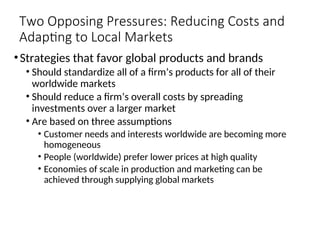
4.
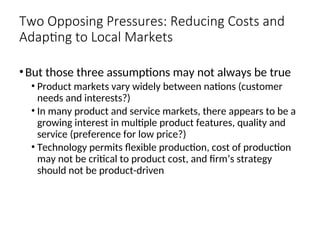
Factors Affecting
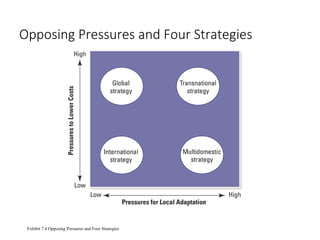
a Nation’sCompetitiveness
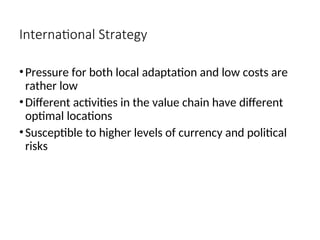
Michael Porter’s diamond of national
advantage explains why some nations
and their industries outperform others.
•Factor endowments
•Demand conditions
•Related and supporting industries
•Firm strategy, structure, & rivalry
5.
Factors Affecting
a Nation’sCompetitiveness
Factor endowments involve factors of
production.
•Land
•Capital
•Labor
Factors of production must be industry & firm
specific.
• Must be rare, valuable, difficult to
imitate, and rapidly & efficiently deployed
6.
Factors Affecting
a Nation’sCompetitiveness
Demand conditions refer to the demands that
consumers place on an industry.
Demanding consumers drive firms in that country to:
•Meet high standards.
•Upgrade existing products and services.
•Create innovative products and services.
•Better anticipate future global demand.
•Proactively respond to product & service
requirements.
7.
Factors Affecting
a Nation’sCompetitiveness
Related and supporting industries
Presence or absence in the nation of internationally
competitive
Supplier industries
Other related industries
Firm strategy, structure, and rivalry
Conditions in the nation governing how companies are
Created
Organized
Managed
Nature of domestic rivalry
8.
Factor Conditions
•To achievecompetitive advantage, factors of
production must be created
• Industry specific
• Firm specific
• Pool of resources at a firm’s or country’s disposal is less
important than the speed and efficiency with which the
resources are deployed
9.
Demand Conditions
•Demands thatconsumers place on an industry for
goods and services
• Demanding consumers push firms to move ahead of
companies from other nations
• Demanding consumers drive firms in a country to
• Meet high standards
• Upgrade existing products and services
• Create innovative products and services
10.
Example
•The demand forgasoline in the United States has not
fallen despite recent surges in gasoline prices.
•An increased supply has eased the price of gasoline
for consumers recently.
•There are still several risks that could affect the
demand conditions for gasoline
• The high price of Ethanol
• Volatility in the oil market
Source: Business Week, June 5, 2006
11.
Related and SupportingIndustries
•Related and supporting industries
• Enable firms to manage inputs more effectively
• Strong supplier base adds efficiency to downstream
activities
• Competitive supplier base lets a firm obtain inputs using
cost-effective, timely methods
• Allow joint efforts among firms
• Create the probability that new entrants will enter the
market
12.
Firm Strategy, Structureand Rivalry
•Rivalry is intense in nations with conditions of
• Strong consumer demand
• Strong supplier bases
• High new entrant potential from related industries
•Competitive rivalry increases the efficiency with which
firms develop, market, and distribute products and
services within the home country
13.
Firm Strategy, Structureand Rivalry
•Competitive rivalry increases the efficiency with which
firms
• Develop within the home country
• Market within the home country
• Distribute products and services within the home country
14.
Firm Strategy, Structureand Rivalry
•Domestic rivalry provides a strong impetus for firms to
• Innovate
• Find new sources of competitive advantage
•Domestic rivalry forces firms to look beyond national
borders for new markets
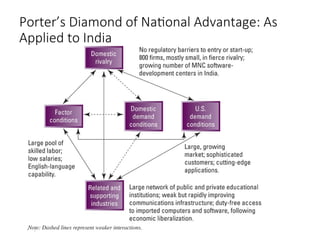
15.
Porter’s Diamond ofNational Advantage: As
Applied to India
Adapted from Exhibit 7.1 India’s Diamond in Software
16.
A Company’s Motivationfor International
Expansion
Increase the size of potential markets
Attain economies of scale
Reducing the costs of R&D as well as operating costs
Extend the life cycle of a product
Optimize the physical location for every activity in its
value chain
Performance enhancement
Cost reduction
Risk reduction
17.
Potential Risks of
InternationalExpansion
•Political and economic risk
• Social unrest
• Military turmoil
• Demonstrations
• Violent conflicts and terrorism
• Laws and their enforcement
18.
Example
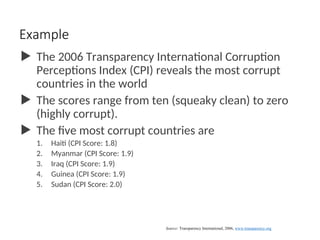
The 2006Transparency International Corruption
Perceptions Index (CPI) reveals the most corrupt
countries in the world
The scores range from ten (squeaky clean) to zero
(highly corrupt).
The five most corrupt countries are
1. Haiti (CPI Score: 1.8)
2. Myanmar (CPI Score: 1.9)
3. Iraq (CPI Score: 1.9)
4. Guinea (CPI Score: 1.9)
5. Sudan (CPI Score: 2.0)
Source: Transparency International, 2006, www.transparency.org
19.
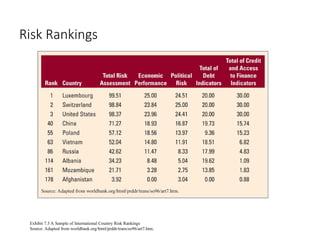
Risk Rankings
Exhibit 7.3A Sample of International Country Risk Rankings
Source: Adapted from worldbank.org/html/prddr/trans/so96/art7.htm.
20.
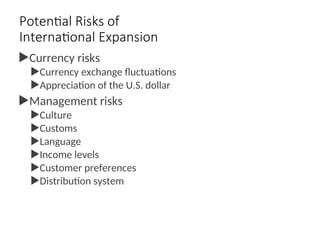
Potential Risks of
InternationalExpansion
Currency risks
Currency exchange fluctuations
Appreciation of the U.S. dollar
Management risks
Culture
Customs
Language
Income levels
Customer preferences
Distribution system
21.
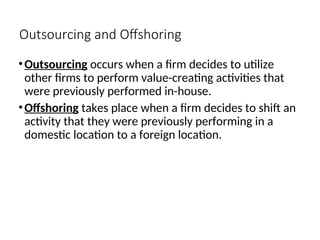
Outsourcing and Offshoring
•Outsourcingoccurs when a firm decides to utilize
other firms to perform value-creating activities that
were previously performed in-house.
•Offshoring takes place when a firm decides to shift an
activity that they were previously performing in a
domestic location to a foreign location.
22.
Two Opposing Pressures:Reducing Costs and
Adapting to Local Markets
•Strategies that favor global products and brands
• Should standardize all of a firm’s products for all of their
worldwide markets
• Should reduce a firm’s overall costs by spreading
investments over a larger market
• Are based on three assumptions
• Customer needs and interests worldwide are becoming more
homogeneous
• People (worldwide) prefer lower prices at high quality
• Economies of scale in production and marketing can be
achieved through supplying global markets
23.
Two Opposing Pressures:Reducing Costs and
Adapting to Local Markets
•But those three assumptions may not always be true
• Product markets vary widely between nations (customer
needs and interests?)
• In many product and service markets, there appears to be a
growing interest in multiple product features, quality and
service (preference for low price?)
• Technology permits flexible production, cost of production
may not be critical to product cost, and firm’s strategy
should not be product-driven
24.
Opposing Pressures andFour Strategies
Exhibit 7.4 Opposing Pressures and Four Strategies
25.
International Strategy
•Pressure forboth local adaptation and low costs are
rather low
•Different activities in the value chain have different
optimal locations
•Susceptible to higher levels of currency and political
risks
26.
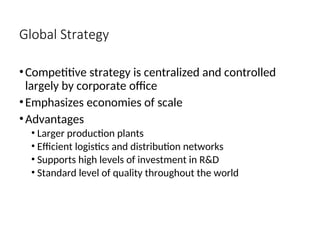
Global Strategy
•Competitive strategyis centralized and controlled
largely by corporate office
•Emphasizes economies of scale
•Advantages
• Larger production plants
• Efficient logistics and distribution networks
• Supports high levels of investment in R&D
• Standard level of quality throughout the world
27.
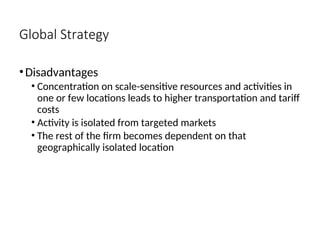
Global Strategy
•Disadvantages
• Concentrationon scale-sensitive resources and activities in
one or few locations leads to higher transportation and tariff
costs
• Activity is isolated from targeted markets
• The rest of the firm becomes dependent on that
geographically isolated location
28.
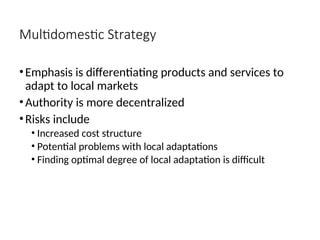
Multidomestic Strategy
•Emphasis isdifferentiating products and services to
adapt to local markets
•Authority is more decentralized
•Risks include
• Increased cost structure
• Potential problems with local adaptations
• Finding optimal degree of local adaptation is difficult
29.
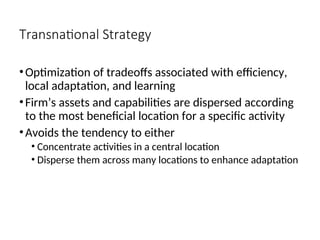
Transnational Strategy
•Optimization oftradeoffs associated with efficiency,
local adaptation, and learning
•Firm’s assets and capabilities are dispersed according
to the most beneficial location for a specific activity
•Avoids the tendency to either
• Concentrate activities in a central location
• Disperse them across many locations to enhance adaptation
30.
Transnational Strategy
•Unique risksand challenges
• Choice of an “optimal” location cannot guarantee that the
quality and cost of factor inputs will be optimal
• Knowledge transfer can be a key source of competitive
advantage, but it does not take place automatically
31.
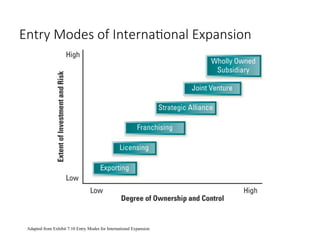
Entry Modes ofInternational Expansion
Adapted from Exhibit 7.10 Entry Modes for International Expansion
Editor's Notes
#10 This is a highly discussed issue in the United States, however most consumers do not realize that the law of supply and demand is what actually sets the price of gasoline in the market. The demand for gasoline in the United States is relatively inelastic as consumers continue to purchase gasoline.
#18 The least corrupt countries are Finland, Iceland, and New Zealand. Haiti is perceived to be the most corrupt. Corruption is defined by this index as the use of public office for private gains.