Module 07: International strategies for competing in global markets
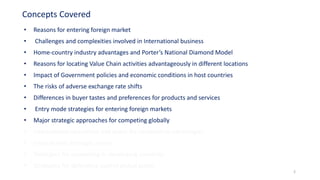
• Reasons for entering foreign market
• Challenges and complexities involved in International business
• Home-country industry advantages and Porter’s National Diamond Model
• Reasons for locating Value Chain activities advantageously in different locations
• Impact of Government policies and economic conditions in host countries
• The risks of adverse exchange rate shifts
• Differences in buyer tastes and preferences for products and services
• Entry mode strategies for entering foreign markets
• Major strategic approaches for competing globally
• International operations and quest for competitive advantages
• Cross-border strategic moves
• Strategies for competing in developing countries
• Strategies for defending against global giants
Concepts Covered
2
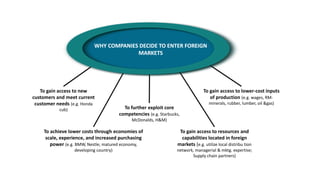
To further exploit core
competencies (e.g. Starbucks,
McDonalds, H&M)
To gain access to lower-cost inputs
of production (e.g. wages, RM-
minerals, rubber, lumber, oil &gas)
To gain access to new
customers and meet current
customer needs (e.g. Honda
cub)
To achieve lower costs through economies of
scale, experience, and increased purchasing
power (e.g. BMW, Nestle; matured economy,
developing country)
To gain access to resources and
capabilities located in foreign
markets (e.g. utilize local distribu tion
network, managerial & mktg. expertise;
Supply chain partners)
WHY COMPANIES DECIDE TO ENTER FOREIGN
MARKETS
WHY COMPANIES DECIDE TO ENTER FOREIGN
MARKETS
4
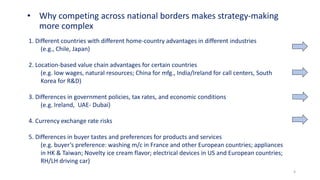
• Why competing across national borders makes strategy-making
more complex
1. Different countries with different home-country advantages in different industries
(e.g., Chile, Japan)
2. Location-based value chain advantages for certain countries
(e.g. low wages, natural resources; China for mfg., India/Ireland for call centers, South
Korea for R&D)
3. Differences in government policies, tax rates, and economic conditions
(e.g. Ireland, UAE- Dubai)
4. Currency exchange rate risks
5. Differences in buyer tastes and preferences for products and services
(e.g. buyer’s preference: washing m/c in France and other European countries; appliances
in HK & Taiwan; Novelty ice cream flavor; electrical devices in US and European countries;
RH/LH driving car)
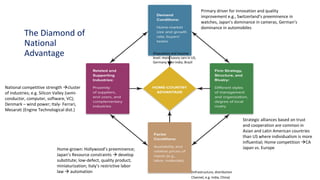
The Diamond of
National
Advantage
Strategic alliances based on trust
and cooperation are common in
Asian and Latin American countries
than US where individualism is more
influential; Home competition →CA
Japan vs. Europe
Primary driver for innovation and quality
improvement e.g., Switzerland’s preeminence in
watches, Japan’s dominance in cameras, German’s
dominance in automobiles
National competitive strength →cluster
of industries; e.g. Silicon Valley (semi-
conductor, computer, software, VC);
Denmark – wind power; Italy- Ferrari,
Mesarati (Engine Technological dist.)
Home-grown: Hollywood’s preeminence;
Japan’s Resource constraints → develop
substitute; low-defect, quality product;
miniaturization; Italy’s restrictive labor
law → automation (Infrastructure, distribution
Channel, e.g. India, China)
(Population and income
level: more luxury cars in US,
Germany than India, Brazil
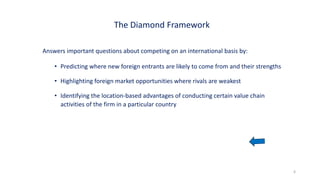
The Diamond Framework
Answers important questions about competing on an international basis by:
• Predicting where new foreign entrants are likely to come from and their strengths
• Highlighting foreign market opportunities where rivals are weakest
• Identifying the location-based advantages of conducting certain value chain
activities of the firm in a particular country
6
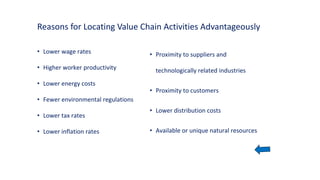
Reasons for Locating Value Chain Activities Advantageously
• Lower wage rates
• Higher worker productivity
• Lower energy costs
• Fewer environmental regulations
• Lower tax rates
• Lower inflation rates
• Proximity to suppliers and
technologically related industries
• Proximity to customers
• Lower distribution costs
• Available or unique natural resources
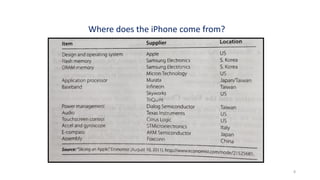
Where does the iPhone come from?
8
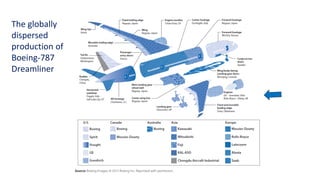
The globally
dispersed
production of
Boeing-787
Dreamliner
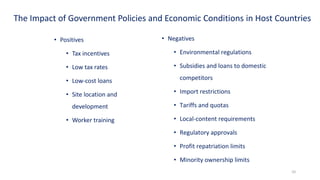
The Impact of Government Policies and Economic Conditions in Host Countries
• Positives
• Tax incentives
• Low tax rates
• Low-cost loans
• Site location and
development
• Worker training
• Negatives
• Environmental regulations
• Subsidies and loans to domestic
competitors
• Import restrictions
• Tariffs and quotas
• Local-content requirements
• Regulatory approvals
• Profit repatriation limits
• Minority ownership limits
10
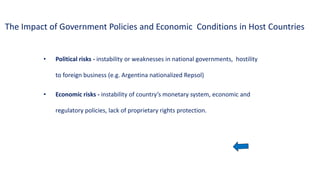
The Impact of Government Policies and Economic Conditions in Host Countries
• Political risks - instability or weaknesses in national governments, hostility
to foreign business (e.g. Argentina nationalized Repsol)
• Economic risks - instability of country’s monetary system, economic and
regulatory policies, lack of proprietary rights protection.
The risks of adverse exchange rate shifts
Effects of exchange rate shifts
• What happens to exporters when home country currency grows weaker relative to
the importing country’s currency?
• What happens to exporters when home country currency grows stronger relative
to the importing country’s currency?
12
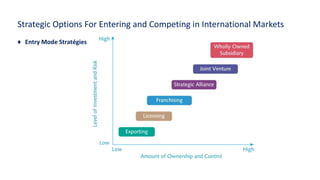
Strategic Options For Entering and Competing in International Markets
♦ Entry Mode Stratégies
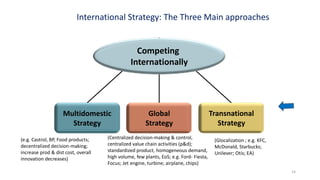
International Strategy: The Three Main approaches
Multidomestic
Strategy
Global
Strategy
Transnational
Strategy
Competing
Internationally
(e.g. Castrol, BP, Food products;
decentralized decision-making;
increase prod & dist cost, overall
innovation decreases)
(Centralized decision-making & control,
centralized value chain activities (p&d);
standardized product, homogeneous demand,
high volume, few plants, EoS; e.g. Ford- Fiesta,
Focus; Jet engine, turbine; airplane, chips)
(Glocalization ; e.g. KFC,
McDonald, Starbucks;
Unilever; Otis; EA)
14
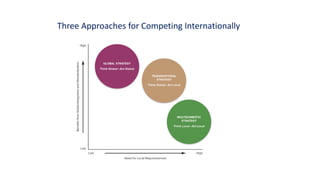
Three Approaches for Competing Internationally
Transnational
Strategy
Global
Strategy
Multi-domestic
Strategy
No
International
Strategy
Low High
Force Towards Local Responsiveness
Force
Towards
Global
Integration
High
Low
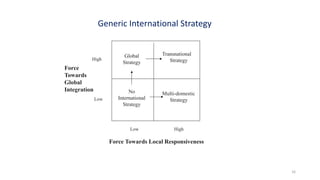
Generic International Strategy
16
• This chapter highlights the underlying reasons for venturing into the foreign markets by a domestic
company, the complexities and challenges of cross-border strategic decision-making and competing
with the global players.
• It also discusses factors that determine a nation’s competitiveness in a particular industry, and
summarizes these factors in a framework known as Porter's “diamond of national advantage” for
competitive advantage.
• It highlights the reasons for locating value chain activities advantageously in different international
locations, the impact of Government policies and economic conditions in host countries, the risks
of adverse exchange rate shifts, and others.
• It dwells on the “entry mode” options for entering the foreign markets, and discusses in detail the
three main approaches for competing globally viz. global strategy, transnational strategy, and
multidomestic strategy citing live examples.
• In multidomestic strategy, product offerings, and competitive approaches vary from country to
country based on buyers' needs and local market conditions. Global strategy follows an
undifferentiated competitive approach and standardized product and reaps the benefits of
economies of scale. Transnational strategy is a middle-ground strategy where mass-customization
of local responsiveness and appreciable benefits from standardization are realized. It incorporates
elements of both multidomestic and global strategies.
Conclusion
1. Crafting and Executing Strategy – The Quest for Competitive Advantage, Concepts and Cases,
Thomson & Strickland, McGraw-Hill Education.
2. Contemporary Strategy Analysis – Text and Cases, Robert M. Grant, 10th ed, John Wiley & Sons Inc.
3. Strategic Management – Text and Cases, Dess, McNamara and Eisener McGraw-Hill Education, 8th
edition.
4. Exploring Strategy – Text and Cases, Gerry Johnson, Richard Whittington, Kevan Scholes, Duncan
Angwin, and Patrick Regner, Pearson, 10th edition.
References
18

Strategy management International Strategy_phd.pdf

  • 1.
    Module 07: Internationalstrategies for competing in global markets
  • 2.
    • Reasons forentering foreign market • Challenges and complexities involved in International business • Home-country industry advantages and Porter’s National Diamond Model • Reasons for locating Value Chain activities advantageously in different locations • Impact of Government policies and economic conditions in host countries • The risks of adverse exchange rate shifts • Differences in buyer tastes and preferences for products and services • Entry mode strategies for entering foreign markets • Major strategic approaches for competing globally • International operations and quest for competitive advantages • Cross-border strategic moves • Strategies for competing in developing countries • Strategies for defending against global giants Concepts Covered 2
  • 3.
    To further exploitcore competencies (e.g. Starbucks, McDonalds, H&M) To gain access to lower-cost inputs of production (e.g. wages, RM- minerals, rubber, lumber, oil &gas) To gain access to new customers and meet current customer needs (e.g. Honda cub) To achieve lower costs through economies of scale, experience, and increased purchasing power (e.g. BMW, Nestle; matured economy, developing country) To gain access to resources and capabilities located in foreign markets (e.g. utilize local distribu tion network, managerial & mktg. expertise; Supply chain partners) WHY COMPANIES DECIDE TO ENTER FOREIGN MARKETS WHY COMPANIES DECIDE TO ENTER FOREIGN MARKETS
  • 4.
    4 • Why competingacross national borders makes strategy-making more complex 1. Different countries with different home-country advantages in different industries (e.g., Chile, Japan) 2. Location-based value chain advantages for certain countries (e.g. low wages, natural resources; China for mfg., India/Ireland for call centers, South Korea for R&D) 3. Differences in government policies, tax rates, and economic conditions (e.g. Ireland, UAE- Dubai) 4. Currency exchange rate risks 5. Differences in buyer tastes and preferences for products and services (e.g. buyer’s preference: washing m/c in France and other European countries; appliances in HK & Taiwan; Novelty ice cream flavor; electrical devices in US and European countries; RH/LH driving car)
  • 5.
    The Diamond of National Advantage Strategicalliances based on trust and cooperation are common in Asian and Latin American countries than US where individualism is more influential; Home competition →CA Japan vs. Europe Primary driver for innovation and quality improvement e.g., Switzerland’s preeminence in watches, Japan’s dominance in cameras, German’s dominance in automobiles National competitive strength →cluster of industries; e.g. Silicon Valley (semi- conductor, computer, software, VC); Denmark – wind power; Italy- Ferrari, Mesarati (Engine Technological dist.) Home-grown: Hollywood’s preeminence; Japan’s Resource constraints → develop substitute; low-defect, quality product; miniaturization; Italy’s restrictive labor law → automation (Infrastructure, distribution Channel, e.g. India, China) (Population and income level: more luxury cars in US, Germany than India, Brazil
  • 6.
    The Diamond Framework Answersimportant questions about competing on an international basis by: • Predicting where new foreign entrants are likely to come from and their strengths • Highlighting foreign market opportunities where rivals are weakest • Identifying the location-based advantages of conducting certain value chain activities of the firm in a particular country 6
  • 7.
    Reasons for LocatingValue Chain Activities Advantageously • Lower wage rates • Higher worker productivity • Lower energy costs • Fewer environmental regulations • Lower tax rates • Lower inflation rates • Proximity to suppliers and technologically related industries • Proximity to customers • Lower distribution costs • Available or unique natural resources
  • 8.
    Where does theiPhone come from? 8
  • 9.
  • 10.
    The Impact ofGovernment Policies and Economic Conditions in Host Countries • Positives • Tax incentives • Low tax rates • Low-cost loans • Site location and development • Worker training • Negatives • Environmental regulations • Subsidies and loans to domestic competitors • Import restrictions • Tariffs and quotas • Local-content requirements • Regulatory approvals • Profit repatriation limits • Minority ownership limits 10
  • 11.
    The Impact ofGovernment Policies and Economic Conditions in Host Countries • Political risks - instability or weaknesses in national governments, hostility to foreign business (e.g. Argentina nationalized Repsol) • Economic risks - instability of country’s monetary system, economic and regulatory policies, lack of proprietary rights protection.
  • 12.
    The risks ofadverse exchange rate shifts Effects of exchange rate shifts • What happens to exporters when home country currency grows weaker relative to the importing country’s currency? • What happens to exporters when home country currency grows stronger relative to the importing country’s currency? 12
  • 13.
    Strategic Options ForEntering and Competing in International Markets ♦ Entry Mode Stratégies
  • 14.
    International Strategy: TheThree Main approaches Multidomestic Strategy Global Strategy Transnational Strategy Competing Internationally (e.g. Castrol, BP, Food products; decentralized decision-making; increase prod & dist cost, overall innovation decreases) (Centralized decision-making & control, centralized value chain activities (p&d); standardized product, homogeneous demand, high volume, few plants, EoS; e.g. Ford- Fiesta, Focus; Jet engine, turbine; airplane, chips) (Glocalization ; e.g. KFC, McDonald, Starbucks; Unilever; Otis; EA) 14
  • 15.
    Three Approaches forCompeting Internationally
  • 16.
    Transnational Strategy Global Strategy Multi-domestic Strategy No International Strategy Low High Force TowardsLocal Responsiveness Force Towards Global Integration High Low Generic International Strategy 16
  • 17.
    • This chapterhighlights the underlying reasons for venturing into the foreign markets by a domestic company, the complexities and challenges of cross-border strategic decision-making and competing with the global players. • It also discusses factors that determine a nation’s competitiveness in a particular industry, and summarizes these factors in a framework known as Porter's “diamond of national advantage” for competitive advantage. • It highlights the reasons for locating value chain activities advantageously in different international locations, the impact of Government policies and economic conditions in host countries, the risks of adverse exchange rate shifts, and others. • It dwells on the “entry mode” options for entering the foreign markets, and discusses in detail the three main approaches for competing globally viz. global strategy, transnational strategy, and multidomestic strategy citing live examples. • In multidomestic strategy, product offerings, and competitive approaches vary from country to country based on buyers' needs and local market conditions. Global strategy follows an undifferentiated competitive approach and standardized product and reaps the benefits of economies of scale. Transnational strategy is a middle-ground strategy where mass-customization of local responsiveness and appreciable benefits from standardization are realized. It incorporates elements of both multidomestic and global strategies. Conclusion
  • 18.
    1. Crafting andExecuting Strategy – The Quest for Competitive Advantage, Concepts and Cases, Thomson & Strickland, McGraw-Hill Education. 2. Contemporary Strategy Analysis – Text and Cases, Robert M. Grant, 10th ed, John Wiley & Sons Inc. 3. Strategic Management – Text and Cases, Dess, McNamara and Eisener McGraw-Hill Education, 8th edition. 4. Exploring Strategy – Text and Cases, Gerry Johnson, Richard Whittington, Kevan Scholes, Duncan Angwin, and Patrick Regner, Pearson, 10th edition. References 18