Traditional
Media Channels


                 8-1
Media Strategy

The process of analyzing and
choosing media for an advertising
and promotional campaign to
maximise the “reach” and “impact”
among the TG.


                                    8-2
People Involved in Media
         Selection

Media Buyer


           Media Planner


                Account
Creative
               Executive
                           Client


                                    8-3
People Involved in Media Selection
             Media Planner

      • Formulates media program
      • Conducts research on
        audience characteristics
      • Matches media with target
        market characteristics


                                     8-4
People Involved in Media Selection
               Media Buyer


  • Works closely with media
    planner
  • Purchases media time and
    space
      Agency size not related to media
       price, quality
      Culture and experience important
                                          8-5
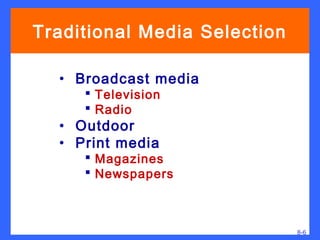
Traditional Media Selection

  • Broadcast media
      Television
      Radio
  • Outdoor
  • Print media
      Magazines
      Newspapers


                              8-6
Television

    Advantages                 Disadvantages

•   High reach             •    Clutter
•   High frequency         •    Channel surfing
    potential                   during
•   Low cost per contact        commercials
•   Creative               •    Short amount of
    opportunities               copy
•   High intrusion value   •    High cost per ad
•   Segmentation           •    Low recall due to
    possibilities               clutter


                                                    8-7
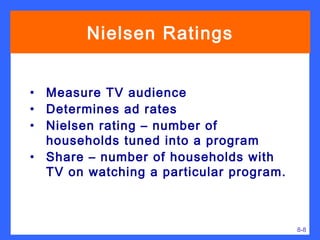
Nielsen Ratings


• Measure TV audience
• Determines ad rates
• Nielsen rating – number of
  households tuned into a program
• Share – number of households with
  TV on watching a particular program.


                                         8-8
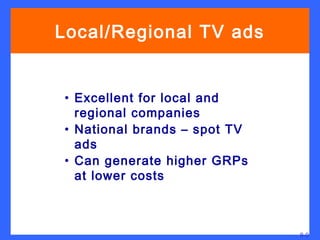
Televisionads
Local/Regional TV


• Excellent for local and
  regional companies
• National brands – spot TV
  ads
• Can generate higher GRPs
  at lower costs


                              8-9
Radio

    Advantages                  Disadvantages

•   Low cost per spot       •    Short exposure
•   Low production cost          time
•   Use of music            •    Low attention
•   High segmentation       •    Poor national
    potential                    audience capability
•   Flexibility in making   •    Target duplication
    new ads                      in many areas
•   Ability to modify ads
    quickly and locally
•   DJ intimacy
•   Mobility

                                                   8-10
Outdoor

 Advantages            Disadvantages

• Large ads           • Legal limitations
• Select geographic   • Short-exposure
  areas                 time
• Accessible for      • Brief message
  local ads           • Limited
• Low cost per          segmentation
  impression          • Cluttered travel
• Broad reach           routes
• High frequency

                                        8-11
Magazines

    Advantages                Disadvantages

•   High segmentation     •    Long lead time
•   High color quality    •    Little flexibility
•   Long life             •    High cost
•   Direct response       •    Clutter
    techniques            •    Declining
•   Read during                readership
    leisure
•   Longer attention to
    ads

                                                    8-12
Newspapers

    Advantages                  Disadvantages
•   Priority to local ads   •    Clutter
•   Coupons and             •    Short time span
    special response        •    Poor quality
    ads                          reproduction
•   High credibility        •    Limited audience
•   Strong audience         •    Poor national
    interest                     buying
•   Longer copy                  procedures
•   High flexibility
•   Cumulative volume
    discounts
                                                    8-13
Developing Logical Combinations of
              Media


                                     8-14
U.S. Advertising Expenditures by
      Media for Coca-Cola
B-to-B Advertising


• Shift in media buys
    Approximately half of all b-to-b ad spends
     are in non-business environments
• Reasons for shift
    Business decision makers are consumers.
    Business decision makers are difficult to
     reach at work.
    Clutter among business outlets.


                                              8-16
B-to-B Advertising

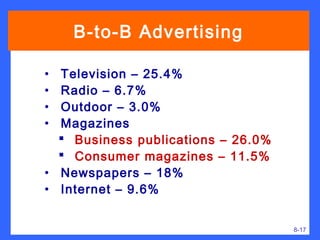
• Television – 25.4%
• Radio – 6.7%
• Outdoor – 3.0%
• Magazines
   Business publications – 26.0%
   Consumer magazines – 11.5%
• Newspapers – 18%
• Internet – 9.6%


                                    8-17

Media edi

  • 1.
  • 2.
    Media Strategy The processof analyzing and choosing media for an advertising and promotional campaign to maximise the “reach” and “impact” among the TG. 8-2
  • 3.
    People Involved inMedia Selection Media Buyer Media Planner Account Creative Executive Client 8-3
  • 4.
    People Involved inMedia Selection Media Planner • Formulates media program • Conducts research on audience characteristics • Matches media with target market characteristics 8-4
  • 5.
    People Involved inMedia Selection Media Buyer • Works closely with media planner • Purchases media time and space  Agency size not related to media price, quality  Culture and experience important 8-5
  • 6.
    Traditional Media Selection • Broadcast media  Television  Radio • Outdoor • Print media  Magazines  Newspapers 8-6
  • 7.
    Television Advantages Disadvantages • High reach • Clutter • High frequency • Channel surfing potential during • Low cost per contact commercials • Creative • Short amount of opportunities copy • High intrusion value • High cost per ad • Segmentation • Low recall due to possibilities clutter 8-7
  • 8.
    Nielsen Ratings • MeasureTV audience • Determines ad rates • Nielsen rating – number of households tuned into a program • Share – number of households with TV on watching a particular program. 8-8
  • 9.
    Televisionads Local/Regional TV • Excellentfor local and regional companies • National brands – spot TV ads • Can generate higher GRPs at lower costs 8-9
  • 10.
    Radio Advantages Disadvantages • Low cost per spot • Short exposure • Low production cost time • Use of music • Low attention • High segmentation • Poor national potential audience capability • Flexibility in making • Target duplication new ads in many areas • Ability to modify ads quickly and locally • DJ intimacy • Mobility 8-10
  • 11.
    Outdoor Advantages Disadvantages • Large ads • Legal limitations • Select geographic • Short-exposure areas time • Accessible for • Brief message local ads • Limited • Low cost per segmentation impression • Cluttered travel • Broad reach routes • High frequency 8-11
  • 12.
    Magazines Advantages Disadvantages • High segmentation • Long lead time • High color quality • Little flexibility • Long life • High cost • Direct response • Clutter techniques • Declining • Read during readership leisure • Longer attention to ads 8-12
  • 13.
    Newspapers Advantages Disadvantages • Priority to local ads • Clutter • Coupons and • Short time span special response • Poor quality ads reproduction • High credibility • Limited audience • Strong audience • Poor national interest buying • Longer copy procedures • High flexibility • Cumulative volume discounts 8-13
  • 14.
  • 15.
    U.S. Advertising Expendituresby Media for Coca-Cola
  • 16.
    B-to-B Advertising • Shiftin media buys  Approximately half of all b-to-b ad spends are in non-business environments • Reasons for shift  Business decision makers are consumers.  Business decision makers are difficult to reach at work.  Clutter among business outlets. 8-16
  • 17.
    B-to-B Advertising • Television– 25.4% • Radio – 6.7% • Outdoor – 3.0% • Magazines  Business publications – 26.0%  Consumer magazines – 11.5% • Newspapers – 18% • Internet – 9.6% 8-17

Editor's Notes

  • #10 Local and regional television is excellent for local and regional companies. National brands can advertise on these stations through purchasing spot TV space. About 75% of national time slots are sold during sweeps week. By selecting local channels to supplement the national time, companies can generate higher GRPs at a lower cost. Effective television advertising requires matching the product target audience with a shows viewing audience. Television can reach larger audiences at a lower cost per contact. Cable channels provide opportunities to segment audiences based on interests.
  • #15 Developing logical combinations of media takes planning. It starts by deciding the scale of the media market – local, regional, national, or global. Next comes an understanding of the market characteristics – demographics, geographic location, psychographic profile, and media habits. From this information decisions can be made about which media is the best – TV, radio, outdoor, newspaper, magazines, direct mail. Last, comes the content.
  • #16 This graph provides an illustration of the multiple media used by Coca-Cola. Television accounts for 63.4% of their media buys, the vast majority. But, Coca-Cola also spends on radio, outdoor, the Internet, magazines, and newspapers.