CT Simulation Refresher Course
Sasa Mutic, M.S.
Mallinckrodt Institute of Radiology
Washington University School of Medicine
St. Louis, MO 63110
I. INTRODUCTION
The radiation therapy simulator has been an
integral component of the treatment planning
process for over 30 years. Conventional simulators
are a combination of diagnostic x
-ray machine and
certain components of a radiation therapy linear
accelerator. Consisting of a diagnostic quality x-ray
unit and fluoroscopic imaging system, the treatment
table and the gantry are designed to mimic functions
of a linear accelerator. The images are transmission
radiographs with field collimator settings outlined
by delineator wires. Using primarily bony
landmarks a physician outlines areas to receive
therapeutic radiation doses. One shortcoming of a
conventional simulation process is that very little
anatomy, other than bony anatomy, is available for
design of treatment portals.
CT images provide information not only about
target volumes but about critical (normal) organs as
well. Using CT images for radiation therapy
treatment planning has enabled us to improve dose
delivery to target volumes while reducing the dose
to critical organs. CT images also provide density
information for heterogeneity-based dose
calculations. A major weakness of CT images is a
relatively limited soft tissue contrast. This,
limitation can be overcome by using CT images in
conjunction with magnetic resonance (MR) studies
for treatment planning. Positron emission
computed (PET) images can be used to add
physiological information.
In 1983 Goitein and Abrams1, 2
described
multidimensional treatment planning based on CT
images. They described a “beam’s-eye-view”
(BEV) function which “provides the user with an
accurate reproduction of anatomic features from the
viewpoint of a treatment source”. They also
described how “projection through the CT data
from any desired origin provides an alignment film
simulation which can be used to confirm accuracy
of treatment, as well as help establish anatomic
relationships relative to the margins of a treatment
field”. This was a description of major
characteristics of a system known today as the CT-
simulator. An alignment film created from a
divergent projection through the CT study data is
commonly known today as the digitally
reconstructed radiograph (DRR). Sherouse et al3
further discussed DRR use in radiation therapy.
Sherouse et al4, 5
also described a CT image
based virtual simulation process which they referred
to as a “software analog to conventional
simulation”. This series of publications described
software tools and addressed technical issues that
affect today’s CT-simulation process. The also
described the need for fast computers, specialized
software, but also for improved patient
immobilization and setup reproducibility.
Several other authors also described the CT
simulation process6-8
. These authors outlined
several problems associated with CT simulation: 70
cm CT scanner bore inadequate for large patients
and asymmetric setups, transfer of volumetric CT
data slow, difficulty with image analysis (requires
diagnostic expertise), time consuming contouring,
slow generation of DRRs, quality of printed graphic
display (hardcopy), inconsistent accuracy, necessity
of physical simulator verification.8
Some of these
have been overcome (scanner bore size, speed of
data transfer, speed of DRR generation, hardcopy
quality) while others are still not completely
resolved.
One of the early commercial CT simulation
packages (introduced in 1994) which is probably
the most often described system in literature is
shown in Figure 1. (AcqSim Oncodiagnostic
Simulation/Localization System, Marconi Medical
Systems, Inc. (formerly Picker International)
Cleveland, OH).
Figure 2. CT-Simulator. (Courtesy Marconi
Medical Systems, Inc.)
II. CT SIMULATOR COMPONENTS
CT simulator consists of a diagnostic quality CT
scanner, laser patient positioning / marking system,
virtual simulation / 3D treatment planning software,
and different hardcopy output devices. The CT
scanner is used to acquire a volumetric CT scan of a
patient which represents the virtual patient and the
simulation software creates virtual functions of a
conventional simulator. Proper selection of
components of a CT-simulator or a CT-simulator as
a commercial package is very important, as they
will notably affect the rest of the treatment planning
and delivery process in a clinic.
a) CT scanner
Generation - Common historical CT scanner
classification is into four generations9
:
First generation - x-ray tube and a single detector
translate and rotate together,
Second generation - involved multiple detectors, x-
ray tube translated and rotated,
Third generation - fan beam geometry with multiple
detectors, x-ray tube and detector rotate together,
Fourth generation - fan beam geometry with a
complete rotation of the x-ray tube around a
stationary ring of x-ray detectors.
Scanners commercially available today are either 3rd
or 4th
generation. Both scanner generations give
excellent images with no significant advantages of
one over the other.
X-ray tube - Two characteristics of CT simulation
process guide requirements for the X-ray tube
selection:
a) Large number of images per study- CT studies
for image based radiation therapy treatment
planning and CT-simulation involve larger number
of images per patient than in diagnostic radiology.
Depending on the treatment site and the length of
the scanned volume, typically 80 to over 200
images per patient are acquired.
b) Rapid study acquisition time- A CT simulation
study should be imaged in a single rapid
acquisition. Rapid scan time minimizes motion
artifacts (due to breathing or patient movement). In
addition, if the scanned volume is not imaged in a
single continues acquisition; the patient can move
between acquisitions and distort the spatial integrity
of the study.
CT simulator X-ray tube must have large heat
anode loading and heat dissipation capabilities to
withstand the very high heat loads associated with
the large number of images acquired in a rapid
sequence.
Scan geometry- Axial or Spiral (Helical) - Axial
and spiral scanning modes have been described in
many publications9-12
.
Virtually all modern scanners are spiral (helical)
machines. These scanners are capable of
continuous x-ray tube rotation while the couch is
moving during the scan procedure. In spiral
scanning, as the x-ray tube rotates around the
patient, the couch moves the patent through the
imaging plane and the scanner gantry. The resultant
path geometry that the x-ray tube describes around
the patient is a spiral or helical winding. With this
technique, volumes of tissue rather than single
slices are acquired, so the technique is sometimes
referred to as volumetric scanning13
. Spiral imaging
is capable of sub-second image acquisition times.
Fast imaging makes spiral scanning the preferred
choice for CT simulation.
Single-slice and multi-slice scanning- In 1992,
Elscint CT Twin was introduced as the first CT
scanner capable of simultaneously acquiring more
than one transaxial slice. In 1998, four more
manufacturers introduced their versions of multi-
slice scanners. These scanners were capable of
acquiring four simultaneous slices. Manufacturers
are in various stages of developing scanners capable
of acquiring at least 8 simultaneous slices.
The main advantage of multi-slice scanners is
the ability to acquire images faster than single slice
scanners14-16
. A four-slice system with a 0.5 second
rotation can acquire volume data up to 8 times
faster than a single slice machine with a 1 second
rotation. Due to the longer length of imaged
volume per tube rotation (multiple slices
simultaneously), the tube heat loading during a scan
of a certain patient volume is lower for multi-slice
than for a single-slice scanner. This allows thinner
slice thickness to be used for scanning or longer
volumes to be scanned. Faster acquisition times,
decreased tube loading (which will allow longer
volumes to be scanned in a single acquisition), and
thinner slice thickness associated with multi-slice
scanners can potentially provide advantage over
single-slice systems for CT simulation purposes.
Bore (gantry opening) size- When patients are
scanned for diagnostic purposes they are typically
in a supine position with their head towards the
gantry, arms at their side or on their chest, and their
legs extended. Diagnostic CT scanners have
predominantly 70 cm bore openings. This is quite
adequate for diagnostic scan purposes. For CT
simulation purposes, patients are often in positions
that can prevent them from entering the 70 cm bore
opening. For example, breast treatments where the
ipsilateral arm is subtended at close to a 90° angle
frequently have difficulty entering the 70 cm bore.
Inability to simulate all patients in an optimal
treatment position due to restricted bore opening
has often been cited as on of the major weaknesses
of the CT simulation process8, 12, 17, 18
. Marconi
Medical Systems, Inc. has manufactured a scanner
specifically designed for radiation oncology
purposes with an 85 cm bore opening. The first unit
was installed in December 2000 at Mallinckrodt
Institute of Radiology in St. Louis.
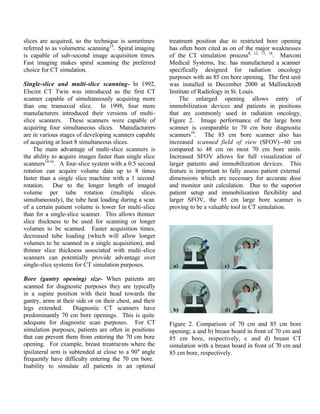
The enlarged opening allows entry of
immobilization devices and patients in positions
that are commonly used in radiation oncology,
Figure 2. Image performance of the large bore
scanner is comparable to 70 cm bore diagnostic
scanners19
. The 85 cm bore scanner also has
increased scanned field of view (SFOV)--60 cm
compared to 48 cm on most 70 cm bore units.
Increased SFOV allows for full visualization of
larger patients and immobilization devices. This
feature is important to fully assess patient external
dimensions which are necessary for accurate dose
and monitor unit calculation. Due to the superior
patient setup and immobilization flexibility and
larger SFOV, the 85 cm large bore scanner is
proving to be a valuable tool in CT simulation.
Figure 2. Comparison of 70 cm and 85 cm bore
opening; a and b) breast board in front of 70 cm and
85 cm bore, respectively, c and d) breast CT
simulation with a breast board in front of 70 cm and
85 cm bore, respectively.
Couch- CT simulator couch should have a flat top
similar to radiation therapy treatment machines.
Additionally, it should accommodate commercially
available registration devices. The registration
device allows patient immobilization device to be
moved from the CT simulator to a treatment
machine, in a reproducible manner. The couch
should have sag of less than 2 mm. This is in
accordance with specifications for linear
accelerators20
. The couch weight limit should be
comparable to those of medical linear accelerators
(at least 400 to 450 lbs).
Patient marking lasers- A laser system is necessary
to provide reference marks on patient skin or on the
immobilization device. Figure 1 shows the laser
system for a CT simulator:
Wall lasers – Vertical and horizontal, mounted
to the side of the gantry and typically immobile
Sagittal laser – Ceiling or wall mounted single
laser, preferably movable. Scanner couch can
move up/down and in/out but can not move
left/right, therefore the sagittal laser should
move left/right to allow marking away from
patient mid line.
Scanner lasers – Internally mounted, vertical
and horizontal lasers on the either side of the
gantry and an overhead sagittal laser.
Lasers should be spatially stable over time and
allow for positional adjustment.
Image quality performance- The corner stone of
3D conformal radiation therapy (3DCRT) treatment
planning are patient images. These should be high
quality diagnostic type images and the CT simulator
should be capable of producing these types of
images. When purchasing a CT simulator, image
quality should be one of the top concerns. At the
very least, the following image quality indicators9
should be considered:
Spatial resolution – measure of the
scanner’s ability to discriminate objects of
varying density a small distance apart against a
uniform background. Specified in line pairs per
cm (Lp/cm).
Low contrast resolution – the ability of an
imaging system to demonstrate small changes in
tissue contrast. Specified as the ability of the
CT unit to image objects 2 to 5 mm in size
which vary slightly in density from a uniform
background.
Noise – the fluctuation of CT numbers from
point to point in the image of a uniformobject.
Cross-field uniformity – the uniformity of
CT numbers throughout the entire scan field.
This performance characteristic can potentially
be important in heterogeneity-based dose
calculations.
Hard copy printers – DRRs can be printed on paper
or on film using laser film printers. DRRs printed
on film are generally much easier to use and often
preferred.
b) Virtual simulation/3D treatment planning
software and workstation
As with all software programs, user-friendly, fast,
and well functioning virtual simulation software
with useful features and tools will be a determining
factor for the success of a CT simulation program.
Several features are very important when
considering virtual simulation/3D treatment
planning software:
Contouring and localization of structures – At
present, contouring and localization of structures is
often mentioned as one of the most time consuming
tasks in the treatment planning process. The
software should allow for fast, user-friendly
contouring process with the help of semi-automatic
or automatic contouring tools.
Image processing and display - Virtual simulation
workstation must be capable of processing large
volumetric sets of images and displaying them in
different views as quickly as possible (near real
time image manipulation and display is desired).
The following are some of the important display
capabilities:
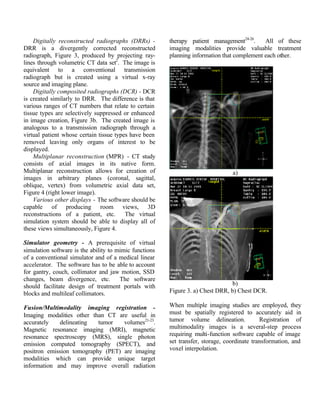
Digitally reconstructed radiographs (DRRs) -
DRR is a divergently corrected reconstructed
radiograph, Figure 3, produced by projecting ray-
lines through volumetric CT data set2
. The image is
equivalent to a conventional transmission
radiograph but is created using a virtual x-ray
source and imaging plane.
Digitally composited radiographs (DCR) - DCR
is created similarly to DRR. The difference is that
various ranges of CT numbers that relate to certain
tissue types are selectively suppressed or enhanced
in image creation, Figure 3b. The created image is
analogous to a transmission radiograph through a
virtual patient whose certain tissue types have been
removed leaving only organs of interest to be
displayed.
Multiplanar reconstruction (MPR) - CT study
consists of axial images in its native form.
Multiplanar reconstruction allows for creation of
images in arbitrary planes (coronal, sagittal,
oblique, vertex) from volumetric axial data set,
Figure 4 (right lower image).
Various other displays - The software should be
capable of producing room views, 3D
reconstructions of a patient, etc. The virtual
simulation system should be able to display all of
these views simultaneously, Figure 4.
Simulator geometry - A prerequisite of virtual
simulation software is the ability to mimic functions
of a conventional simulator and of a medical linear
accelerator. The software has to be able to account
for gantry, couch, collimator and jaw motion, SSD
changes, beam divergence, etc. The software
should facilitate design of treatment portals with
blocks and multileaf collimators.
Fusion/Multimodality imaging registration -
Imaging modalities other than CT are useful in
accurately delineating tumor volumes21-23
.
Magnetic resonance imaging (MRI), magnetic
resonance spectroscopy (MRS), single photon
emission computed tomography (SPECT), and
positron emission tomography (PET) are imaging
modalities which can provide unique target
information and may improve overall radiation
therapy patient management24-26
. All of these
imaging modalities provide valuable treatment
planning information that complement each other.
a)
b)
Figure 3. a) Chest DRR, b) Chest DCR.
When multiple imaging studies are employed, they
must be spatially registered to accurately aid in
tumor volume delineation. Registration of
multimodality images is a several-step process
requiring multi-function software capable of image
set transfer, storage, coordinate transformation, and
voxel interpolation.
Figure 4. Simultaneous display of an axial image, 3D display, DCR, and a MPR image.
Connectivity - Virtual simulation workstation is
commonly the first step for image transfer
between the CT scanner and various treatment
planning computers, record and verify systems,
and treatment delivery machines. When
purchasing new software, the manufacturer should
provide the “DICOM conformance” statement;
from the Radiological Society of North America,
Inc. web-site (http://rsna.org/practice/dicom).
“DICOM (Digital Imaging and Communications
in Medicine) is the industry standard for transferal
of radiologic images and other medical
information between computers. Patterned after
the Open System Interconnection of the
International Standards Organization, DICOM
enables digital communication between diagnostic
and therapeutic equipment and systems from
various manufacturers.”
“DICOM conformance” means the
manufacturer states that the software can
communicate with other DICOM conformant
products. The conformance statement will list all
DICOM functions that are implemented. A
comparison of conformance statements from each
product should reveal potential communication
problems. In addition, one should contact other
health care institutions with similar equipment to
verify that connectivity between products actually
works.
Dose calculation - Virtual simulation workstation
can also have 3D dose calculation and display
capabilities. The dose calculation software should
have capabilities that are commonly found on
other 3D treatment planning systems27-30
.
III. CT SIMULATION PROCESS
CT simulation process has been described by
several authors4, 12, 17, 18, 31, 32
. The process
includes the following steps:
• Patient positioning and immobilization
• Patient marking
• CT scanning
• Transfer to virtual simulation workstation
• Localization of initial coordinate system
• Localization of targets and placement of
isocenter
• Marking of patient and immobilization
devices based on isocenter coordinates
• Contouring of critical structures and target
volumes
• Beam placement design, design of
treatment portals
• Transfer of data to treatment planning
system for dose calculation
• Prepare documentation for treatment
• Perform necessary verifications and
treatment plan checks
This process and its implementation vary from
institution to institution. The system design is
dependent on available resources (equipment and
personnel), patient workload, physical layout and
location of different components and proximity of
team members.
a) CT Scan, Patient Positioning and
Immobilization
The CT simulation scan is similar to conventional
diagnostic scans. However there are several
particularities. Patient positioning and
immobilization are very important. Scan
parameters and long scan volumes with large
number of slices often push scanners to their
technical performance limits.
Patient positioning and immobilization - The
success of conformal radiation therapy process
begins with proper setup and immobilization.
Positioning should be as comfortable as possible.
Patients who are uncomfortable typically have poor
treatment setup reproducibility. Immobilization
devices tremendously improve reproducibility and
rigidity of the setup. Patient setup design should
consider location of critical structures and target
volumes, patient overall health and flexibility,
possible implants and anatomic anomalies, and
available immobilization devices.
Scan protocol - The CT scan parameters should be
designed to optimize both axial and DRR image
quality and rapidly acquire images to minimize
patient motion 9, 18, 32-35
. The parameters
influencing axial and DRR image quality include:
kVp, mAs, slice thickness, slice spacing, spiral
pitch10, 11
, algorithms, scanned volume, total scan
time, and field of view (FOV).
Scan Limits - Scan limits should be specified by the
physician and should encompass area at least 5 cm
away from the anticipated treatment volumes. Slice
thickness and spacing do not have to be constant
throughout the entire scanned volume. Areas of
interest can be scanned with narrow (3 mm)
thickness and spacing, while large slices (5 mm)
can be used for scanning surrounding volumes.
This will maintain good DRR quality while
minimizing tube heat.
Contrast - For several treatment sites contrast can
be used to help differentiate between tumors and
surrounding healthy tissue.
Reference Marks - During the CT scan a set of
reference marks must be placed on the patient so the
patient can be positioned on the treatment machine.
When and in relationship to which anatomical
landmarks the reference marks are placed can be
performed in two different ways.
No shift method - for this method patient is
scanned and, while the patient is still on the CT
scanner couch, images are transferred to the virtual
simulation workstation. The physician contours the
target volume and the software calculates the
coordinates of the contoured volume center. The
calculated coordinates are transferred to the CT
scanner, the couch and the movable sagittal laser
are placed at that position and the patient is
marked using pen or tattoos).
Shift method - this method dose not require
physician to be available for the CT scan. Prior to
the scan procedure, based on the diagnostic
workup (CT, MRI, PET, palpation, etc.), the
physician instructs CT simulator therapist where
to place the reference marks on the patient. After
the scan is done and the patient goes home, the
physician contours target volumes and determines
the treatment isocenter coordinates. Shifts
(distances in three directions) between the
reference marks drawn on the CT scanner and the
treatment isocenter are then calculated. On the
first day of treatment, the patient is first
positioned to the initial reference marks and then
shifted to the treatment isocenter using the
calculated shifts.
b) Virtual simulation
Virtual simulation process typically consists of
contouring target and normal structures,
computation of the isocenter, manipulation of
treatment machine motions for placement of the
beams, design of treatment portals, printing of
DRRs and documentation. This process is largely
dependent on the software capabilities. Also there
are well designed methods for simulating specific
treatment sites. Several publications describe
these methods in detail12, 17, 31, 32, 36-38
.
IV. QUALITY ASSURANCE
Quality assurance (QA) of CT simulators consists
of procedures for QA of (1) CT scanner, (2) CT
simulation software, and (3) QA of the overall
process. Several publications have addressed QA
needs for CT scanners and CT simulators 11, 12, 19,
20, 27, 32, 34, 39-51
. The American Association of
Physicist in Medicine (AAPM) Task Group 66
has been charged with addressing the QA process
for CT simulation. The task group is currently in
the process of preparing a comprehensive
document that will address all of the above-
mentioned QA procedures. The goals of the
quality assurance program should be concentrated
on the imaging performance and mechanical
integrity of the CT scanner, accuracy of the virtual
simulation software in reconstruction of the
virtual patient and treatment machine and other
functions27
, and the overall correct positioning and
treatment of the patient. As often suggested by the
AAPM20, 39
, the QA procedures are separated into
daily, weekly, monthly, quarterly, and annual
procedures. The frequency of a QA task depends
on its significance for the overall program accuracy
and reliability and other factors (past performance,
etc.)20
. Tolerance and action levels for various
components of the QA program depend on the
institutional policies and national and international
organization recommendations20, 27, 39
and current
standard of practice.
If the CT scanner is located within the radiation
oncology department, establishment of a well-
designed QA program should not be a problem. In
a situation where the CT scanner is located outside
the radiation oncology department, establishment
and overseeing of an appropriate QA program may
be somewhat harder to do. If the equipment is
shared with another department it is the
responsibility of the CT simulation team (physician,
medical physicist, administration) to ensure that the
CT scanner QA program satisfies the needs of the
virtual simulation process, that the QA is performed
at specified intervals, and that specified action
levels are followed. It is very important that proper
communication channels be established with all
users of a shared CT scanner so that any changes or
modifications in the scanner operation and
performance can be notified and explained to all
users. Radiation oncology personnel do not
necessarily have to perform the actual QA of an
outside scanner but should at minimum understand
the QA procedures and review QA records at
routine intervals.
Quality assurance of CT scanners: The AAPM
Report Number 39, “Specification and acceptance
testing of computed tomography scanners”39
has
describe in great detail acceptance testing and QA
procedures for CT scanners. Several other
references have been published that address this
issue12, 40, 44-46
. Also a good source of information is
the www.impactscan.org website. Until publication
of the AAPM TG66 report, the above referenced
documents can be used for designing a CT
simulator QA program. The QA Program should
address radiation safety, CT scanner dosimetry,
electromechanical performance, x-ray generator
operation, and imaging performance.
Quality assurance of the CT simulation
software: The QA of the virtual simulation
software is in many aspects similar to QA
procedures for 3D treatment planning systems as
many functions and features are common to these
two types of software. The AAPM TG53 report
“Quality assurance for clinical radiotherapy
treatment planning27
” has addressed in detail the
QA needs for clinical radiation oncology
treatment planning. This document can be
applied when designing a virtual simulation
software QA program. Additionally, the AAPM
TG66 will address QA issues more specific to
virtual simulation. The QA should include
verification of spatial and geometric accuracy of
the software (contour delineation, isocenter
localization, treatment port definition, virtual
treatment machine operation, etc.), evaluation of
DRRs and DCRs, and accuracy of the
multimodality image fusion and registration
process. .
V. CONCLUSIONS
CT simulation process has made significant
improvements over the past ten years due to
advances in CT scanner technology and constant
increase in computer abilities. Virtual simulation
has gone from a concept practiced at few
academic centers to several available
sophisticated commercial system located in
hundreds of radiation oncology departments
around the world. The concept has been
embraced by the radiation community as a whole.
This acceptance of virtual simulation comes from
improved outcomes and increased efficiency
associated with conformal radiation therapy.
Imaged based treatment planning is necessary to
properly treat a multitude of cancers and CT
simulation is a key component in this process.
Due to demand for CT images, CT scanners are
being placed directly in radiation oncology
departments. In our radiation oncology center,
two dedicated CT simulators are used and a large
number of our patients are scanned using MR and
PET scanners located in the diagnostic radiology
department. As CT technology and computer
power continue to improve so will the simulation
process and it may no longer be based on CT alone.
CT/PET combined units are commercially available
and could prove to be very useful for radiation
oncology needs. Several authors have described
MR Simulators where the MR scanner has taken the
place of the CT scanner. It is difficult to predict
what will happen over the next ten years, but it is
safe to say that image-based treatment planning has
much more to offer. Image- based treatment
planning is one of the great research avenues with
tremendous opportunities for improved patient care.
REFERENCES
1. Goitein M, Abrams M. Multi-dimensional treatment planning: I.
Delineation of anatomy. Int J Radiat Oncol Biol Phys,9:777-
787,1983.
2. Goitein M, Abrams M, Rowell D, Pollari H, Wiles J. Multi-
dimensional treatment planning: II. Beam's eye-view, back
projection, and projection through CT sections. Int J Radiat Oncol
Biol Phys,9:789-797,1983.
3. Sherouse GW, Novins K, Chaney EL. Computation of digitally
reconstructed radiographs for use in radiotherapy treatment design.
Int J Radiat Oncol Biol Phys,18:651-658,1990.
4. Sherouse G, Mosher KL, Novins K, Rosenman EL, Chaney EL.
Virtual Simulation: Concept and Implementation.". In: Bruinvis IAD,
van der Giessen PH, van Kleffens HJ, Wittkamper FW, editors. Ninth
International Conference on the Use of Computers in Radiation
Therapy: North-Holland Publishing Co.); 1987. p. 433-436.
5. Sherouse GW, Bourland JD, Reynolds K. Virtual simulation in the
clinical setting: some practical considerations. Int J Radiat Oncol Biol
Phys,19:1059-1065,1990.
6. Nagata Y, Nishidai T, Abe M, Takahashi M, Okajima K, Yamaoka
N, et al. CT simulator: a new 3-D planning and simulating system for
radiotherapy: Part 2. Clinical application [see comments]. Int J Radiat
Oncol Biol Phys,18:505-513,1990.
7. Nishidai T, Nagata Y, Takahashi M, Abe M, Yamaoka N, Ishihara
H, et al. CT simulator: a new 3-D planning and simulating system for
radiotherapy: Part 1. Description of system [see comments]. Int J
Radiat Oncol Biol Phys,18:499-504,1990.
8. Perez CA, Purdy JA, Harms W, Gerber R, Matthews J, Grigsby
PW, et al. Design of a fully integrated three-dimensional computed
tomography simulator and preliminary clinical evaluation. Int J
Radiat Oncol Biol Phys,30:887-897,1994.
9. Curry TS, Dowdey JE, Murry RC. Computed Tomography.
Chriestensen's Physics of Diagnostic Radiology. 4th ed. Malvern,
Pennsylvania: Lea & Febiger; 1990. p. 289-322.
10. Kalender WA, Polacin A. Physical performance characteristics of
spiral CT scanning. Med Phys,18:910-915,1991.
11. Kalender WA, Polacin A, Suss C. A comparison of conventional
and spiral CT: an experimental study on the detection of spherical
lesions [published erratum appears in J Comput Assist Tomogr 1994
Jul-Aug;18(4):671]. journal of computer assisted
tomography,18:167-176,1994.
12. Van Dyk J, Taylor, J.S. CT-Simulators. In: Van Dyk J, editor. The
Modern Technology for Radiation Oncology: A Compendium for
Medical Physicist and Radiation Oncologists. Madison, WI: Medical
Physics Publishing; 1999. p. 131-168.
13. Kalender WA, Seissler W, Klotz E, Vock P. Spiral volumetric CT
with single-breath-hold technique, continuous transport, and
continuous scanner rotation. Radiology,176:181-183,1990.
14. Fuchs T, Kachelriess M, Kalender WA. Technical advances in
multi-slice spiral CT. Eur J Radiol,36:69-73,2000.
15. Klingenbeck_Regn K, Schaller S, Flohr T, Ohnesorge B, Kopp
AF, Baum U. Subsecond multi-slice computed tomography: basics
and applications. Eur J Radiol,31:110-124,1999.
16. Hu H. Multi-slice helical CT: scan and reconstruction. Med
Phys,26:5-18,1999.
17. Butker EK, Helton DJ, Keller JW, Crenshaw T, Fox TH, Elder
ES, et al. Practical Implementation of CT-Simulation: The Emory
Experience. In: Purdy JA, Starkschall G, editors. A Practical Guide
to 3-D Planning and Conformal Radiation Therapy. Middleton,
WI: Advanced Medical Publishing; 1999. p. 58-59.
18. Conway J, Robinson MH. CT virtual simulation. british journal
of radiology,70 Spec No:S106-118,1997.
19. Garcia-Ramirez JL, Mutic S, Dempsey JF, Low DA, Purdy JA.
Performance evaluation of an 85 cm bore x-ray computed
tomography scanner designed for radiation oncology and
comparison with
current diagnostic CT scanners. Int J Radiat Oncol Biol
Phys,Submitted for publication, Jun, 2001.
20. Kutcher GJ, Coia L, Gillin M, Hanson WF, Leibel S, Morton
RJ, et al. Comprehensive QA for radiation oncology: report of
AAPM Radiation Therapy Committee Task Group 40. Med
Phys,21:581-618,1994.
21. Nowak B, Di_Martino E, Janicke S, Cremerius U, Adam G,
Zimny M, et al. Diagnostic evaluation of m
alignant head and neck
cancer by F-18-FDG PET compared to CT/MRI.
Nuklearmedizin,38:312-318,1999.
22. Slevin NJ, Collins CD, Hastings DL, Waller ML, Johnson RJ,
Cowan RA, et al. The diagnostic value of positron emission
tomography (PET) with radiolabelled fluorodeoxyglucose (18F-
FDG) in head and neck cancer. J Laryngol Otol,113:548-554,1999.
23. Torre W, Garcia_Velloso MJ, Galbis J, Fernandez O, Richter J.
FDG-PET detection of primary lung cancer in a patient with an
isolated cerebral metastasis.,41:503-505,2000.
24. Kessler ML, Pitluck S, Petti P, Castro JR. Integration of
multimodality imaging data for radiotherapy treatment planning.
Int J Radiat Oncol Biol Phys,21:1653-1667,1991.
25. Ling CC, Humm J, Larson S, Amols H, Fuks Z, Leibel S, et al.
Towards multidimensional radiotherapy (MD-CRT): biological
imaging and biological conformality. Int J Radiat Oncol Biol
Phys,47:551-560,2000.
26. Chao KS, Bosch WR, Mutic S, Lewis JS, Dehdashti F, Mintun
MA, et al. A novel approach to overcome hypoxic tumor
resistance: Cu-ATSM-guided intensity-modulated radiation
therapy. Int J Radiat Oncol Biol Phys,49:1171-1182,2001.
27. Fraass B, Doppke K, Hunt M, Kutcher G, Starkschall G, Stern
R, et al. American Association of Physicists in Medicine Radiation
Therapy Committee T
ask Group 53: quality assurance for clinical
radiotherapy treatment planning. Med Phys,25:1773-1829,1998.
28. Chaney EL, Thorn JS, Tracton G, Cullip T, Rosenman JG,
Tepper JE. A portable software tool for computing digitally
reconstructed radiographs. Int J Radiat Oncol Biol Phys,32:491-
497,1995.
29. Jacky J, Kalet I, Chen J, Coggins J, Cousins S, Drzymala R, et
al. Portable software tools for 3D radiation therapy planning. Int J
Radiat Oncol Biol Phys,30:921-928,1994.
30. Drzymala RE, Holman MD, Yan D, Harms WB, Jain NL, Kahn
MG, et al. Integrated software tools for the evaluation of
radiotherapy treatment plans. Int J Radiat Oncol Biol Phys,30:909-
919,1994.
31. Van Dyk J, Mah, K. Simulation and Imaging for Radiation
Therapy Planning. In: Williams JRaT, T.I., editor. Radiotherapy
Physics in Practice. Second ed. Oxford, England: Oxford
Univeristy Press; 2000. p. 118-149.
32. Coia LR, Schultheiss TE, Hanks G, editors. A Practical Guide to
CT Simultion. Madison, WI: Advanced Medical Publishing; 1995.
33. Bahner ML, Debus J, Zabel A, Levegrun S, Van Kaick G.
Digitally reconstructed radiographs from abdominal CT scans as a
new tool for radiotherapy planning. investigative radiology,34:643-
647,1999.
34. McGee KP, Das IJ, Sims C. Evaluation of digitally reconstructed
radiographs (DRRs) used for clinical radiotherapy: a phantom study.
Med Phys,22:1815-1827,1995.
35. Yang C, Guiney M, Hughes P, Leung S, Liew KH, Matar J, et al.
Use of digitally reconstructed radiographs in radiotherapy treatment
planning and verification. Australas Radiol,44:439-443,2000.
36. Butker EK, Helton DJ, Keller JW, Hughes LL, Crenshaw T,
Davis LW. A totally integrated simulation technique for three-field
breast treatment using a CT simulator. Med Phys,23:1809-1814,1996.
37. Mah K, Danjoux CE, Manship S, Makhani N, Cardoso M, Sixel
KE. Computed tomographic simulation of craniospinal fields in
pediatric patients: improved treatment accuracy and patient comfort.
Int J Radiat Oncol Biol Phys,41:997-1003,1998.
38. Jani SK, editor. CT Simulation for Radiotherapy. Madison, WI:
Medical Physics Publishing; 1993.
39. AAPM RN. Specification and Acceptance Testing of Computed
Tomography Scanners. New York: American Institute of Physics;
1993.
40. Alexander J, Kalender W, Linke G. Computed Tomography:
Assurance Criteria, CT System Technology, Clinical Applications.
Chichester: Wiley; 1986.
41. Bel A, Bartelink H, Vijlbrief RE, Lebesque JV. Transfer errors of
planning CT to simulator: a possible source of setup inaccuracies?
Radiother Oncol,31:176-180,1994.
42. Cacak RA, Hendee RR. Performance evaluation of a fourth-
generation computed tomography (CT) scanner. Proc Soc Photo-
Optical Instrum Eng,173:194-207,1979.
43. Craig TC, Brochu D, Van Dyk J. A quality assurance phantom for
three-dimensional radiation treatment planning. Int J Radiat Oncol
Biol Phys,1999.
44. Gerber RL, Purdy JA. Quality assurance procedres and
performance testing for CT-simulators. In: Purdy JA, Starkschall G,
editors. A Practical Guide to 3
-D Planning and Conformal Radiation
Therapy. Middleton, WI: Advanced Medical Publishing, Inc.; 1999.
p. 123-132.
45. Loo D, editor. "CT Acceptance Testing." In Specification,
Acceptance Testing and Quality Control of Diagnostic X-ray Imaging
Equipment. New York: American Institute of Physics; 1991. Seibert
JA, Barnes GT, Gould RG, editors. Proceedings of AAPM Summer
School.
46. McGee KP, Das IJ. Commissioning, acceptance testing, and
quality assurance of a CT simulator. In: Coia LR, Schultheiss TE,
Hanks GE, editors. A practical guide to CT simulation. Madison, WI:
Advanced Medical Publishing; 1995. p. 39-50.
47. Mutic S, Dempsey JF, Bosch WR, Low DA, Drzymala R, Chao
KS, et al. Multimodality image registration quality assurance for
conformal three-dimensional treatment planning. Int J Radiat Oncol
Biol Phys,In press,2001.
48. Polacin A, Kalender WA, Brik MA, Vannier MA. Measurement
of slice sensitivity profiles in spiral CT. Med Phys,21:133-140,1994.
49. Polacin A, Kalender WA, Marchal G. Evaluation of section
sensitivity profiles and image noise in spiral CT. Radiol,185:29-
35,1992.
50. Poletti JL. An ionization chamber-based CT scanner dosimetry.
Phys Med Biol,29:725-731,1984.
51. Spokas JJ. Dose descriptors for computed tomography. Med
Phys,9:288-292,1982.

7200 35328

  • 1.
    CT Simulation RefresherCourse Sasa Mutic, M.S. Mallinckrodt Institute of Radiology Washington University School of Medicine St. Louis, MO 63110 I. INTRODUCTION The radiation therapy simulator has been an integral component of the treatment planning process for over 30 years. Conventional simulators are a combination of diagnostic x -ray machine and certain components of a radiation therapy linear accelerator. Consisting of a diagnostic quality x-ray unit and fluoroscopic imaging system, the treatment table and the gantry are designed to mimic functions of a linear accelerator. The images are transmission radiographs with field collimator settings outlined by delineator wires. Using primarily bony landmarks a physician outlines areas to receive therapeutic radiation doses. One shortcoming of a conventional simulation process is that very little anatomy, other than bony anatomy, is available for design of treatment portals. CT images provide information not only about target volumes but about critical (normal) organs as well. Using CT images for radiation therapy treatment planning has enabled us to improve dose delivery to target volumes while reducing the dose to critical organs. CT images also provide density information for heterogeneity-based dose calculations. A major weakness of CT images is a relatively limited soft tissue contrast. This, limitation can be overcome by using CT images in conjunction with magnetic resonance (MR) studies for treatment planning. Positron emission computed (PET) images can be used to add physiological information. In 1983 Goitein and Abrams1, 2 described multidimensional treatment planning based on CT images. They described a “beam’s-eye-view” (BEV) function which “provides the user with an accurate reproduction of anatomic features from the viewpoint of a treatment source”. They also described how “projection through the CT data from any desired origin provides an alignment film simulation which can be used to confirm accuracy of treatment, as well as help establish anatomic relationships relative to the margins of a treatment field”. This was a description of major characteristics of a system known today as the CT- simulator. An alignment film created from a divergent projection through the CT study data is commonly known today as the digitally reconstructed radiograph (DRR). Sherouse et al3 further discussed DRR use in radiation therapy. Sherouse et al4, 5 also described a CT image based virtual simulation process which they referred to as a “software analog to conventional simulation”. This series of publications described software tools and addressed technical issues that affect today’s CT-simulation process. The also described the need for fast computers, specialized software, but also for improved patient immobilization and setup reproducibility. Several other authors also described the CT simulation process6-8 . These authors outlined several problems associated with CT simulation: 70 cm CT scanner bore inadequate for large patients and asymmetric setups, transfer of volumetric CT data slow, difficulty with image analysis (requires diagnostic expertise), time consuming contouring, slow generation of DRRs, quality of printed graphic display (hardcopy), inconsistent accuracy, necessity of physical simulator verification.8 Some of these have been overcome (scanner bore size, speed of data transfer, speed of DRR generation, hardcopy quality) while others are still not completely resolved.
  • 2.
    One of theearly commercial CT simulation packages (introduced in 1994) which is probably the most often described system in literature is shown in Figure 1. (AcqSim Oncodiagnostic Simulation/Localization System, Marconi Medical Systems, Inc. (formerly Picker International) Cleveland, OH). Figure 2. CT-Simulator. (Courtesy Marconi Medical Systems, Inc.) II. CT SIMULATOR COMPONENTS CT simulator consists of a diagnostic quality CT scanner, laser patient positioning / marking system, virtual simulation / 3D treatment planning software, and different hardcopy output devices. The CT scanner is used to acquire a volumetric CT scan of a patient which represents the virtual patient and the simulation software creates virtual functions of a conventional simulator. Proper selection of components of a CT-simulator or a CT-simulator as a commercial package is very important, as they will notably affect the rest of the treatment planning and delivery process in a clinic. a) CT scanner Generation - Common historical CT scanner classification is into four generations9 : First generation - x-ray tube and a single detector translate and rotate together, Second generation - involved multiple detectors, x- ray tube translated and rotated, Third generation - fan beam geometry with multiple detectors, x-ray tube and detector rotate together, Fourth generation - fan beam geometry with a complete rotation of the x-ray tube around a stationary ring of x-ray detectors. Scanners commercially available today are either 3rd or 4th generation. Both scanner generations give excellent images with no significant advantages of one over the other. X-ray tube - Two characteristics of CT simulation process guide requirements for the X-ray tube selection: a) Large number of images per study- CT studies for image based radiation therapy treatment planning and CT-simulation involve larger number of images per patient than in diagnostic radiology. Depending on the treatment site and the length of the scanned volume, typically 80 to over 200 images per patient are acquired. b) Rapid study acquisition time- A CT simulation study should be imaged in a single rapid acquisition. Rapid scan time minimizes motion artifacts (due to breathing or patient movement). In addition, if the scanned volume is not imaged in a single continues acquisition; the patient can move between acquisitions and distort the spatial integrity of the study. CT simulator X-ray tube must have large heat anode loading and heat dissipation capabilities to withstand the very high heat loads associated with the large number of images acquired in a rapid sequence. Scan geometry- Axial or Spiral (Helical) - Axial and spiral scanning modes have been described in many publications9-12 . Virtually all modern scanners are spiral (helical) machines. These scanners are capable of continuous x-ray tube rotation while the couch is moving during the scan procedure. In spiral scanning, as the x-ray tube rotates around the patient, the couch moves the patent through the imaging plane and the scanner gantry. The resultant path geometry that the x-ray tube describes around the patient is a spiral or helical winding. With this technique, volumes of tissue rather than single
  • 3.
    slices are acquired,so the technique is sometimes referred to as volumetric scanning13 . Spiral imaging is capable of sub-second image acquisition times. Fast imaging makes spiral scanning the preferred choice for CT simulation. Single-slice and multi-slice scanning- In 1992, Elscint CT Twin was introduced as the first CT scanner capable of simultaneously acquiring more than one transaxial slice. In 1998, four more manufacturers introduced their versions of multi- slice scanners. These scanners were capable of acquiring four simultaneous slices. Manufacturers are in various stages of developing scanners capable of acquiring at least 8 simultaneous slices. The main advantage of multi-slice scanners is the ability to acquire images faster than single slice scanners14-16 . A four-slice system with a 0.5 second rotation can acquire volume data up to 8 times faster than a single slice machine with a 1 second rotation. Due to the longer length of imaged volume per tube rotation (multiple slices simultaneously), the tube heat loading during a scan of a certain patient volume is lower for multi-slice than for a single-slice scanner. This allows thinner slice thickness to be used for scanning or longer volumes to be scanned. Faster acquisition times, decreased tube loading (which will allow longer volumes to be scanned in a single acquisition), and thinner slice thickness associated with multi-slice scanners can potentially provide advantage over single-slice systems for CT simulation purposes. Bore (gantry opening) size- When patients are scanned for diagnostic purposes they are typically in a supine position with their head towards the gantry, arms at their side or on their chest, and their legs extended. Diagnostic CT scanners have predominantly 70 cm bore openings. This is quite adequate for diagnostic scan purposes. For CT simulation purposes, patients are often in positions that can prevent them from entering the 70 cm bore opening. For example, breast treatments where the ipsilateral arm is subtended at close to a 90° angle frequently have difficulty entering the 70 cm bore. Inability to simulate all patients in an optimal treatment position due to restricted bore opening has often been cited as on of the major weaknesses of the CT simulation process8, 12, 17, 18 . Marconi Medical Systems, Inc. has manufactured a scanner specifically designed for radiation oncology purposes with an 85 cm bore opening. The first unit was installed in December 2000 at Mallinckrodt Institute of Radiology in St. Louis. The enlarged opening allows entry of immobilization devices and patients in positions that are commonly used in radiation oncology, Figure 2. Image performance of the large bore scanner is comparable to 70 cm bore diagnostic scanners19 . The 85 cm bore scanner also has increased scanned field of view (SFOV)--60 cm compared to 48 cm on most 70 cm bore units. Increased SFOV allows for full visualization of larger patients and immobilization devices. This feature is important to fully assess patient external dimensions which are necessary for accurate dose and monitor unit calculation. Due to the superior patient setup and immobilization flexibility and larger SFOV, the 85 cm large bore scanner is proving to be a valuable tool in CT simulation. Figure 2. Comparison of 70 cm and 85 cm bore opening; a and b) breast board in front of 70 cm and 85 cm bore, respectively, c and d) breast CT simulation with a breast board in front of 70 cm and 85 cm bore, respectively.
  • 4.
    Couch- CT simulatorcouch should have a flat top similar to radiation therapy treatment machines. Additionally, it should accommodate commercially available registration devices. The registration device allows patient immobilization device to be moved from the CT simulator to a treatment machine, in a reproducible manner. The couch should have sag of less than 2 mm. This is in accordance with specifications for linear accelerators20 . The couch weight limit should be comparable to those of medical linear accelerators (at least 400 to 450 lbs). Patient marking lasers- A laser system is necessary to provide reference marks on patient skin or on the immobilization device. Figure 1 shows the laser system for a CT simulator: Wall lasers – Vertical and horizontal, mounted to the side of the gantry and typically immobile Sagittal laser – Ceiling or wall mounted single laser, preferably movable. Scanner couch can move up/down and in/out but can not move left/right, therefore the sagittal laser should move left/right to allow marking away from patient mid line. Scanner lasers – Internally mounted, vertical and horizontal lasers on the either side of the gantry and an overhead sagittal laser. Lasers should be spatially stable over time and allow for positional adjustment. Image quality performance- The corner stone of 3D conformal radiation therapy (3DCRT) treatment planning are patient images. These should be high quality diagnostic type images and the CT simulator should be capable of producing these types of images. When purchasing a CT simulator, image quality should be one of the top concerns. At the very least, the following image quality indicators9 should be considered: Spatial resolution – measure of the scanner’s ability to discriminate objects of varying density a small distance apart against a uniform background. Specified in line pairs per cm (Lp/cm). Low contrast resolution – the ability of an imaging system to demonstrate small changes in tissue contrast. Specified as the ability of the CT unit to image objects 2 to 5 mm in size which vary slightly in density from a uniform background. Noise – the fluctuation of CT numbers from point to point in the image of a uniformobject. Cross-field uniformity – the uniformity of CT numbers throughout the entire scan field. This performance characteristic can potentially be important in heterogeneity-based dose calculations. Hard copy printers – DRRs can be printed on paper or on film using laser film printers. DRRs printed on film are generally much easier to use and often preferred. b) Virtual simulation/3D treatment planning software and workstation As with all software programs, user-friendly, fast, and well functioning virtual simulation software with useful features and tools will be a determining factor for the success of a CT simulation program. Several features are very important when considering virtual simulation/3D treatment planning software: Contouring and localization of structures – At present, contouring and localization of structures is often mentioned as one of the most time consuming tasks in the treatment planning process. The software should allow for fast, user-friendly contouring process with the help of semi-automatic or automatic contouring tools. Image processing and display - Virtual simulation workstation must be capable of processing large volumetric sets of images and displaying them in different views as quickly as possible (near real time image manipulation and display is desired). The following are some of the important display capabilities:
  • 5.
    Digitally reconstructed radiographs(DRRs) - DRR is a divergently corrected reconstructed radiograph, Figure 3, produced by projecting ray- lines through volumetric CT data set2 . The image is equivalent to a conventional transmission radiograph but is created using a virtual x-ray source and imaging plane. Digitally composited radiographs (DCR) - DCR is created similarly to DRR. The difference is that various ranges of CT numbers that relate to certain tissue types are selectively suppressed or enhanced in image creation, Figure 3b. The created image is analogous to a transmission radiograph through a virtual patient whose certain tissue types have been removed leaving only organs of interest to be displayed. Multiplanar reconstruction (MPR) - CT study consists of axial images in its native form. Multiplanar reconstruction allows for creation of images in arbitrary planes (coronal, sagittal, oblique, vertex) from volumetric axial data set, Figure 4 (right lower image). Various other displays - The software should be capable of producing room views, 3D reconstructions of a patient, etc. The virtual simulation system should be able to display all of these views simultaneously, Figure 4. Simulator geometry - A prerequisite of virtual simulation software is the ability to mimic functions of a conventional simulator and of a medical linear accelerator. The software has to be able to account for gantry, couch, collimator and jaw motion, SSD changes, beam divergence, etc. The software should facilitate design of treatment portals with blocks and multileaf collimators. Fusion/Multimodality imaging registration - Imaging modalities other than CT are useful in accurately delineating tumor volumes21-23 . Magnetic resonance imaging (MRI), magnetic resonance spectroscopy (MRS), single photon emission computed tomography (SPECT), and positron emission tomography (PET) are imaging modalities which can provide unique target information and may improve overall radiation therapy patient management24-26 . All of these imaging modalities provide valuable treatment planning information that complement each other. a) b) Figure 3. a) Chest DRR, b) Chest DCR. When multiple imaging studies are employed, they must be spatially registered to accurately aid in tumor volume delineation. Registration of multimodality images is a several-step process requiring multi-function software capable of image set transfer, storage, coordinate transformation, and voxel interpolation.
  • 6.
    Figure 4. Simultaneousdisplay of an axial image, 3D display, DCR, and a MPR image. Connectivity - Virtual simulation workstation is commonly the first step for image transfer between the CT scanner and various treatment planning computers, record and verify systems, and treatment delivery machines. When purchasing new software, the manufacturer should provide the “DICOM conformance” statement; from the Radiological Society of North America, Inc. web-site (http://rsna.org/practice/dicom). “DICOM (Digital Imaging and Communications in Medicine) is the industry standard for transferal of radiologic images and other medical information between computers. Patterned after the Open System Interconnection of the International Standards Organization, DICOM enables digital communication between diagnostic and therapeutic equipment and systems from various manufacturers.” “DICOM conformance” means the manufacturer states that the software can communicate with other DICOM conformant products. The conformance statement will list all DICOM functions that are implemented. A comparison of conformance statements from each product should reveal potential communication problems. In addition, one should contact other health care institutions with similar equipment to verify that connectivity between products actually works.
  • 7.
    Dose calculation -Virtual simulation workstation can also have 3D dose calculation and display capabilities. The dose calculation software should have capabilities that are commonly found on other 3D treatment planning systems27-30 . III. CT SIMULATION PROCESS CT simulation process has been described by several authors4, 12, 17, 18, 31, 32 . The process includes the following steps: • Patient positioning and immobilization • Patient marking • CT scanning • Transfer to virtual simulation workstation • Localization of initial coordinate system • Localization of targets and placement of isocenter • Marking of patient and immobilization devices based on isocenter coordinates • Contouring of critical structures and target volumes • Beam placement design, design of treatment portals • Transfer of data to treatment planning system for dose calculation • Prepare documentation for treatment • Perform necessary verifications and treatment plan checks This process and its implementation vary from institution to institution. The system design is dependent on available resources (equipment and personnel), patient workload, physical layout and location of different components and proximity of team members. a) CT Scan, Patient Positioning and Immobilization The CT simulation scan is similar to conventional diagnostic scans. However there are several particularities. Patient positioning and immobilization are very important. Scan parameters and long scan volumes with large number of slices often push scanners to their technical performance limits. Patient positioning and immobilization - The success of conformal radiation therapy process begins with proper setup and immobilization. Positioning should be as comfortable as possible. Patients who are uncomfortable typically have poor treatment setup reproducibility. Immobilization devices tremendously improve reproducibility and rigidity of the setup. Patient setup design should consider location of critical structures and target volumes, patient overall health and flexibility, possible implants and anatomic anomalies, and available immobilization devices. Scan protocol - The CT scan parameters should be designed to optimize both axial and DRR image quality and rapidly acquire images to minimize patient motion 9, 18, 32-35 . The parameters influencing axial and DRR image quality include: kVp, mAs, slice thickness, slice spacing, spiral pitch10, 11 , algorithms, scanned volume, total scan time, and field of view (FOV). Scan Limits - Scan limits should be specified by the physician and should encompass area at least 5 cm away from the anticipated treatment volumes. Slice thickness and spacing do not have to be constant throughout the entire scanned volume. Areas of interest can be scanned with narrow (3 mm) thickness and spacing, while large slices (5 mm) can be used for scanning surrounding volumes. This will maintain good DRR quality while minimizing tube heat. Contrast - For several treatment sites contrast can be used to help differentiate between tumors and surrounding healthy tissue. Reference Marks - During the CT scan a set of reference marks must be placed on the patient so the patient can be positioned on the treatment machine. When and in relationship to which anatomical landmarks the reference marks are placed can be performed in two different ways. No shift method - for this method patient is scanned and, while the patient is still on the CT scanner couch, images are transferred to the virtual simulation workstation. The physician contours the target volume and the software calculates the coordinates of the contoured volume center. The calculated coordinates are transferred to the CT scanner, the couch and the movable sagittal laser
  • 8.
    are placed atthat position and the patient is marked using pen or tattoos). Shift method - this method dose not require physician to be available for the CT scan. Prior to the scan procedure, based on the diagnostic workup (CT, MRI, PET, palpation, etc.), the physician instructs CT simulator therapist where to place the reference marks on the patient. After the scan is done and the patient goes home, the physician contours target volumes and determines the treatment isocenter coordinates. Shifts (distances in three directions) between the reference marks drawn on the CT scanner and the treatment isocenter are then calculated. On the first day of treatment, the patient is first positioned to the initial reference marks and then shifted to the treatment isocenter using the calculated shifts. b) Virtual simulation Virtual simulation process typically consists of contouring target and normal structures, computation of the isocenter, manipulation of treatment machine motions for placement of the beams, design of treatment portals, printing of DRRs and documentation. This process is largely dependent on the software capabilities. Also there are well designed methods for simulating specific treatment sites. Several publications describe these methods in detail12, 17, 31, 32, 36-38 . IV. QUALITY ASSURANCE Quality assurance (QA) of CT simulators consists of procedures for QA of (1) CT scanner, (2) CT simulation software, and (3) QA of the overall process. Several publications have addressed QA needs for CT scanners and CT simulators 11, 12, 19, 20, 27, 32, 34, 39-51 . The American Association of Physicist in Medicine (AAPM) Task Group 66 has been charged with addressing the QA process for CT simulation. The task group is currently in the process of preparing a comprehensive document that will address all of the above- mentioned QA procedures. The goals of the quality assurance program should be concentrated on the imaging performance and mechanical integrity of the CT scanner, accuracy of the virtual simulation software in reconstruction of the virtual patient and treatment machine and other functions27 , and the overall correct positioning and treatment of the patient. As often suggested by the AAPM20, 39 , the QA procedures are separated into daily, weekly, monthly, quarterly, and annual procedures. The frequency of a QA task depends on its significance for the overall program accuracy and reliability and other factors (past performance, etc.)20 . Tolerance and action levels for various components of the QA program depend on the institutional policies and national and international organization recommendations20, 27, 39 and current standard of practice. If the CT scanner is located within the radiation oncology department, establishment of a well- designed QA program should not be a problem. In a situation where the CT scanner is located outside the radiation oncology department, establishment and overseeing of an appropriate QA program may be somewhat harder to do. If the equipment is shared with another department it is the responsibility of the CT simulation team (physician, medical physicist, administration) to ensure that the CT scanner QA program satisfies the needs of the virtual simulation process, that the QA is performed at specified intervals, and that specified action levels are followed. It is very important that proper communication channels be established with all users of a shared CT scanner so that any changes or modifications in the scanner operation and performance can be notified and explained to all users. Radiation oncology personnel do not necessarily have to perform the actual QA of an outside scanner but should at minimum understand the QA procedures and review QA records at routine intervals. Quality assurance of CT scanners: The AAPM Report Number 39, “Specification and acceptance testing of computed tomography scanners”39 has describe in great detail acceptance testing and QA procedures for CT scanners. Several other references have been published that address this issue12, 40, 44-46 . Also a good source of information is the www.impactscan.org website. Until publication of the AAPM TG66 report, the above referenced documents can be used for designing a CT simulator QA program. The QA Program should address radiation safety, CT scanner dosimetry,
  • 9.
    electromechanical performance, x-raygenerator operation, and imaging performance. Quality assurance of the CT simulation software: The QA of the virtual simulation software is in many aspects similar to QA procedures for 3D treatment planning systems as many functions and features are common to these two types of software. The AAPM TG53 report “Quality assurance for clinical radiotherapy treatment planning27 ” has addressed in detail the QA needs for clinical radiation oncology treatment planning. This document can be applied when designing a virtual simulation software QA program. Additionally, the AAPM TG66 will address QA issues more specific to virtual simulation. The QA should include verification of spatial and geometric accuracy of the software (contour delineation, isocenter localization, treatment port definition, virtual treatment machine operation, etc.), evaluation of DRRs and DCRs, and accuracy of the multimodality image fusion and registration process. . V. CONCLUSIONS CT simulation process has made significant improvements over the past ten years due to advances in CT scanner technology and constant increase in computer abilities. Virtual simulation has gone from a concept practiced at few academic centers to several available sophisticated commercial system located in hundreds of radiation oncology departments around the world. The concept has been embraced by the radiation community as a whole. This acceptance of virtual simulation comes from improved outcomes and increased efficiency associated with conformal radiation therapy. Imaged based treatment planning is necessary to properly treat a multitude of cancers and CT simulation is a key component in this process. Due to demand for CT images, CT scanners are being placed directly in radiation oncology departments. In our radiation oncology center, two dedicated CT simulators are used and a large number of our patients are scanned using MR and PET scanners located in the diagnostic radiology department. As CT technology and computer power continue to improve so will the simulation process and it may no longer be based on CT alone. CT/PET combined units are commercially available and could prove to be very useful for radiation oncology needs. Several authors have described MR Simulators where the MR scanner has taken the place of the CT scanner. It is difficult to predict what will happen over the next ten years, but it is safe to say that image-based treatment planning has much more to offer. Image- based treatment planning is one of the great research avenues with tremendous opportunities for improved patient care. REFERENCES 1. Goitein M, Abrams M. Multi-dimensional treatment planning: I. Delineation of anatomy. Int J Radiat Oncol Biol Phys,9:777- 787,1983. 2. Goitein M, Abrams M, Rowell D, Pollari H, Wiles J. Multi- dimensional treatment planning: II. Beam's eye-view, back projection, and projection through CT sections. Int J Radiat Oncol Biol Phys,9:789-797,1983. 3. Sherouse GW, Novins K, Chaney EL. Computation of digitally reconstructed radiographs for use in radiotherapy treatment design. Int J Radiat Oncol Biol Phys,18:651-658,1990. 4. Sherouse G, Mosher KL, Novins K, Rosenman EL, Chaney EL. Virtual Simulation: Concept and Implementation.". In: Bruinvis IAD, van der Giessen PH, van Kleffens HJ, Wittkamper FW, editors. Ninth International Conference on the Use of Computers in Radiation Therapy: North-Holland Publishing Co.); 1987. p. 433-436. 5. Sherouse GW, Bourland JD, Reynolds K. Virtual simulation in the clinical setting: some practical considerations. Int J Radiat Oncol Biol Phys,19:1059-1065,1990. 6. Nagata Y, Nishidai T, Abe M, Takahashi M, Okajima K, Yamaoka N, et al. CT simulator: a new 3-D planning and simulating system for radiotherapy: Part 2. Clinical application [see comments]. Int J Radiat Oncol Biol Phys,18:505-513,1990. 7. Nishidai T, Nagata Y, Takahashi M, Abe M, Yamaoka N, Ishihara H, et al. CT simulator: a new 3-D planning and simulating system for radiotherapy: Part 1. Description of system [see comments]. Int J Radiat Oncol Biol Phys,18:499-504,1990. 8. Perez CA, Purdy JA, Harms W, Gerber R, Matthews J, Grigsby PW, et al. Design of a fully integrated three-dimensional computed tomography simulator and preliminary clinical evaluation. Int J Radiat Oncol Biol Phys,30:887-897,1994. 9. Curry TS, Dowdey JE, Murry RC. Computed Tomography. Chriestensen's Physics of Diagnostic Radiology. 4th ed. Malvern, Pennsylvania: Lea & Febiger; 1990. p. 289-322. 10. Kalender WA, Polacin A. Physical performance characteristics of spiral CT scanning. Med Phys,18:910-915,1991. 11. Kalender WA, Polacin A, Suss C. A comparison of conventional and spiral CT: an experimental study on the detection of spherical lesions [published erratum appears in J Comput Assist Tomogr 1994 Jul-Aug;18(4):671]. journal of computer assisted tomography,18:167-176,1994. 12. Van Dyk J, Taylor, J.S. CT-Simulators. In: Van Dyk J, editor. The Modern Technology for Radiation Oncology: A Compendium for Medical Physicist and Radiation Oncologists. Madison, WI: Medical Physics Publishing; 1999. p. 131-168. 13. Kalender WA, Seissler W, Klotz E, Vock P. Spiral volumetric CT with single-breath-hold technique, continuous transport, and continuous scanner rotation. Radiology,176:181-183,1990.
  • 10.
    14. Fuchs T,Kachelriess M, Kalender WA. Technical advances in multi-slice spiral CT. Eur J Radiol,36:69-73,2000. 15. Klingenbeck_Regn K, Schaller S, Flohr T, Ohnesorge B, Kopp AF, Baum U. Subsecond multi-slice computed tomography: basics and applications. Eur J Radiol,31:110-124,1999. 16. Hu H. Multi-slice helical CT: scan and reconstruction. Med Phys,26:5-18,1999. 17. Butker EK, Helton DJ, Keller JW, Crenshaw T, Fox TH, Elder ES, et al. Practical Implementation of CT-Simulation: The Emory Experience. In: Purdy JA, Starkschall G, editors. A Practical Guide to 3-D Planning and Conformal Radiation Therapy. Middleton, WI: Advanced Medical Publishing; 1999. p. 58-59. 18. Conway J, Robinson MH. CT virtual simulation. british journal of radiology,70 Spec No:S106-118,1997. 19. Garcia-Ramirez JL, Mutic S, Dempsey JF, Low DA, Purdy JA. Performance evaluation of an 85 cm bore x-ray computed tomography scanner designed for radiation oncology and comparison with current diagnostic CT scanners. Int J Radiat Oncol Biol Phys,Submitted for publication, Jun, 2001. 20. Kutcher GJ, Coia L, Gillin M, Hanson WF, Leibel S, Morton RJ, et al. Comprehensive QA for radiation oncology: report of AAPM Radiation Therapy Committee Task Group 40. Med Phys,21:581-618,1994. 21. Nowak B, Di_Martino E, Janicke S, Cremerius U, Adam G, Zimny M, et al. Diagnostic evaluation of m alignant head and neck cancer by F-18-FDG PET compared to CT/MRI. Nuklearmedizin,38:312-318,1999. 22. Slevin NJ, Collins CD, Hastings DL, Waller ML, Johnson RJ, Cowan RA, et al. The diagnostic value of positron emission tomography (PET) with radiolabelled fluorodeoxyglucose (18F- FDG) in head and neck cancer. J Laryngol Otol,113:548-554,1999. 23. Torre W, Garcia_Velloso MJ, Galbis J, Fernandez O, Richter J. FDG-PET detection of primary lung cancer in a patient with an isolated cerebral metastasis.,41:503-505,2000. 24. Kessler ML, Pitluck S, Petti P, Castro JR. Integration of multimodality imaging data for radiotherapy treatment planning. Int J Radiat Oncol Biol Phys,21:1653-1667,1991. 25. Ling CC, Humm J, Larson S, Amols H, Fuks Z, Leibel S, et al. Towards multidimensional radiotherapy (MD-CRT): biological imaging and biological conformality. Int J Radiat Oncol Biol Phys,47:551-560,2000. 26. Chao KS, Bosch WR, Mutic S, Lewis JS, Dehdashti F, Mintun MA, et al. A novel approach to overcome hypoxic tumor resistance: Cu-ATSM-guided intensity-modulated radiation therapy. Int J Radiat Oncol Biol Phys,49:1171-1182,2001. 27. Fraass B, Doppke K, Hunt M, Kutcher G, Starkschall G, Stern R, et al. American Association of Physicists in Medicine Radiation Therapy Committee T ask Group 53: quality assurance for clinical radiotherapy treatment planning. Med Phys,25:1773-1829,1998. 28. Chaney EL, Thorn JS, Tracton G, Cullip T, Rosenman JG, Tepper JE. A portable software tool for computing digitally reconstructed radiographs. Int J Radiat Oncol Biol Phys,32:491- 497,1995. 29. Jacky J, Kalet I, Chen J, Coggins J, Cousins S, Drzymala R, et al. Portable software tools for 3D radiation therapy planning. Int J Radiat Oncol Biol Phys,30:921-928,1994. 30. Drzymala RE, Holman MD, Yan D, Harms WB, Jain NL, Kahn MG, et al. Integrated software tools for the evaluation of radiotherapy treatment plans. Int J Radiat Oncol Biol Phys,30:909- 919,1994. 31. Van Dyk J, Mah, K. Simulation and Imaging for Radiation Therapy Planning. In: Williams JRaT, T.I., editor. Radiotherapy Physics in Practice. Second ed. Oxford, England: Oxford Univeristy Press; 2000. p. 118-149. 32. Coia LR, Schultheiss TE, Hanks G, editors. A Practical Guide to CT Simultion. Madison, WI: Advanced Medical Publishing; 1995. 33. Bahner ML, Debus J, Zabel A, Levegrun S, Van Kaick G. Digitally reconstructed radiographs from abdominal CT scans as a new tool for radiotherapy planning. investigative radiology,34:643- 647,1999. 34. McGee KP, Das IJ, Sims C. Evaluation of digitally reconstructed radiographs (DRRs) used for clinical radiotherapy: a phantom study. Med Phys,22:1815-1827,1995. 35. Yang C, Guiney M, Hughes P, Leung S, Liew KH, Matar J, et al. Use of digitally reconstructed radiographs in radiotherapy treatment planning and verification. Australas Radiol,44:439-443,2000. 36. Butker EK, Helton DJ, Keller JW, Hughes LL, Crenshaw T, Davis LW. A totally integrated simulation technique for three-field breast treatment using a CT simulator. Med Phys,23:1809-1814,1996. 37. Mah K, Danjoux CE, Manship S, Makhani N, Cardoso M, Sixel KE. Computed tomographic simulation of craniospinal fields in pediatric patients: improved treatment accuracy and patient comfort. Int J Radiat Oncol Biol Phys,41:997-1003,1998. 38. Jani SK, editor. CT Simulation for Radiotherapy. Madison, WI: Medical Physics Publishing; 1993. 39. AAPM RN. Specification and Acceptance Testing of Computed Tomography Scanners. New York: American Institute of Physics; 1993. 40. Alexander J, Kalender W, Linke G. Computed Tomography: Assurance Criteria, CT System Technology, Clinical Applications. Chichester: Wiley; 1986. 41. Bel A, Bartelink H, Vijlbrief RE, Lebesque JV. Transfer errors of planning CT to simulator: a possible source of setup inaccuracies? Radiother Oncol,31:176-180,1994. 42. Cacak RA, Hendee RR. Performance evaluation of a fourth- generation computed tomography (CT) scanner. Proc Soc Photo- Optical Instrum Eng,173:194-207,1979. 43. Craig TC, Brochu D, Van Dyk J. A quality assurance phantom for three-dimensional radiation treatment planning. Int J Radiat Oncol Biol Phys,1999. 44. Gerber RL, Purdy JA. Quality assurance procedres and performance testing for CT-simulators. In: Purdy JA, Starkschall G, editors. A Practical Guide to 3 -D Planning and Conformal Radiation Therapy. Middleton, WI: Advanced Medical Publishing, Inc.; 1999. p. 123-132. 45. Loo D, editor. "CT Acceptance Testing." In Specification, Acceptance Testing and Quality Control of Diagnostic X-ray Imaging Equipment. New York: American Institute of Physics; 1991. Seibert JA, Barnes GT, Gould RG, editors. Proceedings of AAPM Summer School. 46. McGee KP, Das IJ. Commissioning, acceptance testing, and quality assurance of a CT simulator. In: Coia LR, Schultheiss TE, Hanks GE, editors. A practical guide to CT simulation. Madison, WI: Advanced Medical Publishing; 1995. p. 39-50. 47. Mutic S, Dempsey JF, Bosch WR, Low DA, Drzymala R, Chao KS, et al. Multimodality image registration quality assurance for conformal three-dimensional treatment planning. Int J Radiat Oncol Biol Phys,In press,2001. 48. Polacin A, Kalender WA, Brik MA, Vannier MA. Measurement of slice sensitivity profiles in spiral CT. Med Phys,21:133-140,1994. 49. Polacin A, Kalender WA, Marchal G. Evaluation of section sensitivity profiles and image noise in spiral CT. Radiol,185:29- 35,1992. 50. Poletti JL. An ionization chamber-based CT scanner dosimetry. Phys Med Biol,29:725-731,1984. 51. Spokas JJ. Dose descriptors for computed tomography. Med Phys,9:288-292,1982.