HERIDITY
“Like begets like”
HEREDITY
– the process of passing traits from one generation to another.
Gregor Mendel (1822-1884) – conducted
studies that proved the patterns of
inheritance among living things using
pea plants as subjects of his
experiments.
John Friedrich Miescher (1844-1895)
– physician, in 1869 discovered a particular material in the
nuclei of cells from pus. He called it “nuclein”, which eventually
became known as deoxyribonucleic acid or simply DNA.
DNA AS BLUEPRINT
DNA – serves as a blueprint. It is a molecule that contains essential
information that instructs how an organisms develops and functions.
A DNA molecule is composed of :
• a sugar
• a phosphate
• a nucleobase.
Four unique sequencing of nucleobases in the DNA:
- results in diversity among living things.
• Adenine
• Thymine
• Guanine
• Cytosine
DNA REPLICATION
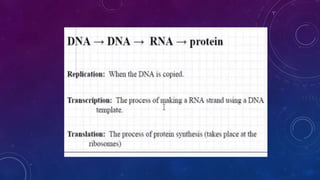
DNA Replication - is the process by which DNA makes a copy of itself
during cell division.
- It begin at specific sites in the DNA double helix
chain. Since the chain is very long, thousands of
sections of the DNA must be replicated at the same
instance to lessen the time of producing complete
DNA copies. The process involves the use of different
enzymes that aid in DNA replication.
.
A chromosome is a long DNA molecule with part or all of the genetic material
of an organism.
DNA PACKAGING
All the cells (except sex cells)
forming the body of a living
thing have the same number of
chromosomes.
Furthermore, the number of
chromosomes among different
species may vary.
Human beings have 46
(23pairs) chromosomes.
Pineapples have 50
Tigers have 38
Dogs have 78
Gorillas have 48
DNA TO RNA
Ribose – the sugar of rna
Deoxyribose – the sugar of
dna
RNA – nucleobase are
cytosine, guanine,adenine,
uracil
DNA – nuecleubase are
sytosine, guanine, adenine
and thymine
RNA – 1 strand of a double
helix, shorter
DNA – two strand
Types or RNA
Messenger RNA (mRNA) – serves as templates for protein
synthesis;
Ribosomal RNA (rRNA) – is the assembly site for proteins;
Transfer RNA(tRNA) – delivers the building blocks of protein
(amino acids).
Transcription – is the copying of DNA templates into RNA.
Why do offspring not look exactly like their
parents?
Thank you
- Teacher Edar

Heredity

  • 1.
  • 2.
  • 3.
    HEREDITY – the processof passing traits from one generation to another. Gregor Mendel (1822-1884) – conducted studies that proved the patterns of inheritance among living things using pea plants as subjects of his experiments.
  • 4.
    John Friedrich Miescher(1844-1895) – physician, in 1869 discovered a particular material in the nuclei of cells from pus. He called it “nuclein”, which eventually became known as deoxyribonucleic acid or simply DNA.
  • 5.
    DNA AS BLUEPRINT DNA– serves as a blueprint. It is a molecule that contains essential information that instructs how an organisms develops and functions. A DNA molecule is composed of : • a sugar • a phosphate • a nucleobase.
  • 6.
    Four unique sequencingof nucleobases in the DNA: - results in diversity among living things. • Adenine • Thymine • Guanine • Cytosine
  • 8.
    DNA REPLICATION DNA Replication- is the process by which DNA makes a copy of itself during cell division. - It begin at specific sites in the DNA double helix chain. Since the chain is very long, thousands of sections of the DNA must be replicated at the same instance to lessen the time of producing complete DNA copies. The process involves the use of different enzymes that aid in DNA replication.
  • 9.
  • 10.
    A chromosome isa long DNA molecule with part or all of the genetic material of an organism. DNA PACKAGING
  • 12.
    All the cells(except sex cells) forming the body of a living thing have the same number of chromosomes. Furthermore, the number of chromosomes among different species may vary. Human beings have 46 (23pairs) chromosomes. Pineapples have 50 Tigers have 38 Dogs have 78 Gorillas have 48
  • 14.
  • 15.
    Ribose – thesugar of rna Deoxyribose – the sugar of dna RNA – nucleobase are cytosine, guanine,adenine, uracil DNA – nuecleubase are sytosine, guanine, adenine and thymine RNA – 1 strand of a double helix, shorter DNA – two strand
  • 16.
    Types or RNA MessengerRNA (mRNA) – serves as templates for protein synthesis; Ribosomal RNA (rRNA) – is the assembly site for proteins; Transfer RNA(tRNA) – delivers the building blocks of protein (amino acids). Transcription – is the copying of DNA templates into RNA.
  • 18.
    Why do offspringnot look exactly like their parents?
  • 19.