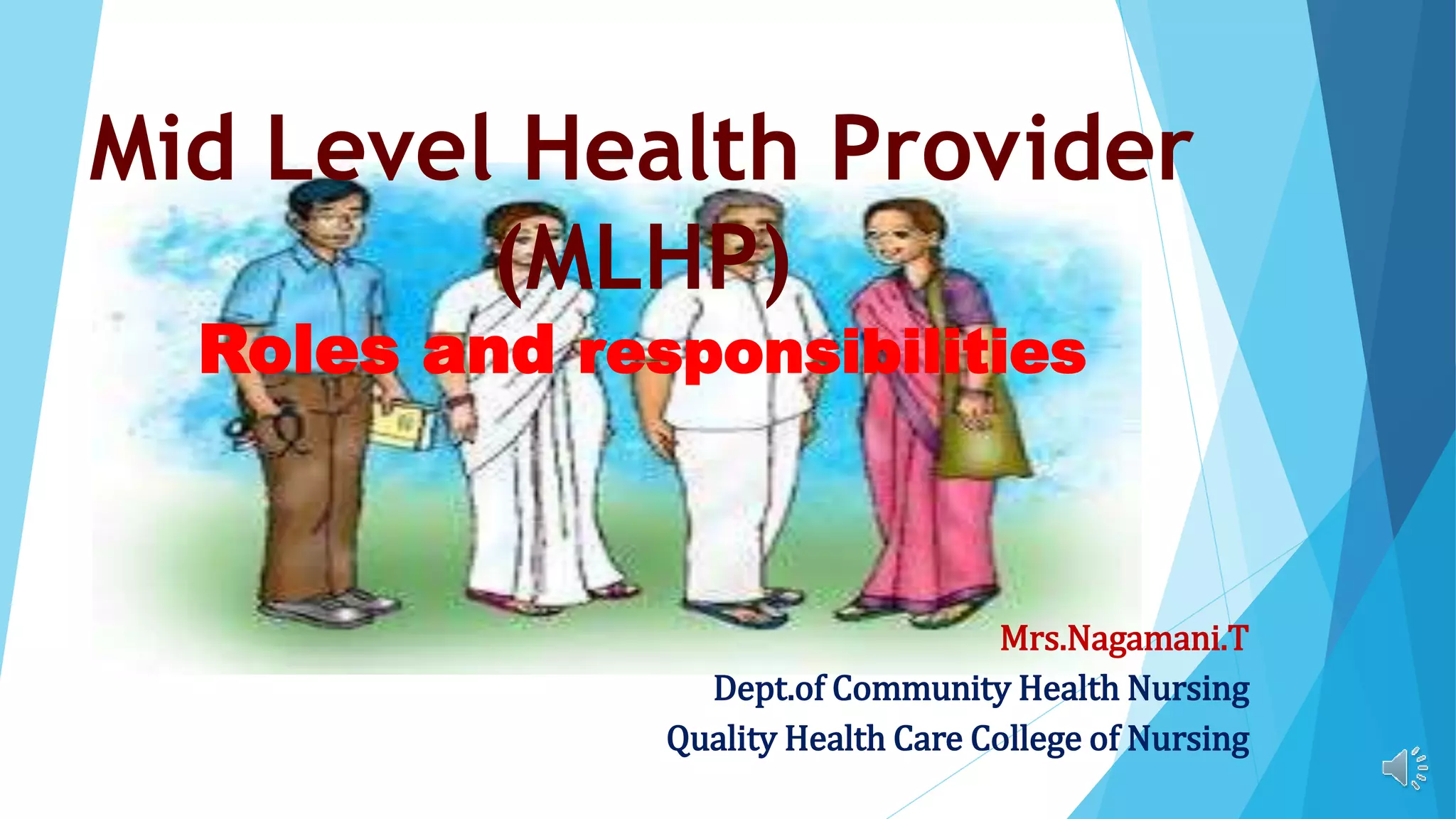
Mid Level Health Provider
(MLHP)
Roles and responsibilities
Mrs.Nagamani.T
Dept.of Community Health Nursing
Quality Health Care College of Nursing
Introduction ( MLHP/CHO/CHP)
 The concept of mid-level health providers started 100 years ago in many
countries and showed a remarkable change in their health indicators. Since
last 10 years, the growth of health professionals is in rise with its new
emerging roles.
 Mid-level health care providers are new emerging workforce in healthcare
sector.
 India is alarming country for disease burden and to cover the huge gap in
providing health care facilities, it requires the mid-level health care providers
at different settings of the country.
 In order to provide quality primary health care In 2019, a new Mid-level
Health Care Provider role was introduced in India, also known as Community
Health Officer/ Community Health Provider. The role was intended for
support the health and wellness centres in community.
 Mid-level practitioners, also called assistant practice
clinicians and non-physician practitioner, are trained health care
providers who have a defined scope of practice. This means that they
are trained and legally permitted to provide healthcare in fewer
situations than physicians and some other health professionals, but
more than other health professionals.
 Mid-level providers are cost-effective in primary care settings, where
they can relieve physicians of the necessity of providing routine care.
 Community health officers play a role to bridge the gap between
community people and health care facilities. The services provided by
them improve the quality of life in community and also empowers the
community health care settings
Definition
 According to WHO, Mid Level Health Provider is :
A health provider:
 Who is trained, authorized and regulated to work
autonomously,
 Who receives pre-service training at a higher education
institution for at least 2-3 years, and
 Whose scope of practice includes (but is not restricted to)
being able to diagnose, manage and treat illness, disease
and impairments (including perform surgery, where
appropriately trained), prescribe medicines, as well as
engage in preventive and promotive care.
Need for MLHP
 Studies reported around 11.5% households in rural areas and about
only 4% in urban areas, are not receiving any form of OPD care at sub-
centre, primary health centre and CHC level. This indicates the low
utilization of primary health care for minor ailments or it may be
because of inefficient health-care services or unavailability of
healthcare providers.
 In order to expand access to comprehensive primary health care
(CPHC), government of India has launched Ayushman Bharat - Pradhan
Mantri Jan Arogya Yojana (PMJAY) in Sept, 2018. PMJAY is a centrally
sponsored scheme. Under this scheme - health and wellness centres
(HWCs), sub health centres (SHCs), and primary health centres (PHCs)
are being strengthened as health and wellness centres (HWCs).
 The services in HWCs will be provided through a mid-level health care
provider (MLHP)/community health officer (CHO) placed at a HWCs
and medical officer at PHC (rural/urban). The MLHP/CHO will undergo
a certificate in community health through IGNOU or public university
 Community health officers are health care workers with training less
than that of a physician but greater than that of more ordinary nurses
and other medical assistants. India is a second most populous nation
in the world and also a developing country. As per WHO, by 2024 the
projected population would be 1,447,560,463.
 With this growing population, India is in a great demand of doctors
and nurses. At present India has a shortage of an estimated 600,000
doctors despite of more than 529 government and private medical
colleges having an annual intake of 70,978 students.
 community health officer will bridge the gap between population and sub-
centre, primary health centre and community health centre.
 CHO’s are permitted to serve the community independently to diagnose,
manage and treat minor ailments and impairments and also engage in
preventive Expended Service Delivery. Continuum of Care – Tele-health/
Referral.
 Their expanding roles are more helpful for low- and middle-income countries,
as a strategy to overcome the shortage of health care workforce challenges
and improve access to essential health care services.
 So, the MLHP or CHO or mid-level practioner (MLP) or community health
provider (CHP) are sounds the same and ultimately it means the majority of
nurses will be in this role.
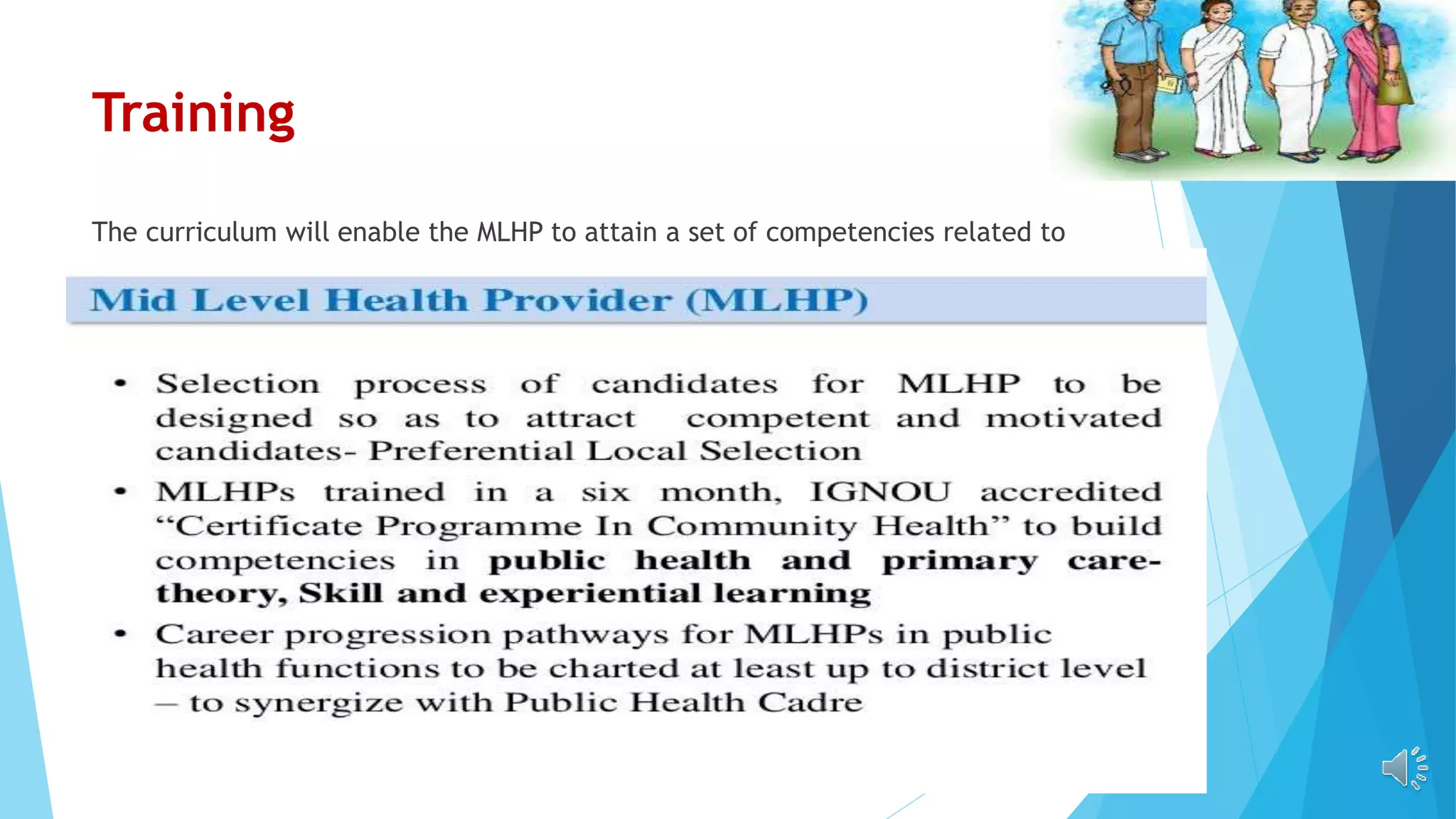
Training
The curriculum will enable the MLHP to attain a set of competencies related to
public health and primary health care.
Roles and responsibilities of MLHP
CHO roles and responsibilities are purely population oriented in public
health.
They are expected to provide specific service delivery, leadership,
supervision, management and take pro-active role in all the activities at
community level, organize various health program and activity in health
promotion according the need
These roles of CHO help to bridge the gap between health care facilities
and population seeking health care.
Roles are:
 Health care services
 Administrative and supervision services
 Other services
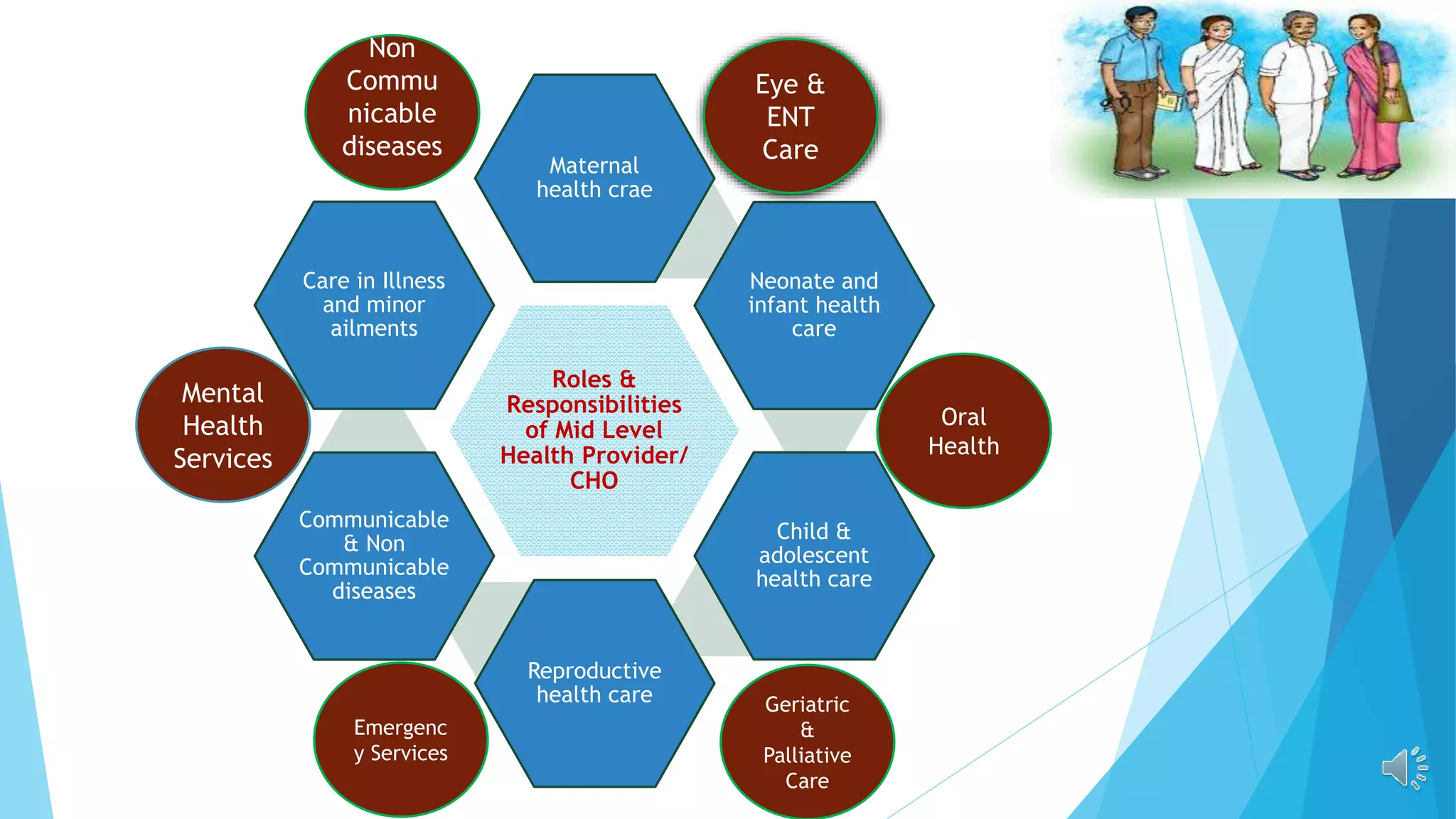
Roles &
Responsibilities
of Mid Level
Health Provider/
CHO
Maternal
health crae
Neonate and
infant health
care
Child &
adolescent
health care
Reproductive
health care
Communicable
& Non
Communicable
diseases
Care in Illness
and minor
ailments
Eye &
ENT
Care
Oral
Health
Geriatric
&
Palliative
Care
Emergenc
y Services
Mental
Health
Services
Non
Commu
nicable
diseases
Health care services
 Maternal health care: Prenatal care like antenatal checkup, screening for
high risk, immunization and supplementation, child birth, postnatal care and
if require referral to higher center.
 Neonate and infant health care: Management of high-risk newborn,
screening of congenital anomalies, IMNCI services, immunization.
 Childhood and adolescent health care: Adolescent health counselling,
identification of drug abuse, detection of any deficiency, nutritional
supplement and referral services.
 Reproductive health care: Family planning, prevention and
management of STI, identification of gynecological problems and
referral services.
 Communicable diseases: Diagnosis and treatment of vector or
water borne diseases, provision of DOTs and DPMR (disability
prevention and medical rehabilitation) services for leprosy along with
referral services.
 Illness and minor ailments: Identification and management of
fever, respiratory infection, diarrhea, cholera, skin rashes, pain,
typhoid, etc.
 Non-communicable diseases: Screening, prevention, control and
management along with follow up and maintenance of treatment
modalities.
 Eye and ENT: Screening along with primary care of ophthalmic and
ENT problem and referral services of any emergency.
 Oral health: Regular checkup and screening of oral health.
 Geriatric and palliative care: Health camp organization routine
checkup.
 Emergency services: Burn, injury, trauma along with first aid
management.
 Mental health care: Screening and counseling along with referral
services.
Administrative and supervision services
 Administrative services: Guidance to other co-health workers
and maintain inventory, report submission.
 Supervision: Supervision of national health program, ASHA,
home visits, health promotion activities.
 Care pathway: Provide specific care according to
standard treatment guidelines.
 Case coordinator and manager: Provide communication to
higher authority regarding specific case, coordinate in care and
management of care.
 Disaster and outbreak of disease: Local response to disease
outbreak and early management of disaster.
 Fund management: Support the team for entitling the fund for
various projects and program.
 Data management: Record population data with various health
indicator and communicate it.
 Environmental role: Education to community, speak about safe
water, sanitation, disposal of waste, pollution control and identify
environmental hazards and control.
Other skills
 Communication skills, interpersonal relationship skills, transcultural
competence, assessment skills, training capability, professionalism,
advocacy, education and facilitation.
Conclusion
 Since we have shortage of doctors and specialists, the shift in role to
mid-level health care provider will relieve the overburdened doctors
and specialists, at least in rural health setting
 Mid-level health care provider has the limited licence only in primary
and preventive healthcare to practice medicine at mid-level, who
qualify the criteria as may be specified by regulations which will have
an overwhelming representation of doctors.
 This initiative by government of India will help to provide easy and
affordable health care services to the population which also play an
important role for universal health coverage in India.
 REFERENCES
 1. World Health Organization, Global Health Workforce Alliance. The Kampala
Declaration and Agenda for Global Action. Geneva: WHO; 2008.
 2. International Labour Organization. The International Standard
Classification of Occupations (ISCO-88). Geneva: ILO; 2004.
 3. World Health Organization, Western Pacific Region. Mid-level and nurse
practitioners in the Pacific: models and issues. Manila: WHO/WPRO; 2001
 4. Desai S et al. Int J Community Med Public Health. 2020 Apr;7(4):1610-1617
THANK YOU

MLHP Roles and Responsibilities

  • 1.
    Mid Level HealthProvider (MLHP) Roles and responsibilities Mrs.Nagamani.T Dept.of Community Health Nursing Quality Health Care College of Nursing
  • 2.
    Introduction ( MLHP/CHO/CHP) The concept of mid-level health providers started 100 years ago in many countries and showed a remarkable change in their health indicators. Since last 10 years, the growth of health professionals is in rise with its new emerging roles.  Mid-level health care providers are new emerging workforce in healthcare sector.  India is alarming country for disease burden and to cover the huge gap in providing health care facilities, it requires the mid-level health care providers at different settings of the country.  In order to provide quality primary health care In 2019, a new Mid-level Health Care Provider role was introduced in India, also known as Community Health Officer/ Community Health Provider. The role was intended for support the health and wellness centres in community.
  • 3.
     Mid-level practitioners,also called assistant practice clinicians and non-physician practitioner, are trained health care providers who have a defined scope of practice. This means that they are trained and legally permitted to provide healthcare in fewer situations than physicians and some other health professionals, but more than other health professionals.  Mid-level providers are cost-effective in primary care settings, where they can relieve physicians of the necessity of providing routine care.  Community health officers play a role to bridge the gap between community people and health care facilities. The services provided by them improve the quality of life in community and also empowers the community health care settings
  • 4.
    Definition  According toWHO, Mid Level Health Provider is : A health provider:  Who is trained, authorized and regulated to work autonomously,  Who receives pre-service training at a higher education institution for at least 2-3 years, and  Whose scope of practice includes (but is not restricted to) being able to diagnose, manage and treat illness, disease and impairments (including perform surgery, where appropriately trained), prescribe medicines, as well as engage in preventive and promotive care.
  • 5.
    Need for MLHP Studies reported around 11.5% households in rural areas and about only 4% in urban areas, are not receiving any form of OPD care at sub- centre, primary health centre and CHC level. This indicates the low utilization of primary health care for minor ailments or it may be because of inefficient health-care services or unavailability of healthcare providers.  In order to expand access to comprehensive primary health care (CPHC), government of India has launched Ayushman Bharat - Pradhan Mantri Jan Arogya Yojana (PMJAY) in Sept, 2018. PMJAY is a centrally sponsored scheme. Under this scheme - health and wellness centres (HWCs), sub health centres (SHCs), and primary health centres (PHCs) are being strengthened as health and wellness centres (HWCs).
  • 6.
     The servicesin HWCs will be provided through a mid-level health care provider (MLHP)/community health officer (CHO) placed at a HWCs and medical officer at PHC (rural/urban). The MLHP/CHO will undergo a certificate in community health through IGNOU or public university  Community health officers are health care workers with training less than that of a physician but greater than that of more ordinary nurses and other medical assistants. India is a second most populous nation in the world and also a developing country. As per WHO, by 2024 the projected population would be 1,447,560,463.  With this growing population, India is in a great demand of doctors and nurses. At present India has a shortage of an estimated 600,000 doctors despite of more than 529 government and private medical colleges having an annual intake of 70,978 students.
  • 7.
     community healthofficer will bridge the gap between population and sub- centre, primary health centre and community health centre.  CHO’s are permitted to serve the community independently to diagnose, manage and treat minor ailments and impairments and also engage in preventive Expended Service Delivery. Continuum of Care – Tele-health/ Referral.  Their expanding roles are more helpful for low- and middle-income countries, as a strategy to overcome the shortage of health care workforce challenges and improve access to essential health care services.  So, the MLHP or CHO or mid-level practioner (MLP) or community health provider (CHP) are sounds the same and ultimately it means the majority of nurses will be in this role.
  • 8.
    Training The curriculum willenable the MLHP to attain a set of competencies related to public health and primary health care.
  • 9.
    Roles and responsibilitiesof MLHP CHO roles and responsibilities are purely population oriented in public health. They are expected to provide specific service delivery, leadership, supervision, management and take pro-active role in all the activities at community level, organize various health program and activity in health promotion according the need These roles of CHO help to bridge the gap between health care facilities and population seeking health care. Roles are:  Health care services  Administrative and supervision services  Other services
  • 10.
    Roles & Responsibilities of MidLevel Health Provider/ CHO Maternal health crae Neonate and infant health care Child & adolescent health care Reproductive health care Communicable & Non Communicable diseases Care in Illness and minor ailments Eye & ENT Care Oral Health Geriatric & Palliative Care Emergenc y Services Mental Health Services Non Commu nicable diseases
  • 11.
    Health care services Maternal health care: Prenatal care like antenatal checkup, screening for high risk, immunization and supplementation, child birth, postnatal care and if require referral to higher center.  Neonate and infant health care: Management of high-risk newborn, screening of congenital anomalies, IMNCI services, immunization.  Childhood and adolescent health care: Adolescent health counselling, identification of drug abuse, detection of any deficiency, nutritional supplement and referral services.
  • 12.
     Reproductive healthcare: Family planning, prevention and management of STI, identification of gynecological problems and referral services.  Communicable diseases: Diagnosis and treatment of vector or water borne diseases, provision of DOTs and DPMR (disability prevention and medical rehabilitation) services for leprosy along with referral services.  Illness and minor ailments: Identification and management of fever, respiratory infection, diarrhea, cholera, skin rashes, pain, typhoid, etc.  Non-communicable diseases: Screening, prevention, control and management along with follow up and maintenance of treatment modalities.  Eye and ENT: Screening along with primary care of ophthalmic and ENT problem and referral services of any emergency.
  • 13.
     Oral health:Regular checkup and screening of oral health.  Geriatric and palliative care: Health camp organization routine checkup.  Emergency services: Burn, injury, trauma along with first aid management.  Mental health care: Screening and counseling along with referral services. Administrative and supervision services  Administrative services: Guidance to other co-health workers and maintain inventory, report submission.  Supervision: Supervision of national health program, ASHA, home visits, health promotion activities.
  • 14.
     Care pathway:Provide specific care according to standard treatment guidelines.  Case coordinator and manager: Provide communication to higher authority regarding specific case, coordinate in care and management of care.  Disaster and outbreak of disease: Local response to disease outbreak and early management of disaster.  Fund management: Support the team for entitling the fund for various projects and program.  Data management: Record population data with various health indicator and communicate it.
  • 15.
     Environmental role:Education to community, speak about safe water, sanitation, disposal of waste, pollution control and identify environmental hazards and control. Other skills  Communication skills, interpersonal relationship skills, transcultural competence, assessment skills, training capability, professionalism, advocacy, education and facilitation.
  • 16.
    Conclusion  Since wehave shortage of doctors and specialists, the shift in role to mid-level health care provider will relieve the overburdened doctors and specialists, at least in rural health setting  Mid-level health care provider has the limited licence only in primary and preventive healthcare to practice medicine at mid-level, who qualify the criteria as may be specified by regulations which will have an overwhelming representation of doctors.  This initiative by government of India will help to provide easy and affordable health care services to the population which also play an important role for universal health coverage in India.
  • 17.
     REFERENCES  1.World Health Organization, Global Health Workforce Alliance. The Kampala Declaration and Agenda for Global Action. Geneva: WHO; 2008.  2. International Labour Organization. The International Standard Classification of Occupations (ISCO-88). Geneva: ILO; 2004.  3. World Health Organization, Western Pacific Region. Mid-level and nurse practitioners in the Pacific: models and issues. Manila: WHO/WPRO; 2001  4. Desai S et al. Int J Community Med Public Health. 2020 Apr;7(4):1610-1617
  • 18.