Participative Leadership, Delegation,
and Empowerment
Participative Leadership, Delegation, and Empowerment
3-1
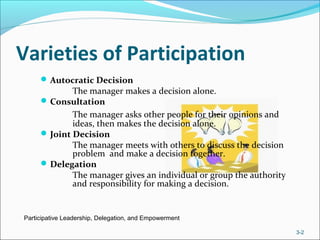
Varieties of Participation
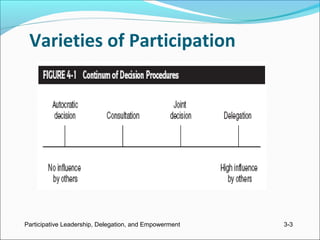
Autocratic Decision
The manager makes a decision alone.
Consultation
The manager asks other people for their opinions and
ideas, then makes the decision alone.
Joint Decision
The manager meets with others to discuss the decision
problem and make a decision together.
Delegation
The manager gives an individual or group the authority
and responsibility for making a decision.
Participative Leadership, Delegation, and Empowerment
3-2
Participative Leadership, Delegation, and Empowerment 3-3
Varieties of Participation
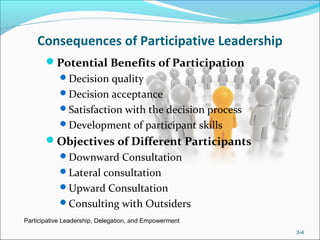
Consequences of Participative Leadership
Potential Benefits of Participation
Decision quality
Decision acceptance
Satisfaction with the decision process
Development of participant skills
Objectives of Different Participants
Downward Consultation
Lateral consultation
Upward Consultation
Consulting with Outsiders
Participative Leadership, Delegation, and Empowerment
3-4
Research on Effects of Participative
Leadership
Example of Research on Participation – Bragg &
Andrews (1973)
Effects of Participation
Limitations of Participation Research
Measurement problems with survey field research
Combining interventions
Short-term programs
Difficulty comparing results across studies
Participative Leadership, Delegation, and Empowerment
3-5
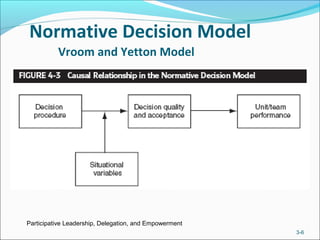
Normative Decision Model
Vroom and Yetton Model
Participative Leadership, Delegation, and Empowerment
3-6
Guidelines for Participative Leadership
Encourage Participation
Encourage people to express their concerns
Describe a proposal as tentative
Record ideas and suggestions
Look for ways to build on ideas and suggestions
Be tactful in expressing concerns about a suggestion
Listen to dissenting views without getting defensive
Try to utilize suggestions and deal with concerns
Show appreciation for suggestions
Participative Leadership, Delegation, and Empowerment
3-7
Delegation
Participative Leadership, Delegation, and Empowerment
3-8
Varieties of Delegation
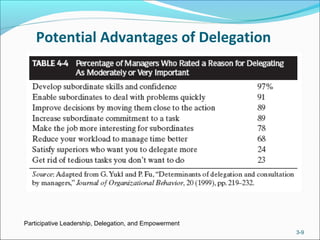
Potential Advantages of Delegation
Improvement in decision quality
Greater subordinate commitment
Making subordinates’ jobs more interesting,
challenging, and meaningful
Improved time management
Important form of management development
Potential Advantages of Delegation
Participative Leadership, Delegation, and Empowerment
3-9
Delegation
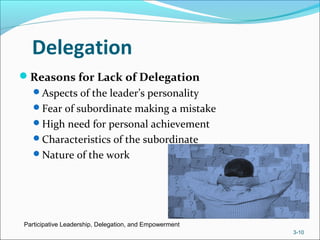
Reasons for Lack of Delegation
Aspects of the leader’s personality
Fear of subordinate making a mistake
High need for personal achievement
Characteristics of the subordinate
Nature of the work
Participative Leadership, Delegation, and Empowerment
3-10
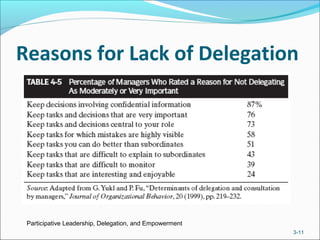
Reasons for Lack of Delegation
Participative Leadership, Delegation, and Empowerment
3-11
Guidelines for Delegating
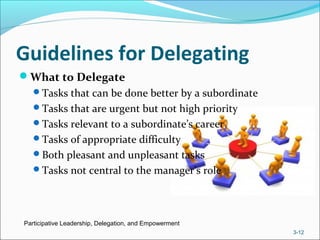
What to Delegate
Tasks that can be done better by a subordinate
Tasks that are urgent but not high priority
Tasks relevant to a subordinate’s career
Tasks of appropriate difficulty
Both pleasant and unpleasant tasks
Tasks not central to the manager’s role
Participative Leadership, Delegation, and Empowerment
3-12
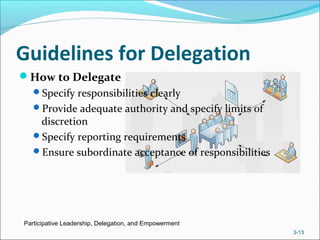
Guidelines for Delegation
How to Delegate
Specify responsibilities clearly
Provide adequate authority and specify limits of
discretion
Specify reporting requirements
Ensure subordinate acceptance of responsibilities
Participative Leadership, Delegation, and Empowerment
3-13
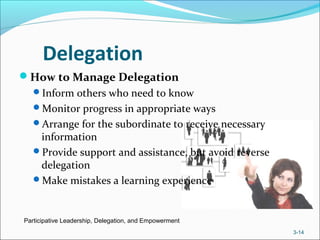
Delegation
How to Manage Delegation
Inform others who need to know
Monitor progress in appropriate ways
Arrange for the subordinate to receive necessary
information
Provide support and assistance, but avoid reverse
delegation
Make mistakes a learning experience
Participative Leadership, Delegation, and Empowerment
3-14
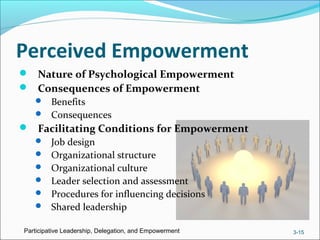
Perceived Empowerment
 Nature of Psychological Empowerment
 Consequences of Empowerment
 Benefits
 Consequences
 Facilitating Conditions for Empowerment
 Job design
 Organizational structure
 Organizational culture
 Leader selection and assessment
 Procedures for influencing decisions
 Shared leadership
Participative Leadership, Delegation, and Empowerment 3-15
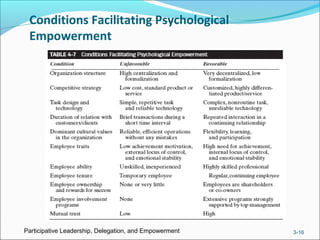
Conditions Facilitating Psychological
Empowerment
Participative Leadership, Delegation, and Empowerment 3-16
Guidelines for Empowerment
Clarify objectives and explain how the work supports
them
Involve people in making decisions that affect them
Delegate responsibility and authority for important
activities
Take into account individual differences in motivation
and skills
Provide access to relevant information
Provide resources needed to carry out new
responsibilities
Change management systems to be consistent with
empowerment
Participative Leadership, Delegation, and Empowerment
3-17
Guidelines for Empowerment
Remove bureaucratic constraints and unnecessary
controls
Express confidence and trust in people
Provide coaching and advice when requested
Encourage and support initiative and problem solving
Recognize important contributions and achievements
Ensure that rewards are commensurate with new
responsibilities
Ensure accountability for the ethical use of power
Participative Leadership, Delegation, and Empowerment
3-18
3-19
Summary
Participative Leadership involves efforts by a manager to
encourage & facilitate participation by others in making decisions
that would otherwise be made by the manager alone
Forms of Participation
 Revising a tentative decision
 Asking for suggestions
 Asking an individual or group to jointly make a decision
 Allowing others to make a decision (subject to manager’s final
authorization)
Why Involving others in Decision Making is often necessary
 Better Decisions
 Greater Acceptance of Decisions
3-20
Summary
Participative Leadership Studies Results
 Research evidence not sufficiently strong
 Inconsistent to draw any firm conclusions
Various Forms of Participation (Subject to Situation)
 Divergent objectives from that of leader
 Lack of will to share responsibility in decision making
 Distrust in leader
 Time pressures
 Dispersion of participants
Group Forms of Participation Effective only
 Manager’s conflict resolution skills
 Facilitation in constructive problem solving
 Dealing with group common process problems
3-21
Summary
Vroom & Yetton Model
 To help managers identify the appropriate decision procedures
in different situations.
 The situational variables are characteristics of the decision
situation that determine whether a particular decision
procedure will increase or decrease decision quality and
acceptance
 The model was extended by Vroom and Jago to include other
criteria & aspects of the situation
 Research on these models is limited, but it provides moderate
support for them
 The findings suggest that managers are likely to be more
effective if they use decision procedures that are appropriate for
the situation
3-22
Summary
Delegation
The assignment of new responsibilities & additional authority
to individual subordinates or to a team
Benefits of Delegation
Better decisions
Increased subordinate motivation
More satisfying jobs for subordinates
Development of subordinate skills
Reduction of work overload for a manager
What Prevents from Delegation
Lack of confidence in subordinates
Desire to consolidate power
Research on the consequences of
using delegation is still limited, but the findings suggest it can be effective when used
for appropriate decisions and carried out in a competent manner
3-23
Summary
Psychological Empowerment (combination of)
 Meaningful work
 High self-efficacy
 Self-determination
 Ability to influence relevant events
Relevant Behaviors (How Leaders can affect Followers)
 Participative Leadership
 Delegation
What Effects Powerful or Powerless Feeling
 Aspects of the job
 The organisation
 The employees
Several types of programs have been used by organizations
to increase member empowerment, but the results from research on these programs
are mixed.
3-24
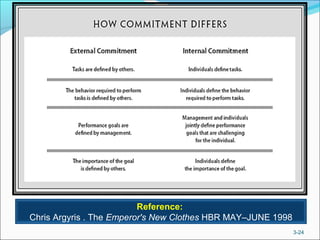
Reference:
Chris Argyris . The Emperor's New Clothes HBR MAY–JUNE 1998
Participative Leadership, Delegation, and Empowerment
3-25
Thank you

Chapter 4 leadership in org

  • 1.
    Participative Leadership, Delegation, andEmpowerment Participative Leadership, Delegation, and Empowerment 3-1
  • 2.
    Varieties of Participation AutocraticDecision The manager makes a decision alone. Consultation The manager asks other people for their opinions and ideas, then makes the decision alone. Joint Decision The manager meets with others to discuss the decision problem and make a decision together. Delegation The manager gives an individual or group the authority and responsibility for making a decision. Participative Leadership, Delegation, and Empowerment 3-2
  • 3.
    Participative Leadership, Delegation,and Empowerment 3-3 Varieties of Participation
  • 4.
    Consequences of ParticipativeLeadership Potential Benefits of Participation Decision quality Decision acceptance Satisfaction with the decision process Development of participant skills Objectives of Different Participants Downward Consultation Lateral consultation Upward Consultation Consulting with Outsiders Participative Leadership, Delegation, and Empowerment 3-4
  • 5.
    Research on Effectsof Participative Leadership Example of Research on Participation – Bragg & Andrews (1973) Effects of Participation Limitations of Participation Research Measurement problems with survey field research Combining interventions Short-term programs Difficulty comparing results across studies Participative Leadership, Delegation, and Empowerment 3-5
  • 6.
    Normative Decision Model Vroomand Yetton Model Participative Leadership, Delegation, and Empowerment 3-6
  • 7.
    Guidelines for ParticipativeLeadership Encourage Participation Encourage people to express their concerns Describe a proposal as tentative Record ideas and suggestions Look for ways to build on ideas and suggestions Be tactful in expressing concerns about a suggestion Listen to dissenting views without getting defensive Try to utilize suggestions and deal with concerns Show appreciation for suggestions Participative Leadership, Delegation, and Empowerment 3-7
  • 8.
    Delegation Participative Leadership, Delegation,and Empowerment 3-8 Varieties of Delegation Potential Advantages of Delegation Improvement in decision quality Greater subordinate commitment Making subordinates’ jobs more interesting, challenging, and meaningful Improved time management Important form of management development
  • 9.
    Potential Advantages ofDelegation Participative Leadership, Delegation, and Empowerment 3-9
  • 10.
    Delegation Reasons for Lackof Delegation Aspects of the leader’s personality Fear of subordinate making a mistake High need for personal achievement Characteristics of the subordinate Nature of the work Participative Leadership, Delegation, and Empowerment 3-10
  • 11.
    Reasons for Lackof Delegation Participative Leadership, Delegation, and Empowerment 3-11
  • 12.
    Guidelines for Delegating Whatto Delegate Tasks that can be done better by a subordinate Tasks that are urgent but not high priority Tasks relevant to a subordinate’s career Tasks of appropriate difficulty Both pleasant and unpleasant tasks Tasks not central to the manager’s role Participative Leadership, Delegation, and Empowerment 3-12
  • 13.
    Guidelines for Delegation Howto Delegate Specify responsibilities clearly Provide adequate authority and specify limits of discretion Specify reporting requirements Ensure subordinate acceptance of responsibilities Participative Leadership, Delegation, and Empowerment 3-13
  • 14.
    Delegation How to ManageDelegation Inform others who need to know Monitor progress in appropriate ways Arrange for the subordinate to receive necessary information Provide support and assistance, but avoid reverse delegation Make mistakes a learning experience Participative Leadership, Delegation, and Empowerment 3-14
  • 15.
    Perceived Empowerment  Natureof Psychological Empowerment  Consequences of Empowerment  Benefits  Consequences  Facilitating Conditions for Empowerment  Job design  Organizational structure  Organizational culture  Leader selection and assessment  Procedures for influencing decisions  Shared leadership Participative Leadership, Delegation, and Empowerment 3-15
  • 16.
    Conditions Facilitating Psychological Empowerment ParticipativeLeadership, Delegation, and Empowerment 3-16
  • 17.
    Guidelines for Empowerment Clarifyobjectives and explain how the work supports them Involve people in making decisions that affect them Delegate responsibility and authority for important activities Take into account individual differences in motivation and skills Provide access to relevant information Provide resources needed to carry out new responsibilities Change management systems to be consistent with empowerment Participative Leadership, Delegation, and Empowerment 3-17
  • 18.
    Guidelines for Empowerment Removebureaucratic constraints and unnecessary controls Express confidence and trust in people Provide coaching and advice when requested Encourage and support initiative and problem solving Recognize important contributions and achievements Ensure that rewards are commensurate with new responsibilities Ensure accountability for the ethical use of power Participative Leadership, Delegation, and Empowerment 3-18
  • 19.
    3-19 Summary Participative Leadership involvesefforts by a manager to encourage & facilitate participation by others in making decisions that would otherwise be made by the manager alone Forms of Participation  Revising a tentative decision  Asking for suggestions  Asking an individual or group to jointly make a decision  Allowing others to make a decision (subject to manager’s final authorization) Why Involving others in Decision Making is often necessary  Better Decisions  Greater Acceptance of Decisions
  • 20.
    3-20 Summary Participative Leadership StudiesResults  Research evidence not sufficiently strong  Inconsistent to draw any firm conclusions Various Forms of Participation (Subject to Situation)  Divergent objectives from that of leader  Lack of will to share responsibility in decision making  Distrust in leader  Time pressures  Dispersion of participants Group Forms of Participation Effective only  Manager’s conflict resolution skills  Facilitation in constructive problem solving  Dealing with group common process problems
  • 21.
    3-21 Summary Vroom & YettonModel  To help managers identify the appropriate decision procedures in different situations.  The situational variables are characteristics of the decision situation that determine whether a particular decision procedure will increase or decrease decision quality and acceptance  The model was extended by Vroom and Jago to include other criteria & aspects of the situation  Research on these models is limited, but it provides moderate support for them  The findings suggest that managers are likely to be more effective if they use decision procedures that are appropriate for the situation
  • 22.
    3-22 Summary Delegation The assignment ofnew responsibilities & additional authority to individual subordinates or to a team Benefits of Delegation Better decisions Increased subordinate motivation More satisfying jobs for subordinates Development of subordinate skills Reduction of work overload for a manager What Prevents from Delegation Lack of confidence in subordinates Desire to consolidate power Research on the consequences of using delegation is still limited, but the findings suggest it can be effective when used for appropriate decisions and carried out in a competent manner
  • 23.
    3-23 Summary Psychological Empowerment (combinationof)  Meaningful work  High self-efficacy  Self-determination  Ability to influence relevant events Relevant Behaviors (How Leaders can affect Followers)  Participative Leadership  Delegation What Effects Powerful or Powerless Feeling  Aspects of the job  The organisation  The employees Several types of programs have been used by organizations to increase member empowerment, but the results from research on these programs are mixed.
  • 24.
    3-24 Reference: Chris Argyris .The Emperor's New Clothes HBR MAY–JUNE 1998
  • 25.
    Participative Leadership, Delegation,and Empowerment 3-25 Thank you