What Do You Look for in a SeniorExecutive?
Previously, I introduced an approach to assessing prospective portfolio
company managers efficiently, during due diligence and in subsequent
waves of management team building. Here, I take a closer look at the
competencies because much of your assessment will focus on
determining the competencies managers possess.
The competencies fall into four domains of individual capability:
 Judgment
 Influence
 Management
 Personality
JUDGMENT includes all of the technical, professional/ intellectual and
creative capabilities that let people make sense of the world around
them – to see the forest for the trees; analyze complex data; break
problems down into their component parts; reach logical conclusions;
and generate alternative and new solutions so that they can
understand, assess and determine what needs to be done. People with
good judgment can recognize patterns, make good intuitive decisions,
act strategically and successfully, and change their approach when their
approach proves suboptimal. Organizations have traditionally assessed
Judgment by looking at academic and professional qualifications, career
track record and psychometric tests.
INFLUENCE includes the communications, interpersonal, persuasion and
political competencies that allow someone to work effectively with
clients and colleagues: to explain, persuade, sell, cajole, network,
negotiate and lobby so that they can successfully influence others and
gain their support to get things done. Influence involves gaining support
while lacking formal authority. Personal impact, networking skills,
organizational influencing and conflict resolution are all parts of
influence.
MANAGEMENT covers project and people management – planning,
organizing, scheduling, monitoring, and controlling work; developing,
counseling, and directing people; building teams and resolving conflicts
so as to ensure services are delivered, results are produced, and
projects are completed on time.
Management competencies are needed to produce results through
other people. High-level management competencies (i.e.,
those appropriate for senior management roles) include Strategic
Leadership, Management Team Building, Business Effectiveness
Orientation, and Product and Process Knowledge.
PERSONALITY includes personal traits and tendencies such as drive,
self-confidence, decisiveness, tenacity, flexibility, and resilience. All of
these enable individuals to meet and overcome the stresses, challenges,
conflicts, and obstacles that may affect performance in the other three
domains.
The Competency Framework identifies a broad range of behavioral
dimensions that make up successful management. The actual
requirements of the position should drive the decision about the
relative importance of each type of competency. Frequently private
equity investors overemphasize intellectual requirements of a job and
underemphasize personality requirements.
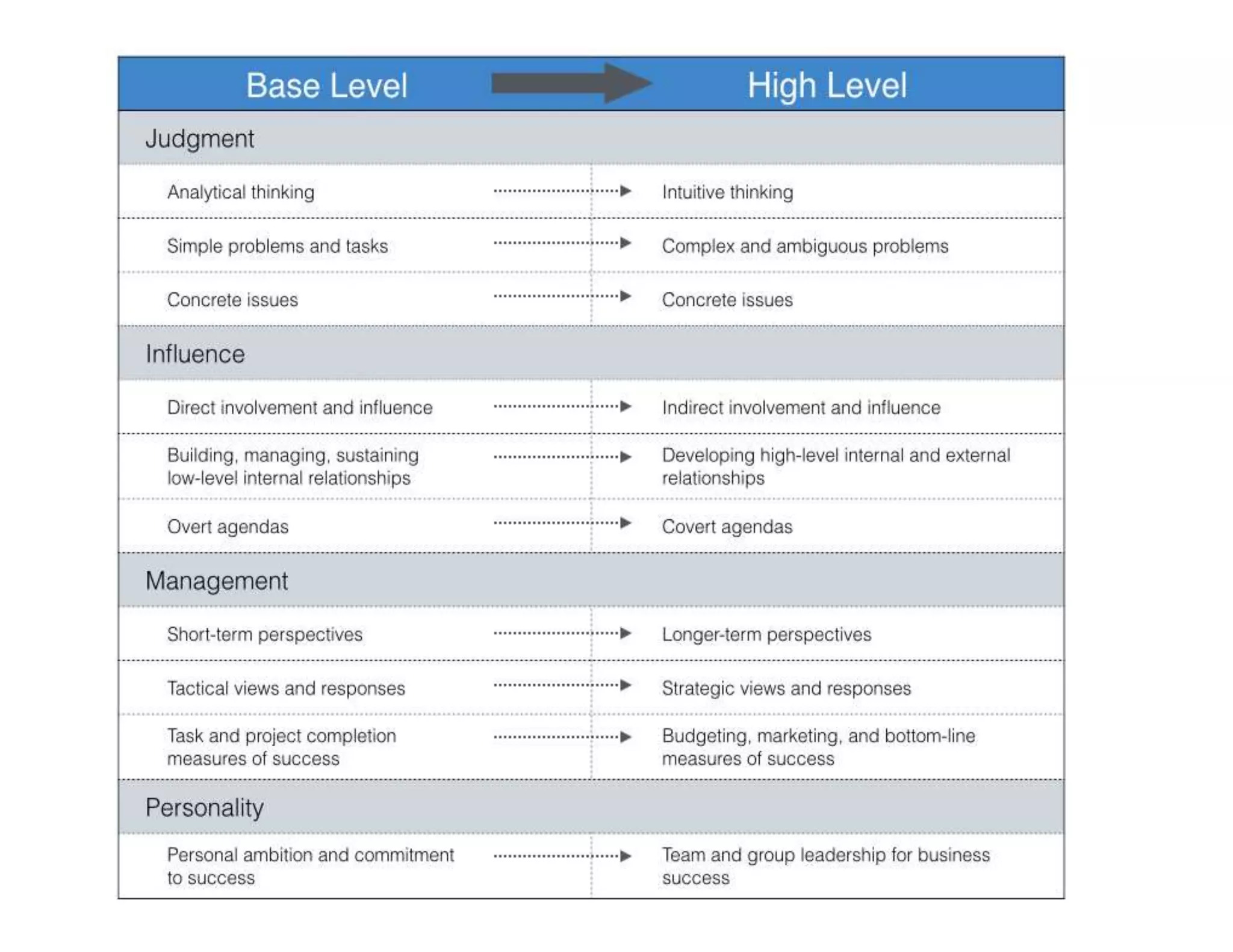
HIGHER AND LOWER TIER COMPETENCIES
Private equity investors seeking senior leaders for portfolio companies
should seek evidence that candidates have the higher-level
competencies listed below, or at least have the potential to develop
those higher-level competencies. (Both solid middle managers and
candidates for senior leadership positions should possess the lower
level competencies.)
By Leslie Pratch
Much of my latest work now appears in The European Financial Review
About the Author
Leslie Pratch
Leslie S. Pratch is the founder and CEO of Pratch & Company. A clinical
psychologist and MBA, she advises private equity investors,
management committees and Boards of Directors of public and
privately held companies whether the executives being considered to
lead companies possess the psychological resources and personality
strengths needed to succeed. In her recently published book, Looks
Good on Paper? (Columbia University Press, 2014), she shares insights
from more than twenty years of executive evaluations and offers an
empirically based approach to identify executives who will be effective
within organizations – and to flag those who will ultimately very likely
fail – by evaluating aspects of personality and character that are hidden
beneath the surface.

What do you look for in a senior executive?

  • 2.
    What Do YouLook for in a SeniorExecutive? Previously, I introduced an approach to assessing prospective portfolio company managers efficiently, during due diligence and in subsequent waves of management team building. Here, I take a closer look at the competencies because much of your assessment will focus on determining the competencies managers possess. The competencies fall into four domains of individual capability:  Judgment  Influence  Management  Personality
  • 3.
    JUDGMENT includes allof the technical, professional/ intellectual and creative capabilities that let people make sense of the world around them – to see the forest for the trees; analyze complex data; break problems down into their component parts; reach logical conclusions; and generate alternative and new solutions so that they can understand, assess and determine what needs to be done. People with good judgment can recognize patterns, make good intuitive decisions, act strategically and successfully, and change their approach when their approach proves suboptimal. Organizations have traditionally assessed Judgment by looking at academic and professional qualifications, career track record and psychometric tests. INFLUENCE includes the communications, interpersonal, persuasion and political competencies that allow someone to work effectively with
  • 4.
    clients and colleagues:to explain, persuade, sell, cajole, network, negotiate and lobby so that they can successfully influence others and gain their support to get things done. Influence involves gaining support while lacking formal authority. Personal impact, networking skills, organizational influencing and conflict resolution are all parts of influence. MANAGEMENT covers project and people management – planning, organizing, scheduling, monitoring, and controlling work; developing, counseling, and directing people; building teams and resolving conflicts so as to ensure services are delivered, results are produced, and projects are completed on time.
  • 5.
    Management competencies areneeded to produce results through other people. High-level management competencies (i.e., those appropriate for senior management roles) include Strategic Leadership, Management Team Building, Business Effectiveness Orientation, and Product and Process Knowledge. PERSONALITY includes personal traits and tendencies such as drive, self-confidence, decisiveness, tenacity, flexibility, and resilience. All of these enable individuals to meet and overcome the stresses, challenges, conflicts, and obstacles that may affect performance in the other three domains. The Competency Framework identifies a broad range of behavioral dimensions that make up successful management. The actual
  • 6.
    requirements of theposition should drive the decision about the relative importance of each type of competency. Frequently private equity investors overemphasize intellectual requirements of a job and underemphasize personality requirements. HIGHER AND LOWER TIER COMPETENCIES Private equity investors seeking senior leaders for portfolio companies should seek evidence that candidates have the higher-level competencies listed below, or at least have the potential to develop those higher-level competencies. (Both solid middle managers and candidates for senior leadership positions should possess the lower level competencies.)
  • 8.
    By Leslie Pratch Muchof my latest work now appears in The European Financial Review About the Author Leslie Pratch Leslie S. Pratch is the founder and CEO of Pratch & Company. A clinical psychologist and MBA, she advises private equity investors, management committees and Boards of Directors of public and
  • 9.
    privately held companieswhether the executives being considered to lead companies possess the psychological resources and personality strengths needed to succeed. In her recently published book, Looks Good on Paper? (Columbia University Press, 2014), she shares insights from more than twenty years of executive evaluations and offers an empirically based approach to identify executives who will be effective within organizations – and to flag those who will ultimately very likely fail – by evaluating aspects of personality and character that are hidden beneath the surface.