Case presentation Prepared by Dr R Musa
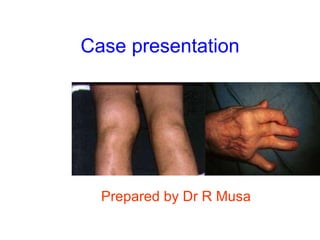
GP referral 71 yrs old Lady presented few of months ago with : History suggestive of PMR Initially good response to 20mg of steroid Difficult to  ↓  steroid, (recurrent symptoms), persist  ↑  ESR 50, CRP 91 Required  ↑  dose to 30mg  Developed arthralgia with puffy hands
History C/O; Aching pain & stiffness in both arms, hands, knees & feet Morning stiffness > 3 hours Soft tissue swelling of both hands, swollen knees and ankles No skin rash, no excess hair loss & (no psoriasis or F/H of psoriasis No dry eyes / dry mouth  No Wt loss, normal bowel habits & No urinary symptoms
Social history Never smoked. Retired, married. Medication Prednisolone 25mg daily  Alendronic acid 70mg once a week Atenolol 100mg Doxazosin 8mg Bendrofluazide 2.5mg Paracetamol 1gm PRN Omeprazole 20mg
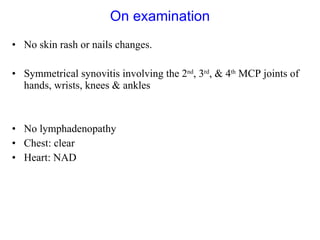
On examination No skin rash or nails changes. Symmetrical synovitis involving the 2 nd , 3 rd , & 4 th  MCP joints of hands, wrists, knees & ankles No lymphadenopathy Chest: clear Heart: NAD
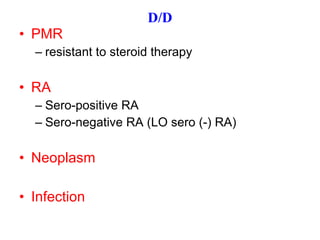
D/D PMR   resistant to steroid therapy RA  Sero-positive RA  Sero-negative RA (LO sero (-) RA) Neoplasm Infection
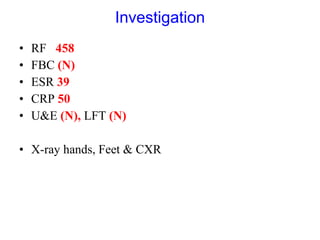
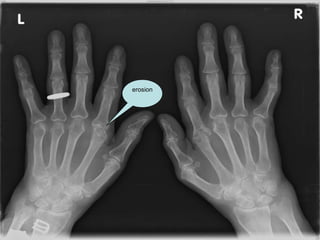
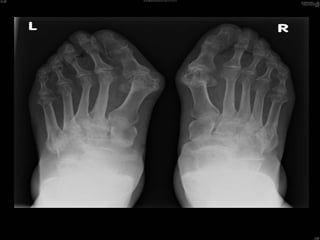
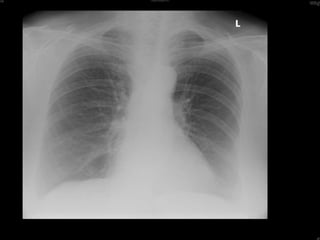
Investigation RF  458 FBC  (N) ESR  39 CRP  50 U&E  (N),  LFT  (N) X-ray hands, Feet & CXR
erosion
 
 
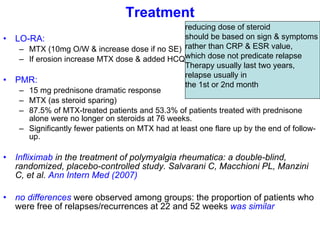
Treatment LO-RA:  MTX (10mg O/W & increase dose if no SE) If erosion increase MTX dose & added HCQ PMR: 15 mg prednisone dramatic response  MTX (as steroid sparing) 87.5% of MTX-treated patients and 53.3% of patients treated with prednisone alone were no longer on steroids at 76 weeks. Significantly fewer patients on MTX had at least one flare up by the end of follow-up.  Infliximab  in the treatment of polymyalgia rheumatica: a double-blind, randomized, placebo-controlled study. Salvarani C, Macchioni PL, Manzini C, et al.  Ann Intern Med (2007)   no differences  were observed among groups: the proportion of patients who were free of relapses/recurrences at 22 and 52 weeks  was similar   reducing dose of steroid  should be based on sign & symptoms  rather than CRP & ESR value,  which dose not predicate relapse Therapy usually last two years,  relapse usually in  the 1st or 2nd month
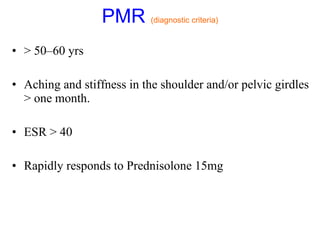
PMR   (diagnostic criteria) > 50–60 yrs  Aching and stiffness in the shoulder and/or pelvic girdles > one month. ESR > 40 Rapidly responds to Prednisolone 15mg
Pathogenesis of PMR ↑   Production of IL-6  chronic stress lead to  ↓   the hypothalamic–pituitary–adrenal (HPA) axis  ↓  Production of adrenal hormones, like cortisol. Functional (21 –hydroxylase) impairment in PMR due to; Genetic defects or Age-related increase serum TNF & IL-6  levels TNF-  was shown to inhibit the 21 -hydroxylase.  Steroid acting as a replacement for the reduced endogenous cortisol production, seems to be more efficient in PMR. During steroid treatment  ↓ ESR was more evident in PMR patients than in LO-RA patients.
Classic RA Symmetrical peripheral joints involvement. RF seropositivity  Development of joint erosions  Extra-articular manifestations  Positive anti-citrullinated peptide (CCP) antibodies
Sero (-) LO-RA Mild symmetric synovitis in  several patients with sero (-) LO-RA Non-erosive course Rapid and complete response to steroid. 35% negative for both RF & anti-CCP Notes; Symptoms and signs of both PMR and LO-RA might alternate during the follow-up of the patients  20%  of PMR patients developed  overt RA  during the follow-up period
Polymyalgia rheumatica  vs  late-onset rheumatoid arthritis M. Cutolo1, M. A. Cimmino1 and A. Sulli1   ( Rheumatology 2009  48(2):93-95) In leeds teaching hospital - 10 years follow up of  142 Pt (LO-RA) 147 (PMR) 42 (PMR + TA) PMR & LA sero (-) RA are different disease High ESR + synovitis of wrist + one MCP/PIP at disease onset were;  predictive of whether a non-erosive sero (-) patient would ultimately be diagnosed as having sero (–)LO-RA or PMR
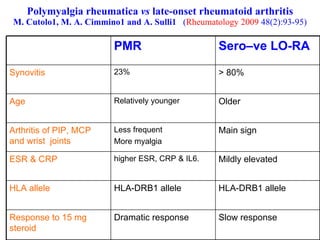
Polymyalgia rheumatica  vs  late-onset rheumatoid arthritis M. Cutolo1, M. A. Cimmino1 and A. Sulli1   ( Rheumatology 2009  48(2):93-95) Slow response Dramatic response Response to 15 mg steroid HLA-DRB1 allele HLA-DRB1 allele HLA allele Mildly elevated higher ESR, CRP & IL6. ESR & CRP Main sign Less frequent More myalgia  Arthritis of PIP, MCP and wrist  joints Older Relatively younger Age > 80% 23% Synovitis Sero–ve LO-RA PMR

polymyalgia rheumatica

  • 1.
  • 2.
    GP referral 71yrs old Lady presented few of months ago with : History suggestive of PMR Initially good response to 20mg of steroid Difficult to ↓ steroid, (recurrent symptoms), persist ↑ ESR 50, CRP 91 Required ↑ dose to 30mg Developed arthralgia with puffy hands
  • 3.
    History C/O; Achingpain & stiffness in both arms, hands, knees & feet Morning stiffness > 3 hours Soft tissue swelling of both hands, swollen knees and ankles No skin rash, no excess hair loss & (no psoriasis or F/H of psoriasis No dry eyes / dry mouth No Wt loss, normal bowel habits & No urinary symptoms
  • 4.
    Social history Neversmoked. Retired, married. Medication Prednisolone 25mg daily Alendronic acid 70mg once a week Atenolol 100mg Doxazosin 8mg Bendrofluazide 2.5mg Paracetamol 1gm PRN Omeprazole 20mg
  • 5.
    On examination Noskin rash or nails changes. Symmetrical synovitis involving the 2 nd , 3 rd , & 4 th MCP joints of hands, wrists, knees & ankles No lymphadenopathy Chest: clear Heart: NAD
  • 6.
    D/D PMR resistant to steroid therapy RA Sero-positive RA Sero-negative RA (LO sero (-) RA) Neoplasm Infection
  • 7.
    Investigation RF 458 FBC (N) ESR 39 CRP 50 U&E (N), LFT (N) X-ray hands, Feet & CXR
  • 8.
  • 9.
  • 10.
  • 11.
    Treatment LO-RA: MTX (10mg O/W & increase dose if no SE) If erosion increase MTX dose & added HCQ PMR: 15 mg prednisone dramatic response MTX (as steroid sparing) 87.5% of MTX-treated patients and 53.3% of patients treated with prednisone alone were no longer on steroids at 76 weeks. Significantly fewer patients on MTX had at least one flare up by the end of follow-up. Infliximab in the treatment of polymyalgia rheumatica: a double-blind, randomized, placebo-controlled study. Salvarani C, Macchioni PL, Manzini C, et al. Ann Intern Med (2007) no differences were observed among groups: the proportion of patients who were free of relapses/recurrences at 22 and 52 weeks was similar reducing dose of steroid should be based on sign & symptoms rather than CRP & ESR value, which dose not predicate relapse Therapy usually last two years, relapse usually in the 1st or 2nd month
  • 12.
    PMR (diagnostic criteria) > 50–60 yrs Aching and stiffness in the shoulder and/or pelvic girdles > one month. ESR > 40 Rapidly responds to Prednisolone 15mg
  • 13.
    Pathogenesis of PMR↑ Production of IL-6 chronic stress lead to ↓ the hypothalamic–pituitary–adrenal (HPA) axis ↓ Production of adrenal hormones, like cortisol. Functional (21 –hydroxylase) impairment in PMR due to; Genetic defects or Age-related increase serum TNF & IL-6 levels TNF- was shown to inhibit the 21 -hydroxylase. Steroid acting as a replacement for the reduced endogenous cortisol production, seems to be more efficient in PMR. During steroid treatment ↓ ESR was more evident in PMR patients than in LO-RA patients.
  • 14.
    Classic RA Symmetricalperipheral joints involvement. RF seropositivity Development of joint erosions Extra-articular manifestations Positive anti-citrullinated peptide (CCP) antibodies
  • 15.
    Sero (-) LO-RAMild symmetric synovitis in several patients with sero (-) LO-RA Non-erosive course Rapid and complete response to steroid. 35% negative for both RF & anti-CCP Notes; Symptoms and signs of both PMR and LO-RA might alternate during the follow-up of the patients 20% of PMR patients developed overt RA during the follow-up period
  • 16.
    Polymyalgia rheumatica vs late-onset rheumatoid arthritis M. Cutolo1, M. A. Cimmino1 and A. Sulli1 ( Rheumatology 2009 48(2):93-95) In leeds teaching hospital - 10 years follow up of 142 Pt (LO-RA) 147 (PMR) 42 (PMR + TA) PMR & LA sero (-) RA are different disease High ESR + synovitis of wrist + one MCP/PIP at disease onset were; predictive of whether a non-erosive sero (-) patient would ultimately be diagnosed as having sero (–)LO-RA or PMR
  • 17.
    Polymyalgia rheumatica vs late-onset rheumatoid arthritis M. Cutolo1, M. A. Cimmino1 and A. Sulli1 ( Rheumatology 2009 48(2):93-95) Slow response Dramatic response Response to 15 mg steroid HLA-DRB1 allele HLA-DRB1 allele HLA allele Mildly elevated higher ESR, CRP & IL6. ESR & CRP Main sign Less frequent More myalgia Arthritis of PIP, MCP and wrist joints Older Relatively younger Age > 80% 23% Synovitis Sero–ve LO-RA PMR